The Geometry of Projection Heads: Conditioning, Invariance, and Collapse
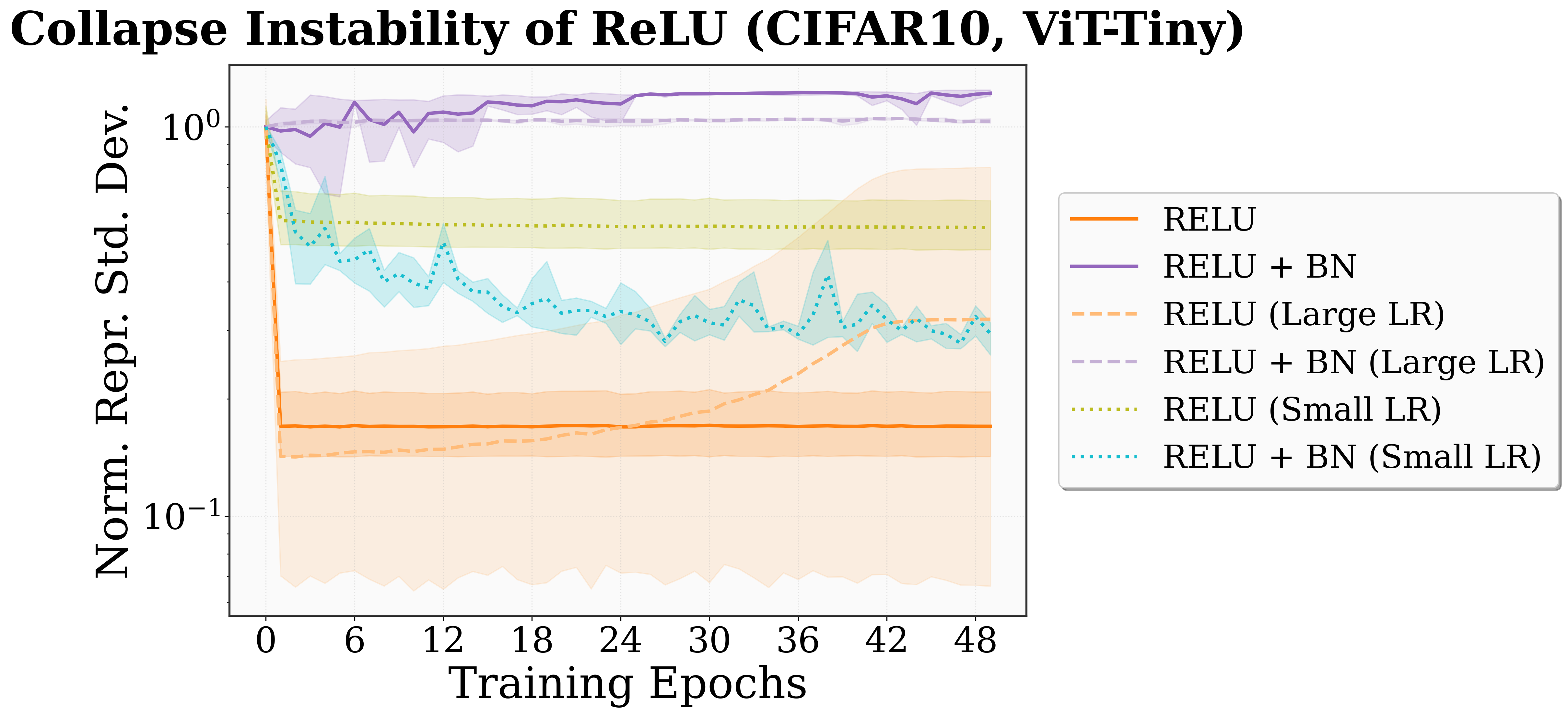
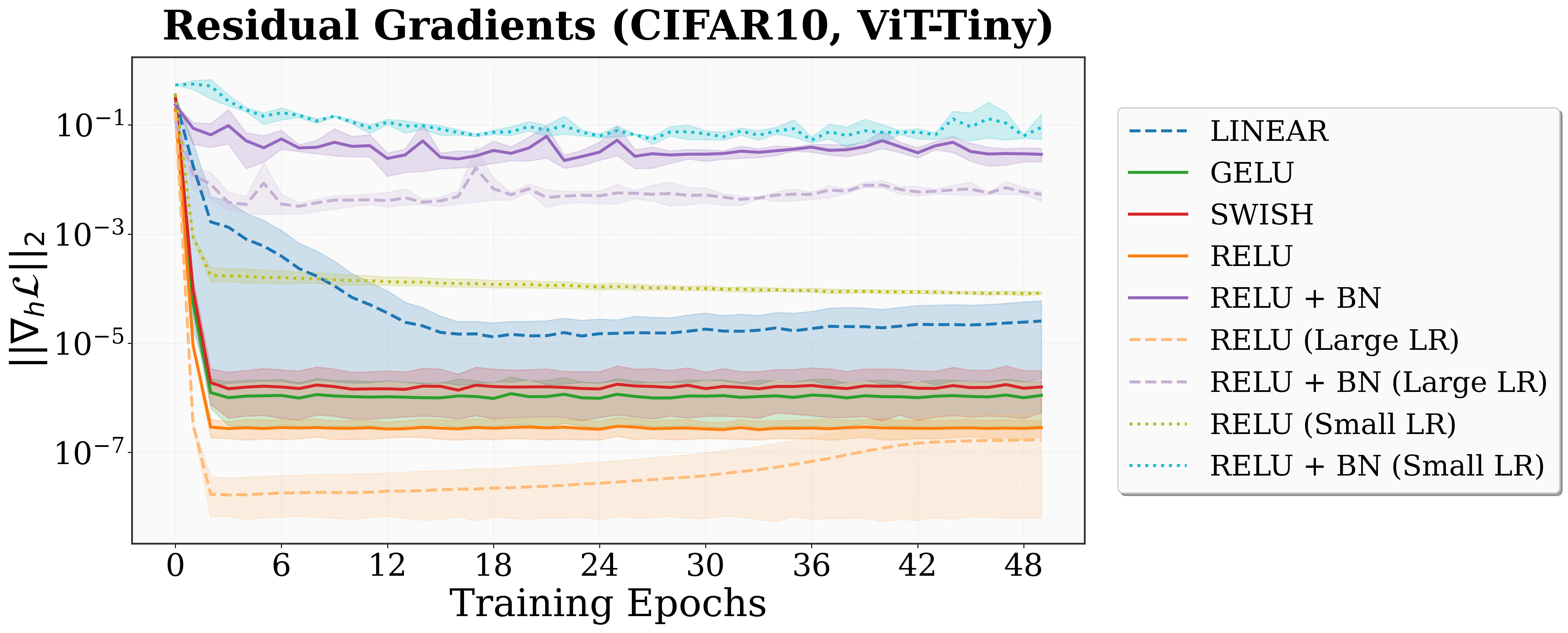
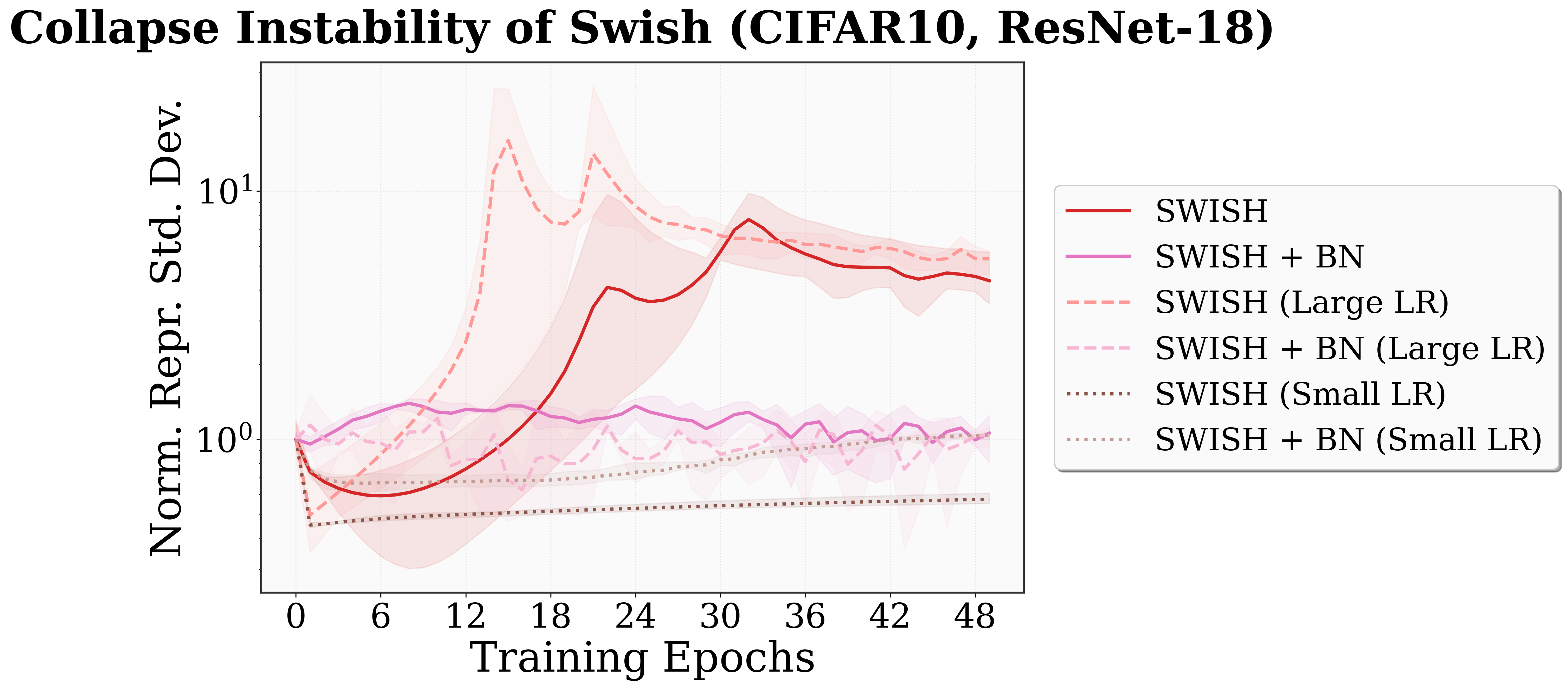
Abstract: We develop a geometric theory of projection heads in self-supervised learning by modeling the head as a trainable Riemannian metric on the backbone representation manifold. We show that linear heads perform implicit subspace whitening, while nonlinear heads adapt local metrics to satisfy the specific topological constraints of the loss, with head depth empirically dictating this capacity. Analyzing dimensional collapse, we prove that smooth nonlinear heads natively induce negative eigenvalues in the Hessian at collapsed equilibria, making them unstable. We empirically validate this by continuously tracking the optimization geometry during training, which reveals that smooth activations like Swish can generate explicit negative curvature to escape collapse, whereas linear and ReLU heads under continuous-time gradient flow cannot, relying instead on discrete-time optimization dynamics and BatchNorm. Finally, we geometrically characterize how metric degeneracy governs the information-invariance trade-off, explaining why the head must be discarded. Evaluated across contrastive and decorrelation-based objectives on foundation models, our results demonstrate that the projection head acts as a universal geometric buffer, decoupling the semantic backbone from the rigid, destructive constraints of the pretraining objective.
Paper Prompts
Sign up for free to create and run prompts on this paper.
Top Community Prompts
Explain it Like I'm 14
A simple explanation of “The Geometry of Projection Heads: Conditioning, Invariance, and Collapse”
What is this paper about?
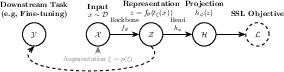
This paper studies a small but important part of many self-supervised learning (SSL) systems called the projection head. In SSL, we teach a model to understand images without labels by making different versions (augmented views) of the same image look similar in a learned feature space. The projection head is a little network placed on top of the main model (the backbone) during training. Oddly, we throw this head away after training. The paper asks: What exactly does the projection head do, why does it need to be nonlinear, and why do we discard it later?
The authors’ big idea: the projection head acts like a trainable “ruler” that changes how distances are measured in the feature space, so the training objective becomes easier and safer to optimize without destroying useful information in the backbone.
What questions does the paper try to answer?
To make the goals clear, here are the main questions the paper explores:
- Why does adding a projection head make training more stable and faster?
- What’s the difference between a linear head (like a single matrix) and a nonlinear head (an MLP with activations)?
- How do certain nonlinear heads help the model avoid “collapse,” where all images look the same to the network?
- Why do we discard the head after training and keep only the backbone features for real tasks?
How did the authors study this? (Methods in simple terms)
The authors use both theory and experiments. They think about the feature space like a rubber sheet:
- The backbone makes features (points on the sheet).
- The projection head changes how we measure distances on that sheet, like switching to a flexible ruler that can stretch or shrink in different directions.
Key technical ideas explained with everyday analogies:
- Trainable ruler (metric): A “metric” is just a rule for measuring distances. A trainable metric means the head learns how to measure what matters for the loss. A linear head uses one fixed ruler everywhere. A nonlinear head uses a flexible ruler that can change from place to place.
- Whitening/conditioning: If some directions are harder to learn than others (the space is “stiff” or “stretched”), learning is slow. “Whitening” means re-scaling directions so learning proceeds at similar speed in each direction—like leveling a bumpy running track so you can run straight.
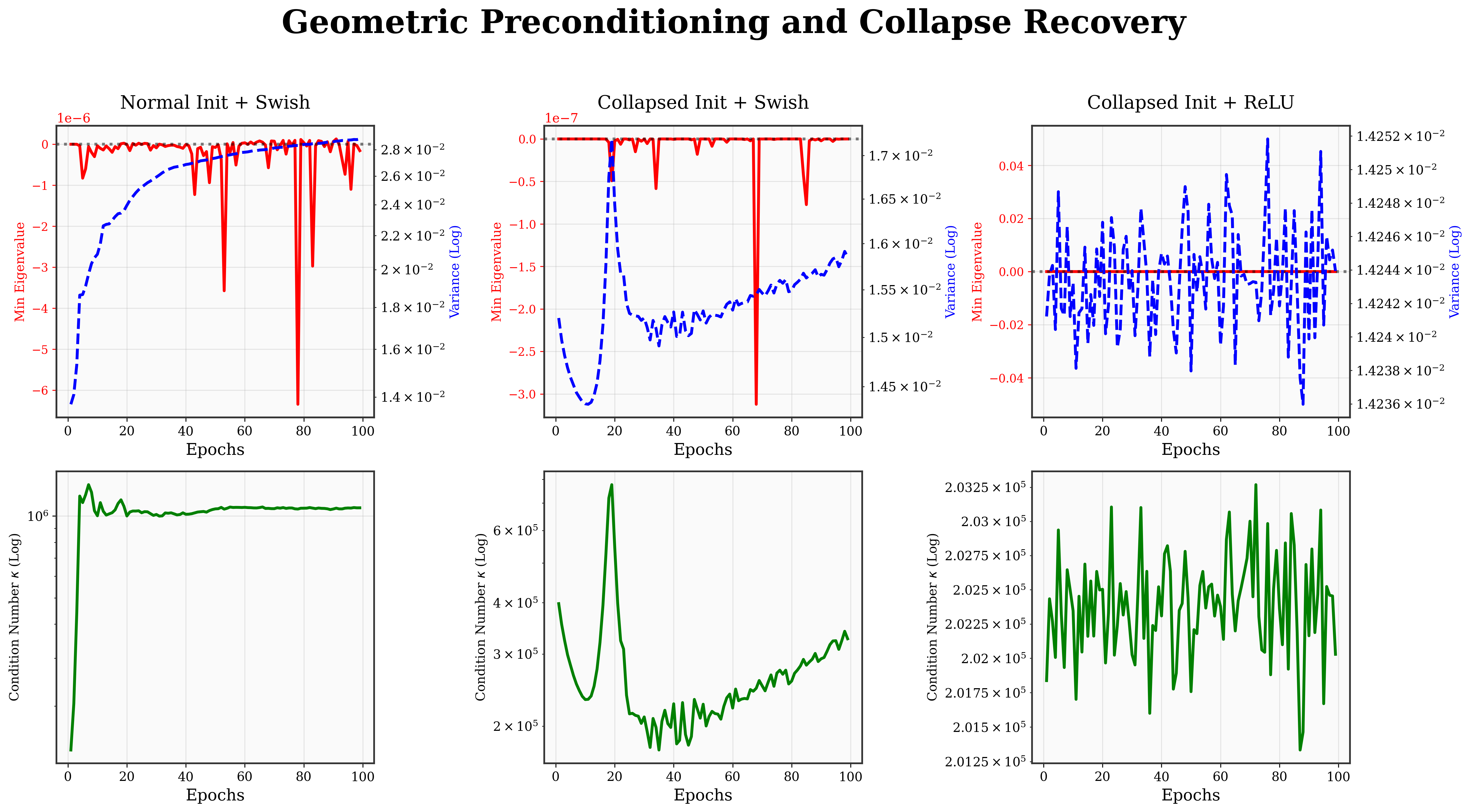
- Curvature and collapse: The “Hessian” is a tool to check how the landscape curves around you (are you at a valley, a hill, or a saddle?). Negative curvature means there’s at least one escape direction (a saddle). Collapse is when the model maps everything to nearly the same point. The authors show that certain nonlinear heads can create negative curvature near collapse, which pushes the model out of that bad state.
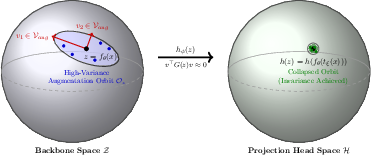
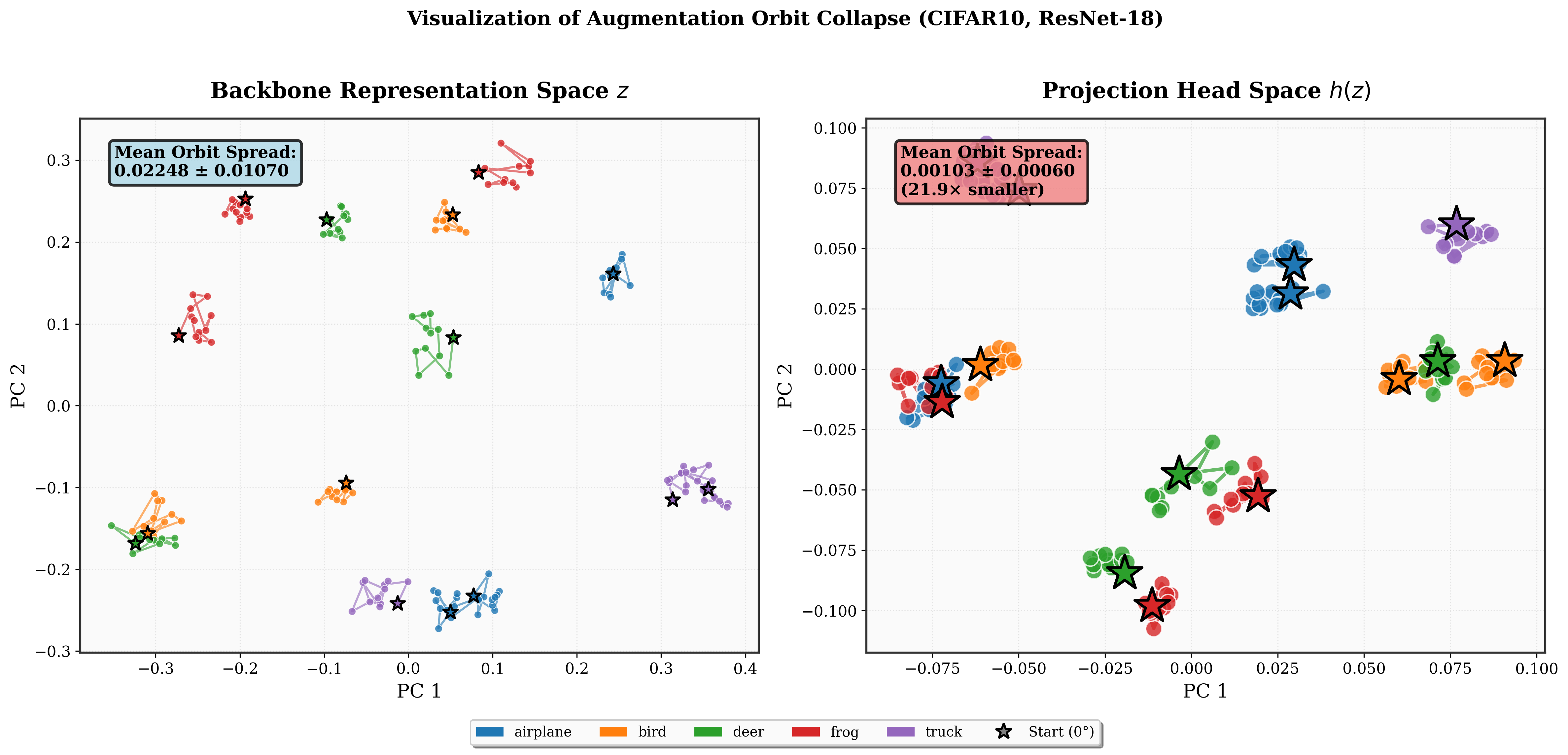
- Augmentations and orbit collapse: Different versions of the same image (rotated, brightened, etc.) form a little “orbit” of points in feature space. To be invariant, the head should squash these orbits so all those versions land together. The authors show the head learns to squeeze exactly those directions, like flattening a wrinkle along the orbit, while keeping other useful directions.
Experiments:
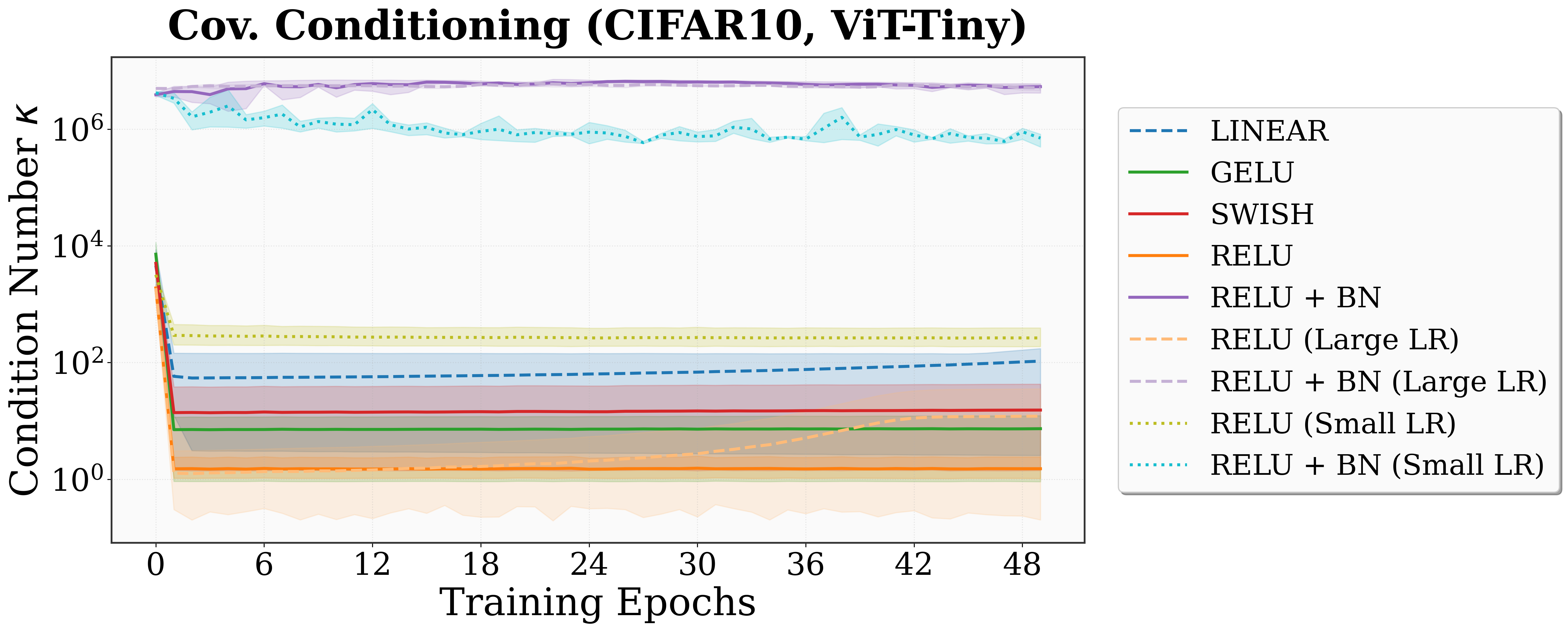
- They track how the training landscape bends (curvature) over time.
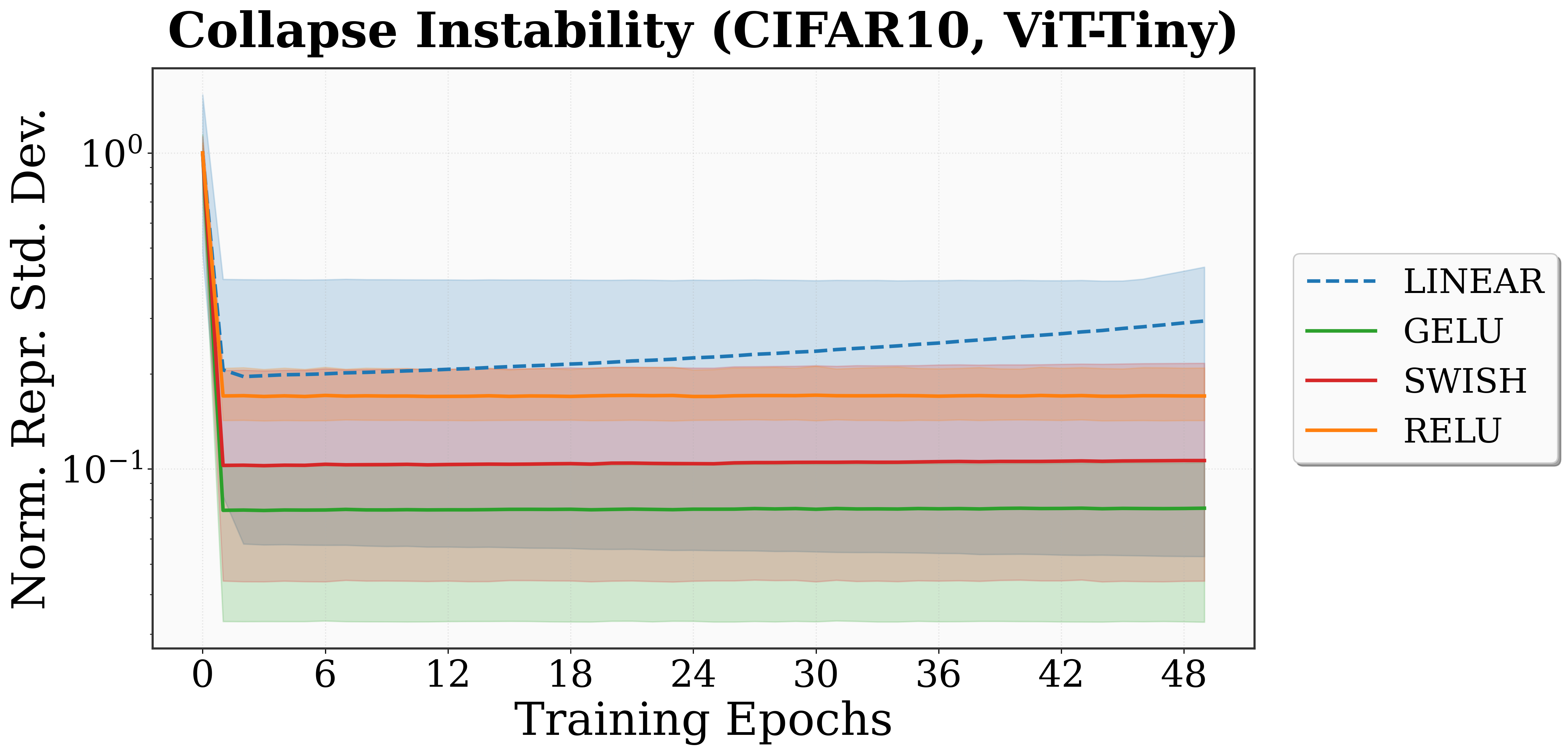
- They compare smooth activations (like Swish/GELU) to ReLU and linear heads.
- They measure how much augmentations’ orbits shrink after the head and how that affects downstream usefulness.
- They test across different SSL methods and architectures to show these effects are general.
What did they find, and why does it matter?
Here are the main findings, explained simply:
- Linear heads act like global re-scaling (whitening): A linear head learns one overall re-scaling of directions so the loss is better conditioned. This can speed up learning, but it’s too limited: it can’t adapt differently at different spots in the space, and it can accidentally force the backbone to become low-rank (throwing away capacity).
- Nonlinear heads act like adaptive, local re-scaling: A nonlinear head (MLP) can change the ruler depending on where you are in feature space. This helps along curved training paths and makes optimization smoother and faster. Deeper heads have more capacity to do this well.
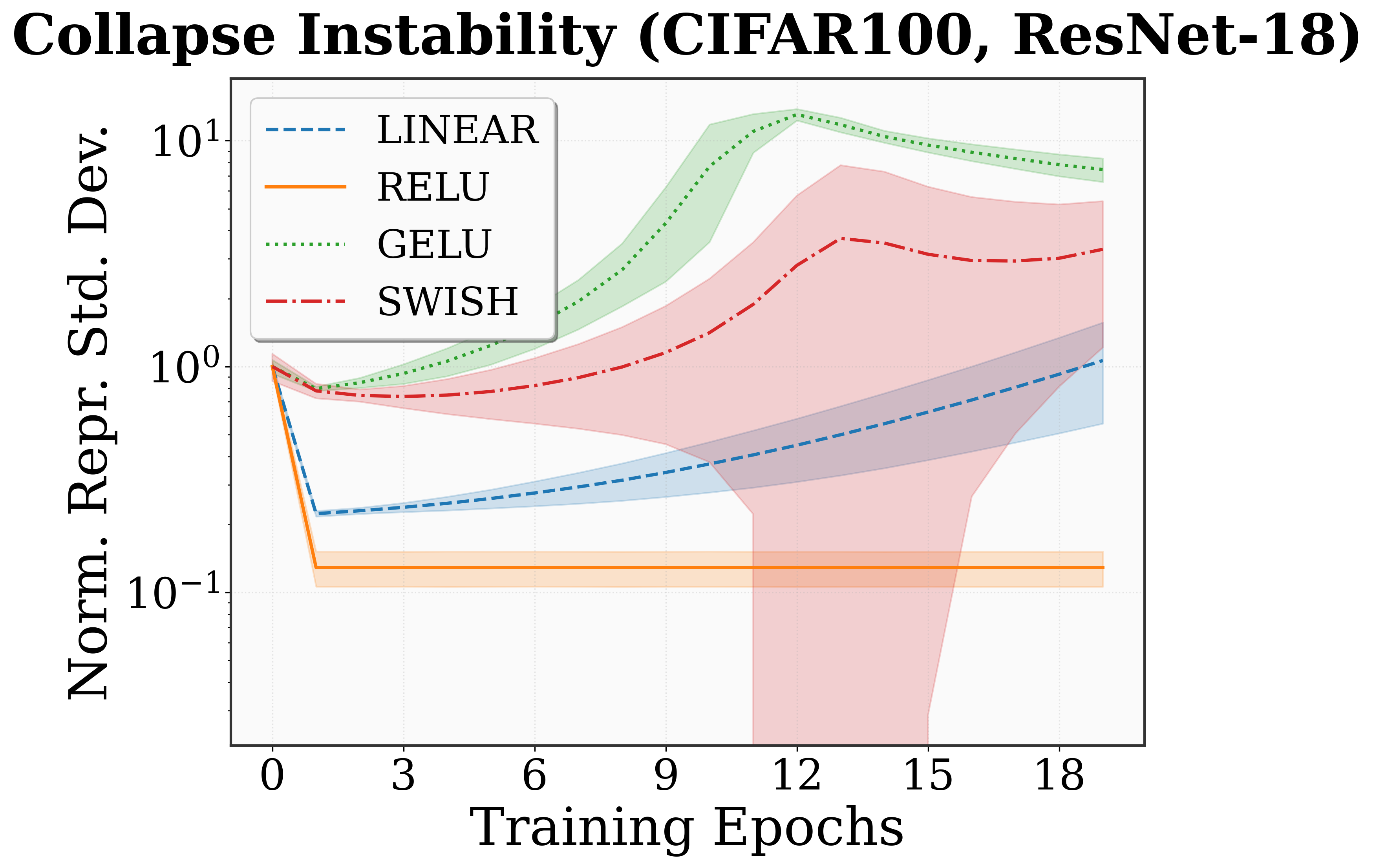
- Smooth nonlinear heads help avoid collapse by creating escape routes: With smooth activations (like Swish or GELU), the head naturally introduces negative curvature near collapsed representations. That creates a “saddle” shape that pushes learning away from collapse. Linear and ReLU heads don’t create this curvature by themselves. They tend to rely on extra tricks like BatchNorm or large step sizes in optimization to escape.
- The head must destroy some information to enforce invariance: To make augmented versions of an image map to the same point, the head squashes the directions that represent those augmentations (like rotation or color changes). This “squeezing” is targeted: it compresses nuisance differences while trying to preserve semantic differences (like object identity). But it still removes information along those augmentation directions.
- Why we remove the head after training: Because the head intentionally crushes certain differences, its output is not ideal for all future tasks. For example, if the pretraining used heavy color changes, the head may have removed color information. The backbone features, however, keep more of the original information. That’s why we “train with the head, deploy without it.”
- Empirical highlights:
- Smooth heads show clear spikes of negative curvature that coincide with escaping collapsed states.
- The projection head can shrink augmentation orbits by over 20× while keeping class separation relatively better than orbit spread—showing it’s selectively removing nuisance variation.
- Across different SSL objectives (contrastive, decorrelation) and model types (including foundation models), the head works as a universal geometric buffer.
What does this mean for the future? (Implications and impact)
- Design better heads: Use smooth activations and enough depth so the head can adapt the “ruler” well. This can make training more stable and reduce the need for fragile tricks.
- Understand why the head is temporary: It’s a buffer that absorbs the harsh requirements of the pretraining loss (strong invariances), protecting the backbone’s useful features for later tasks.
- Inspire new objectives: Knowing the head causes a targeted information squeeze suggests we might create new SSL losses that build in invariance without forcing such a strong squeeze—or even make “headless” designs that avoid throwing away information.
- General lesson: Thinking geometrically—how the network warps distances—helps explain and improve self-supervised learning beyond trial-and-error.
In short, the projection head is not just an extra MLP. It’s a smart, trainable measuring tool that reshapes the learning space, prevents collapse (if it’s smooth and nonlinear), and selectively removes nuisance differences. That’s why it’s essential during training—but also why we remove it afterward.
Knowledge Gaps
Knowledge gaps, limitations, and open questions
Below is a single, consolidated list of what remains missing, uncertain, or unexplored. Each item is phrased to be concrete and actionable for future research.
- Formalizing timescale separation: The theory assumes the projection head adapts faster than the backbone. Quantify when this holds (as a function of optimizer, learning rates, momentum, batch size, and head depth) and provide guarantees or diagnostics for detecting violations during training.
- Dependence on residual gradient asymmetry: Collapse instability requires a nonzero residual gradient at the head output near collapse (e.g., via stop-grad, predictor lag). Characterize conditions under which this residual vanishes and determine whether collapse can then remain stable even with smooth activations.
- Discrete-time and normalization effects for ReLU: The paper posits that ReLU heads rely on discrete-time dynamics and BatchNorm to escape collapse. Develop a theoretical model that predicts escape probabilities/times as a function of step size, momentum, BatchNorm statistics, and batch size, and validate across datasets and architectures.
- Architectural capacity thresholds: The results are existential (there exists an MLP head that achieves ε-isotropy). Derive constructive width/depth/sample-complexity bounds that guarantee a given conditioning error ε along a trajectory, and map accuracy/conditioning degradation to concrete capacity limits.
- Activation design for curvature control: Systematically evaluate which smooth activations (e.g., Swish, GELU, ELU, Softplus) maximize beneficial negative curvature while preserving stability. Can one design parametric activations or curvature regularizers that target a desired spectrum of the interaction term?
- Linear and piecewise-linear heads: While linear heads lack curvature and ReLU is flat almost everywhere, deep ReLU nets can approximate nonlinear maps piecewise. Precisely characterize when (and how many regions) piecewise-linear heads can still induce effective negative curvature via Jacobian discontinuities and optimization noise.
- Beyond pairwise losses: Extend the geometric analysis to multi-view/multi-crop objectives, masked prediction, teacher–student distillation (e.g., DINO), and language–vision contrastive losses. Identify how intrinsic Hessian rank and curvature structure change for these objectives.
- Role of temperature and normalization in the metric: The loss’s intrinsic geometry depends strongly on temperature scaling and normalization (e.g., L2 normalizations, LayerNorm, BatchNorm). Provide a formal characterization of how these operations alter the induced pullback metric and effective Hessian spectrum.
- Handling nonconstant Hessian rank: Results often assume constant intrinsic Hessian rank along trajectories. Analyze rank-varying regions and transitions (e.g., near hard-negative boundaries), and how heads should adapt when the active curved subspace changes.
- Discrete augmentations and non-group transformations: The analysis is local and differential (continuous augmentations). Develop a principled geometric treatment for discrete transformations (e.g., flips, cutout) or non-group augmentations (e.g., mixup, solarization), where tangent-space modeling is not directly applicable.
- Global vs local invariance: The theory focuses on local tangent-space invariance at . Quantify how local metric adaptation composes along long augmentation orbits, and identify failure modes where local flattening does not accumulate to global invariance.
- Estimating augmentation tangent spaces in practice: Provide robust, scalable procedures to estimate and track its alignment with the head’s metric null space during training on large models, possibly via low-cost Jacobian-vector products or randomized probes.
- Scalable curvature monitoring: Hessian tracking was demonstrated on small models. Devise computationally efficient proxies (e.g., curvature-sensitive gradient tests, Lanczos sketches, directional negative curvature detectors) for foundation-scale training and validate their fidelity.
- Interaction with optimizers and regularization: Analyze how weight decay, Adam/AdamW preconditioning, gradient clipping, and schedule strategies influence the effective Hessian, the interaction term, and collapse instability, and whether they complement or conflict with head-induced geometry.
- Generalization and transfer guarantees: The work emphasizes optimization and invariance but does not tie geometric conditioning to generalization bounds or transfer performance. Derive bounds or predictors (e.g., via Fisher information or margin-based arguments) linking the head’s metric geometry to downstream accuracy.
- Partial/structured collapse: Beyond full collapse, characterize the stability and escape dynamics for low-rank or class-conditional collapse. Which subspaces become unstable first, and how does activation-induced curvature distribute across classes/features?
- Backbone–head co-adaptation: Timescale separation decouples backbone/head learning. Explore joint dynamics when this assumption is relaxed: does the backbone learn to “lean on” the head’s metric, and can this entangle semantics in ways that harm transfer?
- ViT and attention-specific geometry: The paper flags self-attention as inducing a data-dependent metric but leaves analysis open. Formalize the induced metric from attention maps, and study how projection heads interact with attention geometry under SSL losses.
- Multi-task and conditional invariance: In practice, augmentation sets can conflict with downstream needs (e.g., color jitter vs. color-based tasks). Develop methods to condition the head’s metric on context or data, enabling selective invariance and mitigating destructive compression.
- Headless or invertible objectives: The paper suggests designing invertible or variance-preserving losses that avoid metric singularities. Propose concrete formulations, analyze their curvature, and test whether they can replace the head without sacrificing invariance.
- Cross-modal SSL settings: Extend the geometric buffer hypothesis to multi-modal pretraining (e.g., CLIP). Do dual heads learn complementary metrics to reconcile heterogeneous invariances, and how should their curvatures be coordinated?
- Robustness to distribution shift: Study how the learned metric degeneracy interacts with domain shifts. Does head-induced invariance help or hurt robustness to corruptions or new augmentation regimes, and can adaptive metrics be updated post hoc?
- Empirical breadth and scale: Experiments center on CIFAR and moderate models, with foundation-model analysis deferred to appendices. Conduct large-scale, controlled ablations across datasets (e.g., ImageNet-1k/21k), architectures (ResNet/ViT/ConvNeXt), and SSL methods to confirm universality and quantify effect sizes.
- Quantifying the cost–benefit trade-off: Smooth activations and deeper heads may increase compute and memory costs. Measure the training/inference overhead, stability in mixed precision, and energy efficiency relative to the gains in conditioning and collapse avoidance.
- Measuring and enforcing metric singularity selectively: Develop training-time penalties or constraints that explicitly align the head’s metric null space with estimated augmentation tangents while protecting semantically relevant directions, and evaluate downstream impact.
- Formal transversality arguments: Several statements invoke genericity/measure-zero claims. Provide rigorous, fully specified transversality proofs, including precise parameterizations and regularity conditions for the set where the interaction term is PSD.
- Quantitative link to whitening methods: The paper argues heads implicitly whiten; formalize equivalences or separations to explicit decorrelation losses (e.g., VICReg/Barlow Twins) and determine when implicit vs. explicit conditioning is preferable.
- Safety of discarding the head: While discarding is motivated by metric degeneracy, test whether partially retaining or fine-tuning the head (e.g., reinitializing last layer, conditional heads) can preserve useful invariances without harming downstream semantics.
- Data modality generalization: Validate the geometric buffer hypothesis beyond vision (audio, text, graphs) where augmentation groups and loss curvature differ, and adapt the framework accordingly.
Practical Applications
Immediate Applications
Below are actionable use cases that can be deployed now, based on the paper’s findings on projection heads as trainable Riemannian metrics that condition optimization, buffer invariance constraints, and destabilize collapse.
- Replace ReLU with smooth activations (e.g., Swish/GELU) in projection heads for SSL pretraining
- Sectors: software/ML platforms; vision (healthcare imaging, AV/perception, manufacturing QA), speech/audio, remote sensing, finance time-series (with validation).
- Tools/workflows: PyTorch/TensorFlow head modules with Swish/GELU; drop-in changes to SimCLR/MoCo/BYOL/SimSiam-style heads; recipe: 2–3 layer MLP, BN optional, smooth activations, higher LR for head than backbone.
- Benefits: native escape from collapse via negative curvature; better conditioning; reduced reliance on large batch sizes and BatchNorm.
- Assumptions/dependencies: timescale separation (faster head updates); head has sufficient depth; residual gradient at collapsed states (common in BYOL/SimSiam with stop-grad asymmetry).
- Adopt head–backbone learning-rate decoupling (“fast head, slow backbone”)
- Sectors: all that pretrain foundation models (software, robotics, healthcare).
- Tools/workflows: optimizer parameter groups; LR multipliers (e.g., head LR = 5–10× backbone); early-stage warmup for head.
- Benefits: head rapidly adapts metric (pullback) to improve conditioning along training trajectories.
- Assumptions/dependencies: stability-tested optimizers; monitoring for overfitting in the head.
- Enforce “train-with, deploy-without” as a standard deployment rule
- Sectors: MLOps across industry and academia; model hubs releasing backbones.
- Tools/workflows: pipelines that automatically discard the head before fine-tuning; CI checks that downstream code consumes backbone z, not h(z).
- Benefits: preserves semantic features filtered out by the head’s invariance-induced metric singularity; aligns with theory explaining the guillotine effect.
- Assumptions/dependencies: downstream tasks require information along augmentation directions that the head collapses.
- Geometry-aware diagnostics during SSL pretraining
- Sectors: software tooling; MLOps; research labs.
- Tools/products: “SSL Geometry Dashboard” that tracks (approximate) min-eigenvalue of effective Hessian, condition number, orbit spread before/after head, and Fisher-information rank; implementations using Lanczos/power iteration and Jacobian-vector products.
- Benefits: early detection of collapse risk; validation that smooth heads inject negative curvature; objective temperature tuning based on conditioning.
- Assumptions/dependencies: computational budget for second-order proxies; batched approximations for large models.
- Augmentation policy audits to protect downstream task signal
- Sectors: healthcare (e.g., don't erase color that indicates pathology), manufacturing (surface finish), remote sensing (spectral channels), finance (seasonality vs anomaly).
- Tools/workflows: measure augmentation tangent spaces and orbit compression; compare Fisher-information rank for z vs h(z); adjust augmentation strengths accordingly.
- Benefits: prevents over-invariance that harms downstream performance; quantifies the information–invariance trade-off.
- Assumptions/dependencies: ability to estimate augmentation tangents (finite differences); domain knowledge to label nuisance vs essential factors.
- Objective-aware head design for decorrelation vs contrastive losses
- Sectors: teams using VICReg/Barlow Twins/DINO-like objectives.
- Tools/workflows: for implicit whitening objectives (DINO), use compressive heads that strongly collapse augmentation orbits; for explicit whitening (VICReg), ensure head capacity to maintain full-rank covariance while buffering curvature.
- Benefits: aligns head behavior with objective-induced geometry; avoids rank shrinkage of the backbone in linear heads.
- Assumptions/dependencies: verify covariance/whitening constraints in training logs; use 2–3 layer nonlinear heads instead of linear bottlenecks.
- Reduce reliance on very large batch sizes in non-contrastive SSL
- Sectors: robotics, edge-training, research with limited compute.
- Tools/workflows: swap in smooth nonlinear heads, moderate batch sizes, monitor negative curvature and representation variance.
- Benefits: stable collapse avoidance without needing massive batches or heavy BN reliance.
- Assumptions/dependencies: proper optimizer settings; some residual asymmetry (e.g., predictor lag, stop-grad) to maintain nonzero gradients at collapsed states.
- Temperature and optimizer scheduling guided by effective conditioning
- Sectors: software tooling, research labs.
- Tools/workflows: adapt contrastive temperature and LR based on measured condition number of pulled-back Hessian; integrate with schedulers.
- Benefits: faster, more stable convergence by aligning step sizes to local geometry.
- Assumptions/dependencies: stable and sufficiently frequent conditioning estimates.
- Release/provenance standards for pretrained models
- Sectors: model hubs, foundation model providers, policy/compliance.
- Tools/workflows: model cards documenting orbit compression, information hierarchy (FIM rank) between z and h(z); explicit recommendation to discard heads.
- Benefits: transparency on invariances induced during pretraining; better downstream decision-making.
- Assumptions/dependencies: standardized metrics and reporting formats.
- Fairness and compliance checks via invariance audits
- Sectors: regulated domains (healthcare, finance, hiring).
- Tools/workflows: measure whether protected-attribute information is being irreversibly removed by the head; ensure backbone retains necessary signals for audits while respecting policy constraints.
- Benefits: avoids unintended removal of attributes crucial for fairness monitoring or mandated reporting.
- Assumptions/dependencies: availability of attribute annotations or proxies; careful legal/ethical interpretation.
Long-Term Applications
These opportunities require additional research, scaling, or engineering to realize.
- “Headless” or invertible/variance-preserving SSL objectives
- Sectors: software, research, foundation-model pretraining.
- Tools/products: new losses applied directly on augmentation orbits that enforce invariance without inducing a metric singularity (e.g., invertible contrastive transforms, quotient-aware regularizers).
- Impact: eliminates the need to discard the head; preserves information needed by downstream tasks.
- Assumptions/dependencies: tractable formulations for discrete augmentations; stable optimization without curvature provided by the head.
- Learnable Riemannian preconditioners and natural-gradient-inspired heads
- Sectors: all SSL; large-scale training stacks.
- Tools/products: modules that explicitly learn pullback metrics; hybrid optimizers that combine learned metrics with natural gradient approximations.
- Impact: improved conditioning and convergence speed; more principled temperature/LR adaptation.
- Assumptions/dependencies: efficient, memory-friendly implementations of Jacobian/Hessian-vector products at scale.
- Curvature-injection beyond the head (e.g., smooth residual blocks, second-order layers)
- Sectors: deep vision and multimodal architectures (CNNs, ViTs).
- Tools/products: architectural components that guarantee negative curvature near collapse without BN or large batches.
- Impact: robust non-contrastive SSL in resource-constrained settings; reduced hyperparameter sensitivity.
- Assumptions/dependencies: maintain accuracy at scale; compilers/hardware support for smooth activations.
- Quotient-manifold-aware training and explicit group-action modeling
- Sectors: robotics/perception, AR/VR, autonomous driving.
- Tools/products: pipelines that estimate augmentation groups and train on quotient space representations while preserving semantically relevant directions.
- Impact: principled invariance with controllable information retention; improved transferability.
- Assumptions/dependencies: robust identification of augmentation groups; handling of non-smooth/discrete transformations.
- AutoML for invariance–information trade-off
- Sectors: enterprise ML, platform providers.
- Tools/products: automated search over augmentations, head capacity/depth, activation types, and LR decoupling to optimize downstream transfer metrics.
- Impact: task-adaptive SSL configurations that avoid over-invariance.
- Assumptions/dependencies: efficient metrics for orbit compression/FIM rank as search objectives; compute budget.
- Foundation-model protocols and standards for invariance reporting
- Sectors: policy, compliance, model governance.
- Tools/products: standard benchmarks and documentation practices (orbit spread, class/orbit ratios, FIM rank deltas) included in model cards and audits.
- Impact: comparability and accountability across pretrained models; informed deployment decisions in regulated domains.
- Assumptions/dependencies: community consensus on metrics; evaluation suites.
- Cross-modality extensions (text, speech, time-series, graphs)
- Sectors: NLP, ASR, IoT/energy, finance.
- Tools/products: adaptation of geometric preconditioning concepts to modality-specific augmentations (e.g., textual paraphrase, audio pitch/tempo, sensor drift).
- Impact: broader applicability of collapse-avoidance and conditioning benefits.
- Assumptions/dependencies: define and estimate augmentation tangents per modality; verify that smooth heads carry over empirically.
- Efficient second-order monitoring at scale
- Sectors: large-model training, cloud ML services.
- Tools/products: low-overhead online estimators of negative curvature and conditioning (e.g., randomized subspace methods) integrated into training frameworks.
- Impact: routine geometry-aware training without prohibitive overhead.
- Assumptions/dependencies: algorithmic advances for scalable Hessian proxies.
- Energy- and cost-efficient pretraining
- Sectors: edge/embedded ML, sustainability-focused R&D.
- Tools/products: training recipes leveraging smooth heads and geometry-aware schedules to reduce batch sizes and training time.
- Impact: lower compute and energy budgets for SSL pretraining.
- Assumptions/dependencies: confirm savings at foundation scale; hardware–software co-design.
- Educational and visualization tooling
- Sectors: academia, corporate training.
- Tools/products: interactive notebooks visualizing pullback metrics, orbit compression, and curvature dynamics; curriculum modules for geometric deep learning.
- Impact: better practitioner intuition about SSL geometry; improved reproducibility.
- Assumptions/dependencies: accessible datasets/demos; maintenance of teaching resources.
Glossary
- augmentation manifold: The continuous set of augmented representations parameterized by augmentation variables, viewed as a manifold in representation space. Example: "the augmentation manifold is nontrivial"
- augmentation orbit: The set of representations produced by applying continuous augmentations to an input, forming a smooth curve/surface in representation space. Example: "called the augmentation orbit:"
- augmentation tangent space: The linear subspace spanned by infinitesimal changes in representations induced by small changes in augmentation parameters. Example: "the augmentation tangent space"
- Barlow Twins: A self-supervised objective that encourages invariance and decorrelation by penalizing cross-correlation off-diagonals. Example: "Barlow Twins"
- BatchNorm: Batch Normalization; a normalization technique that can affect optimization dynamics and collapse avoidance. Example: "BatchNorm"
- BYOL: A non-contrastive self-supervised method using online and target networks without negative pairs. Example: "BYOL"
- condition number: The ratio of the largest to smallest curvature (eigenvalues) of the Hessian, indicating optimization difficulty. Example: "the condition number exhibits a rapid initial spike"
- contrastive objectives: Losses that bring positive pairs together and push negatives apart to learn invariant representations. Example: "contrastive objectives like InfoNCE"
- covariance penalty: A term encouraging whitening by penalizing off-diagonal covariance or promoting isotropy. Example: "VICReg's covariance penalty"
- decorrelation-based objectives: Methods that explicitly reduce feature correlations to encourage isotropic embeddings. Example: "decorrelation-based objectives"
- DINO: A self-distillation SSL method leveraging student-teacher training without labels. Example: "DINO's self-distillation"
- discrete-time optimization dynamics: Effects arising from finite learning-rate updates (as opposed to continuous gradient flow). Example: "discrete-time optimization dynamics"
- effective Hessian: The Hessian of the SSL objective with respect to backbone representations, incorporating the head’s geometry. Example: "the effective Hessian"
- Fisher information degeneracy: A reduction in Fisher information along certain directions due to invariance-induced singular metrics. Example: "Fisher information degeneracy"
- Fisher information matrix (FIM): A matrix measuring the amount of information a random variable carries about parameters; used to quantify information loss. Example: "Fisher information matrix (FIM)"
- Gauss-Newton term: The first-order curvature component arising from Jacobian and loss Hessian composition. Example: "first-order (Gauss-Newton) term"
- GELU: A smooth activation function (Gaussian Error Linear Unit) providing nonzero second derivatives for curvature. Example: "Swish or GELU"
- geometric buffer: A mechanism that decouples the backbone from destructive objective constraints by absorbing geometric distortions. Example: "universal geometric buffer"
- guillotine effect: The observation that the projection head is essential during pretraining but discarded for downstream tasks. Example: "the guillotine effect"
- gradient flow: The continuous-time limit of gradient descent dynamics. Example: "continuous-time gradient flow"
- Hessian: The matrix of second derivatives of a loss, encoding local curvature. Example: "Hessian"
- InfoNCE: A contrastive loss using temperature-scaled softmax over positives and negatives. Example: "InfoNCE"
- information geometry: A geometric framework studying statistical models through differential geometry (e.g., metrics, curvature). Example: "information geometry"
- instance discrimination: An SSL paradigm treating each instance as its own class via augmentations. Example: "instance discrimination"
- intrinsic rank: The rank of the loss Hessian with respect to the head outputs, indicating active curved directions. Example: "intrinsic rank"
- isotropic conditioning: Shaping the effective Hessian to have equal curvature across relevant directions for well-conditioned optimization. Example: "isotropic conditioning"
- Jacobian: The matrix of first derivatives mapping representation perturbations through the head. Example: "the projection head's Jacobian"
- Mahalanobis metric: A learned quadratic form defining distances that reweight and decorrelate features. Example: "Mahalanobis metric"
- manifold: A smooth space locally resembling Euclidean space used to model representations and augmentation orbits. Example: "representation manifold"
- metric degeneracy: The collapse (singularity) of the induced metric along certain directions, eliminating sensitivity. Example: "metric degeneracy"
- metric singularity: A singular (rank-deficient) pullback metric that annihilates distances along augmentation directions. Example: "metric singularity"
- MoCo: A contrastive SSL framework using momentum encoders and queues for negatives. Example: "MoCo"
- natural gradient descent: An optimization method preconditioned by the inverse Fisher information metric. Example: "natural gradient descent"
- negative curvature: Directions where the Hessian has negative eigenvalues, creating unstable saddle geometry. Example: "negative curvature"
- non-contrastive methods: SSL approaches without negative pairs that must avoid collapse via other mechanisms. Example: "non-contrastive methods"
- nullspace: The set of directions mapped to zero by a linear operator, e.g., flat directions of the pullback metric. Example: "nontrivial nullspace"
- pullback metric: The induced metric on backbone space obtained by pulling back the loss geometry through the head’s Jacobian. Example: "pullback metric"
- PSD (positive semidefinite): A matrix with nonnegative eigenvalues, indicating no negative curvature. Example: "is PSD"
- projection head: The network module mapping backbone features to the space where the SSL loss is applied. Example: "projection head"
- Riemann curvature: Tensorial measure of intrinsic curvature of a manifold or metric. Example: "Riemann curvature"
- Riemannian metric: An inner product defined smoothly on tangent spaces, inducing geometry on manifolds. Example: "Riemannian metric"
- Riemannian preconditioner: A metric-induced transformation that reshapes the optimization landscape for better conditioning. Example: "Riemannian preconditioner"
- ReLU gap: The lack of curvature from piecewise-linear activations that hinders collapse escape under continuous flow. Example: "ReLU gap"
- saddle point (strict saddle): A critical point with at least one direction of negative curvature, enabling escape by gradient methods. Example: "strict saddle point"
- self-supervised learning (SSL): Learning from unlabeled data by predicting properties of augmented views. Example: "self-supervised learning (SSL)"
- SimCLR: A contrastive SSL framework emphasizing strong augmentations and large batches. Example: "SimCLR"
- SimSiam: A non-contrastive SSL approach using Siamese networks with stop-gradients and predictors. Example: "SimSiam"
- stop-gradient: An operation blocking gradient flow through part of the network to shape training dynamics. Example: "stop-gradient"
- Swish: A smooth activation function (x·sigmoid(x)) providing nonzero second derivatives for curvature. Example: "Swish"
- timescale separation: An assumption that different parts of the network adapt at different speeds, allowing quasi-equilibrium analyses. Example: "timescale separation"
- transversality theorem: A result from differential topology about generic intersections, used to argue measure-zero stability sets. Example: "transversality theorem"
- Trajectory Linearization: A theorem asserting that nonlinear heads can make curvature nearly isotropic along training paths. Example: "Trajectory Linearization"
- universal approximator: A model class (e.g., sufficiently wide/deep MLPs) capable of approximating a broad family of functions. Example: "universal approximator"
- VICReg: A self-supervised objective with variance, invariance, and covariance regularization terms. Example: "VICReg"
- whitening (subspace whitening): Making feature directions uncorrelated with equal variance to improve conditioning. Example: "subspace whitening"