From Foundation to Application: Improving VLA Models in Practice
Abstract: Despite recent progress of VLA foundation models, the disparity between laboratory conditions and real-world applications continues to impede their practical implementation. To bridge this gap, we present LingBot-VLA 2.0, which advances LingBot-VLA through improvements in three functional domains. (1) Generalization across tasks and embodiments. Compared to the previous version, we revamp the data processing pipeline and curate around 60,000 hours of data for pretraining, including 50,000 hours of robot trajectories spanning 20 robot configurations and 10,000 hours of egocentric human videos. (2) Expanded action space in addition to dual-arm hardware platforms. In particular, our system accommodates degrees of freedom for the heads, waists, mobile bases, and dexterous hands, thereby empowering the robots to tackle more complex tasks in practical scenarios. (3) Predictive dynamics modeling for improved temporal reasoning. Specifically, we formulate future prediction as a proxy task, facilitated by a video representation model for semantic priors and a depth estimation model for geometric cues. Evaluations on the GM-100 benchmark, conducted in a generalist setting, validate the beneficial impact of these proposed modifications. Furthermore, benefiting from the expanded pretraining data that covers whole-body degrees of freedom, LingBot-VLA-2.0 demonstrates strong cross-embodiment long-horizon mobile manipulation capability across the two robotic platforms.
First 10 authors:
Paper Prompts
Sign up for free to create and run prompts on this paper using GPT-5.
Top Community Prompts
Explain it Like I'm 14
Overview
This paper is about teaching robots to see, understand instructions, and act in the real world—not just in controlled lab tests. The authors present an upgraded robot “brain” called LingBot‑VLA‑2.0. “VLA” stands for Vision‑Language‑Action: the robot looks (vision), reads or listens (language), and then moves (action). The main goal is to make one general robot model work well across many different robot bodies and everyday tasks, and to help it plan a few steps into the future.
What questions does the paper ask?
The research focuses on three simple questions:
- How can we help one robot model handle many different tasks and many different robot bodies?
- How can we let robots control more than just arms—like their heads, waists, wheels, and fingers—so they can do real‑world chores?
- How can we train robots to predict what might happen next, instead of only reacting to what they see right now?
How did they do it?
To answer those questions, the team improved data, control, and prediction in practical, down‑to‑earth ways.
1) A huge, cleaner training set (more and better examples)
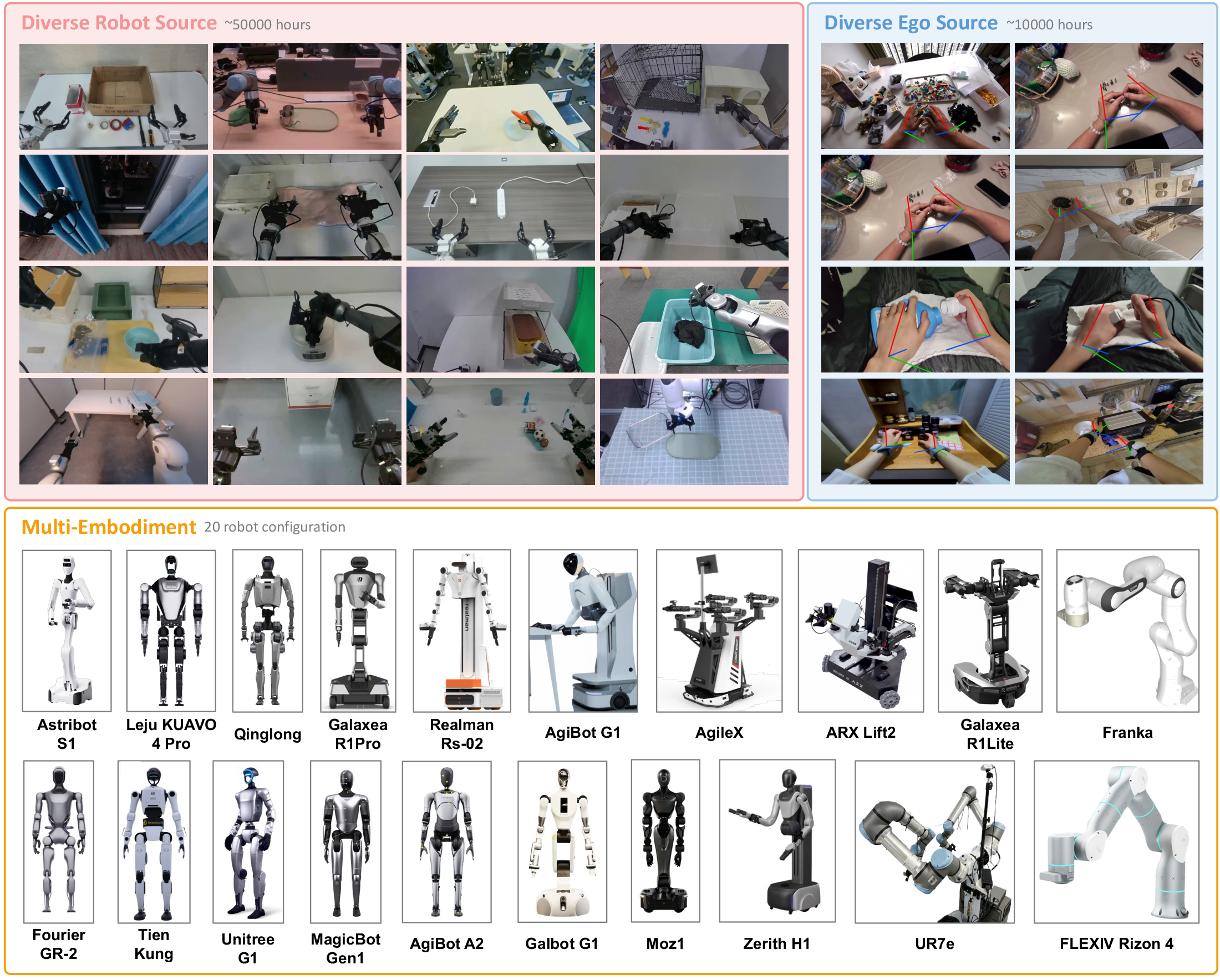
They built a giant “study library” for the robot: about 60,000 hours of video and robot data (that’s roughly seven years of footage if you watched nonstop).
- About 50,000 hours are real robot demonstrations from 20 different robot setups (different “embodiments,” or robot bodies).
- About 10,000 hours are first‑person (egocentric) human videos where you see what a person sees while doing tasks with their hands.
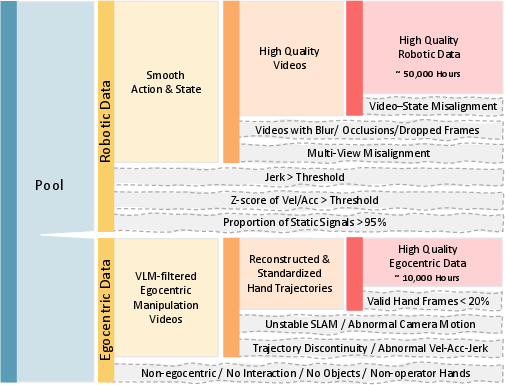
They carefully cleaned the data so the robot learns from good examples:
- They removed “messy” episodes where robot movements were too jerky, frozen for too long, or didn’t match the video.
- For human videos without labels, they estimated camera motion (like building a 3D map) and hand poses to recover smooth, realistic hand paths.
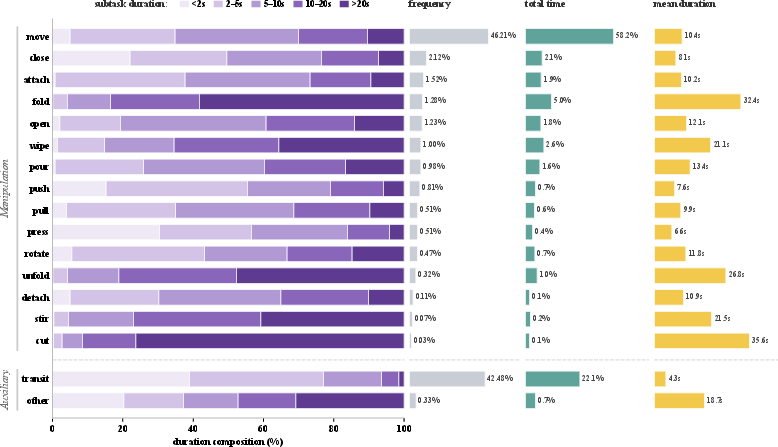
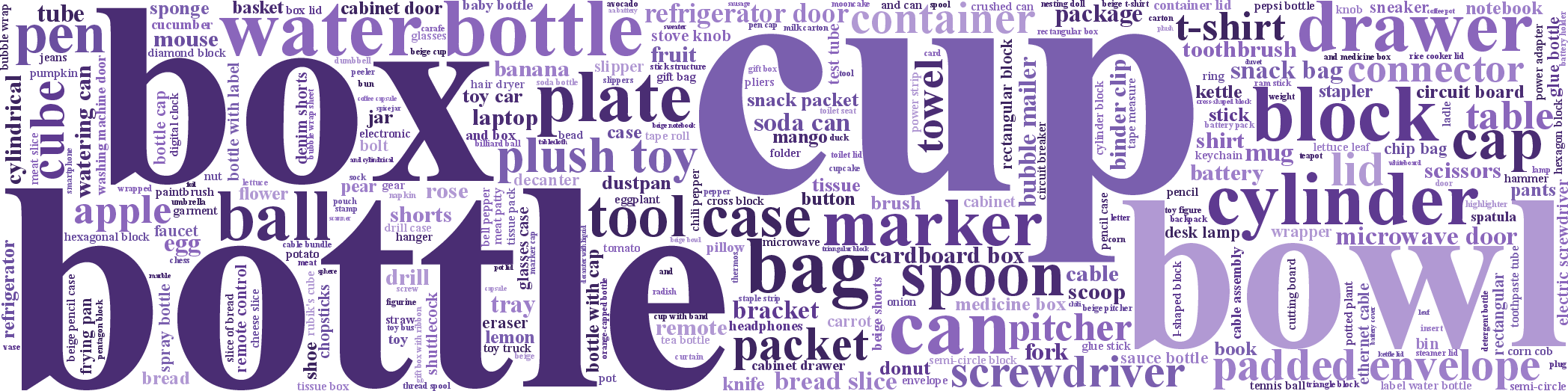
- They used an AI system to split long videos into clear mini‑steps (subtasks) and to add short, helpful instructions (like “open,” “push,” “pour”).
Think of it like giving a student both lots of homework and making sure the homework is actually correct and clear.
2) Whole‑body control with a “universal remote”
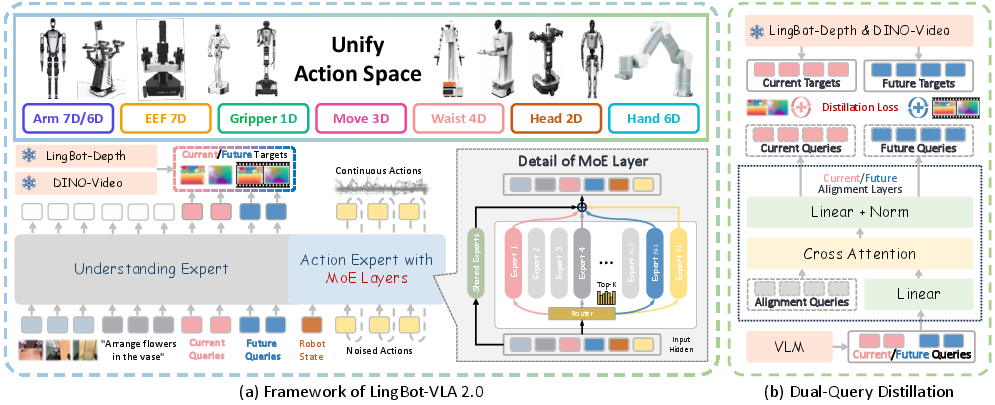
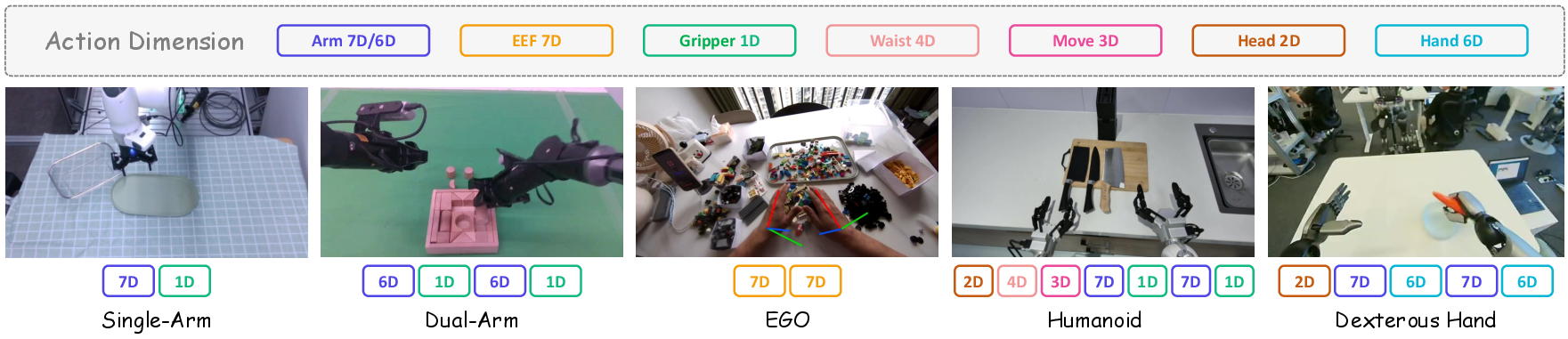
Real robots are not just two arms. They can move their heads, waists, bases (to roll or walk), and even have dexterous hands with many finger joints. The team designed a unified “control panel” (a 55‑number action format) that can describe all these parts in one place:
- If a robot doesn’t have, say, a mobile base, those “slots” are simply left empty.
- This makes one model work across many robot bodies without rewriting everything each time.
Imagine a universal TV remote that can work with any brand—this is the robot version of that.
3) Teaching robots to “think ahead”
The model practices predicting the near future, which helps it plan better:
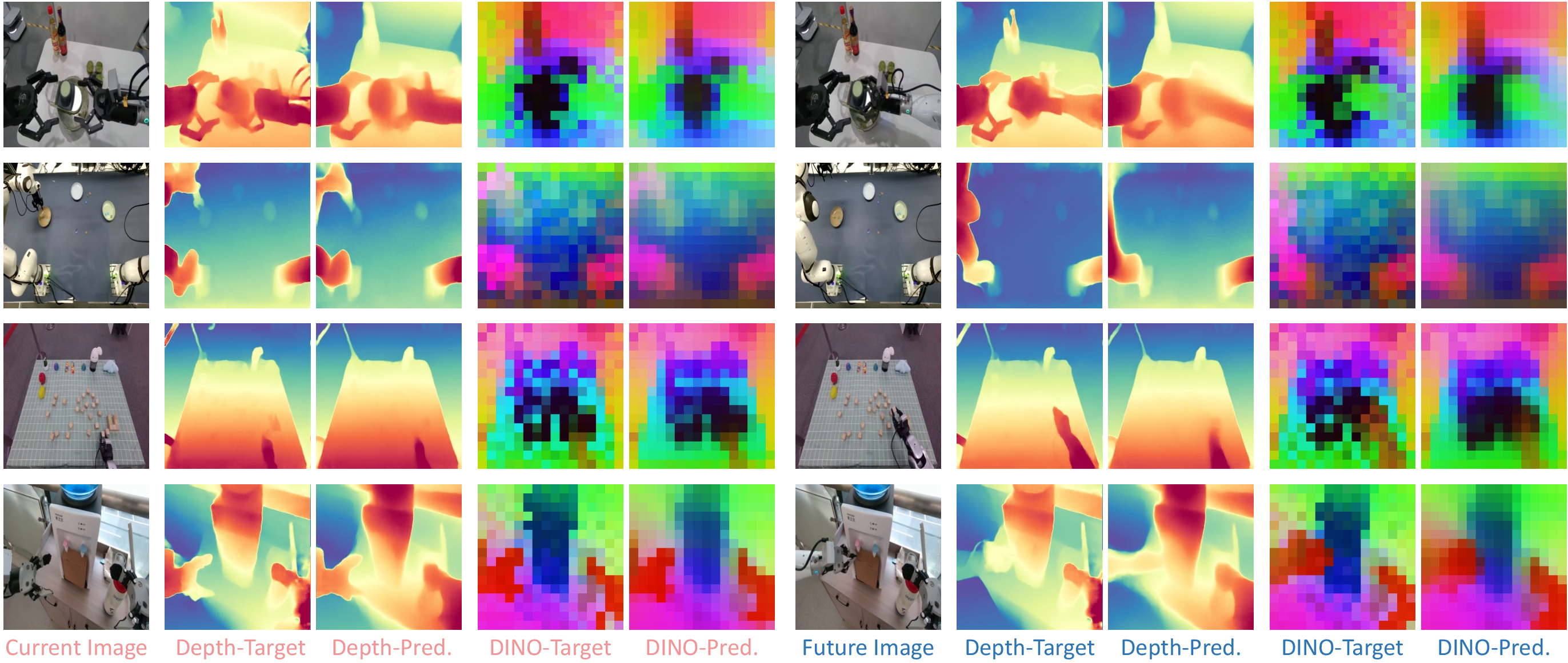
- Depth teacher (3D clue): They use a depth model (like giving the robot 3D glasses) so it learns the shape and distance of objects.
- Video teacher (motion clue): They use a video model that understands how things move over time, but only based on what has already happened (causal), so the robot learns cause‑and‑effect.
- Dual queries: The robot keeps two special “question tokens” in its head—one for “what’s happening now?” and one for “what will it look like in a few moments?” It learns both at once, like practicing present and near‑future snapshots.
This is like a chess player not only seeing the current board but also imagining the next move.
4) A smarter “team of specialists” brain
Inside the model, they use a Mixture‑of‑Experts (MoE) design—think of it as a team of mini‑experts:
- Each piece of the robot’s action plan can call on a few specialists best suited for that situation.
- A simple, fair “routing” method spreads the workload so no single expert gets overloaded.
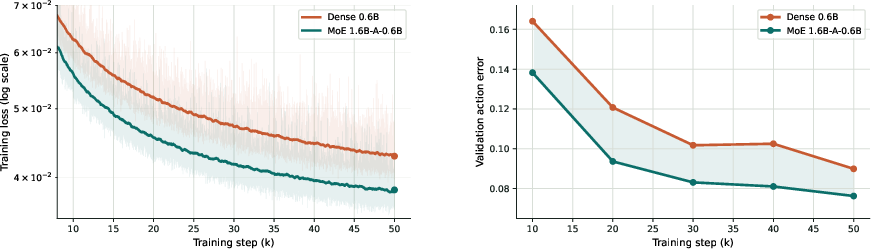
- Under the same computing budget, this expert team learned better than one big generalist network.
What did they find?
They tested the upgraded model on:
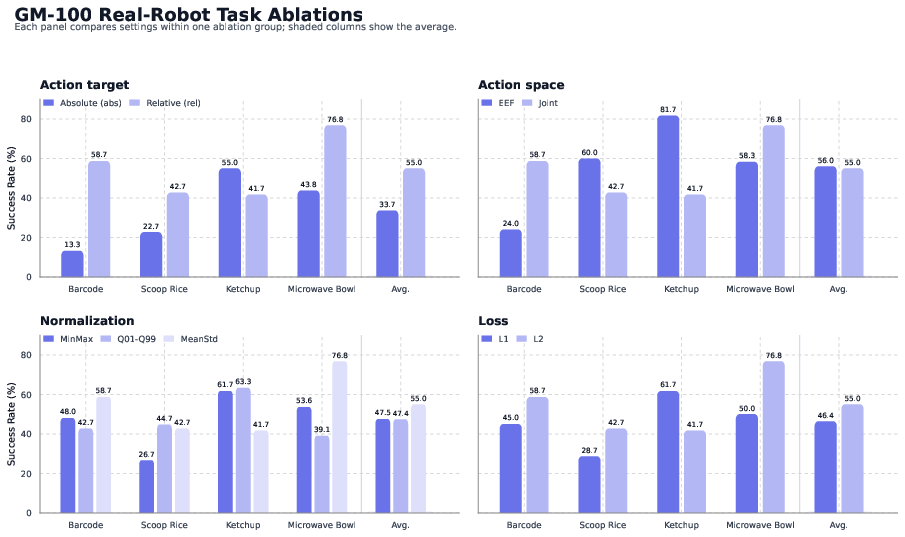
- A well‑known benchmark of two‑arm (bimanual) tasks (like sorting blocks, packing eggs, opening/closing things).
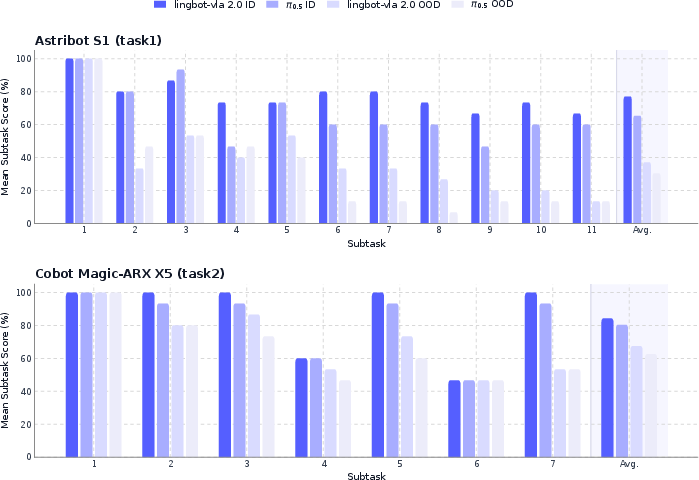
- Two long, multi‑step “mobile manipulation” tasks that combine moving around and using arms (like putting items into a refrigerator or cleaning a stove).
Main results, in simple terms:
- It scored higher and finished tasks more often than older versions and other strong baselines.
- It did especially well on tasks needing good object understanding and multi‑step planning.
- It also handled new situations better, like starting from slightly different spots or dealing with unseen objects (though performance still drops somewhat when things change a lot).
A concrete highlight: on a “retrieve keychain” task, the new model reached perfect success in one setup (100%), showing stronger, reliable execution.
There are still challenges:
- On some tasks, the model makes good progress but fails the final precise step (like exact placement).
- Different robot bodies still bring different difficulties (camera angles, arm reach, finger control).
Why does this matter?
This work moves robots closer to being genuinely useful helpers in homes, hospitals, and workplaces. The key lessons are:
- Quantity and quality of data both matter—more diverse, cleaner examples make a big difference.
- Whole‑body control opens the door to real‑world chores that need more than arms.
- Learning to predict the near future helps robots act safely and efficiently in changing environments.
In short, LingBot‑VLA‑2.0 is a practical step from “cool lab demos” to “robots that can actually help,” and it points the way to future work on even more varied robot bodies, finer precision, and stronger safety and reliability in everyday settings.
Knowledge Gaps
Knowledge gaps, limitations, and open questions
The following list identifies concrete gaps and unresolved questions that limit the paper’s replicability, scope, or real-world applicability and suggest directions for future research.
- Data composition and coverage: Precise breakdown of the 60,000h corpus by robot embodiment, task families, scene types, viewpoints, and sensor modalities (RGB only vs RGB-D) is missing, making it hard to assess task/embodiment balance and potential data biases.
- Sampling strategy: How pretraining batches are sampled across embodiments, tasks, and human vs robot data (and with what reweighting) is unspecified; the impact of sampling on cross-embodiment generalization remains unquantified.
- Data quality thresholds: The embodiment-specific jerk/derivative Z-score thresholds and their sensitivity to performance are not reported; no ablation on how aggressive filtering affects downstream results.
- Video–state alignment scalability: The alignment verification relies on human annotators; no automated metric, error rate, or cost–benefit analysis is provided, raising questions about scalability to larger or continuously updated corpora.
- Multi-camera calibration: Procedures and accuracy for calibrating intrinsics/extrinsics across overhead and wrist views are not documented; robustness to calibration drift or mis-sync is untested.
- Egocentric trajectory reconstruction error: Quantitative accuracy of SLAM and MANO-based 3D hand trajectory recovery (e.g., per-frame pose/position error, failure modes under occlusions) is not reported, nor its effect on robot policy learning.
- Human-to-robot action gap: The method to map human hand trajectories to robot gripper/dexterous-hand controls (including left/right handedness, scale, and kinematic mismatch) is not evaluated; transfer loss from human priors is unknown.
- Language annotation reliability: No quality assessment of the VLM-generated video/subtask annotations (error rates, hallucination types, temporal boundary accuracy) or their impact on training is provided.
- Closed subtask vocabulary: The 18-category closed vocabulary may be insufficient for fine-grained or tool-rich tasks; how out-of-vocabulary actions are handled and whether an open-set scheme would improve performance remains open.
- Unified 55D action/state vector: The effect of heavy zero-padding for missing body parts on learning and inference is not ablated; normalization, units, joint limits, and embodiment-specific scaling of each field are not documented.
- Dexterous hands representation: It is unclear whether 12-DoF hand control is expressive enough for in-hand manipulation and whether hand synergies or contact constraints are modeled; no dexterous manipulation benchmarks are reported.
- Embodiment adapters: The mechanism that maps the canonical 55D actions to each robot’s low-level controllers (gains, rate limits, safety constraints) is not described; stability and safety of this interface under distribution shift are untested.
- Control frequency mismatches: Policy frequency varies by embodiment (e.g., 15–30 Hz), but the handling of asynchronous sensing/actuation and controller latency is not evaluated; no latency/throughput measurements for on-robot inference.
- Predictive modeling horizon: The chosen future horizon T (and chunk size) is not justified; no ablation over T to quantify the trade-off between temporal foresight and compounding error.
- Depth vs video distillation contributions: The incremental benefits of depth distillation, DINO-Video distillation, and their combination are not disentangled via ablations; robustness of depth supervision in texture-poor scenes is unknown.
- Teacher quality dependence: Sensitivity of the student policy to teacher errors (e.g., DINO-Video trained on 5M clips) is unexplored; no experiment shows how weaker/stronger teachers change robot performance.
- Predictive accuracy metrics: The paper claims better temporal reasoning, but does not report explicit future-prediction metrics (e.g., next-frame feature reconstruction error, future depth error) or their correlation with control success.
- MoE hyperparameters and stability: Critical MoE choices (number of routed experts Nr, top-K, λ scaling, bias update speed γ, update frequency) lack ablations; training stability across embodiments and tasks is unreported.
- Expert specialization interpretability: Whether experts specialize by embodiment, task phase, or body part is unknown; no routing visualizations or diagnostics are provided to validate the intended division of labor.
- Auxiliary-loss-free load balancing limits: While avoiding explicit balancing loss, the conditions under which bias-based balancing fails (e.g., severe imbalance, rare tokens) are not analyzed.
- Safety and contact-awareness: No use of force/tactile sensing is reported; failures related to contact-rich interactions (precise placement, insertion, squeezing) and mitigation strategies (impedance control, tactile feedback) are not investigated.
- Failure analysis: The paper notes gaps between progress and success but does not categorize failure modes (grasp failure, mis-grounding, final placement precision, base–arm coordination) or propose targeted remedies.
- Generalization scope: OOD tests are limited (±10 cm base perturbations and a few unseen objects); robustness to lighting, occlusions, clutter, adversarial viewpoints, novel tools/articulations, and long-horizon error recovery is not evaluated.
- Cross-embodiment single policy: Although claiming cross-embodiment capability, the experiments appear per-embodiment; it remains open whether a single policy can control many embodiments without finetuning and with what degradation.
- Transfer to unseen robots: No protocol for zero-shot or few-shot adaptation to a new robot (different kinematics, cameras, hands) is provided; effectiveness of the unified action space for rapid retargeting is untested.
- Long-horizon memory and hierarchy: The approach does not include explicit hierarchical planning, subgoal memory, or option discovery; how the model maintains consistency over dozens of steps without high-level structuring is unclear.
- Language grounding at inference: It is unclear how task instructions are provided and used at test time for mobile-manipulation tasks; effects of ambiguous or multi-turn language are not studied.
- Real-world operations: No discussion of safety policies, collision avoidance with humans, or fail-safe behaviors; reset needs, recovery strategies, and time-to-complete distributions are not reported.
- Compute and deployment constraints: Model size, active parameters, training compute, and on-robot inference latency/energy are unspecified; feasibility on embedded hardware and benefits of quantization/distillation are open.
- Reproducibility and availability: The full dataset (licenses, privacy), trained checkpoints, teacher models (DINO-Video, LingBot-Depth), and annotation tools are not confirmed as released; end-to-end reproducibility may be limited.
- Benchmark breadth: Results focus on a subset of GM-100 and two bespoke mobile tasks; performance on standardized mobile-manipulation suites, dexterous benchmarks, and articulated-object datasets beyond those listed is unknown.
- Precision bottlenecks: The observed difficulty with final precise steps suggests missing high-frequency closed-loop control or sensor feedback; whether adding wrist-depth/tactile sensing or visual servoing would close this gap is untested.
- Multimodal extensions: Audio, proprioception nuances (e.g., torque), and external depth maps are not leveraged; the benefit of integrating additional modalities for robustness remains unexplored.
- Continual and online learning: No mechanism for on-robot data collection, safe online adaptation, or lifelong learning is presented; catastrophic forgetting and domain drift handling are open questions.
- Ethical and bias considerations: Potential biases in internet/egocentric data, consent for egocentric footage, and downstream fairness/safety implications are not discussed.
Practical Applications
Immediate Applications
Below are practical, deployable use cases that draw directly from the paper’s data pipeline, model design, and demonstrated results.
- Generalist mobile manipulation for light facilities work — sectors: logistics, retail, hospitality, smart buildings
- What: Out-of-the-box execution of long-horizon sequences such as “sort items into refrigerator,” “stove wiping/cleaning,” “tool packing,” “barcode scanning,” “retrieval,” and “stocking/tidying.”
- How it uses the paper: LingBot-VLA-2.0’s cross-embodiment generalization, expanded action space (base, head, waist, dexterous hands), and predictive dynamics improve long-horizon execution; validated on GM-100 and mobile tasks.
- Tools/products/workflows: “Generalist Manipulation Policy” model checkpoint; site-specific fine-tuning workflows; task libraries for common chores; teleop/oversight UI for fallback.
- Assumptions/dependencies: Safe mobile base and grippers/hands; calibrated cameras/URDFs; on-board GPU for real-time inference; facility safety SOPs; human-supervision for edge cases.
- Backroom/warehouse support tasks — sectors: e-commerce, 3PLs, micro-fulfillment
- What: Shelf replenishment, bin sorting, light kitting, picking-and-placing varied objects with basic articulated-object interaction (open/close drawers or doors).
- How: Unified 55D action representation and cross-embodiment MoE improve transfer across different arms and mobile bases; future-aware planning improves failure recovery.
- Tools/products/workflows: “Cross-Embodiment Controller SDK” that maps site robots to 55D action vectors; batch execution of pick-sort-pack tasks; integration with WMS.
- Assumptions: Reliable perception in clutter; gripper/hand suitability for SKUs; collision-avoidance stack; throughput may still require human-in-the-loop in OOD scenes.
- Retail floor nightly operations — sectors: retail
- What: End-of-day tidying (collect/box small items), light cleaning, signage placement, door operations, scanning stock with handheld scanners.
- How: Demonstrated abilities (e.g., barcode scan, replace paper roll, push ball to box) transfer to similar primitives; predictive dynamics aids moving-object anticipation by staff.
- Tools/workflows: Workflow scripts chaining primitives; staff “approve/continue” prompts for high-precision steps.
- Assumptions: Store navigation maps; low-traffic windows; compliance with retail safety standards.
- Hospital logistics and environmental services pilots — sectors: healthcare
- What: Non-contact patient logistics: transport supplies/medication bins, open/close doors, place items in compartments; light cleaning of non-sterile areas.
- How: Long-horizon mobile manipulation and articulated-object handling; predictive proxy tasks reduce hazard by anticipating near-term outcomes.
- Tools/workflows: “Clinical Pilot Pack” with restricted action sets and geofences; integration with hospital RTLS/EMR for task issuance.
- Assumptions: Strict infection control and device certification; limited to non-sterile, low-risk tasks; human oversight.
- Kitchen and food-prep support in controlled environments — sectors: food service, robotics kitchens
- What: Repetitive prep tasks (scooping, pouring, bottle handling, wiping surfaces).
- How: Subtask vocabulary and practice on pour/scoop/squeeze actions; future-aware visual tokens help plan placements and tilts.
- Tools/workflows: Recipe step templates mapped to atomic actions; QA monitoring and timed sanitation cycles.
- Assumptions: Food-grade end-effectors; compliance with hygiene regulations; constrained menus and stations.
- Home assistance pilot deployments — sectors: smart home, eldercare
- What: Tidying, sorting, fridge organization, microwave use, and placing items on surfaces under supervision.
- How: Cross-embodiment support enables operation on different home robots; predictive queries and depth-guided reasoning reduce timing/placement errors.
- Tools/workflows: Voice instruction via VLA; caregiver supervision app; restricted zones and schedules.
- Assumptions: Still pilot-level due to reliability constraints (success rates <100%); safety certification; cost of hardware.
- Shared autonomy and teleoperation assistance — sectors: field robotics, inspection, remote operations
- What: Operator-in-the-loop control with predictive assistance (action suggestions, collision forecasts, next-step proposals).
- How: Future-prediction proxy task and DINO-Video features supply anticipatory context to reduce operator workload.
- Tools/workflows: “Predictive Safety Shim” overlay (trajectory preview, risk heatmaps); haptic nudging for dexterous hands.
- Assumptions: Reliable low-latency comms; trained operators; fallback manual override.
- Robotics data cleaning and standardization — sectors: robotics software, OEMs, academia
- What: Clean large-scale logs via jerk/derivative Z-score thresholds, inactivity detection, and video–state alignment checks; normalize to a canonical 55D format.
- How: Directly implements the paper’s redesigned pipeline.
- Tools/workflows: “Robotics Data Cleaner” CLI/library; automated URDF-based replay validation; padding/mapping utilities.
- Assumptions: Accurate URDFs and timestamp sync; human verification for tricky cases.
- Automated subtask annotation for manipulation datasets — sectors: robotics software, academia
- What: Generate step-level labels and concise instructions with a VLM, building training corpora quickly.
- How: Qwen3.6-27B-based segmentation into 18 closed-vocabulary primitives with open-vocabulary object labels.
- Tools/workflows: “Auto-Annotation for Manipulation” pipeline; quality gates (consistency checks, action coverage stats).
- Assumptions: VLM capability and domain adaptation; occasional human spot checks.
- Egocentric video to 3D hand-trajectory conversion — sectors: HRI, VR/AR, sports/skill capture, academia
- What: Turn action-free head-cam videos into world-frame hand trajectories using SLAM + MANO estimation; augment robot pretraining or human skill libraries.
- How: Paper’s SLAM + hand pose pipeline with trajectory QC and physics-consistency filters.
- Tools/workflows: “Egocentric-to-World Hand Trajectory Converter” package; privacy-preserving video filters.
- Assumptions: Good SLAM in the scene; camera intrinsics/rolling shutter effects manageable; consent and privacy compliance.
- Drop-in perception modules — sectors: robotics, CV
- What: Use DINO-Video as a causal, motion-aware encoder and LingBot-Depth for geometry priors in existing stacks (pose estimation, tracking, grasp proposals).
- How: Dual-query distillation teachers are modular; can be adopted outside VLA training.
- Tools/workflows: “Causal Video Encoder” and “Depth Teacher” checkpoints; adapters for ROS2 pipelines.
- Assumptions: Compute latency budgets; calibration and lighting constraints.
- Embodiment-agnostic controller integration — sectors: OEMs, systems integrators
- What: Use a unified control head across robot families (single-arm, dual-arm, mobile, humanoid).
- How: Canonical 55D action representation and per-embodiment padding/mapping + MoE layers that specialize per-token.
- Tools/workflows: “Unified Action Mapper” SDK; validation harness for embodiment-specific constraints.
- Assumptions: Robust kinematics/limits mapping; joint limits and self-collision constraints enforced in the stack.
- Education and lab coursework kits — sectors: education, academia
- What: Course modules on generalist VLA models: data curation, subtask annotation, cross-embodiment transfer, MoE routing.
- How: Reproduce paper’s pipeline using small arms and mobile bases.
- Tools/workflows: Teaching kits with mini-datasets and evaluation scripts.
- Assumptions: Modest compute; simplified task sets.
Long-Term Applications
These rely on further research, scaling, or engineering and standardization before broad deployment.
- Household generalist robots with robust autonomy
- What: Reliable execution of diverse chores across unseen homes without site-specific fine-tuning.
- Gaps: OOD robustness (objects, layouts) and precise placement remain challenging; safety and cost constraints.
- Hospital and eldercare assistance beyond logistics
- What: Bathing assistance, feeding, dressing, medication preparation with dexterous hands and strong future-aware reasoning.
- Gaps: Contact-rich skills, hygiene-grade hardware, regulatory certification, and force/tactile MoE integration.
- Factory cell reconfiguration by language — zero/setup-minimal reprogramming
- What: Rapidly repurpose lines for new SKUs via natural-language instructions chaining reusable primitives.
- Gaps: Reliability in tight tolerances, integration with PLCs/PLMs, formal verification of safety.
- Fleet learning across embodiments
- What: Continual updates where knowledge transfers between different robots via canonical 55D action space and token-level MoE specialization.
- Gaps: Federated learning infrastructure, privacy/security guarantees, cross-site evaluation standards.
- Dexterous in-hand manipulation and fine assembly
- What: Folding, cutting, threading, wiring, and tool use at human-level dexterity.
- Gaps: Scarce data for rare primitives; integration of tactile/force feedback into MoE; higher-frequency control and sim-to-real.
- Human–robot collaboration with intent prediction
- What: Predict coworkers’ actions in shared workspaces and coordinate proactively.
- Gaps: Rich multi-agent datasets; social safety norms; near-future trajectory prediction benchmarks in-the-wild.
- Open standards for manipulation data and action spaces
- What: Industry-wide adoption of a canonical state/action schema (expanding the 55D design) with shared evaluation protocols (e.g., GM-100-class tasks).
- Gaps: Consortium formation, IP and licensing frameworks, mapping tools for legacy systems.
- Autonomous maintenance and inspection in energy/industrial sites
- What: Long-horizon operations involving valves, panels, doorways, and ladders with predictive risk models.
- Gaps: Harsh environment robustness, safety and cybersecurity certification, sensor redundancy.
- Personalized home robots trained from user egocentric videos
- What: Teach robots personal routines via wearable cameras; convert to world-frame demonstrations.
- Gaps: High-quality SLAM in clutter; robust hand pose estimation; user privacy and on-device learning.
- Regulatory and safety certification frameworks for VLA-driven robots
- What: Model-based explainability, predictive safety margins, and standardized tests for deployment approval in public spaces.
- Gaps: Accepted metrics for future-aware controllers; incident logging and auditing standards.
- Robotics-as-a-Service “Generalist Manipulation OS”
- What: Subscription platform providing a cloud-updated VLA policy, device drivers, perception teachers, and data tools to diverse hardware.
- Gaps: Network reliability, edge-cloud co-inference, vendor-neutral driver abstractions.
- Multimodal learning with richer sensors (force/tactile/audio)
- What: Combine the paper’s MoE with contact signals for robust, contact-rich manipulation.
- Gaps: Sensorized hardware penetration; synchronized multimodal datasets at scale; training stability.
Key Assumptions and Dependencies (cross-cutting)
- Data scale and diversity: Many gains derive from 60,000h of curated data; new deployments benefit from site-specific logs for fine-tuning.
- Hardware and embodiment support: Effective mapping to the 55D action space requires accurate kinematics, URDFs, and driver support for heads/waists/bases/hands.
- Compute and latency: On-board GPUs or edge compute are needed for real-time inference with VLA + perception teachers.
- Safety and compliance: Human-in-the-loop oversight, geofencing, and certified safety controllers are advised until reliability improves.
- Perception quality: Calibration, good lighting, and stable SLAM improve success; DINO-Video/LingBot-Depth integration should be profiled for latency.
- Privacy and licensing: Egocentric data usage must comply with consent and privacy regulations; dataset licenses should allow commercial use where applicable.
Glossary
- 3D-RoPE (3D rotary positional embeddings): A positional encoding technique extending rotary embeddings to spatiotemporal (3D) sequences for video transformers. "3D rotary positional embeddings (3D-RoPE)"
- articulated object: An object with joints or hinges that allow parts to move relative to each other. "Open a hinged or articulated object"
- auxiliary-loss-free (MoE balancing): A MoE training strategy that balances expert loads without adding an extra loss term to the main objective. "we adopt an auxiliary-loss-free strategy inspired by DeepSeek-V3"
- autoregressive reasoning-action unification: A modeling approach that jointly sequences reasoning and action tokens in a single autoregressive process. "autoregressive reasoning-action unification"
- bimanual manipulation: Robotic control involving coordinated use of two arms/hands. "dexterous bimanual manipulation"
- camera extrinsics: Parameters describing a camera’s pose (position and orientation) in a world or other reference frame. "per-frame camera extrinsics"
- camera intrinsics: Parameters defining a camera’s internal characteristics such as focal length and principal point. "estimate camera intrinsics"
- causal temporal attention: Attention that conditions only on current and past frames to preserve temporal causality in video models. "block-wise causal temporal attention"
- cross-embodiment: Spanning or transferring across different robot bodies or configurations. "cross-embodiment long-horizon mobile manipulation capability"
- degrees of freedom (DoF): Independent coordinates that define a robot’s allowable motion. "accommodates degrees of freedom for the heads, waists, mobile bases, and dexterous hands"
- DINO-Video: A robotics-aware video representation model built on a DINOv3 backbone with causal temporal modeling. "we introduce DINO-Video, a robotics-aware video representation model"
- DINOv3: A self-supervised vision backbone used for strong image representations, extended here for video. "built on top of the DINOv3 image backbone"
- dual-query distillation: A training method that adds current and future learnable queries to distill spatial and temporal teacher signals. "we adopt a dual-query distillation framework"
- egocentric manipulation assumption: The requirement that videos be from the operator’s viewpoint and depict hand-object interactions suitable for manipulation learning. "do not satisfy the egocentric manipulation assumption"
- egocentric SLAM: Simultaneous localization and mapping run on head-mounted or first-person videos to recover camera motion and scene structure. "we run egocentric SLAM to estimate camera intrinsics and per-frame camera extrinsics"
- end-effector pose: The position and orientation of a robot arm’s tool or gripper in space. "The end-effector pose of each arm is represented by XYZ coordinates and a rotation quaternion"
- geometric cues: Explicit depth- or geometry-related signals used to inform perception or control. "a depth estimation model for geometric cues."
- geometry-aware supervision: Training signals that encode geometric structure (e.g., depth) to improve spatial understanding. "geometry-aware supervision"
- GM-100 benchmark: A standardized suite of dual-arm manipulation tasks for evaluating robot policies. "Evaluations on the GM-100 benchmark"
- grounding (object/visual grounding): Linking language or goals to specific objects and locations in visual scenes. "accurate object grounding"
- iBOT: A self-supervised vision learning method using masked image modeling and self-distillation. "iBOT self-distillation objectives"
- jerk (third-order finite difference): The rate of change of acceleration; used here to detect trajectory smoothness. "compute the third-order finite difference (jerk)"
- latent action model: A model that learns a compact, latent representation of actions to aid decision making. "latent action model"
- load balancing (MoE): Ensuring tokens are distributed evenly across experts during MoE routing. "promote load balancing within the MoE architecture"
- long-horizon: Tasks requiring many sequential steps and sustained planning over extended time. "long-horizon mobile manipulation"
- MANO parameters: A parametric 3D hand model used to represent hand shape and pose from images or video. "recover MANO parameters in the camera coordinate frame"
- Mixture-of-Experts (MoE): A neural architecture that routes inputs to specialized sub-networks (experts) to scale capacity efficiently. "Mixture-of-Experts (MoE) has emerged as a pivotal mechanism"
- mobile manipulation: Combining base (locomotion) and arm control to interact with objects in larger environments. "mobile manipulation"
- open vocabulary: An unbounded set of object or action labels not limited to a fixed list. "a diverse, open vocabulary"
- out-of-distribution (OOD): Evaluation on data that differs from the training distribution. "out-of-distribution (OOD) settings"
- patch-level feature space: Representation granularity at the image-patch level used by vision transformers. "the patch-level feature space of DINO-Video"
- predictive dynamics modeling: Training models to anticipate future scene evolution and action consequences. "we introduce predictive dynamics modeling as a proxy objective"
- projection module with cross-attention: A mapping mechanism that aligns query states with teacher features using cross-attention. "a projection module with cross-attention"
- proxy task: An auxiliary training objective designed to teach desired capabilities indirectly. "we formulate future prediction as a proxy task"
- rotation quaternion: A four-parameter representation of 3D orientation without singularities like gimbal lock. "a rotation quaternion"
- router logits: Scores produced by a router to decide which experts tokens are sent to in MoE. "we compute router logits with a linear router in FP32"
- routing correction bias: Bias terms applied to expert affinities to encourage balanced expert utilization. "each expert maintains a routing correction bias"
- semantic priors: High-level concepts or alignments (e.g., from language-vision models) used to inform perception and planning. "for semantic priors"
- self-distillation objectives: Training a student model to match features from a teacher model derived from itself or a stronger network. "self-distillation objectives"
- SiLU: A smooth, non-linear activation function also known as the Sigmoid Linear Unit. "SiLU"
- SwiGLU: A gated MLP variant (SiLU-gated GLU) used in transformer feed-forward layers for performance gains. "implemented as a SwiGLU MLP"
- token-level sparse MoE: An MoE design where each token selects a small subset of experts, enabling sparse activation. "token-level sparse MoE layers"
- unified action representation: A shared, fixed-dimensional vectorization that maps heterogeneous robot controls into a common space. "Unified action representation."
- URDF (Unified Robot Description Format): A standard XML format for describing robot kinematics and visuals. "using the corresponding URDF"
- video representation model: A model that encodes video into features capturing semantics and motion. "a video representation model"
- Vision-Language-Action (VLA): Models that jointly process visual inputs, language instructions, and output robot actions. "Vision-language-action (VLA) models"
- world-modeling objectives: Learning tasks that build internal predictive models of environment dynamics. "predictive or world-modeling objectives"
- Z-scores: Standardized scores indicating how many standard deviations a value is from the mean; used for anomaly filtering. "the Z-scores of their first-order derivatives"
Collections
Sign up for free to add this paper to one or more collections.