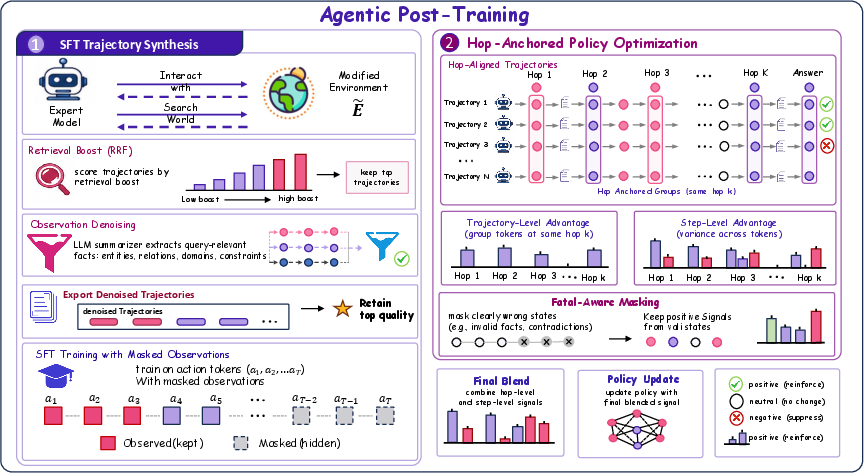
- The paper introduces SearchEyes, which unifies data synthesis, environment simulation, and RL credit assignment via typed knowledge graphs to enable robust multi-hop reasoning.
- It employs a Perception-Knowledge Chain synthesis method and Hop-Anchored Policy Optimization, achieving significant accuracy gains and efficient parameter scaling.
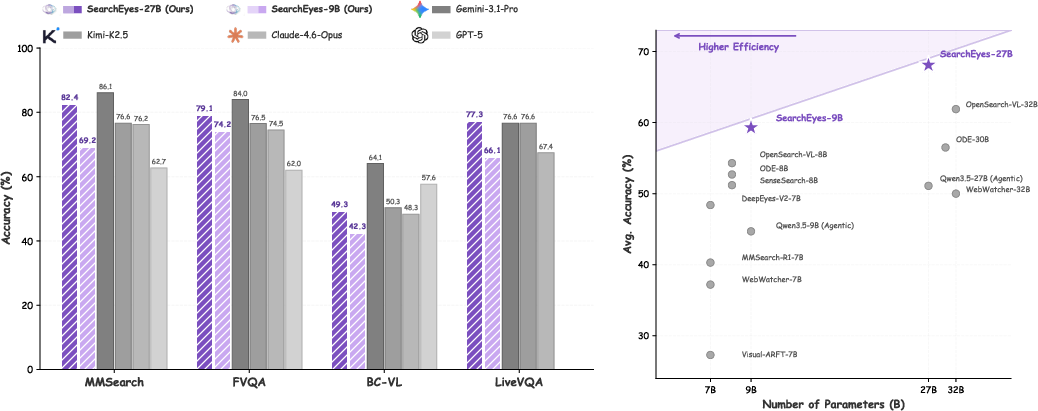
- Empirical results on six benchmarks demonstrate state-of-the-art performance, with competitive metrics against larger models using far fewer parameters.
SearchEyes: Unifying Multimodal Multi-Hop Search Agents via Knowledge Graph Simulation and Step-Level RL Credit
The construction of multimodal search agents that perform robust multi-hop reasoning tasks is fundamentally impeded by a disconnect between data generation, environment simulation, and reward signal construction. Previous pipelines synthesize training data, design environments—typically dependent on external search APIs—and construct RL rewards independently. This fragmentation yields irreproducible, brittle environments and sparse, high-variance RL signals, thereby limiting policy learning efficacy for long-horizon compositional tasks.
SearchEyes addresses this disconnect by treating a typed knowledge graph as a unified simulation environment, data generator, and step-level reward anchor. This co-design paradigm leverages Wikidata5M entities—cross-joined with Wikipedia textual and visual content—to enable end-to-end agentic RL on frontier, open-domain, multimodal question-answering and reasoning objectives.
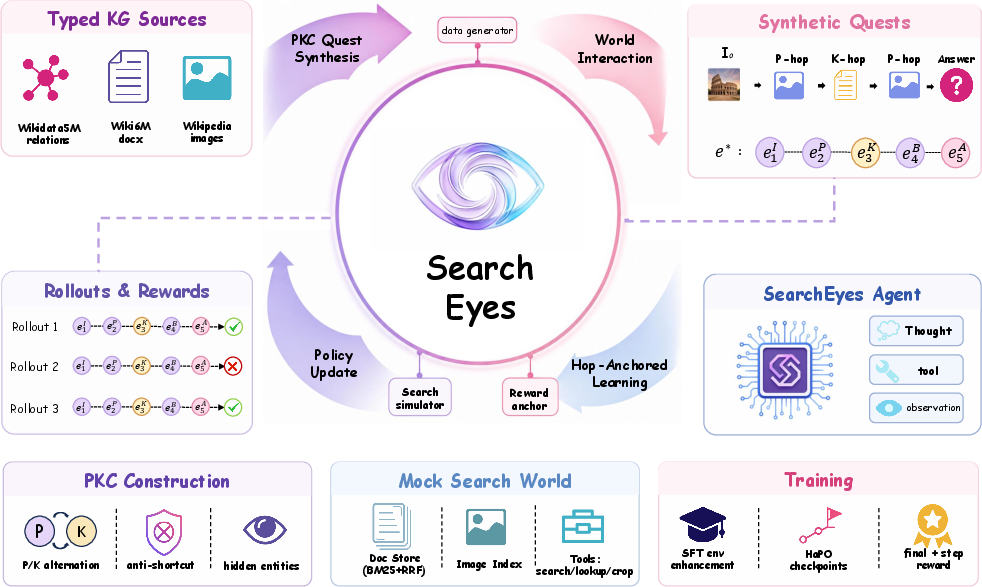
Figure 1: SearchEyes system overview, showing the knowledge graph as a unified backbone for question synthesis, environment interaction, and step-level rewards.
Methodology
SearchEyes advances a two-pronged solution: (1) Perception-Knowledge Chain (PKC) synthesis for training data and environment construction, and (2) Hop-Anchored Policy Optimization (HaPO) for RL-driven step-level policy optimization.
Knowledge Graph Construction & Self-Contained Environment
A typed entity-relation knowledge graph is built from intersected subsets of Wikidata5M, Wiki6M (entity text), and Wikipedia images, yielding 1.2M entities (340K with high-quality images) and 5.8M relation triples with entities typed by four semantic domains. This supports context-rich, deterministic retrieval: the agent’s tools (text_search, lookup, visual_search) operate over this closed-world environment, ensuring full reproducibility and tracking of ground-truth entity access.
Perception-Knowledge Chain Synthesis
PKC samples multi-hop paths in the knowledge graph constrained by (i) strict alternation between perception (visual grounding) and knowledge (text-based retrieval) hops; (ii) disambiguation constraints to enforce multi-branch reasoning (treewidth ≤2); (iii) anti-shortcut and hub-avoidance filters; (iv) domain diversity requirements for robust compositional coverage.
This process outputs detailed structural metadata: each composed instance includes the full gold chain of entities to be traversed, ensuring intermediate states are annotated and disallowing training/evaluation shortcuts via leakage.
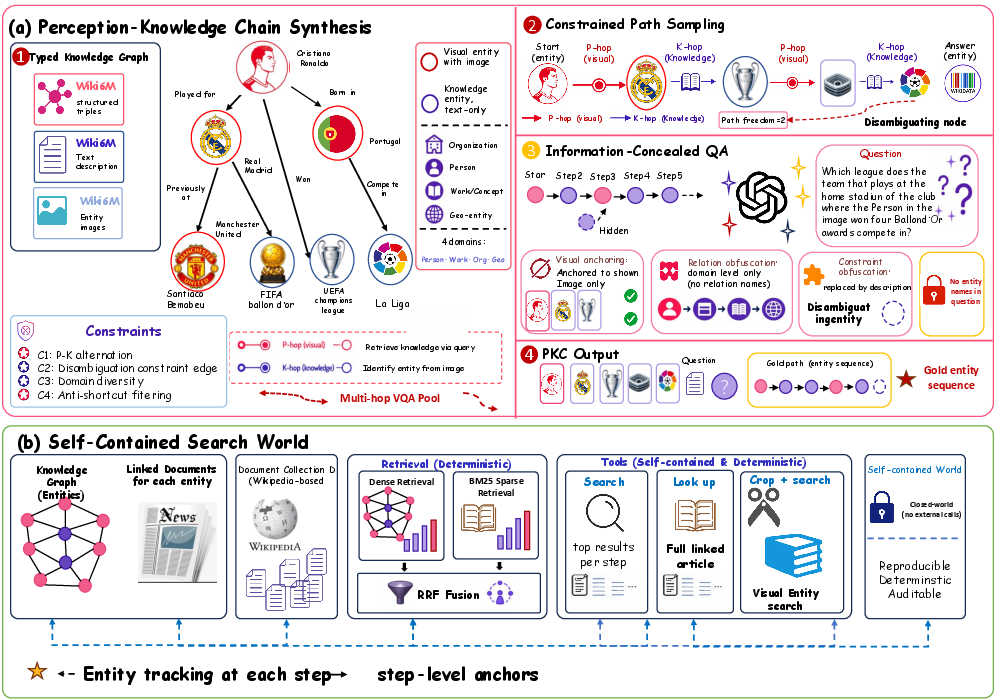
Figure 3: PKC path-sampling and data generation pipeline; all entities maintain path-aligned metadata, supporting environment construction and step-level credit.
RL and Policy Optimization
The agent undergoes a multi-stage training regime:
Empirical Results
SearchEyes is evaluated on six established multimodal knowledge-intensive QA/web-search benchmarks (SimpleVQA, VDR, MMSearch, LiveVQA, BrowseComp-VL, FVQA) and the bespoke, held-out VisSearch Bench (guaranteed multi-hop visual structure). Key results:
Notably, PKC/HAPO ablations reveal that P–K alternation and anti-shortcut filtering in synthesis, and hop-anchored credit in training, yield the largest accuracy gains (up to +7.7/-4.2 versus removing constraints, and +4.0 over standard GRPO). Baselines using unconstrained web/corpus sampling or trajectory-only reward lag far behind.
Transfer and Generalization
On VisSearch Bench, which specifically evaluates multi-hop and modality alternation, proprietary models (including GPT-5, Kimi-K2.5) score below 10%, confirming that SearchEyes’ explicit structural constraints and anchor-based training transfer to genuinely hard, compositional reasoning objectives.
Theoretical and Practical Implications
SearchEyes establishes that knowledge graph simulation enables joint optimization of data quality, environment fidelity, and RL credit assignment. The design removes dependencies on irreproducible web APIs, yielding stable, scalable environments for step-level policy improvement and resource-efficient model scaling. The use of hop-anchored credit eliminates the need for bespoke process reward models, yielding a practical blueprint for RL on long-horizon compositional tasks. The joint P–K alternation and fine-grained filtering ensure the learned policy generalizes beyond shallow tool invocation to true multi-modal reasoning, as supported by both quantitative and qualitative results.
Future Directions
The approach sets a new benchmark for environment and data co-design in agentic multimodal RL. Future research directions include expanding knowledge graph coverage, incorporating richer ontological structures (ontology-based constraints, dynamic relation typing), scaling to massively parallel simulated worlds for self-evolving curriculum learning, and transferring these techniques to reinforcement learning from human feedback (RLHF) pipelines for robust real-world compositional generalization.
Conclusion
SearchEyes introduces a unified, structurally grounded framework for training multimodal multi-hop search agents by tightly coupling data synthesis, environment simulation, and step-level RL signals through typed knowledge graphs. Empirical results show substantial gains over prior open-source and proprietary methods, indicating the critical role of structural metadata preservation and credit assignment for future agentic AI development.
References
For comprehensive evaluation and ablation records, see "SearchEyes: Towards Frontier Multimodal Deep Search Intelligence via Search World Simulation" (2607.05943).