- The paper introduces heading-specific activation steering to control tool invocation by extracting and manipulating internal decision representations in LLMs.
- It employs steering vectors derived from activation states to either suppress or enhance tool use, optimizing model performance in math, time, and intention tasks.
- Experimental results across five models demonstrate that activation addition reduces unnecessary tool use, while orthogonalization refines tool-specific behaviors.
Introduction
The increasing complexity and capacity of LLMs have prompted the use of external tools to augment their capabilities, allowing these models to perform tasks that go beyond static parametric knowledge. However, this tool augmentation often leads to a failure mode known as tool overuse, where models unnecessarily invoke tools, even in scenarios where internal reasoning would suffice. The paper "Controlling Tool Use with Heading-Specific Activation Steering" explores whether the decision-making process regarding tool invocations can be extracted and manipulated at an intrinsic level within the model, without modifying the model's weights.
Methodology
The study investigates the internal representations of tool-use decisions by employing steering vectors derived from heading-anchor positions within the model's activation states. These vectors exert bidirectional causal control over tool invocation, demonstrating suppression in environments where internal model reasoning is adequate and requiring augmentation only when needed. The approach is applied and evaluated across five open-source models and three domains: Math, Time, and Intention.
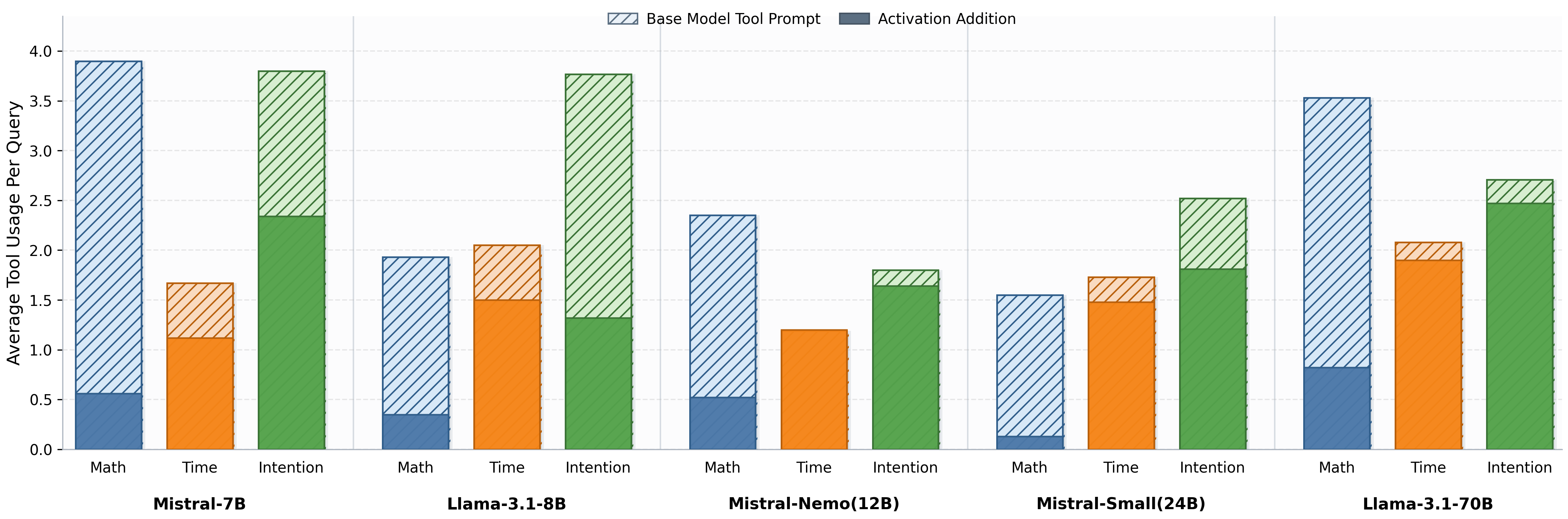
Figure 1: Average tool calls per query across five models under three conditions show the impact of different steering methods.
Experimental Setup
The experimental framework leverages steering vectors crafted from the difference in activation states between Reasoning and Tool heading occurrences. This method allows for activation addition and orthogonalization interventions at specified layers of the model. By doing so, the researchers effectively modulate the model's propensity to invoke tools. These interventions were benchmarked using the SMART dataset across domains requiring distinct tool-usage strategies.
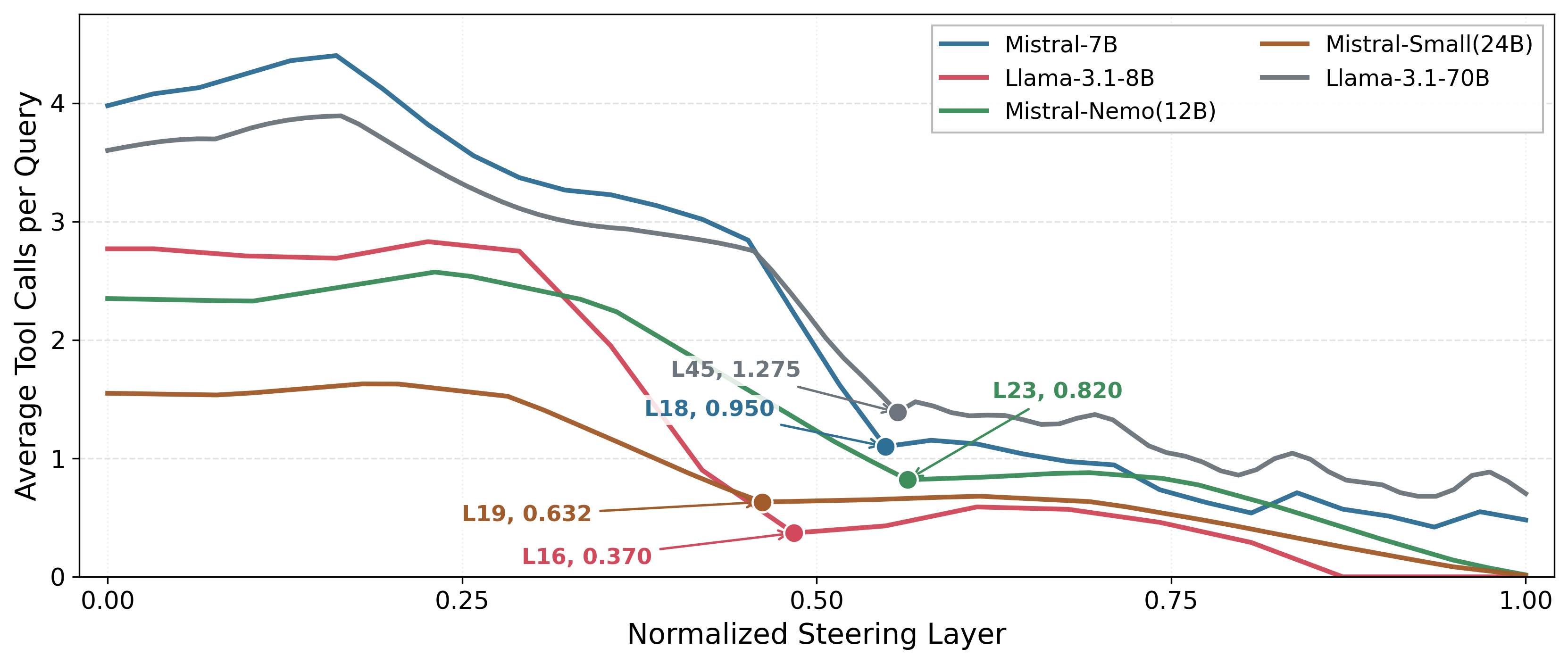
Figure 2: Average tool calls per query as a function of normalized steering layer depth display the stabilization of tool-use representations.
Through rigorous experimentation, the effective layers, i.e., steering layers, were identified for each model setup, demonstrating a consistent pattern where tool-use representations tend to stabilize at similar relative network depths. In practical terms, the models successfully reduced unnecessary tool use while maintaining performance on tasks that genuinely required external engagement.
Results
The results indicate that activation addition can significantly suppress unnecessary tool usage, while orthogonalization enhances it. This dual capability confirms the relevance of extracted steering vectors in controlling tool-use behavior. An intriguing aspect of the findings is the domain-specific effectiveness of these interventions; suppression is markedly more advantageous in domains like Math, whereas in Time and Intention, tool calls were essential for performance, thereby displaying less effectiveness of suppression strategies.
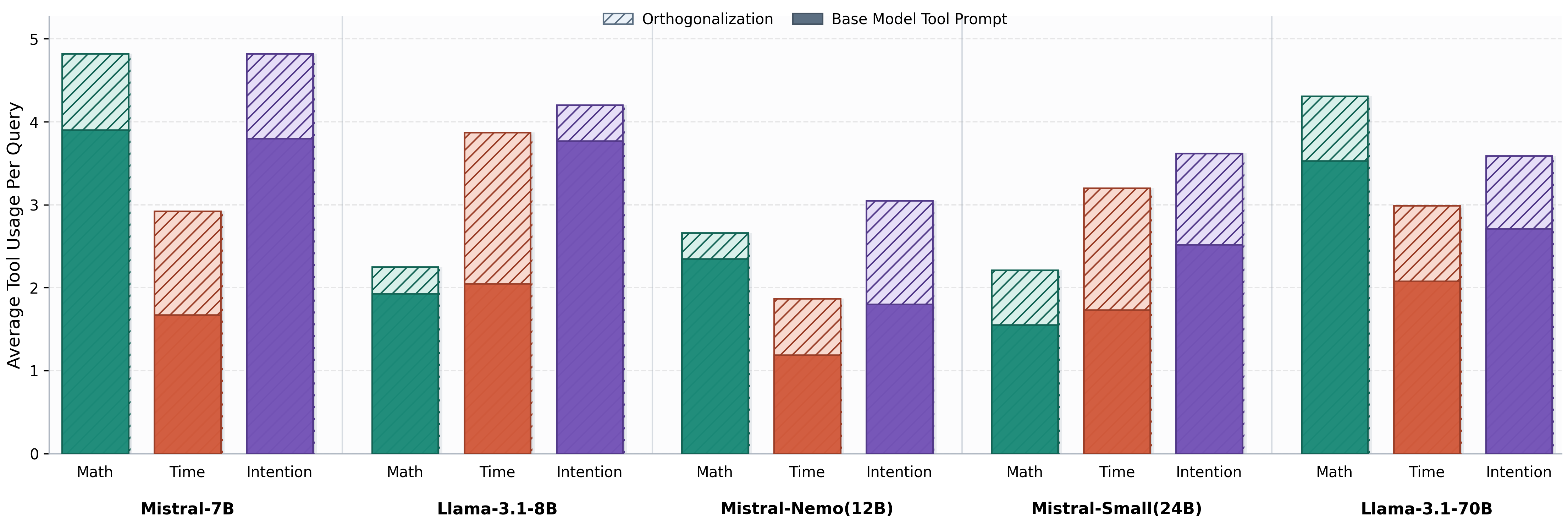
Figure 3: Average tool calls per query under orthogonalization and base conditions across multiple models, underscoring the effect of steering interventions.
Geometric Analysis
Geometric analyses of the steering vectors revealed a lack of linear consistency that one might expect if tool-use intent was straightforwardly encoded within the activations. Instead, tool-invocation activations displayed a bimodal cosine similarity distribution relative to the suppression vector, with both acute and oblique alignments present. This suggests that the steerable direction is not a simple linear encoding but rather an empirical control axis that accounts for the non-parametric injection of tool behavior in context.
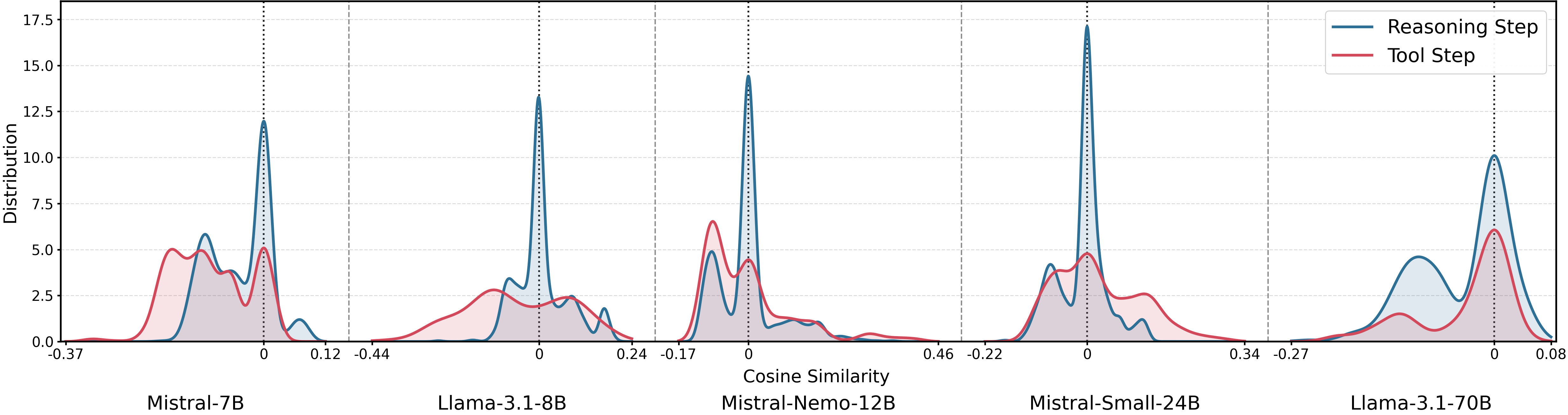
Figure 4: Cosine similarity patterns between steering vector and states during reasoning and invocation indicate non-linear encoding.
Furthermore, cross-tool vector similarities highlighted a distinct separation between types of tool-use behaviors, with more similarity between computational-related tools (code and search) than with query tools (askuser), indicating differentiated internal structures for these actions.
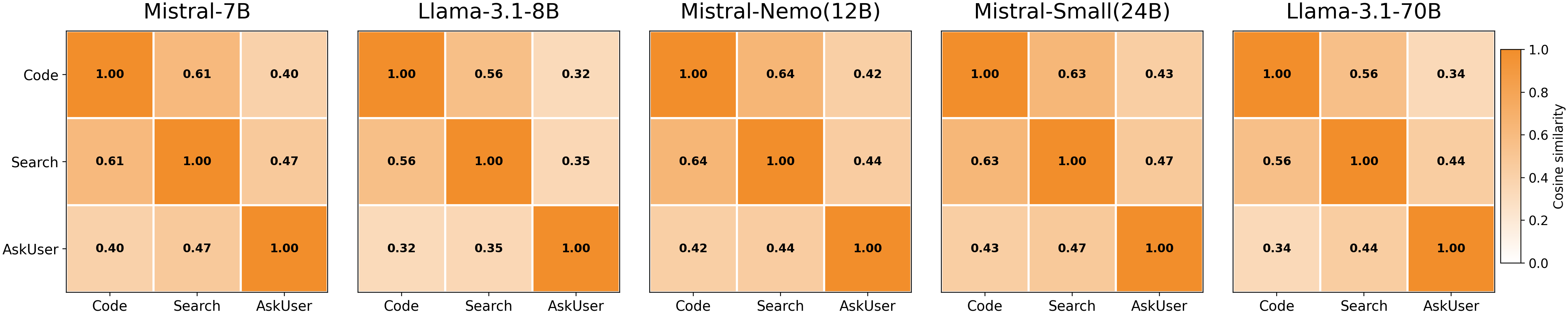
Figure 5: Cosine similarity between steering vectors for various tool types across models suggests distinct internal representations.
Conclusion
The findings of this paper elucidate a novel methodology for governing the tool-use behaviors of LLMs through heading-specific activation steering. This method adds a layer of inference-time behavioral modulation that enhances model efficiency by reducing tool overuse. While the geometric analysis poses intriguing questions about the representation of non-parametric concepts, it also underscores the emergence of a functional mechanism for steering ML models without direct parametric representation. Future advancements could further explore the nuances of these behavioral steering mechanisms, possibly enhancing the robustness and applicability of complex, tool-augmented AI systems.