PixWorld: Unifying 3D Scene Generation and Reconstruction in Pixel Space
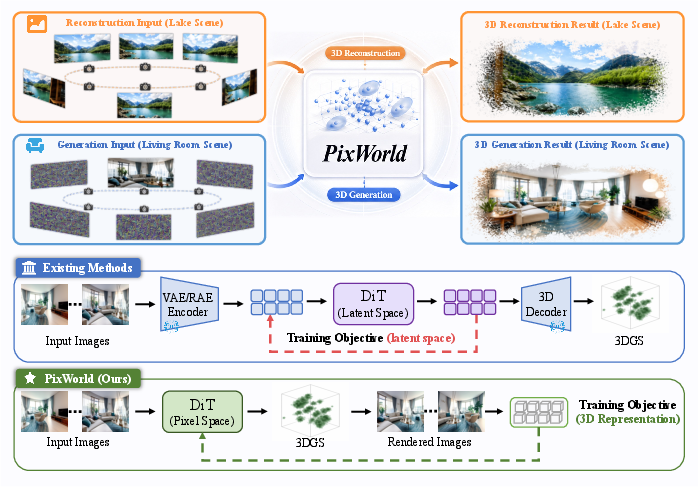
Abstract: 3D reconstruction and generation are commonly tackled by separate paradigms: pixel-based regression for reconstruction, and latent diffusion for generation. Recent works attempt to unify them in latent space, but with notable drawbacks: the diffusion objective is defined on latent features rather than the underlying 3D representation, and both branches suffer from information loss introduced by latent encoding, while requiring a pretrained Variational Autoencoder (VAE) or Representation Autoencoder (RAE). In this paper, we reformulate these two tasks under a unified pixel-space diffusion paradigm and introduce PixWorld, a single model that jointly addresses 3D reconstruction and generation. By supervising diffusion directly on rendered images, PixWorld removes the above limitations and aligns optimization with 3D scene fidelity. Beyond photometric and perceptual supervision that operates at the 2D image level and lacks 3D geometric awareness, we further introduce a geometry perception loss that aligns rendered views with their ground truth in the geometry-aware feature space of a pretrained 3D foundation model, providing 3D structural supervision. PixWorld consistently outperforms prior latent-space generation methods and matches state-of-the-art reconstruction methods, demonstrating the superiority of a unified pixel-space approach.
Paper Prompts
Sign up for free to create and run prompts on this paper using GPT-5.
Top Community Prompts
Explain it Like I'm 14
PixWorld: A simple explanation
What is this paper about?
This paper introduces PixWorld, a single AI model that can both:
- rebuild a 3D scene from real photos (reconstruction), and
- imagine or complete a 3D scene when some views are missing or even from just a prompt (generation).
The twist: instead of working in a hidden, compressed space, PixWorld learns directly from images (pixels). That helps it keep more detail and match what our eyes see.
What questions does the paper try to answer?
In easy terms, the authors ask:
- Can we use one model to both “copy” real scenes from photos and “create” new views of those scenes?
- If we train directly on images (not on compressed codes), will the 3D results look sharper and be more accurate?
- Can we teach the model not just to make pretty pictures, but also to build the right 3D shape of the scene?
How does PixWorld work? (With simple analogies)
Think of building a 3D world like making a diorama from photos.
- Pixel space vs. latent space:
- Latent space is like zipping your photos into small files before learning. It’s faster, but you can lose detail.
- Pixel space is like learning from the full, uncompressed photos. It’s heavier, but you keep all the fine textures and colors. PixWorld works in pixel space.
- Noisy and clean views:
- The model takes several camera views of a scene.
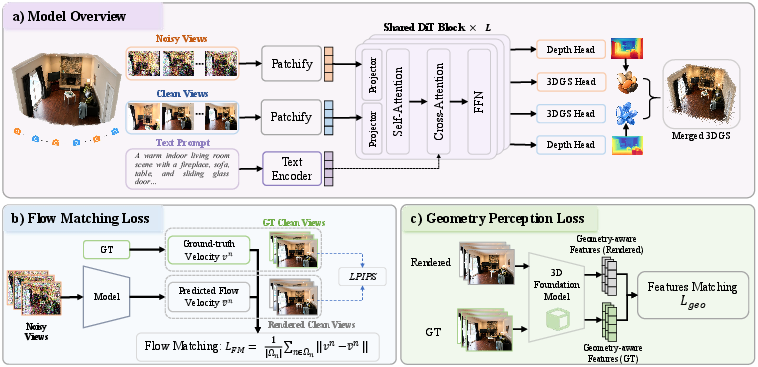
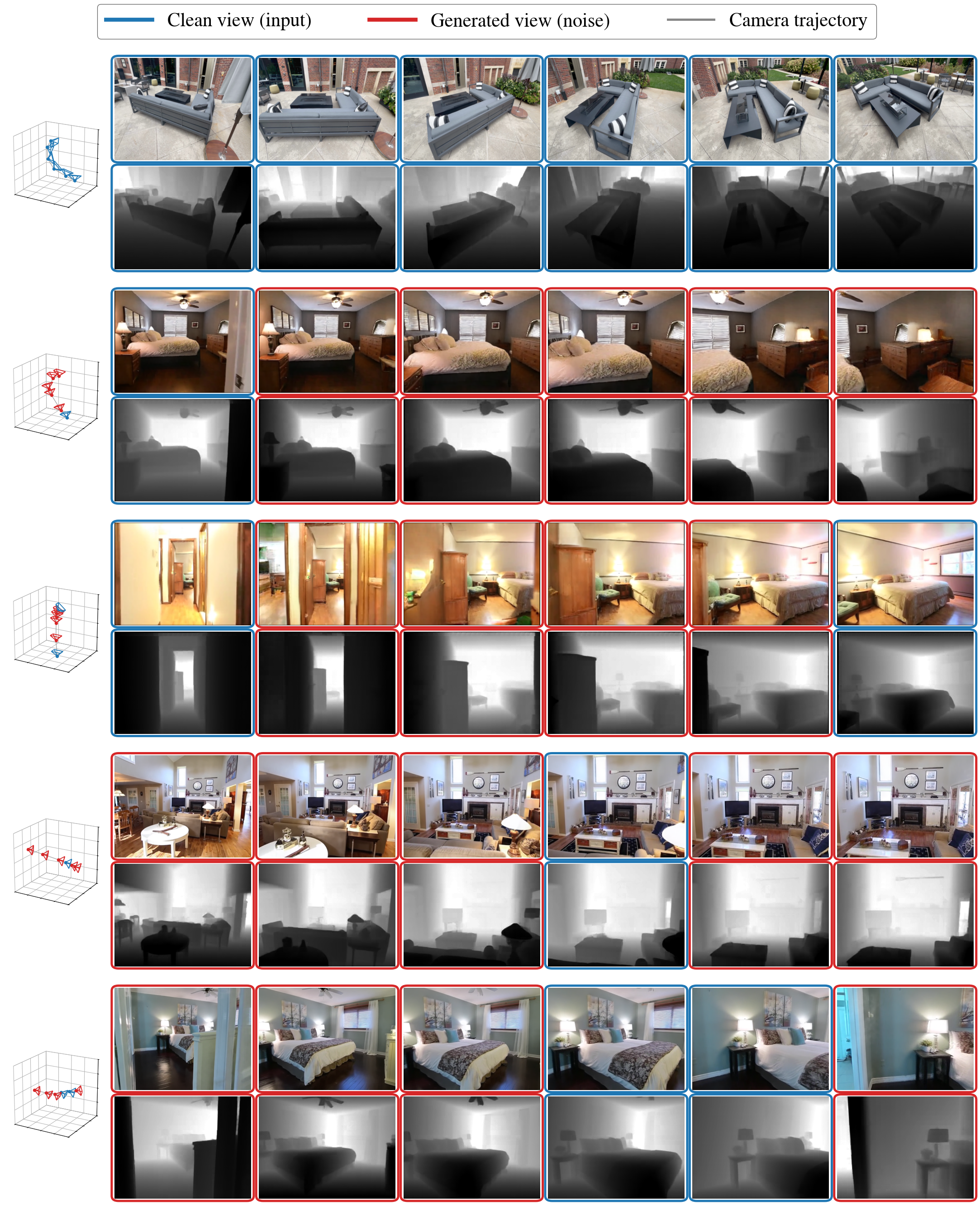
- Some are “clean” (normal photos). Others are “noisy” (the image is mixed with random static, like TV snow).
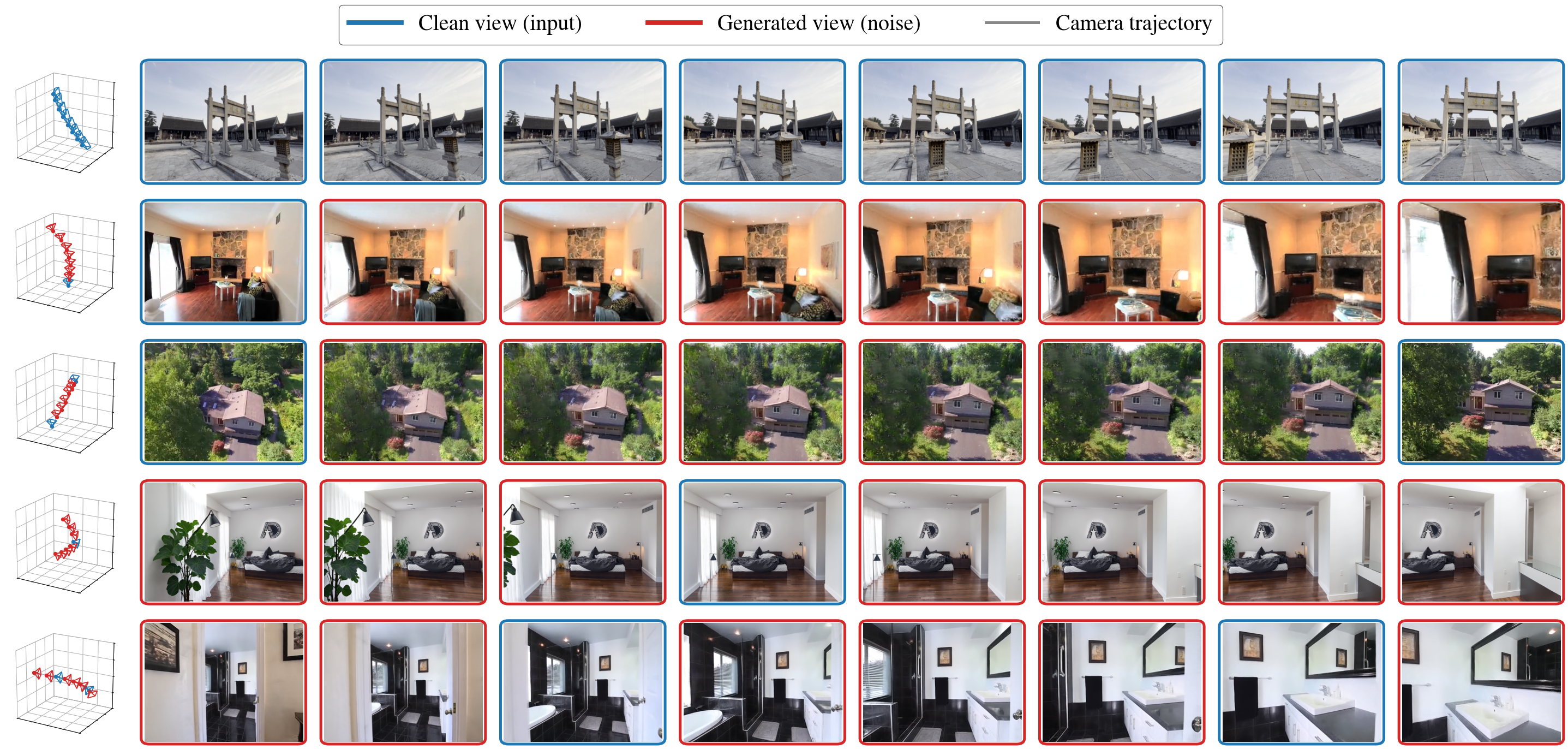
- The model learns to “denoise” the noisy views using the clean ones. If all views are clean, that’s normal reconstruction. If some are noisy or missing, it’s generation—filling in what’s not there.
- Diffusion with flow matching (denoising):
- Imagine gradually turning a noisy picture into a clear one, step by step. The model learns the direction from “noisy” to “clean.” That’s the idea behind diffusion and “flow matching.”
- 3D representation: 3D Gaussian Splatting
- The scene is represented as lots of small, soft, colored “bubbles” in 3D (called Gaussians). When you look at them from a camera, they render into an image—like spray-painting a scene from many dots that blend smoothly.
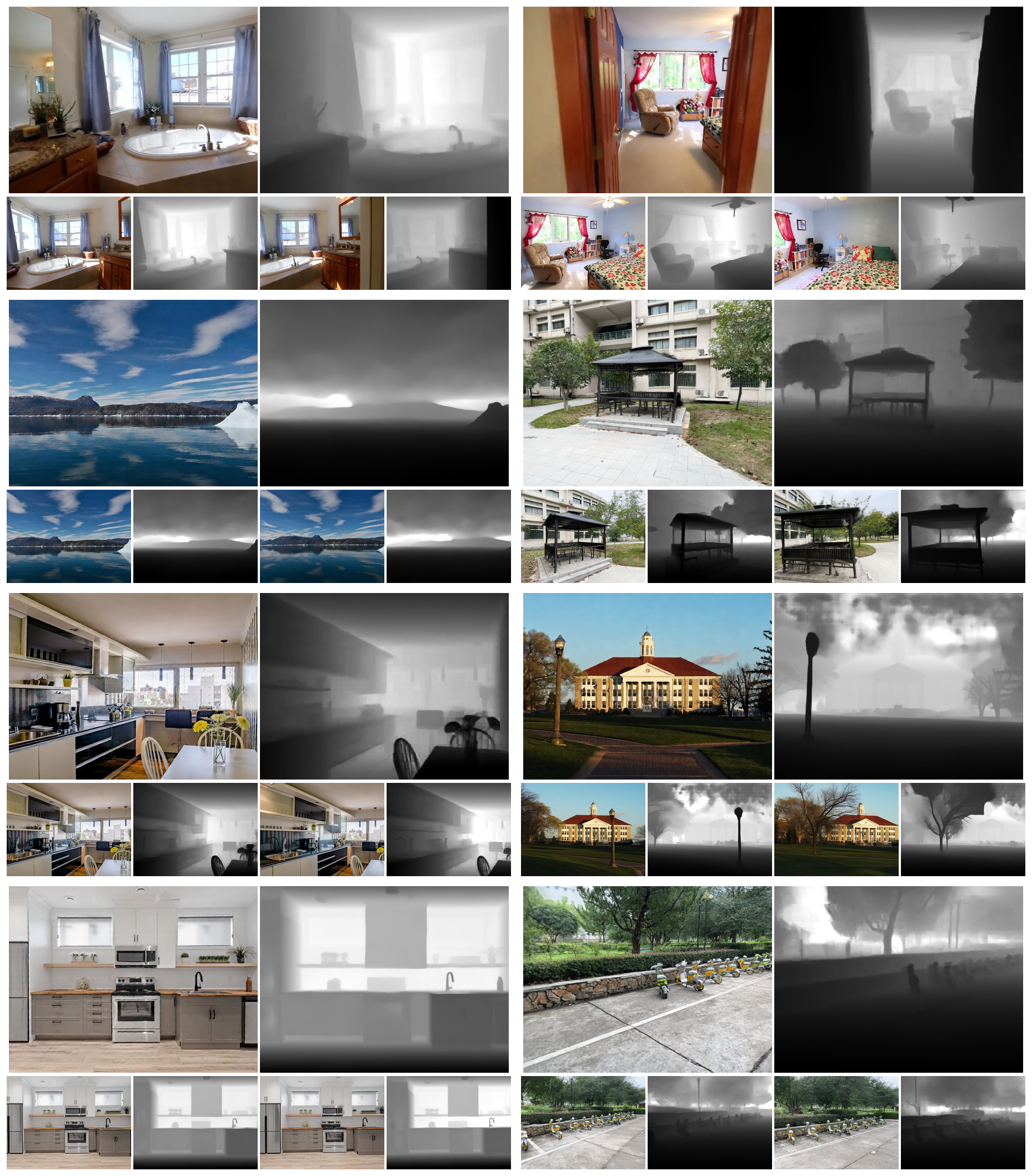
- PixWorld predicts depth and these bubbles from the input views. It uses a “camera simulator” (a differentiable renderer) to turn the bubbles back into images and see how well they match the target images.
- Two-stream transformer (two lanes of thinking):
- One lane handles clean images; the other handles noisy images.
- They share the same core “brain,” so the model learns how clean views help fix noisy ones—and vice versa.
- Geometry perception loss (a 3D-savvy critic):
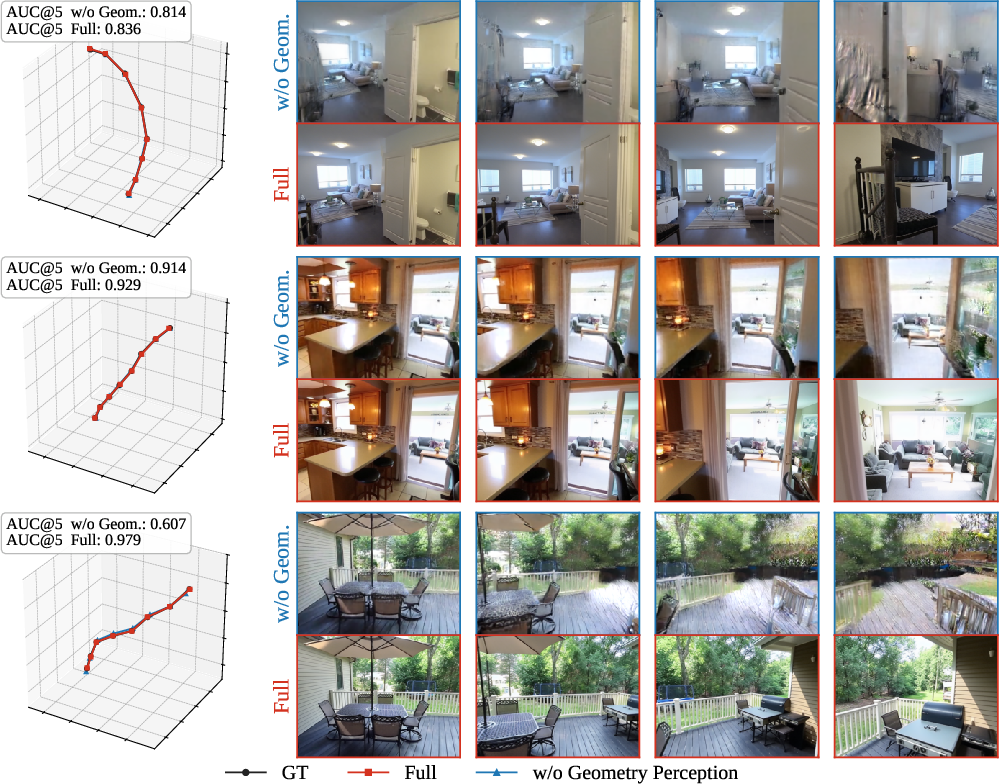
- Matching pixels alone can fool you: a picture might look fine but have wrong 3D shape.
- So PixWorld uses a frozen, pretrained 3D “judge” that understands structure across multiple views. It compares features from the model’s renderings with features from real images, pushing the model to build the correct 3D geometry, not just pretty pictures.
In short:
- Feed clean and noisy views with their camera poses (and optionally text).
- Predict depth and a cloud of 3D “bubbles.”
- Render the 3D scene back into images.
- Compare these renders to the real images at the pixel level and in a 3D-aware feature space.
- Learn to do both reconstruction and generation in one pass.
What did they find, and why does it matter?
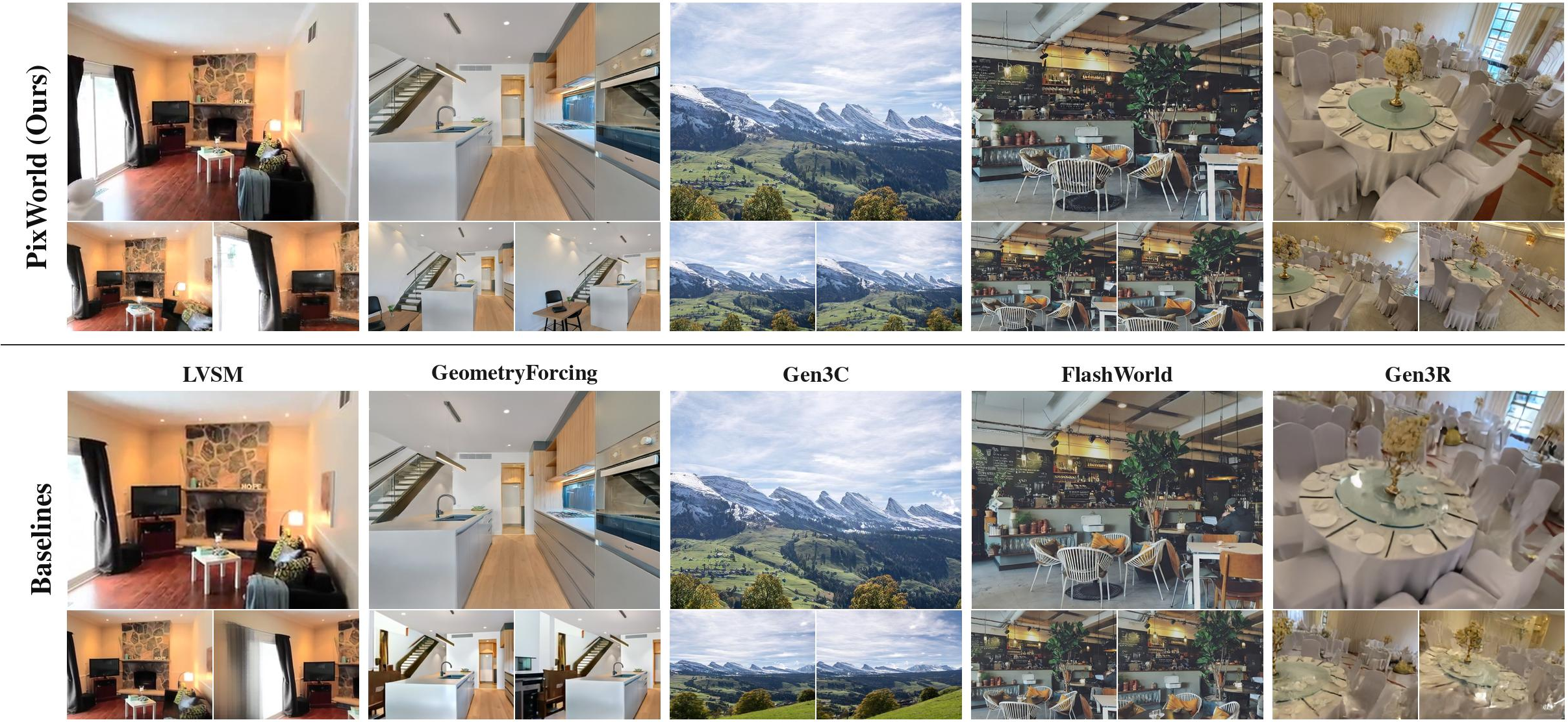
- Better reconstruction: On standard datasets (RealEstate10K and DL3DV), PixWorld matches or beats top methods that focus only on reconstruction, especially in image sharpness and cross-view consistency.
- Stronger generation: With just one or two input images, PixWorld generates new views that are more consistent and follow camera motion better than competing methods. It also scores well on human-focused quality checks.
- Real-world benchmark win: On the WorldScore benchmark, which measures things like camera control, 3D consistency, and overall quality, PixWorld achieves the highest average score and tops key categories like camera controllability and 3D consistency.
Why it matters:
- Working directly in pixel space avoids the detail loss from compression and skips the extra step of training a separate compressor (like a VAE). That makes training simpler and the outputs more faithful.
- The geometry-aware loss helps the model “think in 3D,” so the scene stays consistent when the camera moves.
What’s the big picture?
PixWorld shows that a single, unified model can both rebuild and create 3D scenes with high quality by:
- learning directly from images,
- supervising the 3D representation through a camera simulator, and
- using a 3D-savvy critic to keep the structure correct.
This could make it easier to build virtual worlds for games, VR/AR, movies, and robots—faster, more reliably, and with fewer separate tools. It points toward future systems that can capture, edit, and imagine 3D spaces all in one place.
Knowledge Gaps
Knowledge gaps, limitations, and open questions
Below is a concise list of what remains missing, uncertain, or unexplored in the paper, phrased to guide actionable future work:
- Computational scalability: the method is trained at 336×448 with a 1.04B-parameter model on 32 A800 GPUs, but training/inference throughput, memory footprint, and latency vs. latent-space baselines are not reported; feasibility at HD/4K or long trajectories remains untested.
- Resolution scaling strategies: no exploration of cascaded diffusion, multi-scale render supervision, or super-resolution heads to extend pixel-space diffusion to higher resolutions.
- Dependence on accurate camera poses: all experiments assume known, accurate intrinsics/extrinsics; robustness to pose noise, and pose-free conditioning (e.g., estimating poses from a single image) are not evaluated.
- Camera trajectory generalization: the model is conditioned on provided camera paths; its ability to plan or sample plausible trajectories from sparse inputs (or text alone) is not studied.
- Static-scene assumption: the framework and datasets target static scenes; handling dynamics (moving objects/camera) and time-consistent 4D representations is left open.
- Representation constraints of 3DGS: limitations for thin structures, highly specular/transparent surfaces, fine geometry, and topology changes are not analyzed; alternatives (meshes, SDFs, hybrid reps) are not explored.
- Differentiable rendering biases: potential gradient artifacts from 3DGS rasterization (e.g., translucency, blending) and their impact on geometry fidelity are not quantified.
- Geometry supervision reliance: the geometry perception loss depends on a frozen 3D foundation model (π3/VGGT); sensitivity to the choice of backbone, feature layer, training domain, and potential bias transfer is not assessed.
- Evaluation fairness: camera-control AUC is computed with π3, the same family used as the geometry critic; risk of evaluator–critic coupling bias is unaddressed (e.g., cross-check with a different estimator).
- Cost of geometry critic: the compute overhead of running the 3D foundation model during training and its effect on scalability is not reported.
- Pseudo-depth dependency: depth supervision uses pseudo labels (DA3); sensitivity to their noise, scale ambiguity, and domain biases, and gains from better/multi-sensor depth are not studied.
- Lack of geometry-grounded metrics: evaluation focuses on NVS/LPIPS and perceptual measures; direct 3D accuracy (e.g., Chamfer distance, normal error, scale consistency) is not measured.
- Clean/noisy partitioning policy: no ablation on how the number of clean views, partition strategies, or per-view timesteps affect performance and stability.
- Noise/timestep schedule sensitivity: the effect of the FM schedule, the shared timestep across noisy views, and the gating threshold t_th for LPIPS/geometry loss lack analysis.
- Architectural ablations: the impact of two-stream vs. single-stream, shared vs. separate blocks, and the depth head on final 3D fidelity is not evaluated.
- Multi-view fusion details: unprojecting per-view pixels to Gaussians can produce duplicates/ghosts; strategies for deduplication, consolidation, and global optimization are not described or ablated.
- Diversity vs. determinism: the extent to which sampling different noise seeds yields diverse yet plausible 3D scenes (from one image or text) is not quantified; diversity–fidelity trade-offs are unknown.
- Reconstruction uncertainty: for pure reconstruction (all-clean), the model outputs a single solution; mechanisms to quantify predictive uncertainty or sample multiple consistent reconstructions are not provided.
- Robustness to photometric artifacts: sensitivity to exposure changes, motion blur, rolling shutter, and sensor noise is not evaluated.
- Domain generalization: training uses RE10K/DL3DV and 10M 2D images; generalization to out-of-domain scenes (e.g., outdoor natural, synthetic, highly cluttered) and cross-dataset transfer are not tested.
- Text conditioning capability: while “optional text” is supported, there is no systematic study of text controllability, geometry vs. appearance disentanglement, or text-to-3D generation from scratch.
- Long-horizon control: performance on very long or complex camera paths, large baselines, and extreme viewpoints beyond training distributions remains unexplored.
- Training heuristics: sampling extra novel views per iteration for supervision may be costly; benefits vs. cost and alternative regularizers (e.g., cycle consistency) are not ablated.
- Ablations on 2D prior: contribution of the 10M 2D image prior (BLIP-3o) to 3D fidelity and generation quality is not isolated.
- Failure cases: qualitative/quantitative failure modes (e.g., floaters, depth drift, view-dependent artifacts) are not cataloged to guide targeted improvements.
- Multi-modal sensors: integration of depth/LiDAR/IMU signals to improve geometry and pose robustness is not considered.
- Metric scale consistency: whether the model preserves metric scale across scenes/cameras (given pseudo-depth) is not evaluated.
- Output modalities: the approach yields 3DGS; pipelines for mesh extraction, watertightness, or CAD-ready assets are not addressed.
- Licensing/bias considerations: potential biases from training corpora (RE10K/DL3DV/BLIP-3o) and their effect on fairness and downstream applications are not discussed.
- Reproducibility of training cost: while the VAE/RAE pretraining cost is avoided, the end-to-end training cost (time/energy) relative to latent-space baselines is not reported.
Practical Applications
Immediate Applications
Below are concrete, deployable use cases that can leverage PixWorld’s unified pixel-space 3D reconstruction/generation today, along with suggested tools/workflows and key feasibility dependencies.
- High-throughput environment capture for games and VFX — Sectors: software, media/entertainment, gaming
- What: Turn a handful of posed frames (or even a single keyframe plus a camera path) into a navigable 3D Gaussian Splatting (3DGS) scene for level blockouts, set extensions, and previsualization.
- Workflow: Import frames + poses → run PixWorld to predict depth + 3DGS → preview in a 3DGS viewer → optional 3DGS-to-mesh conversion → refine in DCC tools (Blender, Unreal, Unity).
- Tools/products: “PixWorld Studio” DCC plug‑in; 3DGS-to-mesh converter; Unreal/Unity importer; cloud inference API.
- Assumptions/dependencies: Accurate camera intrinsics/extrinsics (from SfM, SLAM, or on-device sensors); mostly static scenes; GPU inference; license for the frozen 3D foundation model used as geometric critic if training/fine-tuning.
- Fast VR/AR background and set creation — Sectors: AR/VR, media/entertainment, software
- What: Generate multi-view-consistent virtual environments from a single reference image or a short capture for immersive backgrounds, occlusion, and parallax.
- Workflow: Capture a single frame + pose trajectory → generate views + 3DGS → stream to headset or composited AR scene.
- Tools/products: AR toolchain integration; headset runtime that supports 3DGS or pre-baked textures; pose-aware authoring UI.
- Assumptions/dependencies: Known or estimated camera trajectory; 3DGS runtime support or conversion; static environments.
- Real-estate and interior walkthroughs from sparse captures — Sectors: real estate, AEC (architecture/engineering/construction), retail
- What: Produce explorable room/house tours from 4–8 posed photos or a brief video, filling missing views while maintaining structural consistency.
- Workflow: Realtor captures key viewpoints → PixWorld reconstructs 3DGS + depth → export a web-friendly viewer or mesh for BIM viewers.
- Tools/products: Web viewer for 3DGS; export to glTF/mesh; “one-click tour” pipeline.
- Assumptions/dependencies: Scale ambiguity unless poses are metrically calibrated; scenes should be static and well-lit; mesh conversion may lose some fidelity.
- Data augmentation for robotics and autonomous systems — Sectors: robotics, automotive
- What: Augment training data by reconstructing scenes from sparse robot/dashcam frames and generating additional, pose-controlled views to cover blind spots and rare viewpoints.
- Workflow: Ingest recorded frames + poses → PixWorld reconstructs scene and synthesizes novel views along planned trajectories → feed to perception model training.
- Tools/products: ROS/Autoware adapters; pose-programmable view generator; uncertainty tagging for generated views.
- Assumptions/dependencies: Domain gap to outdoor/dynamic scenes; generated views should be tagged as synthetic for training; moving objects may cause artifacts.
- Rapid set extension and camera relighting for post-production — Sectors: media/entertainment
- What: From plate photography, reconstruct a lighting‑aware 3DGS proxy to enable new camera moves and background completion.
- Workflow: Plate selection with poses → reconstruct + generate coverage outside the original frustum → composite with existing plates.
- Tools/products: Nuke/After Effects plug-in for 3DGS backplates; camera path authoring tools.
- Assumptions/dependencies: Appearance is view-consistent but physically based relighting is limited; dynamic actors must be handled separately.
- Cultural heritage and museum digitization on a budget — Sectors: public sector, culture, education
- What: Create navigable records of exhibits and rooms from minimal imagery for online access and education.
- Workflow: Volunteer/staff capture → PixWorld reconstructs → online viewer; optional mesh for long-term archival.
- Tools/products: “Digitize-in-a-day” toolkit; public-facing viewer; curator QA overlays to flag uncertain geometry.
- Assumptions/dependencies: Permissions and privacy; stability of scenes; clear signage if generated portions extend beyond captures.
- E-commerce room staging and product contextualization — Sectors: retail, marketing
- What: Generate multi-view room context from one listing photo and insert products consistently across views.
- Workflow: Input listing photo + target camera arc → generate room views/3DGS → product insertion using existing 3D assets → render carousel.
- Tools/products: Merchandising UI; pose-consistent multi-view renderer; basic occlusion reasoning via depth outputs.
- Assumptions/dependencies: Accurate scale may need calibration; product geometry is separate and must match perspective/lighting.
- Education and research prototyping — Sectors: academia, edtech
- What: Hands-on labs for 3D reconstruction/generation; ablations on pixel-space vs latent-space supervision; geometry-aware loss research.
- Workflow: Load datasets (Re10K/DL3DV) → reproduce training/inference → implement alternative 3D critics or losses → evaluate on NVS and WorldScore metrics.
- Tools/products: Teaching notebooks; evaluation harness (PSNR/SSIM/LPIPS, camera AUC); ablation scaffolds.
- Assumptions/dependencies: Compute availability; licensing for pretrained 3D critic; dataset access.
- Insurance and property claims triage — Sectors: finance/insurtech, proptech
- What: Reconstruct and “view around” damaged areas from a few claim photos to assist assessors’ understanding.
- Workflow: Upload photos with (estimated) poses → reconstruct 3DGS → interactive inspection.
- Tools/products: Claims portal viewer; pose estimation front-end; risk scoring hooks.
- Assumptions/dependencies: Hallucinated completions must be clearly flagged and not treated as ground truth; human-in-the-loop review.
- Simulation asset factory for synthetic data — Sectors: software, robotics, autonomous driving
- What: Batch-generate 3D scenes from seed photos/text and program camera sweeps to populate simulation libraries.
- Workflow: Seed (image or prompt) + camera scripts → generate 3DGS + render view banks → QA via geometric consistency metrics → publish to dataset registry.
- Tools/products: Camera-trajectory scripting; quality gates using LPIPS/pose AUC and geometry-perception features.
- Assumptions/dependencies: Clear separation of synthetic vs real; bias audit of generated content; static-scene focus.
Long-Term Applications
These opportunities are compelling but will likely require further research, scaling, or engineering (e.g., model compression, dynamic-scene support, uncertainty quantification, domain transfer).
- Real-time, on-device AR world capture and completion — Sectors: AR/VR, mobile
- What: Live reconstruction + view synthesis on headsets/phones for robust occlusion and persistent AR content.
- Needed advances: Model compression/quantization; streaming inference; robust online pose tracking; energy-efficient 3DGS rendering.
- Risks/assumptions: Thermal/power limits; privacy of continuously captured spaces.
- Dynamic scene modeling and free-viewpoint video — Sectors: media, telepresence, sports
- What: Extend PixWorld to handle non-rigid motion and temporally consistent generation for free-viewpoint video from minimal cameras.
- Needed advances: Temporal 3DGS/4D representations; motion-aware diffusion; learned deformations; data with ground-truth trajectories.
- Risks/assumptions: Managing motion/occlusion; higher latency and memory.
- Autonomous robot world models with generative completion — Sectors: robotics, logistics
- What: Closed-loop mapping that reconstructs known regions and proposes plausible completions for occluded areas, guiding exploration.
- Needed advances: Uncertainty-aware generation; safety constraints; active perception policies; integration with SLAM/planning stacks.
- Risks/assumptions: Hallucination control in safety-critical tasks; certification requirements.
- City-scale digital twins from sparse heterogeneous sensing — Sectors: smart cities, infrastructure, energy
- What: Maintain up-to-date twins by fusing sporadic imagery (CCTV, drones) and generating missing coverage.
- Needed advances: Multi-source calibration; large-scene memory; streaming/tiling 3DGS; change detection and versioning.
- Risks/assumptions: Privacy and governance; potential bias/drift; compute cost.
- Surgical/endoscopic 3D guidance from sparse frames — Sectors: healthcare
- What: Reconstruct and generate consistent views inside cavities from minimal endoscopic imagery to aid navigation.
- Needed advances: Domain adaptation to medical imagery; strict geometric/metric accuracy; uncertainty estimates; clinical validation and regulation.
- Risks/assumptions: Safety/regulatory hurdles; dynamic fluids/tissues; lighting specularity.
- Disaster response: rapid 3D situational awareness from few drone shots — Sectors: public safety, humanitarian aid
- What: Build approximate 3D overviews and generate additional viewpoints for planning when coverage is sparse.
- Needed advances: Robustness to debris/smoke; explicit confidence maps; fast edge inference.
- Risks/assumptions: Clear labeling of generated vs observed content; operator training.
- AV simulation engines with controllable, physically grounded 3D generation — Sectors: automotive
- What: Generate long, pose‑accurate routes and diverse scenes with controllable factors (weather, traffic).
- Needed advances: Domain control knobs; dynamic agents; physics consistency; scalable evaluation metrics.
- Risks/assumptions: Sim-to-real gap; mis-specified priors.
- Content moderation and provenance for generative 3D — Sectors: policy, platform governance
- What: Standards and tooling to watermark 3DGS assets and disclose generated view regions in consumer apps.
- Needed advances: 3D watermarking for splats/meshes; provenance metadata standards; platform integration.
- Risks/assumptions: Adversarial removal; interoperability across engines.
- Foundational 3D training objectives and critics — Sectors: academia, AI infrastructure
- What: Generalize the geometry-perception loss into a standard “3D critic” interface for training 3D models with better structural priors.
- Needed advances: Stronger, open 3D foundation models; task-agnostic geometric features; efficient multi-view feature extraction.
- Risks/assumptions: Compute demands; licensing; benchmarking consensus.
- Property risk assessment and underwriting from limited imagery — Sectors: finance/insurance
- What: Estimate layout, access, and exposure from sparse photos by reconstructing and “looking around” blind spots.
- Needed advances: Calibrated uncertainty; standardized “do-not-use-as-fact” demarcations; integration with actuarial models.
- Risks/assumptions: Regulatory acceptance; fairness/bias.
- Industrial inspection and facilities maintenance — Sectors: energy, manufacturing
- What: Reconstruct plant areas from limited captures and generate novel angles for remote inspection planning.
- Needed advances: Domain adaptation to reflective/textureless materials; mesh extraction for CAD alignment; temporal change tracking.
- Risks/assumptions: Safety-critical misinterpretations; need for expert review.
Cross-cutting assumptions and dependencies
- Camera poses: Most deployments need accurate intrinsics/extrinsics; if unavailable, integrate robust pose estimation (SfM/SLAM/IMU).
- Scene stationarity: Current method targets static scenes; dynamic content requires future extensions.
- Representation constraints: 3DGS is fast and photoreal but not watertight; some applications require mesh conversion (with potential detail loss).
- Compute and latency: The 1.04B-parameter pixel-space DiT implies substantial inference compute; production uses may need distillation, pruning, or specialized accelerators.
- Domain generalization: Trained on primarily consumer indoor/outdoor data; out-of-domain performance may require fine-tuning.
- Attribution and safety: Generated content should be labeled; provide confidence/uncertainty overlays and guardrails against misuse.
- Licensing: If training/fine-tuning, verify licenses for datasets and the frozen 3D foundation model used in the geometry perception loss.
These application patterns leverage PixWorld’s core strengths: end-to-end pixel-space supervision directly tied to rendering fidelity, a unified path for both reconstruction and conditioned generation, and improved structural consistency via geometry-aware features.
Glossary
- 3D foundation model: A large pretrained model that encodes 3D structure from multi-view observations and cameras, used as a geometric prior. "in the geometry-aware feature space of a pretrained 3D foundation model"
- 3D Gaussian Splatting (3DGS): A scene representation that models surfaces with many 3D Gaussians rendered by splatting, enabling fast differentiable rendering. "NeRF~\citep{mildenhall2021nerf} and 3D Gaussian Splatting~\citep{kerbl20233d} popularized per-scene optimization for high-fidelity novel view synthesis."
- AdamW: An optimizer that decouples weight decay from the gradient-based update to improve generalization. "The model is optimized with AdamW~\citep{loshchilov2017decoupled} for K steps"
- Camera frustum: The pyramidal volume that defines a camera’s field of view in 3D space. "where blue and red frustums denote clean input views and generated views, respectively."
- Diffusion Transformer (DiT): A transformer architecture tailored for diffusion models, used to denoise or predict images/features. "PixWorld adopts a unified DiT-based framework that takes noisy and clean multi-view inputs, with optional text conditioning, and jointly predicts depth and 3DGS through shared transformer blocks."
- Differentiable rendering: Rendering that is formulated to allow gradients to flow back to 3D scene parameters for learning. "the diffusion objective directly supervises the 3D representation through differentiable rendering (see Fig.~\ref{fig:teaser})"
- Flow matching (FM): A training objective that matches predicted and target velocity fields along noise-to-data paths in diffusion/flow models. "PixWorld applies a flow matching objective directly in pixel space over multi-view renderings"
- Geometry-aware feature space: A representation whose features encode cross-view 3D structure beyond per-image appearance. "in the geometry-aware feature space of a pretrained 3D foundation model"
- Geometry perception loss: A loss that compares rendered and ground-truth views in a geometry-aware feature space to enforce structural consistency. "we introduce a geometry perception loss that aligns rendered views with ground truth in the geometry-aware feature space of a pretrained 3D foundation model"
- Huber loss: A robust loss function that is quadratic near zero and linear for large errors, reducing sensitivity to outliers. "a Huber loss applied element-wise and then averaged over pixels."
- Implicit triplanes: A factorized 3D representation that stores features on three orthogonal 2D planes to represent a volume implicitly. "with LRM~\citep{hong2023lrm} regressing implicit triplanes"
- Latent diffusion: Diffusion modeling performed in a compressed autoencoder latent space rather than directly on pixels. "latent diffusion as the current mainstream~\citep{yang2025prometheus,go2025splatflow,huang2026gen3r,li2025flashworld}"
- LPIPS (Learned Perceptual Image Patch Similarity): A learned metric that correlates with human perceptual similarity between images. "We activate the LPIPS term only when $t>t_{\mathrm{th}$"
- Multi-view stereo: A method that reconstructs dense 3D geometry from multiple calibrated images. "Classical pipelines rely on multi-view stereo and structure-from-motion to estimate dense geometry"
- NeRF (Neural Radiance Fields): A neural representation that models view-dependent color and density fields for photorealistic view synthesis. "NeRF~\citep{mildenhall2021nerf} and 3D Gaussian Splatting~\citep{kerbl20233d} popularized per-scene optimization for high-fidelity novel view synthesis."
- Novel View Synthesis (NVS): The task of generating images of a scene from previously unseen camera viewpoints. "Novel View Synthesis (NVS) fidelity against ground-truth target views (PSNR, SSIM, LPIPS)"
- Outpainting: Generating plausible image content beyond the original frame boundaries to extend a scene. "incremental outpainting~\citep{chung2023luciddreamer,fridman2023scenescape,schwarz2025recipe,yu2024wonderjourney,yu2025wonderworld}"
- Per-scene optimization: Optimizing a 3D representation separately for each scene rather than using a feed-forward model. "The per-scene iterative optimization further limits their scalability."
- Pixel-aligned 3D Gaussian representation: A 3D Gaussian scene parameterization derived per pixel (e.g., via predicted depth) so that 3D primitives align with image pixels. "producing a pixel-aligned 3D Gaussian representation~\citep{kerbl20233d}"
- Pixel-space diffusion: Diffusion modeling that operates directly on pixel RGB values instead of latent codes. "we reformulate unification under a pixel-space diffusion paradigm"
- PRoPE: A method for injecting camera parameters into a network representation through pose encoding. "Camera parameters are injected via PRoPE~\citep{li2025cameras}"
- Pseudo-depth labels: Depth targets obtained from another estimator used as supervision when ground-truth depth is unavailable. "We further supervise the predicted depth maps against pseudo-depth labels"
- Representation Autoencoder (RAE): An autoencoder trained to produce a compact representation space (without the probabilistic formulation of a VAE). "Representation Autoencoder (RAE)"
- Score Distillation Sampling (SDS): A technique that distills gradients from a pretrained 2D diffusion model to optimize a 3D representation. "Score Distillation Sampling (SDS)~\citep{lin2023magic3d,poole2022dreamfusion,tang2023dreamgaussian,wang2023prolificdreamer}"
- Structure-from-Motion (SfM): The process of estimating camera motion and 3D structure from a set of images. "Classical pipelines rely on multi-view stereo and structure-from-motion to estimate dense geometry"
- Two-stream diffusion transformer: An architecture that processes clean and noisy inputs in separate streams with shared blocks for unified training. "PixWorld uses a two-stream diffusion transformer"
- Unprojection (inverse projection): Mapping a pixel and its depth back into a 3D point in world coordinates. "we unproject each pixel using its predicted depth and camera"
- Variational Autoencoder (VAE): A probabilistic autoencoder that learns a latent distribution for data via variational inference. "Variational Autoencoder (VAE)"
- Velocity field: In diffusion/flow models, the vector field that points from a noisy sample toward the clean data along the denoising path. "The predicted image is converted into a velocity field"
Collections
Sign up for free to add this paper to one or more collections.