World Tracing: Generative Pixel-Aligned Geometry Beyond the Visible
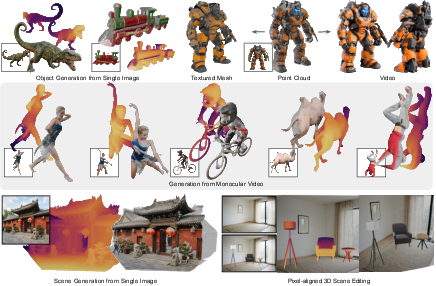
Abstract: Image-to-3D methods often trade off faithfulness and completeness: depth estimators are anchored to input pixels but stop at the visible surface, while image-to-3D models generate complete shapes that are often misaligned with the input. We introduce World Tracing, a generative pixel-aligned geometry representation that predicts 3D points aligned with observed pixels while completing geometry beyond the visible surface. For each input pixel, World Tracing predicts an ordered stack of camera-space 3D points, where the first layer represents the visible surface and subsequent layers represent front-to-back intersections with occluded surfaces. We instantiate this representation with a world-tracing diffusion transformer, WT-DiT, which treats multiple geometry layers as separate denoising tokens coupled through factorized and global attention. WT-DiT is trained with pixel-space flow matching and a mixed noise schedule that balances visible-surface reconstruction with occluded-geometry generation. World Tracing achieves strong performance on visible-surface reconstruction and complete geometry generation across object, scene, and dynamic benchmarks, outperforming both depth predictors and image-to-3D generators. It also preserves 2D-to-3D correspondence, enabling text-driven 3D scene editing, geometry-conditioned novel-view video synthesis, and training-free integration with textured-mesh generators.
Paper Prompts
Sign up for free to create and run prompts on this paper using GPT-5.
Top Community Prompts
Explain it Like I'm 14
A simple explanation of “World Tracing: Generative Pixel-Aligned Geometry Beyond the Visible”
What is this paper about?
The paper introduces a way to turn a single picture or a normal video into a detailed 3D scene that is both:
- faithful to what you actually see in the image, and
- complete, including the parts that are hidden behind objects.
The authors call their method World Tracing. It predicts not just the front surface you can see, but also the hidden surfaces behind it, while staying perfectly aligned with the original pixels of the image.
What questions are the authors trying to answer?
- Can we get the best of both worlds: perfect alignment with the input image and a full 3D shape, including the parts we can’t see?
- Can one approach work for different situations—single objects, indoor rooms, and moving (dynamic) scenes?
- Can this 3D result plug into real applications like editing scenes, making new camera views in a video, or creating clean textured 3D models?
How does the method work (in everyday terms)?
Think of each pixel in a photo as a tiny flashlight shining into the scene. As the light travels forward, it might hit:
- the first visible surface (like the front of a chair), and then
- possibly more surfaces hidden behind it (like the wall behind the chair).
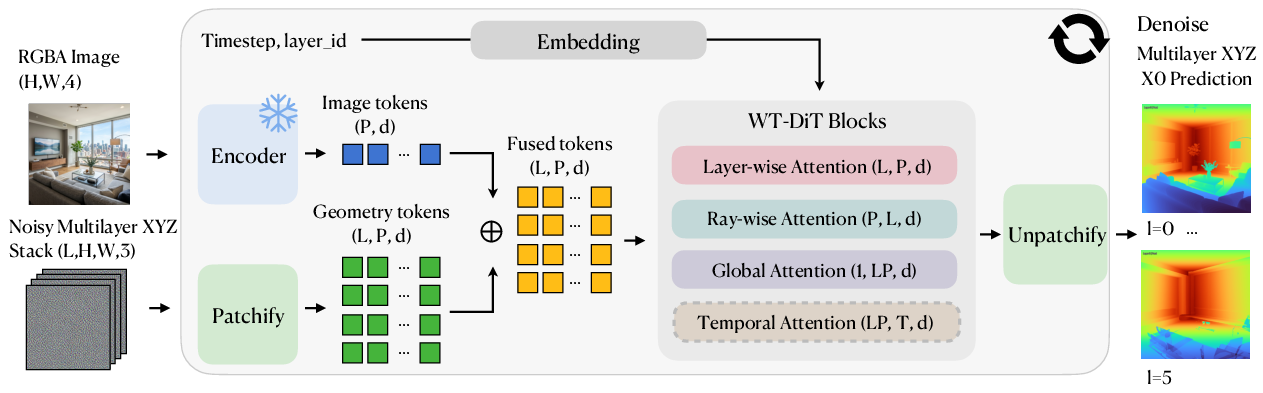
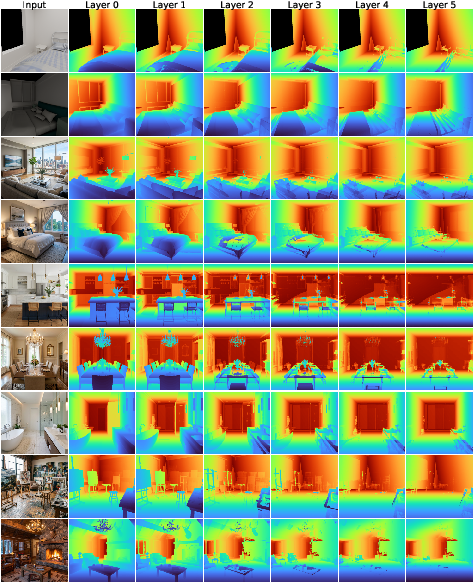
World Tracing predicts a short “stack” of 3D points for every pixel, in order from front to back:
- Layer 0: the visible surface (what you see).
- Layers 1, 2, …: possible hidden surfaces further along the same line of sight.
Key ideas explained simply:
- Pixel-aligned: The 3D points are directly tied to the exact pixels in the image, so what you predict in 3D lines up perfectly with the picture.
- Multilayer geometry: Instead of one depth value per pixel, the method stores multiple “hits” along that pixel’s viewing ray—like X-ray slices along that line.
- Diffusion/flow-matching model (WT-DiT): Imagine starting with TV static (random noise) and gradually “cleaning” it up into the right 3D shape, guided by features extracted from the input image. The model learns how to do this cleanup step by step.
- Three kinds of “attention” (how the model looks around):
- Within each layer: looks around the 2D neighborhood in the image (helps keep local details sharp).
- Along the ray: looks along the front-to-back stack for a single pixel (keeps layers consistent and ordered).
- Globally: looks across the whole image (captures overall structure of the object or scene).
- Training targets (how it learns):
- They render 3D assets and record the first few surface hits per ray (“depth peeling”), so they know exactly where surfaces are in 3D.
- If a deeper layer has no hit, they “forward-fill” it by copying the last valid surface. This avoids tricky “is this layer valid?” yes/no decisions and makes learning stable.
- They don’t need the camera settings as input; they can recover them later from the predicted geometry.
- A special noise schedule helps the model treat visible layers (more certain) and hidden layers (more uncertain) appropriately.
- Variants:
- WT-O: for single objects.
- WT-S: for full scenes (rooms).
- WT-D: for dynamic (moving) content; it adds “temporal attention” so predictions stay consistent across video frames.
What did they find, and why is it important?
In tests on objects, rooms, and moving scenes:
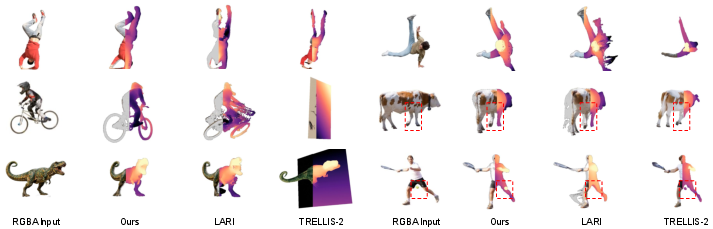
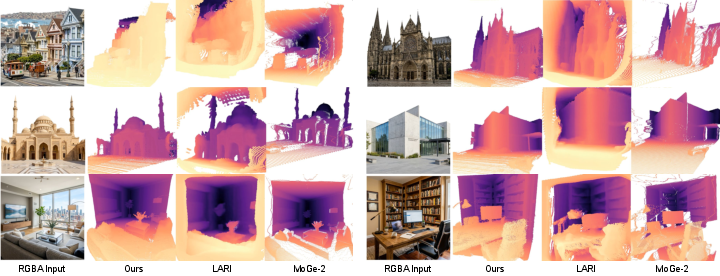
- The method’s Layer 0 (the visible surface) is more accurate than top depth-estimation methods—so it’s very faithful to the image you see.
- The full 3D reconstructions (including hidden parts) are better than popular image-to-3D generators—so it’s more complete and consistent.
- It generalizes well to new kinds of inputs (like photos and generated images that weren’t in training).
- For moving scenes, it beats or matches strong baselines on most benchmarks.
Why this matters:
- The output stays aligned with the original pixels, so you can trust that 3D points correspond to exact places in the image.
- You get useful “hidden” geometry, which is crucial when moving the camera or editing the scene—no more making up the back side from scratch.
This pixel-aligned, multilayer design unlocks practical applications without extra training:
- Text-driven 3D scene editing: Add, remove, or replace objects in a photo, then instantly “lift” the edited image into a 3D-consistent scene that matches the camera.
- Geometry-guided novel-view video: Generate new camera angles by using the multilayer geometry as memory for what’s behind objects, making smoother, more believable videos.
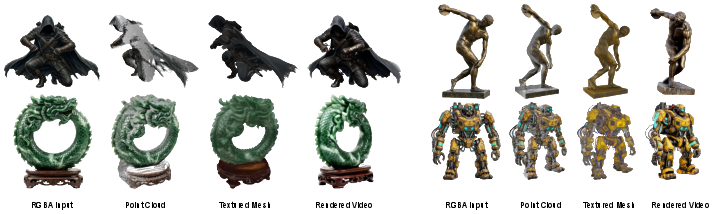
- Better textured meshes: Feed the predicted 3D point stack into existing mesh/texture tools (like TRELLIS). You get cleaner, pose-aligned meshes that reproject correctly into the original image.
What is the potential impact?
- A unified bridge from 2D images to reliable 3D: World Tracing provides the faithful, complete, camera-aligned geometry that many 3D pipelines need.
- Stronger foundations for AR/VR, robotics, and content creation: With accurate visible surfaces and plausible hidden ones, apps can insert objects, plan paths, or create new views much more reliably.
- Scales with widely available 2D supervision: Because the method is pixel-aligned, it can learn from large image/depth datasets, not just hand-curated 3D assets.
- Practical and modular: It plugs into existing systems (video generators, mesh creators) to make them more consistent and camera-aware.
In short, World Tracing shows how to turn a single image or video into a complete, pixel-accurate 3D understanding of the world—even the parts you can’t see—making many 3D tasks easier, faster, and more dependable.
Knowledge Gaps
Knowledge gaps, limitations, and open questions
Below is a consolidated list of what remains uncertain, missing, or unexplored in the paper, framed to be concrete and actionable for future research.
- Synthetic supervision bias: Training relies heavily on depth-peeled renderings of curated 3D assets; there is no quantitative evaluation of occluded-layer accuracy on real photographs. How well do deeper layers generalize to real-world occlusions with complex materials, sensor noise, and view-dependent effects?
- Requirement for RGBA masks: The method assumes an alpha mask at inference (foreground for objects, sky for scenes). What is performance without accurate masks, and can mask prediction be learned jointly or made self-supervised to remove this dependency?
- Fixed layer count and no termination signal: Using a global L=6 with forward-filling provides dense targets but removes explicit per-ray termination/visibility. Investigate adaptive per-ray layer counts, learned termination, or visibility confidence to avoid duplicated points and enable physically meaningful rendering and reasoning.
- Forward-filling side effects: While forward-filling prevents mask collapse, it hides where deeper surfaces are truly absent. How does this affect downstream tasks (e.g., novel-view rendering) and does it introduce artifacts? Explore strategies to learn or recover per-layer visibility post hoc.
- Uncertainty quantification: The model is generative but does not output calibrated uncertainty/confidence per point/layer. Can per-ray/layer uncertainty or distributional outputs be estimated to capture multi-modal occluded hypotheses and guide downstream fusion?
- Best-of-K evaluation bias: Geometry is reported as best-of-8 seeds for stochastic methods, including WT. Provide metrics that assess single-sample performance, diversity-quality trade-offs, and calibration of generative variability.
- Intrinsics estimation assumptions: Fitting K from L0 assumes a pinhole camera and sufficient scene structure. Robustness to lens distortion, rolling shutter, degenerate configurations (e.g., planar scenes), and wide-FOV lenses is not analyzed.
- Metric scale and normalization: Scene training uses per-sample normalization (log-median). How is absolute metric scale recovered at test time without ground truth statistics? Evaluate and/or learn metric scale prediction for real-world deployment.
- Temporal coherence in WT-D: Temporal consistency relies on attention alone. Quantify motion jitter, surface drift, and occlusion consistency with time-series metrics; explore explicit temporal priors, motion constraints, or trajectory regularization.
- Outdoor and complex material generalization: Training/evaluation focuses on indoor scenes and opaque, Lambertian-like assets. Test and adapt the model for outdoor scenes, glass/transparent objects, specular/reflective materials, thin/filamentary structures, and participating media.
- Compute and latency: The 1.7B-parameter model with 20 ODE steps is compute-heavy. Report inference latency/throughput, and explore distillation, pruning, caching, lighter backbones, or fewer denoising steps without degrading quality.
- Multi-view consistency: The model is single-image conditioned; consistency across multiple views of the same scene is untested. Can the representation be extended to multi-view inputs and trained to be cross-view consistent in geometry and scale?
- Per-layer evaluation beyond L0: Quantitative results focus on L0 and aggregated All-L metrics. Provide per-layer accuracy metrics and analyses of how errors grow with depth index, to better guide architecture and training changes.
- Conversion to watertight meshes: Downstream meshing depends on external decoders (e.g., TRELLIS). Investigate direct, training-free meshing from layered point stacks (e.g., layered Poisson, differentiable surfacing) and evaluate watertightness, topology, and fidelity.
- Visibility-aware rendering from layers: How should layered, potentially duplicated points be culled when rasterizing to novel views? Formalize a rendering/culling protocol that accounts for missing termination signals and avoids “thickened” surfaces.
- Control over occluded completions: There is no mechanism to steer generative completions (e.g., with semantics, text, or part priors). Explore conditioning signals to guide what appears behind occluders and to enforce category-consistent structures.
- Data mixture and bias: The asset mix (Objaverse, 3D-FRONT, internal sets) may bias occluded completions toward dataset priors. Quantify and mitigate biases, and probe failure cases on underrepresented categories, scales, and layouts.
- Robustness to mask errors: Although mask-boundary jitter is used in training, robustness to severe segmentation errors is unreported. Measure sensitivity to systematic mask noise and explore self-correction mechanisms.
- Number of layers vs. scene complexity: L=6 may be insufficient for deep occlusions (e.g., long corridors, dense clutter). Study adaptive layer budgets, dynamic allocation per ray, and the trade-off between L, memory, and accuracy.
- Attention factorization ablations: Three-way attention (layer-wise, ray-wise, global) is central but not fully ablated. Quantify the contribution of each path, memory/latency trade-offs, and alternatives (e.g., windowed ray attention, cross-ray coupling).
- Noise schedule design: The layer-aware mixture schedule is heuristic. Investigate adaptive or learned timestep policies per ray/layer, curriculum scheduling tied to training progress, and connections to guided diffusion for visible vs. occluded layers.
- Failure analysis for intrinsics fitting: Provide analyses of when K-fitting fails (e.g., small FOV, textureless regions), its impact on downstream tasks, and remedies (e.g., joint K prediction or regularization).
- Generalization to non-RGB inputs: The approach assumes standard RGB(A). Explore robustness and gains from additional cues (e.g., polarization, NIR, sparse depth, IMU), particularly for occluded-layer plausibility and metric scaling.
- Dynamic topology changes: WT-D does not explicitly handle appearing/disappearing parts or topology changes. Evaluate and model topological events (e.g., articulated contacts, cloth folding) and their effect on layered consistency.
- Quantitative evaluation of downstream demos: Scene editing and video synthesis are demonstrated qualitatively. Introduce metrics (e.g., reprojection error, geometric consistency under edits, view-consistency scores) and controlled user studies.
- Handling of global scale and gravity priors: Explore integrating gravity/Manhattan priors or learned global scene layouts to stabilize large-scale scene geometry and occluded completions.
- Camera model generality: Extend and test beyond pinhole (e.g., fisheye, omnidirectional) and quantify the impact on layered predictions and K recovery.
- Storage and compression: Multilayer stacks are memory-heavy. Investigate compression schemes (e.g., learned codecs, sparse encodings) and the accuracy–size trade-off for deployment.
- Safety and failure-case catalog: Provide a documented catalog of systematic failure modes (e.g., hallucinated back walls, duplicated thin structures) with diagnostic tests and confidence flags to guide downstream use.
Practical Applications
Overview
World Tracing (WT) introduces a pixel-aligned multilayer geometry representation that reconstructs visible surfaces and plausibly completes occluded geometry from a single image or monocular video. It preserves precise 2D-to-3D correspondences in the input camera frame, estimates camera intrinsics in closed form from its own predictions, and works across objects (WT-O), scenes (WT-S), and dynamic clips (WT-D). A flow-matching diffusion transformer (WT-DiT) with three-way attention (within-layer, along-ray, global) and a depth-filling objective underpins the method. The representation enables faithful, complete, and pose-aware 3D geometry without test-time optimization and integrates training-free with mesh decoders (e.g., TRELLIS), 2D editors, and video models.
Below are practical applications grouped by deployment horizon, with sector links, suggested tools/workflows, and feasibility notes.
Immediate Applications
These can be deployed with the paper’s released code/demo and existing off-the-shelf components.
- Text-driven 3D scene editing from a single image
- Sectors: software, media/entertainment, advertising, real estate/architecture, e-commerce
- What: Insert, remove, or replace objects and materials in a photo while maintaining 3D-consistent geometry and camera alignment. Edits remain pixel-aligned and can be reprojected from new views.
- Workflow:
- 1) Use a 2D editor (e.g., Stable Diffusion, Photoshop generative fill) to apply the textual edit.
- 2) Run WT-S (for the scene) and WT-O (for the edited/inserted object) to get multilayer camera-space point stacks and recover intrinsics.
- 3) Fuse the object stack into the scene stack in closed form (shared camera frame).
- 4) Optional: export to mesh via the training-free TRELLIS hybrid for texturing and rasterization.
- Tools: WT-S/WT-O, a 2D generative editor, optional TRELLIS-2 Stage-2 decoder, Blender/Unity importers.
- Assumptions/Dependencies: RGBA or a reliable mask for edited regions; pinhole camera assumption for intrinsics fit; occluded layers are plausible rather than ground-truth; indoor scenes generalize best.
- Geometry-guided novel-view video synthesis
- Sectors: media/entertainment, AR/VR, marketing, education
- What: Generate orbit shots and parallax videos that respect 3D structure, including disoccluded regions, by rasterizing WT’s multilayer point stack as multi-view depth guidance for video diffusion models.
- Workflow:
- 1) Predict WT multilayer geometry in the input camera frame.
- 2) Define a camera trajectory and rasterize dense depth maps per frame from the stack.
- 3) Condition a video model (e.g., Wonderland, TrajectoryCrafter, VACE-like models) on these geometry tracks to synthesize frames with consistent disocclusions.
- Tools: WT-S/WT-O/WT-D, a depth-conditioned video diffusion model, simple rasterizer/projector.
- Assumptions/Dependencies: Video model must accept external depth/geometry guidance; quality depends on WT’s occluded-layer plausibility; complex lens distortion may need calibration.
- Pose-aligned textured-mesh generation (training-free TRELLIS hybrid)
- Sectors: gaming, VFX, e-commerce, digital twins, XR
- What: Produce textured meshes from a single image that reproject accurately into the input camera by replacing canonical, pose-agnostic structural priors with WT’s pixel-aligned multilayer geometry.
- Workflow:
- 1) Run WT-O/WT-S to obtain the multilayer point stack.
- 2) Voxelize/regularize the stack and feed it to TRELLIS Stage-2 (texture/mesh decoder) without retraining.
- 3) Export glTF/OBJ for downstream engines.
- Tools: WT, TRELLIS-2 Stage-2, standard mesh post-processing (e.g., Poisson, screen-space denoisers).
- Assumptions/Dependencies: Mesh fidelity depends on the texture decoder; WT’s deep layers provide plausible completion in occluded regions; masks improve object isolation.
- E-commerce and catalog 3D from single product images
- Sectors: e-commerce/retail, marketing, logistics
- What: Turn product thumbnails into orbitable 3D assets for web viewers, AR try-on, and ad creatives, preserving the photographed pose while plausibly completing occlusions.
- Workflow:
- 1) Segment product (SAM/Mask2Former).
- 2) Run WT-O to get multilayer geometry and intrinsics.
- 3) Generate textured mesh via TRELLIS hybrid; publish glTF to a WebGL/Three.js viewer; auto-generate orbit videos using the geometry-guided pipeline.
- Tools: WT-O, segmentation, TRELLIS-2 Stage-2, web viewers (Babylon.js/Three.js).
- Assumptions/Dependencies: High-quality segmentation needed; reflective/transparent items may underperform; license and consent for image-to-3D use.
- Virtual staging and layout recovery for real estate and interior design
- Sectors: real estate, AEC (architecture, engineering, construction)
- What: Recover room layout (visible and occluded walls, floors behind furniture) and insert furniture with correct scale and pose from a single photo.
- Workflow:
- 1) Run WT-S to get layered scene geometry and intrinsics.
- 2) Insert virtual furniture via WT-O fusion or mesh import; enforce physical plausibility with collision checks in the recovered 3D.
- Tools: WT-S, asset libraries (glTF), simple physics/layout solvers.
- Assumptions/Dependencies: Trained primarily on indoor scenes; metric accuracy depends on scale alignment; occluded geometry is plausible, not guaranteed.
- Monocular depth/pointmap upgrade for 3D-aware creative tools
- Sectors: creative software, mobile camera apps, social media
- What: Replace single-layer depth with WT Layer-0 plus multilayer completion to improve 3D photo effects, parallax, image relighting with occlusion reasoning, and AR stickers that respect depth ordering.
- Workflow:
- 1) Run WT; use L0 for precise reprojection and L1–L5 to guide disocclusions/inpainting under viewpoint changes.
- Tools: WT, mobile-friendly rasterization; optional model distillation for on-device use.
- Assumptions/Dependencies: Current model is large (1.7B parameters); require server-side inference or distilled variants; mobile deployment needs quantization/distillation.
- Robotics and mapping bootstrapping with improved monocular geometry
- Sectors: robotics, SLAM/VIO, inspection
- What: Use WT Layer-0 for more accurate pixel-aligned depth and camera intrinsics estimation from single frames; use deeper layers as priors for occlusion-aware planning or SLAM initialization.
- Workflow:
- 1) At keyframes, run WT to initialize depth maps and intrinsics;
- 2) Feed to SLAM back-end;
- 3) Use multilayer stacks to hypothesize disoccluded surfaces for safer path proposals.
- Tools: WT, existing SLAM stacks (ORB-SLAM, DSO, VINS), outlier rejection on generated occlusions.
- Assumptions/Dependencies: WT-S is strongest indoors; occluded geometry is generative (must be treated as soft priors); real-time constraints may require batching or distillation.
- Education and cultural heritage digitization
- Sectors: education, museums, archives
- What: Convert photos of artifacts/exhibits into pose-aligned 3D assets for interactive learning and exhibits, with consistent reprojected views.
- Workflow:
- 1) WT-O inference on catalog images;
- 2) Optional TRELLIS hybrid for mesh/texture;
- 3) Interactive viewers for classrooms/museums.
- Tools: WT, mesh viewer; optional quality control by curators.
- Assumptions/Dependencies: Accurate masks; legal/ethical approvals for digitization.
- Data augmentation for 3D generative and reconstruction models
- Sectors: AI/ML research and engineering
- What: Use WT multilayer outputs to create synthetic multi-view depth/pointmap supervision and geometry priors, improving data efficiency for downstream 3D tasks.
- Workflow:
- 1) Run WT on large image corpora;
- 2) Rasterize pseudo-multi-view depth;
- 3) Train reconstruction/generation models with WT-guided priors.
- Tools: WT, standard 3D training pipelines.
- Assumptions/Dependencies: Pseudo-label noise in occluded layers; advisable to weight L0 more heavily or use confidence measures.
Long-Term Applications
These require further research, scaling, domain adaptation, or engineering (e.g., real-time constraints, outdoor robustness, metric calibration).
- Real-time, on-device 3D capture and AR navigation
- Sectors: mobile, AR/VR, navigation
- Vision: Phone headsets perform “world tracing” live: pixel-aligned multilayer geometry at video rates for occlusion-aware AR, relighting, and navigation with disoccluded priors.
- Needed advances: Model distillation/quantization to edge; streaming inference; calibrated wide-FOV, distorted optics; robust outdoor training; energy-aware ODE solvers.
- Dependencies: Efficient encoders; hardware acceleration; on-device privacy safeguards.
- Outdoor autonomy and scene understanding with occlusion priors
- Sectors: autonomous driving, robotics, smart cities
- Vision: Use multilayer completion to hypothesize occluded pedestrians/vehicles and street layout behind parked cars for safer planning and perception.
- Needed advances: Outdoor, long-range, adverse-weather training; sensor fusion (LiDAR/radar) to temper generative bias; uncertainty calibration on deeper layers.
- Dependencies: Regulatory approval; rigorous safety validation; domain-specific datasets.
- Standardized pixel-aligned multilayer representations and benchmarks
- Sectors: academia, standards bodies, policy
- Vision: Community standards for layered geometry formats, metrics (visible vs. occluded), and evaluation protocols for faithful 3D generation beyond the visible.
- Needed advances: Public multilayer datasets with depth peeling; annotations for uncertainty; agreed-upon intrinsics recovery procedures.
- Dependencies: Licensing for 3D assets; reproducible rendering pipelines; privacy-preserving data collection.
- Content authenticity and consent in image-to-3D pipelines
- Sectors: policy, platforms, legal
- Vision: Guidelines and tooling to ensure consent for turning images into 3D assets, watermarking of generated geometry, and disclosure for ads and marketplaces.
- Needed advances: Watermarking for 3D outputs; provenance metadata standards; platform-level policy alignment.
- Dependencies: Cross-industry collaboration; compliance with IP and privacy regulations.
- CAD, manufacturing, and inspection from sparse imagery
- Sectors: manufacturing, QA, industrial digital twins
- Vision: Convert limited photography of parts or assemblies into metrically accurate, pose-aligned 3D surrogates for planning, fit checks, and maintenance.
- Needed advances: Metric scale recovery (beyond SSI), domain-specific priors for materials/tolerances, handling of specular/transparent surfaces.
- Dependencies: Calibration targets; multi-view when possible; integration with CAD constraints.
- Cultural heritage and archaeology at scale from archives
- Sectors: heritage, academia
- Vision: Process large photo archives to reconstruct aligned 3D surrogates of artifacts/sites with plausible occlusion completion for exploration and preservation.
- Needed advances: Robustness to varied film/photo conditions; domain priors for thin/fragile structures; human-in-the-loop QA tools.
- Dependencies: Rights management and ethical review; scalable compute.
- Synthetic data factories for 3D world models
- Sectors: AI platforms, simulation
- Vision: Use WT as a geometry prior to generate multi-view-consistent datasets for training 3D/4D generative models and simulators.
- Needed advances: Uncertainty-aware sampling of occluded layers; curriculum for mixing real RGBD and multilayer pseudo-labels; scalable rendering from point stacks.
- Dependencies: Compute; data governance; evaluation protocols to avoid compounding biases.
- Human–scene interaction and embodied simulation from videos
- Sectors: robotics, XR, animation
- Vision: Combine WT-D with pose/trajectory models to produce occlusion-aware 4D reconstructions that support realistic human–object interactions in simulation or XR telepresence.
- Needed advances: Stronger temporal coherence, non-rigid and contact modeling, fine-grained dynamic occlusions, learned physical plausibility.
- Dependencies: Motion capture or robust pose estimators; temporal consistency losses; hardware for online inference.
- Assistive measurement and planning tools for daily life
- Sectors: consumer apps, home improvement
- Vision: Single-photo room measurement, furniture fit checks, and renovation planning with occluded layout inference.
- Needed advances: Reliable metric scale from monocular cues or auxiliary signals (e.g., reference objects); UI to communicate uncertainty in occluded regions.
- Dependencies: On-device or cloud inference; user consent for 3D capture; clear error bounds.
Cross-cutting Assumptions and Dependencies
- Input requirements: RGBA or reliable masks are beneficial; segmentation quality impacts object-level WT-O results.
- Camera model: Intrinsics are recovered under a pinhole assumption; strong lens distortion or rolling shutter may need calibration/rectification.
- Domain coverage: Best performance on indoor scenes and object-centric images; outdoor, transparent, reflective, and thin structures are harder.
- Occluded geometry: Deeper layers are generative—plausible rather than guaranteed accurate; treat as soft priors in safety-critical contexts.
- Compute: Current WT-DiT is large (≈1.7B params) and uses 20 ODE steps; practical deployments may need distillation, quantization, or server-side inference.
- Data/licensing: Training uses depth-peeling renders of 3D assets plus optional RGBD mixes; ensure rights for images/assets and compliance with platform policies.
These applications leverage WT’s core strengths—pixel-aligned multilayer geometry, preserved 2D–3D correspondences, and self-consistent pose—in workflows that benefit from faithful visible-surface reconstruction and plausible completion beyond the visible.
Glossary
- 3D Gaussians: A 3D representation that models scenes or objects as collections of anisotropic Gaussian primitives for fast rendering and optimization. "3DGS denotes 3D Gaussians"
- AdaLN modulation: Adaptive Layer Normalization used to condition transformer features with diffusion time or other signals via learned affine parameters. "The diffusion time uses the standard AdaLN modulation \citep{sd3} shared across all tokens of the stack."
- alpha validity mask: A per-pixel binary mask (from the alpha channel) indicating which image pixels are valid for supervision or loss computation. "where is the alpha validity mask broadcast over layers and XYZ channels"
- canonical frame: A fixed, object-centric coordinate system in which generative models often produce geometry, typically losing alignment with the input camera. "They produce complete geometry, but typically in a canonical object frame, losing pixel alignment with the input."
- CD-L1/CD-L2: Chamfer Distance variants using L1/L2 norms to measure geometric discrepancy between two point sets. "CD-L1, CD-L2, and F-score are computed after unprojection;"
- Chamfer distance: A bidirectional distance between point sets measuring average closest-point error, used to evaluate 3D reconstruction fidelity. "image-to-3D generators on Chamfer distance to ground-truth geometry."
- closed form: An analytical solution that does not require iterative optimization. "we fit a self-consistent in closed form from the predicted layer-$0$ geometry."
- denoising tokens: Tokenized elements in diffusion models that are iteratively refined from noise to signal during denoising. "treats multiple geometry layers as separate denoising tokens coupled through factorized and global attention."
- depth filling: A strategy to create dense multilayer supervision by propagating earlier valid intersections to deeper layers where intersections are missing. "we use a depth-filling strategy: missing deeper-layer intersections are forward-filled in the target"
- depth peeling: A rasterization technique that captures multiple ordered depth layers by peeling away surfaces front-to-back along each ray. "by rasterizing curated 3D assets with depth peeling~\citep{everitt2001interactive,mammen1989transparency,nvdiffrast}."
- Diffusion Transformer (DiT): A transformer architecture used within diffusion models to parameterize the denoising process. "WT-DiT is a flow-matching diffusion transformer"
- DINOv2: A self-supervised vision transformer framework providing strong image features used as frozen encoders. "inheriting image-based geometry priors from a frozen MoGe ViT-L encoder built on DINOv2~\citep{dinov2}."
- EMA (Exponential Moving Average): A running average technique often used to stabilize statistics or gradients during training analysis. "EMA cosine similarity between the two gradients stays near zero or negative"
- endpoint loss: A loss that trains the model to predict the clean signal x0 directly from a noisy input at time t in flow/diffusion frameworks. "trained with the endpoint loss"
- F-score: The harmonic mean of precision and recall computed under a distance threshold in geometric evaluation. "CD-L1, CD-L2, and F-score are computed after unprojection;"
- FiLM (Feature-wise Linear Modulation): A conditioning mechanism that modulates features via per-channel scaling and shifting parameters. "Layer FiLM maps a per-layer embedding through an MLP to channel-wise "
- flow matching: A training objective that learns a velocity field to transport noise to data along an ODE, avoiding likelihood estimation. "We train WT-DiT with flow matching \citep{rf, fm_lipman, ot_cfm, sd3} directly on the normalized coordinate signal"
- flow ODE: The differential equation integrated during inference to transport noisy samples to data using the learned velocity field. "WT-DiT integrates the flow ODE to produce a dense layered camera-space point stack:"
- forward-filling: Filling absent deeper-layer intersections by copying the nearest earlier valid layer to obtain dense targets. "we make the supervision target dense by forward-filling empty intersections."
- global attention: Attention applied over all tokens to capture scene- or object-level context, at higher computational cost. "and global attention that recovers object- or scene-level context at higher cost."
- Layered Depth Images (LDI): An image-based representation storing multiple depth samples per pixel to capture occluded geometry. "Layered depth images \citep{ldi, ldi_shade}"
- LayerScale: A learned per-block scaling of residual connections to stabilize deep transformer training. "with 1D RoPE along the time axis and a small LayerScale init~\citep{layerscale}"
- logit-normal distribution: A probability distribution over (0,1) derived by applying a logistic function to a normal variable; used to sample diffusion timesteps. "the visible layer is sampled from a plateaued logit-normal distribution"
- NeRF: Neural Radiance Fields, a representation that models view-dependent volumetric density and color for novel view synthesis and reconstruction. "fit per-sequence NeRF / Gaussian / mesh / skeleton representations"
- ODE steps: Discrete numerical integration steps used to solve the flow/diffusion ODE during inference. "which we integrate from max noise towards using $20$ ODE steps."
- patchified: The process of splitting a grid (e.g., images or tensors) into non-overlapping patches to create tokens for transformer processing. "the noisy multilayer XYZ is patchified into geometry tokens."
- pinhole intrinsics matrix: The camera calibration matrix K of the pinhole camera model encoding focal lengths and principal point. "when a pinhole intrinsics matrix is needed downstream, we fit a self-consistent in closed form"
- pointmap: A per-pixel mapping to 3D points (XYZ) aligning image pixels with camera-space coordinates. "pointmap predictors that recover scale and intrinsics implicitly"
- radiance-field latents: Latent representations corresponding to radiance fields, used as the generative space for diffusion-based 3D pipelines. "with diffusion backbones over radiance-field latents \citep{rgb2pc, ssd, 3dldm}"
- rasterizing: Converting 3D geometry into pixel-aligned buffers (e.g., depth) via graphics pipelines. "by rasterizing curated 3D assets with depth peeling"
- RoPE (Rotary Position Embeddings): A positional encoding technique that injects relative position via rotations in attention, supporting extrapolation and structure. "with 2D RoPE over "
- SDS optimization: Score Distillation Sampling, an optimization technique using a text-to-image diffusion prior to guide 3D generation. "and SDS optimization \citep{dreamfusion, dreamgaussian, magic3d}"
- self-consistent intrinsics: Camera intrinsics estimated directly from the model’s predicted geometry to align with the input image. "Downstream applications use the self-consistent intrinsics estimated from the layer pointmap,"
- signed log transform: A bounded transformation applying log to magnitude and preserving sign to normalize wide dynamic ranges. "followed by a signed log transform."
- SSI alignment: Per-sample Scale–Shift Invariant alignment commonly used to compare monocular depth predictions against ground truth. "After the same SSI alignment used for all depth baselines, WT-S achieves the best visible-surface depth"
- temporal attention: Attention across time steps/frames to maintain temporal coherence in video or dynamic models. "we keep the static decoder unchanged and insert one temporal-attention block after each global-attention block"
- unpatchification: The inverse of patchification, reconstructing the full grid from patch-level predictions. "followed by unpatchification to the full multilayer image grid."
- unprojection: Mapping per-pixel depth (or intersections) back into 3D camera coordinates using camera parameters. "the first front-to-back intersections along every camera ray are unprojected into camera-space XYZ targets"
- voxelize: Converting point clouds or geometry into volumetric voxels for downstream processing or as priors. "we voxelize this stack and use it as the sparse structure for the later TRELLIS stages"
- z-score normalization: Standardization using mean and standard deviation so data have zero mean and unit variance per channel. "we use a dataset-level per-channel z-score normalization"
Collections
Sign up for free to add this paper to one or more collections.