- The paper demonstrates that upgrading video resolution to 640×368 achieves higher visual fidelity while preserving ~200ms model latency in a native-streaming system.
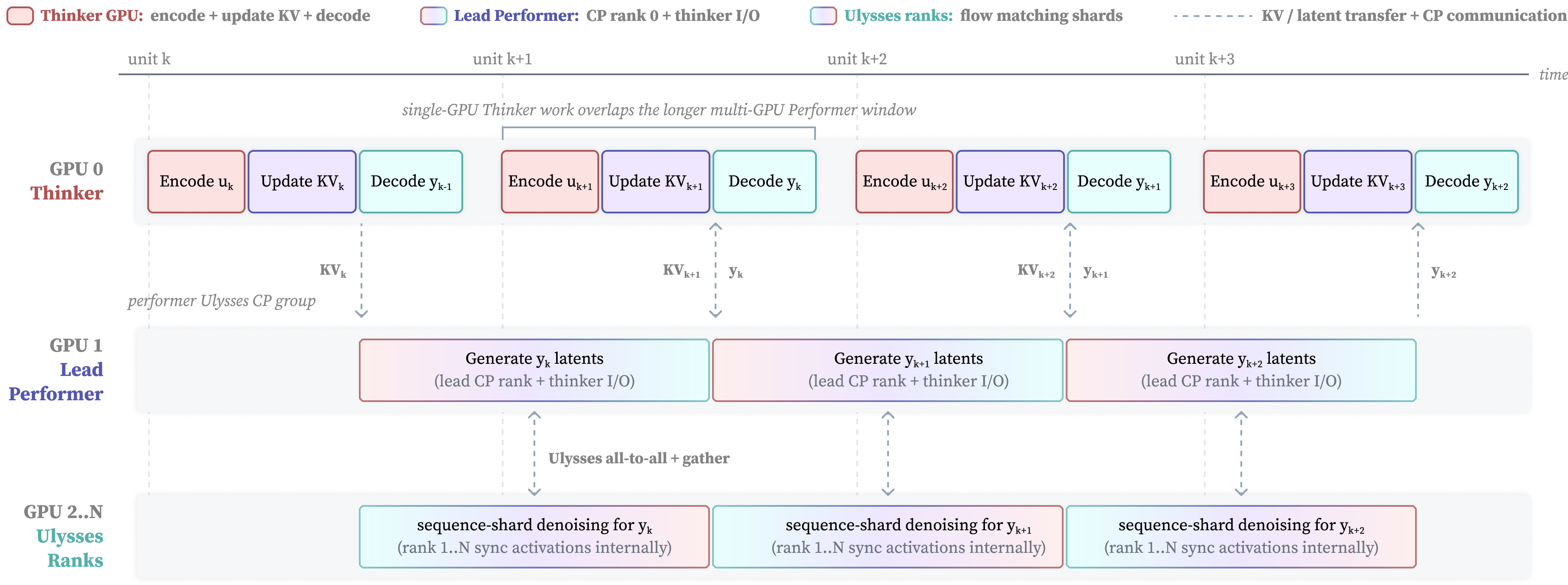
- It introduces a bifurcated Thinker–Performer model where the single-GPU Thinker manages lag-sensitive tasks and the multi-GPU Performer efficiently denoises high-resolution video latents.
- Experimental outcomes show improved legibility of facial expressions and environmental details, enabling more immersive, scene-grounded digital agent interactions.
Wan-Streamer v0.2: Preserving Latency in High-Resolution, Native-Streaming Audio-Visual Dialogue
Wan-Streamer v0.2 advances the paradigm of end-to-end native-streaming multimodal interaction established by v0.1. The architecture frames spoken dialogue, language, and rich visual signals on a shared, block-causal timeline coordinated by a single Transformer. This causal modeling allows audio, video, and linguistic histories to jointly condition agent generation, maintaining tight temporal coherence between modalities during real-time exchange.
In v0.2, the system's output video resolution is elevated from 192×336 to 640×368 at a fixed 25 FPS, targeting a significantly broader and higher-fidelity visual composition. This enhancement preserves posture, hand motion, gaze, physical context, and scene layout, expanding the setting from face-centric, close-up interaction to mid-shot, scene-grounded digital agents. Critically, this upgrade is achieved while maintaining approximately 200 ms model-side signal-to-signal latency.
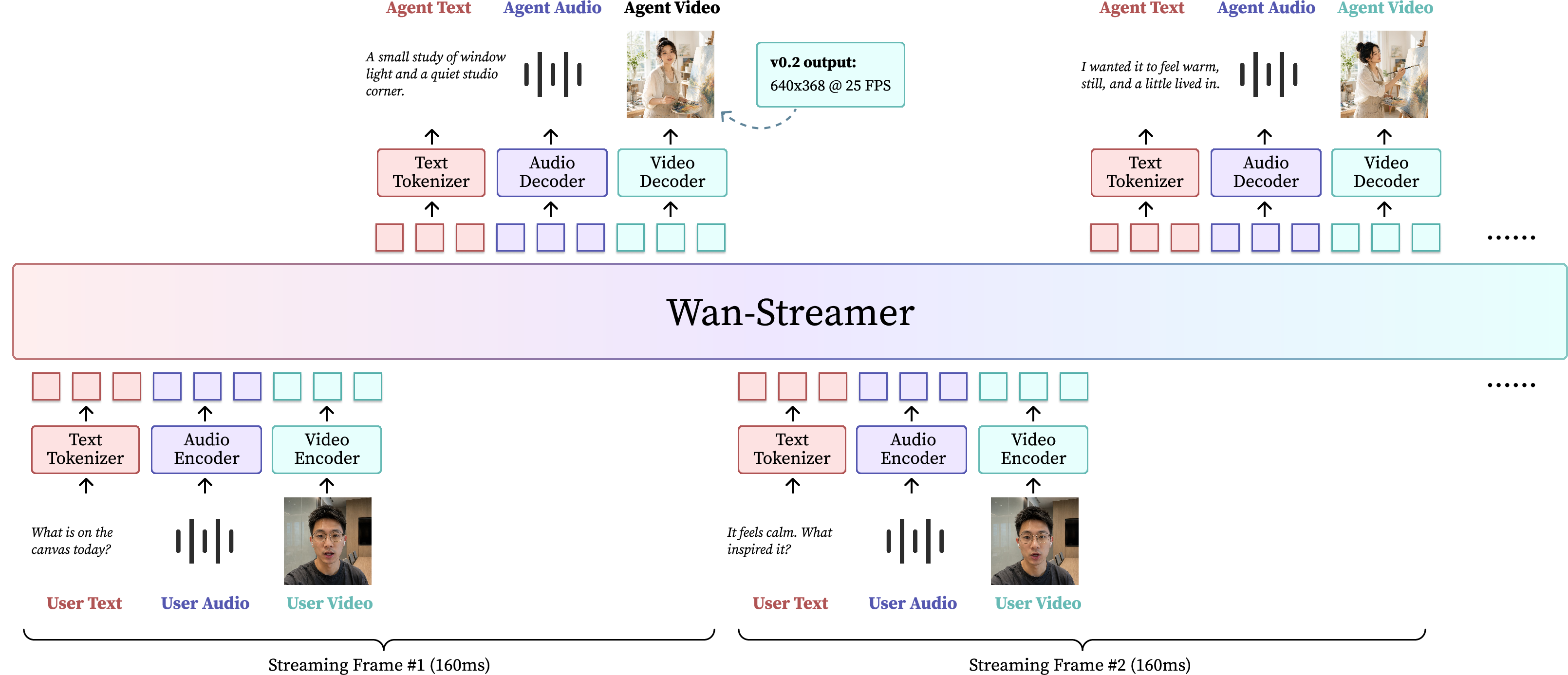
Figure 1: Wan-Streamer architecture; block-causal audio, language, and video states evolve on a unified timeline and are processed via block-causal attention.
Latency-Preserving Infrastructure
Meeting the increased computational cost of high-resolution video generation without degrading responsiveness necessitated a re-architecting of model serving. Wan-Streamer v0.2 bifurcates the model into two optimized paths:
Audio latents, being much shorter, bypass sequence sharding to avoid unnecessary parallelism overhead. Only the video sequence is partitioned for parallel denoising, isolating the computational load and preserving the Thinker–Performer interface as a low-latency boundary. Typical remote interaction latency remains at ≈550 ms when including the same 350 ms bidirectional network budget as previously established in v0.1.
Experimental Outcomes
Evaluations retain the same response boundary definition used in v0.1, isolating model-side processing for fair comparison against latency baselines. Despite the much larger visual output, v0.2 achieves model-side “signal-to-signal” delay near 200 ms at 25 FPS, demonstrating that the serving decomposition and context-parallel denoising approach scale efficiently.
Qualitative inspection of generated 640×368 interaction sequences confirms legibility improvements: facial expression, gaze shifts, manual gestures, and environmental details are all preserved for both listening and speaking states, across typical video-call and mid-shot contexts. The temporal stability of latent generation and decoding avoids artifacts commonly manifest in runtime-constrained, high-resolution synthesis. The richer context enables new forms of situated interaction and embodies a shift towards immersive, conversational AI agents.
Implications and Directions
Wan-Streamer v0.2’s design demonstrates that native-streaming causal modeling and real-time multimodal response can scale to substantially higher visual fidelity without recourse to offline postprocessing or increased perceptual delay. The modular Thinker–Performer split—particularly the isolated, context-parallel Performer path—presents a template for efficiently scaling interactive multimodal agents in both research and deployment.
This work also provides an experimental foundation for direct, fine-grained synchrony of audio, language, and visual modalities over long horizons, relevant for downstream settings such as persistent embodied assistants, digitally mediated telepresence, and interactive human-model world modeling. Future directions will likely include: extension to 3D or world-centric representations, finer control of agent-environment interaction, exploration of more granular agent body/scene state modeling, and throughput scaling for large-population deployment.
Conclusion
Wan-Streamer v0.2 achieves high-resolution (640×368) real-time audio-visual streaming while strictly preserving model-side latency. Through a principled, latency-aware Thinker–Performer decomposition using a Ulysses-style context-parallel group for visual denoising, the system supports scene-grounded, mid-shot digital agents with legible expression, posture, and environmental context. This upgrade establishes a new operational ceiling for low-latency, end-to-end, multimodal interactive models (2607.04443).