- The paper demonstrates a novel, fault-tolerant LLM pipeline that autonomously translates open-corpus research into a publication-grade physics manuscript.
- Methodologically, the pipeline employs fresh-context LLM sessions for numerically anchored calibrations and robust adversarial review across six distinct phases.
- The study validates its approach in altermagnetic piezomagnetism, ensuring high reliability through systematic fault tolerance and minimal human intervention.
Autonomous LLM Pipelines for Grounded Research in Frontier Computational Physics
Introduction and Motivation
The increasing ambition of autonomous research agents leverages LLMs to automate end-to-end scientific pipelines. While prior studies have demonstrated impressive performance in ML-based sandboxes—where agent outputs can be verified directly via execution-calibrated benchmarks—the adaptation of such agents to genuine frontier scientific domains presents distinct challenges. In computational physics, and especially at the research frontier, methodology choices require nuanced physical reasoning, toolchains are often underdocumented, and reliability hinges on external literature calibration rather than empirical execution alone.
The paper "Grounded autonomous research: a fault-tolerant LLM pipeline from corpus to manuscript in frontier computational physics" (2607.02329) addresses these domain-specific challenges by constructing an LLM-driven pipeline that progresses from open-corpus literature exploration to the autonomous production of a publication-grade physics manuscript. The pipeline operates in the context of altermagnetic piezomagnetism, a rapidly evolving subfield in condensed matter physics, demonstrating not only technical automation but also novel fault-tolerance and grounding mechanisms essential for unverifiable, high-stakes scientific research.
Pipeline Architecture and Operation
The architecture encompasses six distinct pipeline phases, each instantiated as fresh-context LLM sessions to guarantee context isolation and prevent cumulative hallucinations or propagation of unchecked claims. The six phases comprise breadth (corpus mapping), depth (research question selection), pilot (methodology anchoring and reproduction), pre-production, production (novel computation), and writing. All phases interface solely via on-disk artifacts, and both curated knowledge and operational "house rules" are structurally incorporated only after prospective research direction has been determined.
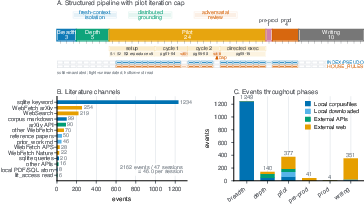
Figure 1: Six-phase pipeline architecture ensures session isolation and enforces literature-grounded workflows, with extensive literature consultation concentrated in conception and calibration phases.
Empirical redundancy is built into the pipeline: independent breadth and depth sampling ensures high complementarity in literature surfacing (only 3.1% overlap in cited arXiv IDs across three breadth subagents), and adversarial review steps are embedded in both calibration and production to maximize the probability of catching errors that escape single LLM session attention.
Literature-Grounded Calibration: From Corpus to Anchoring
Throughout idea conception, the pipeline draws on a curated dataset of over 11,000 recent arXiv papers, utilizing regex-based thematic clustering and diverse retrieval channels. The pipeline operationalizes open-corpus research direction selection: multiple depth programs are generated, each with explicit reproduction targets, and only those with accessible, documented methodology in the literature survive for further validation.
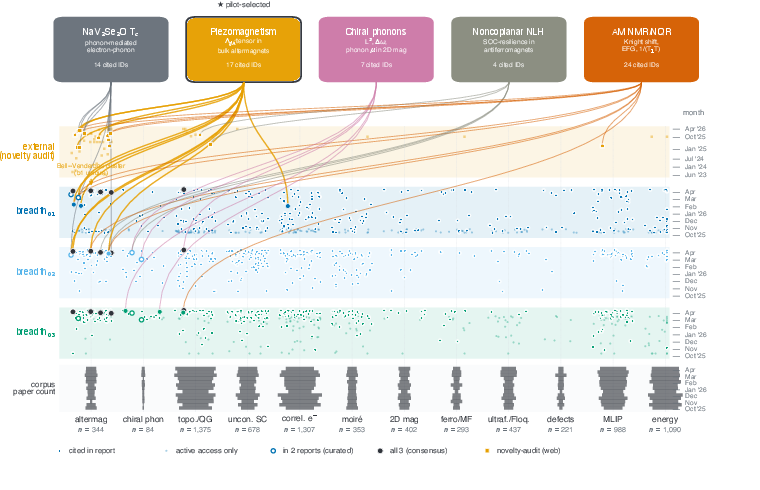
Figure 2: Information flow from the large arXiv corpus through thematic breadth sessions to agent-committed depth programs, visualizing research direction selection and literature anchoring.
Five candidate research programs were independently vetted, including superconducting Tc computations and chiral phonon investigations, but only the program on altermagnetic piezomagnetism passed both literature-anchoring and toolchain-feasibility gates. The pipeline's selection mechanism ensures that only directions with numerically anchorable published results can be pursued, which is crucial for autonomous agents operating at the research frontier.
Pilot Stage: Numerical Confrontation and Fault Tolerance
The pilot stage enacts the principal grounding mechanism. Unlike "citation-based" literature grounding, the pipeline enforces literal numerical confrontation with published values at calibration checkpoints. This is implemented via explicit reference reproduction sessions, bounded review cycles, and a documented verdict taxonomy (T1–T4) assessing agreement strength and calibration fidelity.
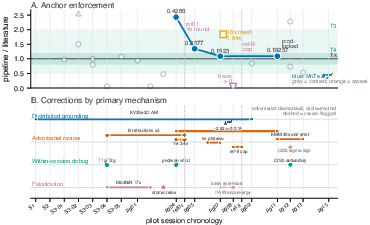
Figure 3: Calibration trajectory in the pilot stage demonstrates adversarial review mechanisms, with session-by-session comparison of agent-computed vs. published anchor values and documentation of error catch episodes.
In detailed case studies, such as the MnTe orbital magnetization calibration, the pipeline surfaced large discrepancies between agent and reference values, retracted overconfident verdicts through adversarial review, and explicitly flagged unresolved convergence and systematic uncertainty via NOT PASS outcomes. Notably, post-hoc human investigation confirmed that the literature anchor itself suffered from hidden convergence issues, vindicating the pipeline's policy of transparency in systematic caveats.
Fault Tolerance and Human Intervention Pattern
Redundant fresh-context sessions, distributed grounding, and adversarial review together underpin fault tolerance, catching both numerical and conceptual errors missed by prior steps. Human intervention, when required, is strictly relegated to offline knowledge base curation—no in-session scientific decisions are made by humans, and all operational interventions are documented. Across the 47 canonical sessions, only nine operational in-session interventions and three knowledge curation edits were necessary, with zero direct scientific or interpretive input.
Empirical Analysis of Grounding and Failure Modes
Two controlled failure mode experiments—(i) a pre-architecture baseline lacking topic-selection grounding, and (ii) a "no-pilot" ablation lacking enforced numerical confrontation—demonstrate the necessity of both topic selection and pilot reproduction as structural mechanisms. In the absence of these phases, agents confidently propagate unreproducible or unanchorable findings, even in the presence of knowledge bases and literature access.
The canonical pipeline, in contrast, achieved literal anchor confrontation across all calibration checkpoints, with all discrepancies and caveats systematically surfaced and reported. This enforces an operationalization of literature grounding that is robust to both agent hallucination and anchor fragility.
Workflow Structuring and Prompt Engineering
The workflow is encoded via explicit, versioned prompt templates for each session type, with numbered task steps, input/output specifications, and detailed disposition criteria. Iteration is restricted to pilot and review cycles to ensure computational tractability and transparency of protocol transitions. Fresh-context isolation is preserved throughout production and writing phases to minimize context leakage and cross-session propagation of unchecked claims.
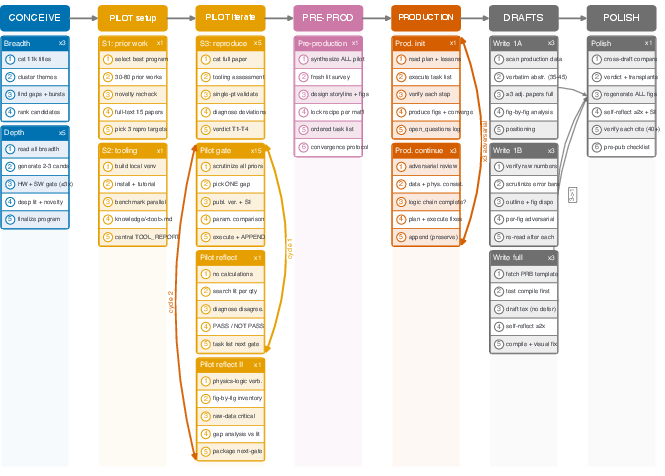
Figure 5: Per-phase workflow diagram illustrates explicit task structure, session parallelization, and adversarial review cycles mandated by prompt templates.
Implications and Future Directions
The work highlights limitations intrinsic to frontier research: scarcity and provisionality of literature anchors, computational cost of multi-trial execution, and the challenge of transitioning from strict reproduction to literature critique when anchor reliability is itself suspect. The structural partitioning between reproduction-anchored creation and execution-grounded critique is identified as the central open problem for future AI-driven autonomous research systems.
Practically, the architecture provides a transferable framework for other high-stakes domains where execution-based calibration is impossible, and external anchors are sparse, unreliable, or in flux. The explicit surfacing of systematic uncertainties and operational caveats, rather than their concealment, sets a critical standard for robustness and transparency in AI-for-science.
Conclusion
This study substantiates the necessity of structurally enforced numerical confrontation with literature anchors and demonstrates that a multi-phase, fault-tolerant LLM pipeline can autonomously generate a publication-grade frontier physics manuscript with limited, well-characterized human intervention. The architecture's commitment to adversarial review, curated operational knowledge, and transparent reporting of calibration caveats lays foundational groundwork for reliable autonomous scientific research well beyond computational physics.
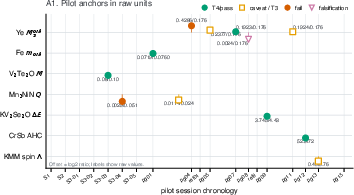
Figure 4: Session-by-session prompt-mandated workflow, displaying linear and cyclical execution flows, and explicit integration of review and writing cycles.