- The paper introduces an autonomous, auditable CFD discovery pipeline that integrates literature mining, source-level code modifications, and visual physics gating.
- It automates rigorous validation using mesh-independence checks and vision-language based assessments to ensure accurate simulation outputs.
- Experimental results show a 7.89% reduction in lower-wall C_f RMSE and effective detection of failure modes, highlighting its value in CFD research.
AI CFD Scientist: Toward Autonomous, Physically-Grounded CFD Discovery via Multimodal AI Agents
Introduction
The paper "AI CFD Scientist: Toward Open-Ended Computational Fluid Dynamics Discovery with Physics-Aware AI Agents" (2605.06607) introduces a comprehensive, open-source agentic framework for automating the full scientific discovery loop in computational fluid dynamics (CFD). Unlike prior AI scientist frameworks designed for software-centric or molecular domains, this system targets the unique requirements of high-fidelity physics simulators, running on top of OpenFOAM, and incorporates domain-specific gates, vision-language modeling (VLM)-based diagnostics, source-level code modification, and manuscript generation in an auditable, modular workflow.
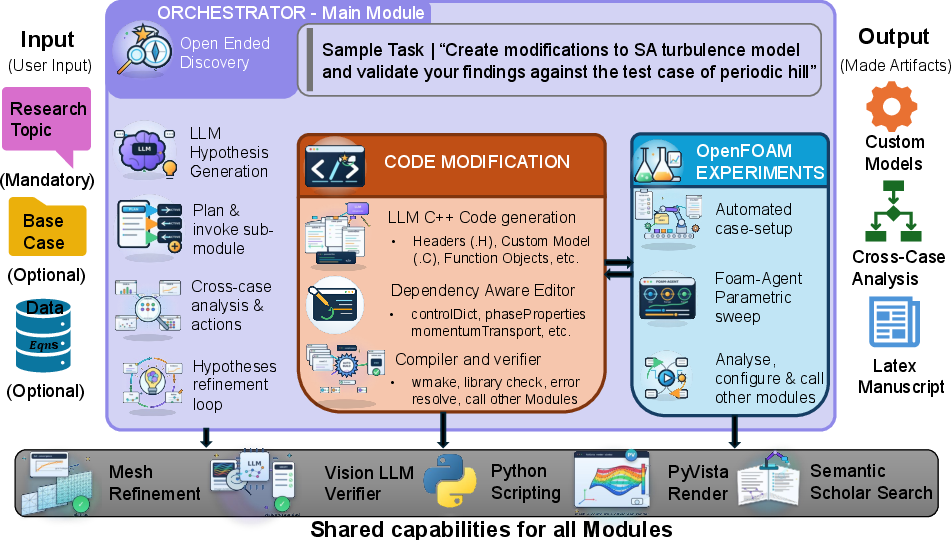
Figure 1: AI CFD Scientist framework: user-specified topics or reference data are transformed through three orchestrated scientific pathways, with vision-based gating and code-level model synthesis as first-class components.
General-purpose LLM-based "AI scientist" systems (e.g., AI Scientist-v2, ARIS, DeepScientist) automate ideation, code, and report generation for machine learning, chemistry, and biology, but are fundamentally limited in CFD by their reliance on tool use and log inspection. Physical validity in CFD cannot be ascertained from solver logs alone, due to mismatches between convergence and physical correctness, mesh dependence, and sensitivity to source-level modeling. Prior CFD-specific systems (e.g., MetaOpenFOAM, turbulence.ai, Foam-Agent) automate parts of the case setup and execution, but do not expose the necessary domain-specific control flow needed to generate defensible scientific claims.
AI CFD Scientist addresses this by integrating literature-grounded ideation, specification validation and repair, mesh-independence gating, code-modification via case-local compilation, vision-language-based physical plausibility gating on rendered field data, and manuscript/figure generation in a unified framework.
System Architecture and Methodology
AI CFD Scientist operationalizes the CFD discovery pipeline via a set of modular, structured agents, implemented in both LangGraph and skill-based forms. The architecture is characterized by three coupled experimentation pathways:
- Regular experimentation: Literature mining, novelty filtering, and experiment specification are followed by automated simulation and validation, with strict requirement and mesh-independence gates prior to postprocessing or claim generation.
- Code modification: Where needed, the agent synthesizes, compiles, and tests case-local C++ model libraries, allowing the hypothesis space to include arbitrary source-level closure modifications.
- Open-ended discovery: An autonomous, outer-loop hypothesis engine iteratively proposes parameter or source-level edits, scores each candidate against reference data, and iterates until an improved model is found. Iterative improvement is checkpointed and gated via field-level, vision-language-based decisions.
A central VLM physics-verification gate is critical: after each run, rendered flow fields are inspected by a vision-LLM for physical plausibility and alignment with the requirement—accepting, rerunning, or aborting as needed. This pipeline enforces strict separation between solver completion and physical validity.
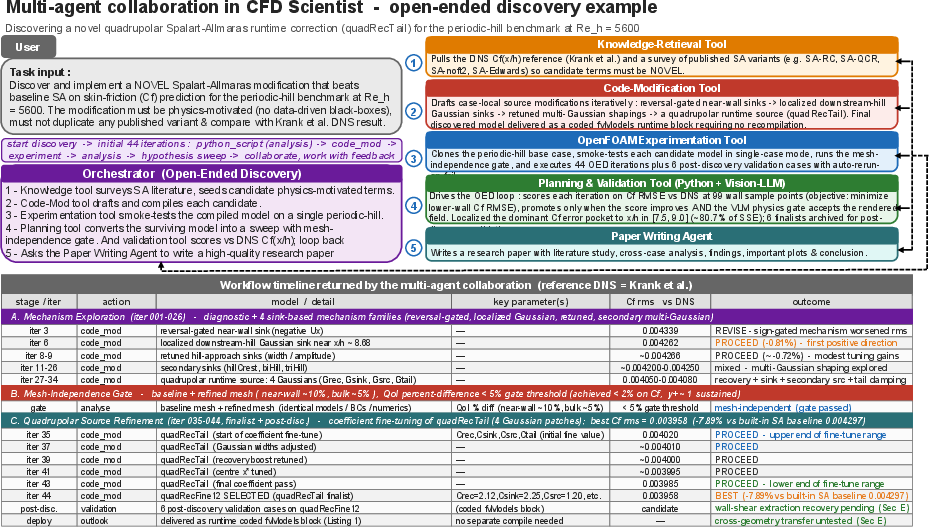
Figure 2: The open-ended discovery (OED) pathway: hypothesis generation, source-code modification, execution, mesh-independence validation, visual physics gating, and reporting are orchestrated in an iterative, checkpointed loop.
Experimental Results and Benchmarking
The system is evaluated on five representative CFD tasks, parsed into three major categories aligning with its pathways:
- Regular experimentation: Backward-facing step turbulence-model sensitivity (Reh=25,400) and jet/plume Reynolds-number sweeps verified the system's ability to manage parameterized studies, mesh-independence, and anomaly flagging.
- Code modification: For cases such as non-Newtonian viscosity on a channel and customized Spalart-Allmaras (SA) turbulence closures in periodic hill geometries, the agent autonomously generated, compiled, and validated custom C++ models, performing cross-case validation including Newtonian degeneracy and APG-modified terms.
- Open-ended discovery: The agent autonomously identified a quadrupolar, spatially-varying modification to the SA turbulence model that reduced lower-wall Cf RMSE against DNS reference by 7.89% (0.004297↦0.003958) after 44 iterations.
Key technical claims and numerical results:
- The VLM gate detected $14/16$ planted silent failures, demonstrating sensitivity to failure modes not apparent in solver logs or via standard numerical checks.
- In comparative studies under equal LLM cost envelopes, AI CFD Scientist uniquely provided mesh-independence gating, source-level editing with control-case validation, VLM-based discard of physically invalid outputs, and figure-grounded manuscript drafting. By contrast, ARIS and DeepScientist executed partial CFD workflows but systematically failed to enforce scientific validity in the absence of these gates.
Analysis of Domain-Specific Control Flow
The core contribution is not “just” automation of simulation or code generation, but closing the scientific claim-production loop with explicit, auditable, physically-grounded control flow. The framework triages numerical, evidential, and narrative failure modes at distinct stages, ensuring that a simulation is only advanced for analysis, and only claims are made, when all validity gates—especially human-interpretable field-visualization gates—are passed.
For open-ended discovery, the agent's ability to autonomously explore, script, compile, and score arbitrary modifications, using reference comparators and gated visual analysis, establishes a robust template for agentic scientific research in domains that fundamentally require multi-modal (text, code, and physics-informed vision) oversight.
Implications and Future Directions
From a practical perspective, AI CFD Scientist's approach enables reliable, auditable, high-fidelity CFD research automation, potentially accelerating hypothesis exploration, closure-model development, and systematic code testing. The explicit separation and automation of mesh independence and visual plausibility as gating steps mark a paradigm shift from generic LLM-based tool use to domain-native scientific agents. The framework's modularity (e.g., reusable VLM gates and orchestration primitives) suggests transferability to adjacent fields (structural mechanics, multiphase flows, etc.) where physical validity is likewise not text-equivalent.
Theoretically, the integration of multi-modal validation and source-level hypothesis generation closes critical gaps in self-driving laboratory analogues for computational physical sciences. However, remaining limitations — e.g., dependence on VLM robustness, current lack of automated rubrics for scientific artifact quality, and the need for further tests on generalization and transfer — constrain unsupervised deployment.
Conclusion
AI CFD Scientist establishes a new baseline for autonomous, physically-defensible CFD research automation, integrating literature mining, code and simulation management, mesh-convergence studies, vision-language-based output validation, and scientific manuscript generation in an auditable, extensible agentic framework (2605.06607). Empirical evaluations demonstrate robust handling of critical physics-driven failure modes and substantiate the necessity of domain-specific gates for moving beyond automation of CFD execution to the autonomous synthesis of scientific claims. The artifact is released open-source, providing a foundation for future research in agentic automation of the physical sciences.

