- The paper introduces AnchorSplat, a 3D-native architecture that refines 3D Gaussian Splatting assets using a point anchor mechanism and an equivalent densification strategy.
- It bypasses multi-stage 2D refinement by achieving state-of-the-art metrics (PSNR 36.57, SSIM 0.943, LPIPS 0.058) in just 0.01 s per asset.
- The method’s source-free, computationally efficient design ensures robust generalization across diverse scenes while restoring high-frequency details.
AnchorSplat: Fast and Structure-Consistent Detail Synthesis for 3D Gaussian Splatting
Motivation and Problem Setting
3D Gaussian Splatting (3DGS) has rapidly emerged as a competitive explicit scene representation for real-time view synthesis, capable of high-fidelity rendering. However, assets reconstructed from low-resolution or limited view inputs typically suffer from sparse geometric density, missing high-frequency details, and visible texture noise. Existing 3D super-resolution (3DSR) approaches mainly rely on 2D image-based refinements followed by 3D re-optimization, introducing multi-view inconsistencies, domain gaps, and substantial computational overhead.
A critical limitation in current methodologies is the absence of a 3D-native, efficient, and strictly source-free solution: a system capable of directly enhancing a pre-existing low-quality 3DGS asset without access to the original multi-view images. AnchorSplat directly addresses this gap by establishing a single-stage, end-to-end network for structure-aware, efficient 3DGS refinement that bypasses the limitations of iterative optimization or 2D conversion.
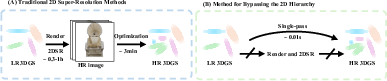
Figure 1: Comparison of the traditional 2D-centric pipeline (A) and the proposed 3D-native AnchorSplat paradigm (B).
AnchorSplat Architecture
AnchorSplat processes the input 3DGS asset in its native 3D domain using a highly efficient feed-forward network, eliminating expensive multi-stage processing. The architecture comprises three principal components:
- 3DGS Feature Encoder: Encodes each Gaussian primitive based on its non-spatial attributes, forming point-wise high-dimensional features. This encoder, instantiated using PTv3, aggregates local geometric and attribute context directly from the unstructured point cloud.
- Point Anchor Mechanism: Imposes a local geometric constraint by generating new, detail-enhanced primitives as local, learned offsets from each anchor point, ensuring that per-point features only influence their immediate vicinity and therefore enforce 3D spatial consistency. This directly addresses the significant gradient confounding inherent in unconstrained 3D prediction.
- Equivalent Densification Mechanism: Achieves asset densification in a single pass by generating multiple (K) primitives per anchor feature, substituting iterative splitting/cloning and supporting simultaneous soft pruning via learnable opacity predictions.
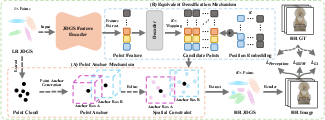
Figure 2: Schematic of the AnchorSplat network: localized refinement via the Point Anchor Mechanism and multiplicative primitive generation using a learnable decoder.
The network is optimized end-to-end using a composite loss integrating pixel-level, structural, and perceptual terms, ensuring both photometric alignment and perceptual quality.
Theoretical Underpinnings
A central innovation in AnchorSplat is the meticulous treatment of the ill-posed mapping from unstructured feature vectors to unconstrained 3D primitives. By constraining the generation domain of new primitives spatially around each anchor (Equation 3 in the paper), AnchorSplat eliminates ambiguous gradient flow and ensures each local feature exclusively governs dense, high-fidelity detail within its geometric neighborhood. This is analytically shown to resolve the confounded learning dynamics present in previous unconstrained 3D generative strategies.
3DGS-SR: A Benchmark for 3D Gaussian Super-Resolution
AnchorSplat is benchmarked on 3DGS-SR, a newly proposed large-scale dataset specifically constructed for 3D asset enhancement rather than reconstruction-from-scratch. Each example consists of paired low-quality 3DGS assets and high-resolution ground truth renders, permitting precise quantitative and qualitative evaluation of various 3DSR paradigms.
Experimental Results
Quantitative and Qualitative Analysis
AnchorSplat delivers state-of-the-art results on 3DGS-SR, outstripping prior 2D- and video-based optimization pipelines in both fidelity and efficiency. It achieves a processing throughput of up to 105 times faster than optimization-based baselines while surpassing them on all key perceptual and pixel-level metrics.
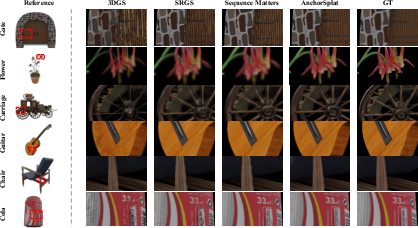
Figure 3: Visual comparison of super-resolved scenes. 2D-based methods yield artifacts and oversmoothing; AnchorSplat restores fine details and edge consistency.
Notable empirical observations include:
- PSNR of 36.57, SSIM of 0.943, and LPIPS of 0.058 on 3DGS-SR, with mere 0.01 s processing time per asset.
- Significant qualitative improvements in geometric edge sharpness and high-frequency texture restoration, confirming multi-view consistency improvements over 2D-native approaches.
Ablation Studies
Comprehensive ablations substantiate the necessity of both core mechanisms:
- Omission of the Point Anchor Mechanism causes sharp performance collapse (e.g., PSNR drops by almost 10 dB), illustrating its indispensability for stable, high-fidelity synthesis.
- Higher multiplicative primitive factors (K) in the densification mechanism yield incrementally richer geometric and textural detail, with diminishing returns for K > 20.
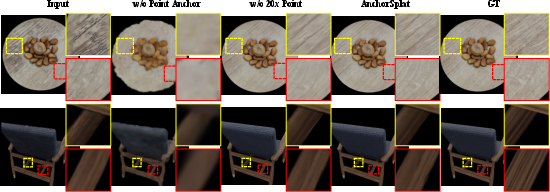
Figure 4: Ablation on (left) the Point Anchor Mechanism and (right) primitive multiplicity; local geometric constraint and higher density are both essential for detail fidelity.
Zero-shot Generalization
AnchorSplat generalizes robustly to previously unseen input domains without fine-tuning. It serves as an effective plug-and-play enhancer for outputs of 3D generative models (e.g., Trellis, LGM) and challenging, noisy real-world scans, consistently sharpening structural boundaries and restoring high-frequency detail unattainable with conventional pipelines.
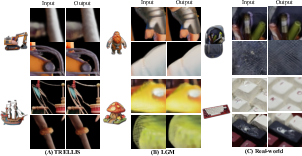
Figure 5: Zero-shot enhancement on diverse scenes, including Trellis and LGM outputs and real-world 3D captures, demonstrating cross-domain efficacy.
Practical and Theoretical Implications
AnchorSplat's architecture exhibits several important implications:
- Strict Source-Free Operation: The method does not require access to original multi-view images, making it practical for industry scenarios and downstream generative pipelines.
- Data-Agnostic Geometric Priors: The network leverages local geometric context to learn robust priors, enabling cross-domain generalization and eliminating overfitting to specific lighting or appearance representations.
- Computational Efficiency: Single-pass design and point-local constraint obliterate the need for per-scene optimization, supporting massive throughput scaling for asset libraries, interactive systems, or online 3D content platforms.
On the theoretical front, the explicit encoding of local geometric correspondence via the Point Anchor Mechanism may inform the design of future 3D asset refinement frameworks that require stability and spatial consistency across unconstrained scenes, and suggests the utility of learned, geometry-tied anchors for other high-dimensional, spatially-structured prediction tasks.
Prospects for Future Research
AnchorSplat paves the way for efficient, structure-preserving 3D enhancement modules compatible with rapidly-proliferating 3D generative models. Key open directions include:
- Extending to temporal or dynamic 3DGS sequences for high-resolution 4D asset refinement.
- Integrating semantic guidance or conditional priors for task-specific restoration.
- Joint learning with upstream generative models for unified asset pipelines.
- Investigating local-global coupling to further enhance cross-part consistency and handle extremely sparse or noisy initializations.
Conclusion
AnchorSplat introduces a principled, 3D-native paradigm for detail synthesis in 3D Gaussian Splatting. By resolving fundamental optimization ambiguities and replacing iterative densification with a direct, local, and feed-forward approach, AnchorSplat delivers superior fidelity and orders-of-magnitude improvements in computational throughput. The method generalizes effectively across domains, requiring only the raw 3D asset, and establishes a new benchmark in 3D asset enhancement for both research and practical deployment.