- The paper introduces a self-supervised pipeline (CORGI) that generates high-fidelity, animatable 3D dog models from a single in-the-wild image.
- It employs a two-stage generative process with CDOG for canonical pose normalization and CA-3DGS for enforcing multi-view geometric consistency.
- DCGR integrates a LoRA-augmented diffusion denoiser to repair cross-view inconsistencies, achieving superior metrics in PSNR, SSIM, LPIPS, FID, NIQE, and CLIP scores.
Consistency-Aware High-Fidelity 3D Dog Reconstruction from a Single In-the-Wild Image: The CORGI Framework
Introduction and Motivation
Recovering high-fidelity, animatable 3D models of complex, highly articulated animals such as dogs from a single unconstrained image is an ill-posed challenge central to computer vision and graphics. Existing techniques are constrained by the lack of in-the-wild multi-view captures and paired 3D supervision, leading to limited geometric expressivity and inconsistent reconstructions, especially for animals exhibiting wide inter-breed variation and non-rigid motion. The CORGI framework introduces a comprehensive and entirely self-supervised pipeline to address these bottlenecks, explicitly targeting realistic, animatable, and identity-preserving 3D dog reconstructions from a single photo, with a systematic architecture for handling generative inconsistencies and lifting 2D priors to robust 3D representations.
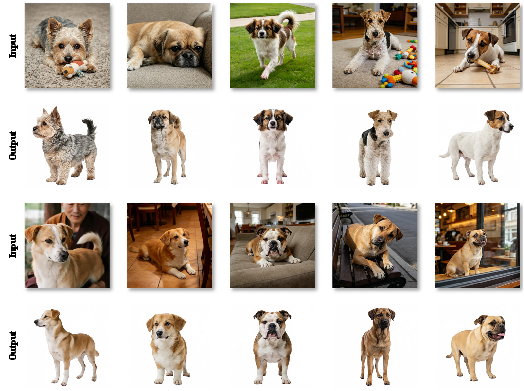
Figure 1: CORGI reconstructs a high-fidelity 3DGS dog in canonical pose from a single image in the wild.
Core Pipeline Architecture
Canonical-Driven Orbital Generation (CDOG)
CORGI employs a two-stage generative strategy to transform an arbitrary input image into a structured multi-view orbital sequence suitable for 3D optimization. First, it normalizes the input into a canonical standing pose using a fine-tuned LoRA injection into a large-scale image editing backbone, curated by self-supervised paired data that disentangles identity from pose and background. Second, with a custom-trained orbital video generation LoRA on an I2V model, CORGI produces a dense, cyclic 360-degree pseudo-multi-view video trajectory, decoupling the geometric prior of the camera path from dog-specific appearance.
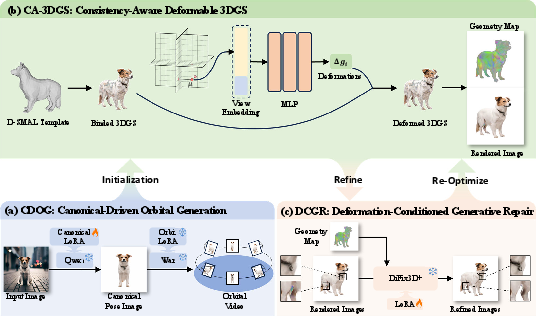
Figure 2: The architecture: CDOG synthesizes a canonical pose then a 360° multi-view video; CA-3DGS lifts these views into a deformable, D-SMAL-anchored 3DGS; DCGR conditions a diffusion model to repair artifacts and recover detail.
This approach establishes spatial and articulatory normalization without reliance on ground-truth 3D supervision or heuristic prompt engineering, generating multi-view consistency essential for high-quality 3D optimization.
Synthesized pseudo-multi-view sequences are prone to local generative inconsistencies such as geometric drift and texture flicker. CORGI counters this via CA-3DGS, which anchors 3D Gaussian primitives to a D-SMAL canine template and leverages dense multi-view alignment (COLMAP-based camera estimation and BITE-based kinematic parameter initialization). Neural deformation fields, parameterized using triplane features and MLP regressors, learn per-view attribute offsets for every Gaussian. This disentangles canonical geometry from view-dependent generative noise, enforcing spatial coherence and supporting vertex-level subject-specific deformations for fine-scale details. The system is regularized by as-rigid-as-possible (ARAP) energy terms for local structural stability and further constrained by mask- and keypoint-based losses for silhouette and articulation fidelity.
To mitigate residual cross-view inconsistencies and hallucinated artifacts, the pipeline integrates a self-supervised diffusion-guided repair module. Utilizing the geometry-aware conditioning (dense deformation maps projected onto each rendered view) and appearance anchors (original input photo), CORGI leverages a LoRA-augmented diffusion denoiser (DiFix3D+) within an iterative closed-loop: each refinement round involves rendering from the CA-3DGS (with frozen deformation to the reference view), repairing each view via diffusion, and using these repaired observations to re-optimize the 3DGS. This process yields convergence to artifact-free, visually sharp, and geometrically consistent 3D representations suitable for downstream animation.
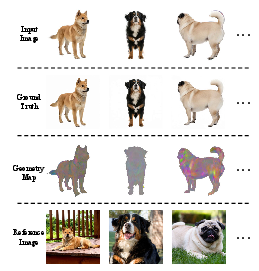
Figure 3: Dataset creation process, including rendered input, pseudo ground truth, geometry-aware condition, and original image as appearance reference.
Quantitative and Qualitative Analysis
Empirical evaluations against leading single-image and multi-image 3D reconstruction baselines demonstrate the robust performance of CORGI:
- On synthetic test sets, CORGI achieves highest PSNR (14.309), second-highest SSIM (0.836), and superior LPIPS (0.236), outperforming regression, multi-view diffusion, and native 3D generative baselines, validating its strict geometric consistency and detail preservation.
- For in-the-wild real photographs, CORGI yields the lowest FID (13.477) and NIQE (6.515) scores and the highest CLIP-based identity similarity (0.800), establishing efficacy in domain generalization, photorealism, and input identity preservation.
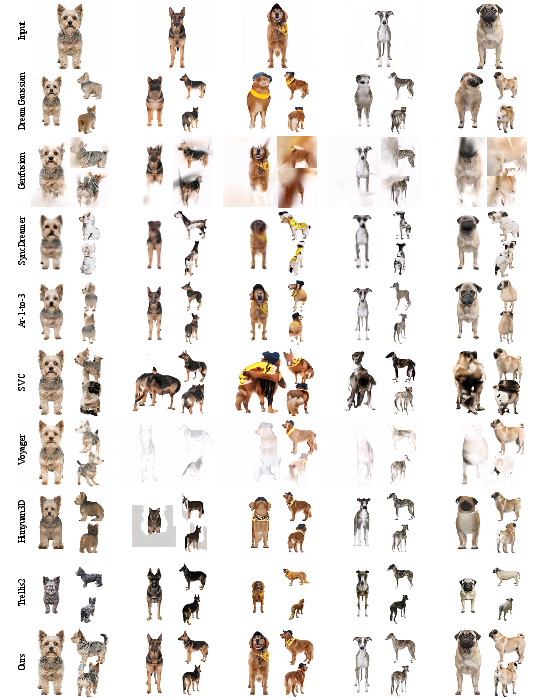
Figure 4: Qualitative comparison versus baselines on in-the-wild dog images, with CORGI demonstrating superior geometric integrity and texture fidelity.
Qualitative results illustrate CORGI's resilience to occlusions, fur texture preservation, and structural complexity compared to methods that either collapse geometrically (standard image-to-Gaussian and multi-view diffusion approaches) or exhibit “template bias” (native 3D generative methods).
Application: Animatable 3D Models
By explicitly attaching optimized 3D Gaussians to D-SMAL template surfaces, CORGI facilitates rigorous canonicalization (via reverse LBS), enabling seamless transfer and animation in arbitrary pose spaces with forward LBS. The resulting assets support complex, identity-preserving dog articulated motions, free from geometric tearing or floating artifacts, with high-frequency detail retention critical for realistic digital content creation.
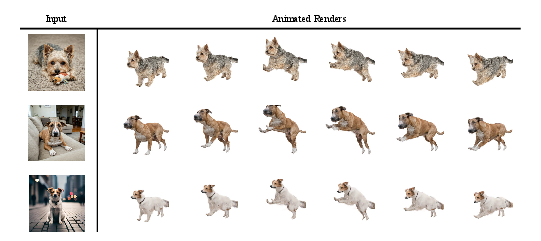
Figure 5: Pose-driven animation; CORGI models perform complex motions while preserving identity, detail, and structure.
Ablation Study
Incremental ablation confirms the necessity of each core architectural contribution:
- Adding the view-dependent deformation field eliminates structural ghosting and resolves optimization conflicts from multi-view generative inconsistencies.
- Geometry-aware, LoRA-tuned diffusion repair effectively removes domain adaptation failures of off-the-shelf 2D repair priors.
- Iterative self-refinement is required to propagate fine details and guarantee strict multi-view spatial consistency, yielding optimal FID/NIQE/CLIP metrics.
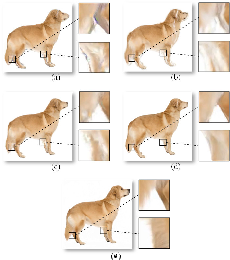
Figure 6: Progressive qualitative ablation: each step resolves a distinct visual or structural deficiency, culminating in the artifact-free full model.
Theoretical and Practical Implications
CORGI demonstrates that large-scale generative 2D diffusion models, even for non-cooperative, highly articulated animal domains, can be systematically adapted to support physically consistent and animatable 3D asset creation—fully circumventing the need for paired 3D supervision. Its architecture showcases the value of explicitly modeling cross-view generative errors and integrating geometry-aware repair modules. The pipeline is immediately generalizable to other animal categories and provides a template for scalable generation-then-reconstruction pipelines, unifying the advances in 2D generative modeling with rigorous 3D geometry optimization.
Conclusion
CORGI establishes a milestone in single-image animal 3D reconstruction by bridging generative 2D priors, template-constrained geometry, and self-supervised multi-modal repairs. Its robust animatable, high-fidelity outputs, strong generalization across breeds and poses, and elimination of 3D ground-truth constraints mark it as a key advance for practical animal digitization and high-end digital content production.
(2607.00321)