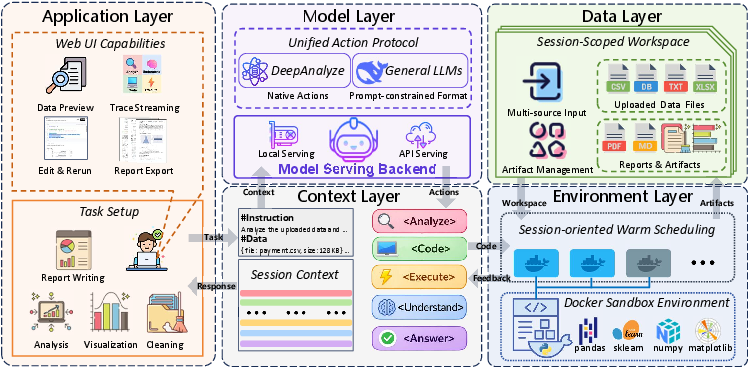
- The paper introduces DA-Studio, an autonomous system that organizes data analysis via a five-layer architecture to ensure execution-grounded workflows and inspectable artifacts.
- It employs a structured action protocol to seamlessly integrate planning, code generation, and execution, thereby enhancing transparency and modifiability.
- The system’s sandboxed execution and detailed artifact management facilitate error correction and reproducibility in complex real-world data analysis.
DA-Studio: Agentic System Design for Autonomous, Execution-Grounded Data Analysis
Motivation and Positioning
Modern data analysis workflows operate over heterogeneous datasets and require multi-step pipelines encompassing planning, data inspection, preprocessing, modeling, visualization, and interpretation. Despite advances in LLM-assisted analysis tools such as "LIDA" [lida], "Data Formulator 2" [dataformulator2], and "nvAgent" [nvagent], most systems remain focused on discrete subtasks like visualization or query generation, lacking integrated support for end-to-end, execution-grounded analysis. DA-Studio directly addresses this gap by providing an agentic system that autonomously organizes analysis actions, executes generated code in an isolated environment, and maintains high inspectability of every intermediate artifact and action trace.
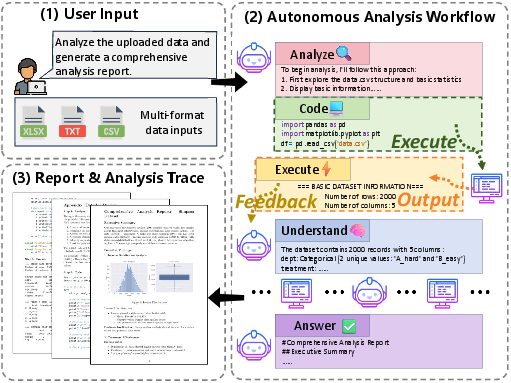
Figure 1: Overview of DA-Studio’s orchestrated agentic workflow with structured analysis actions, sandboxed code execution, execution feedback, and evolving artifacts.
Five-Layer System Architecture
DA-Studio organizes its capabilities in a five-layer architecture unified by three functional views: inspectable interaction, autonomous multi-step analysis, and sandboxed execution.
Interactive Protocol and Execution-Grounded Workflow
DA-Studio exposes the analysis trace and artifacts to the user in real time, supporting full inspectability and correction. The system leverages a structured action protocol to drive agentic analysis, dynamically selecting among planning, inspection, code generation, execution, interpretation, and answer formulation. The frontend reveals streamed action blocks and execution results, while the workspace area exposes produced artifacts for preview and download.
Session isolation, editable code blocks, and rerunnable scripts allow users to intervene post-execution, correcting errors or adapting generated pipelines without restarting from scratch. The export subsystem consolidates analysis traces, artifacts, and final reports for downstream use.
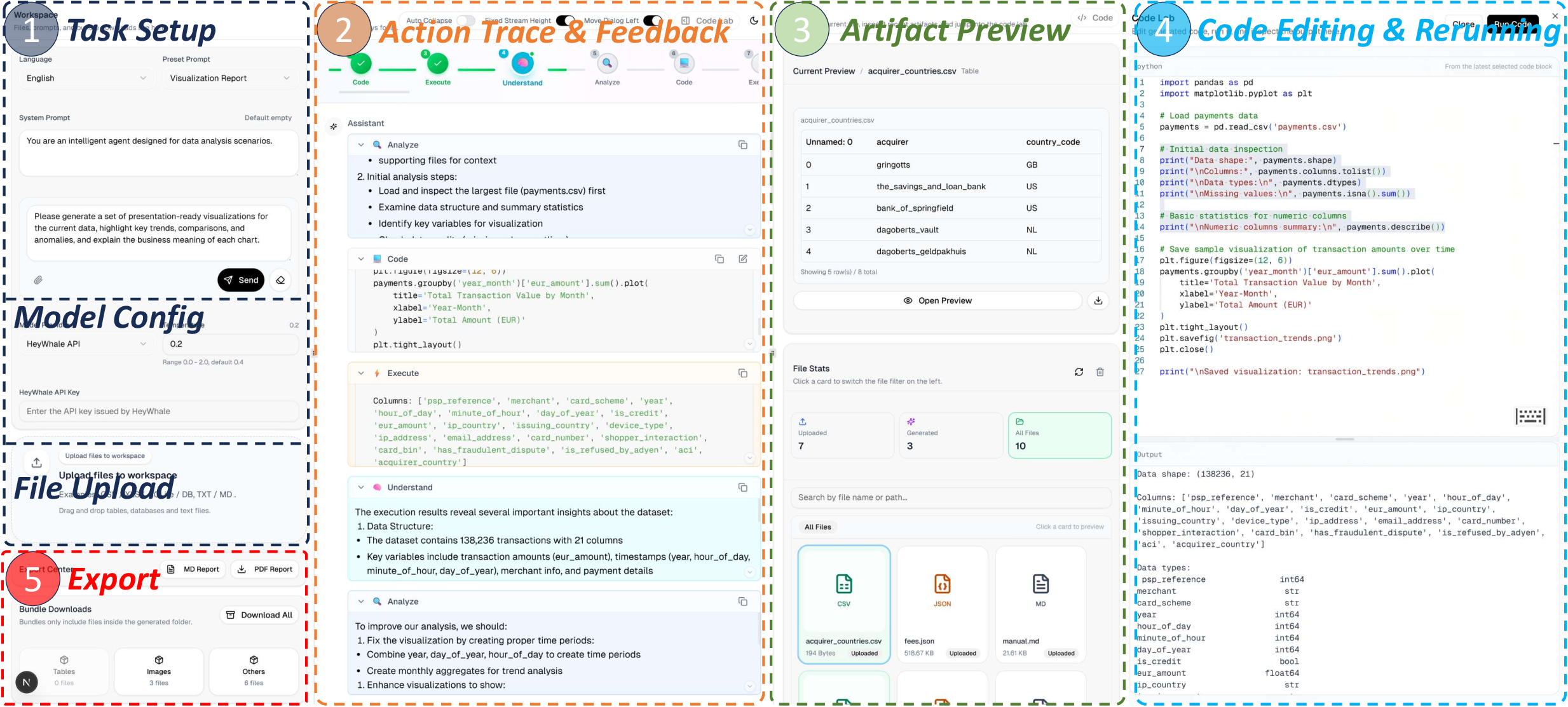
Figure 3: DA-Studio interface screenshot showing session setup, streamed trace, artifact preview, code revision, and export options during a merchant-payment analysis task.
Demonstration and Practical Use Cases
The demonstration workflow illustrates DA-Studio's agentic capabilities:
- Task setup: User uploads heterogeneous files (CSV, JSON, MD) and specifies an analysis request in natural language, optionally tuning system prompt, temperature, and model selection.
- Analysis trace: System iteratively plans (<Analyze>), generates code (<Code>), executes scripts (<Execute>), interprets outputs (<Understand>), and continues refining the workflow, revealing each stage as it unfolds.
- Artifact management: Workspace exposes both input and derived files; artifacts can be browsed, previewed, and exported.
- Intervention: Code blocks are editable and rerunnable, supporting targeted corrections and adaptation.
- Export: Final reports and bundled artifacts are exported in Markdown/PDF, preserving the full trace and outputs for reproducibility.
This fully integrated, execution-grounded workflow positions DA-Studio as a practical solution for autonomous data analysis in complex, real-world settings.
Implications and Future Directions
DA-Studio’s architecture and operational protocol establish a template for inspectable, agent-driven data analysis systems. Compared to prior LLM-powered tools, DA-Studio offers strong improvements in transparency, artifact management, and modifiability. By normalizing agent actions across both specialized and general LLMs, the system can generalize to diverse analysis scenarios without manual pipeline specification.
Promising directions include integrating advanced model selection and orchestration strategies (e.g., hierarchical agent teams or dynamic tool selection), scaling to larger datasets via context-aware retrieval, and improving sandbox security and resource management. Extensive artifact tracing and bundled export will facilitate reproducibility and downstream reuse in collaborative environments.
Conclusion
DA-Studio represents a comprehensive agentic system for autonomous, execution-grounded, and inspectable data analysis. Its modular multi-layer architecture, structured action protocol, sandboxed execution model, and frontend supporting intervention and trace inspection collectively deliver a practical environment for real-world data analysis workflows. The system advances the state-of-the-art in execution-grounded analysis, offering clear paths for extensibility and integration with future advances in agent models and orchestration frameworks (2606.31423).