- The paper introduces a hybrid re-rooting and component repair algorithm that minimizes repair edges by relocating faults to boundary nodes in dense Gaussian networks.
- It employs constant-time candidate-generation and efficient coordinate exclusion tests to optimize recovery operations for both node and link failures.
- Empirical evaluations show near-100% recovery rates and drastic reductions in repair-edge requirements, demonstrating its practical viability for NoC deployments.
Re-Rooting-Assisted Edge-Minimum Runtime Repair in Dense Gaussian Broadcast Networks
Introduction and Motivation
Dense Gaussian networks—degree-four algebraic interconnection networks with compact diameter and coordinate-based routing—are fundamental in parallel processors, NoC fabrics, and distributed accelerators, especially for one-to-all broadcast primitives. Their canonical broadcast trees are optimally shallow but exhibit fragility under node faults, link faults, and propagation-discovered failures. This work formalizes and solves the runtime recovery problem for such networks, addressing static node/link faults, mixed fault regimes, and runtime-discovered single-link failures. The principal algorithm orchestrates a re-rooting procedure to relocate the source, thus reducing damage by placing known node faults as leaves, followed by component repair that connects the resulting healthy fragments with the minimum necessary number of external repair edges.
The Dense Gaussian Model and Broadcast Trees
Dense Gaussian networks parameterized by k possess N=2k2+2k+1 nodes with coordinate mapping onto the Manhattan ball Bk={(x,y)∈Z2:∣x∣+∣y∣≤k}, supporting deterministic diameter-level broadcast trees. The parent relationship in the broadcast tree decreases ∣x∣+∣y∣ via algebraic generator moves (±k, ±(k+1)).
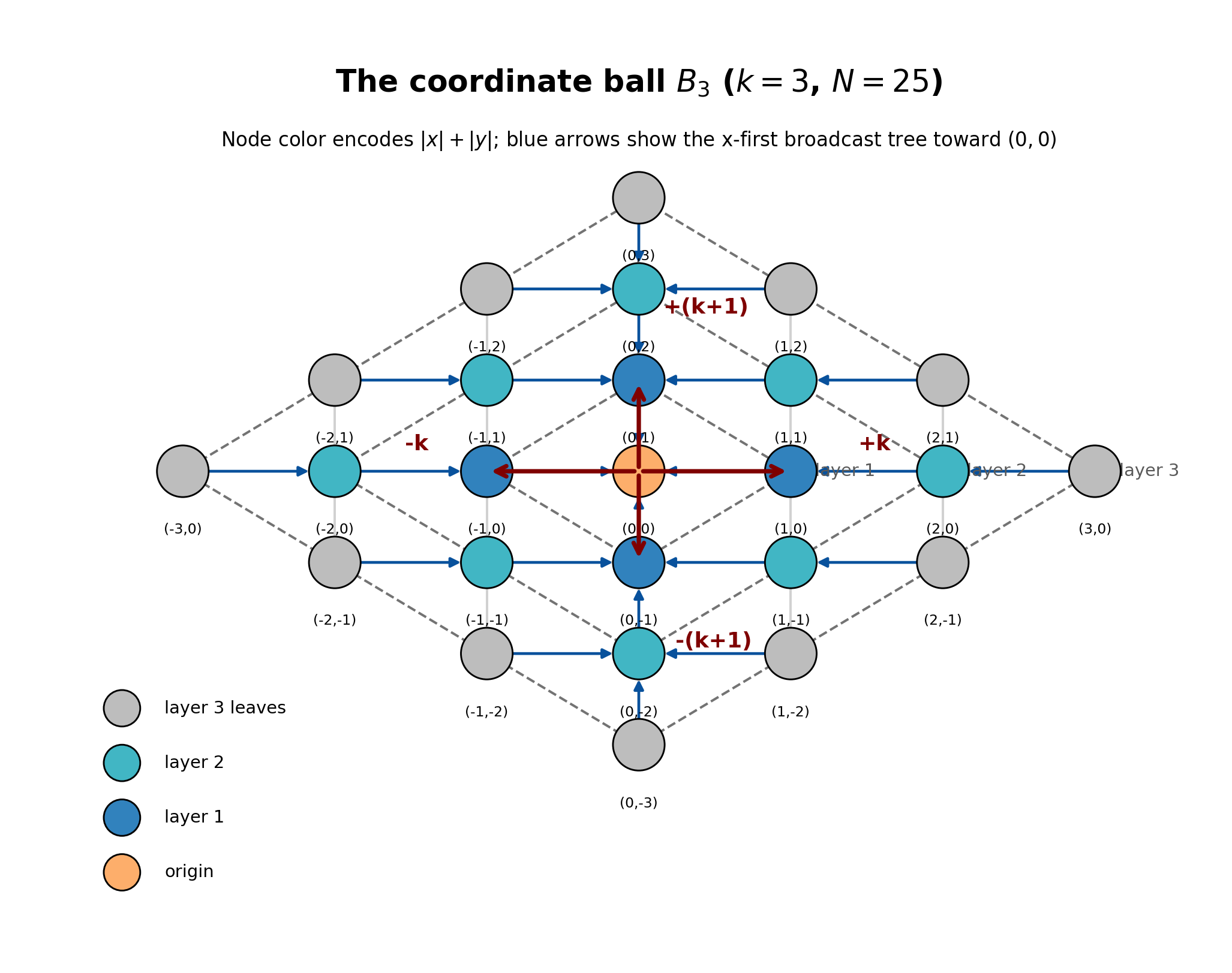
Figure 1: The coordinate ball B3 (k=3, N=25), node color encodes layer ∣x∣+∣y∣; arrows show x-first broadcast tree rooted at N=2k2+2k+10.
Broadcast trees rooted at a selected node ensure concise delivery structures, with boundary nodes acting as leaves. This geometric arrangement is pivotal for re-rooting under node faults: placing faults at the boundary obviates the need for exceptional forwarding rules.
Joint Node/Link Fault Recovery via Re-Rooting and Component Repair
Traditional recovery mechanisms—static re-rooting or component repair—are insufficient in isolation for runtime node/link failures. Static re-rooting places one or two faults as leaves but does not repair residual failed tree links or handle high-order cuts. Component repair, while effective for fixed sources, relies on post-fault component graph connectivity and can incur substantial repair-edge cost.
This paper's approach first selects a damage-minimizing root—preferably one that places as many faults as possible on the boundary—then prunes failed nodes and links, forming healthy components. The induced component graph N=2k2+2k+11 is constructed, and if connected, exactly N=2k2+2k+12 component-crossing repair edges are both necessary and sufficient, irrespective of fault complexity. Crucially, the method proves deterministic single-link repair and offers rigorous bounds on component fragmentation and repair cost.
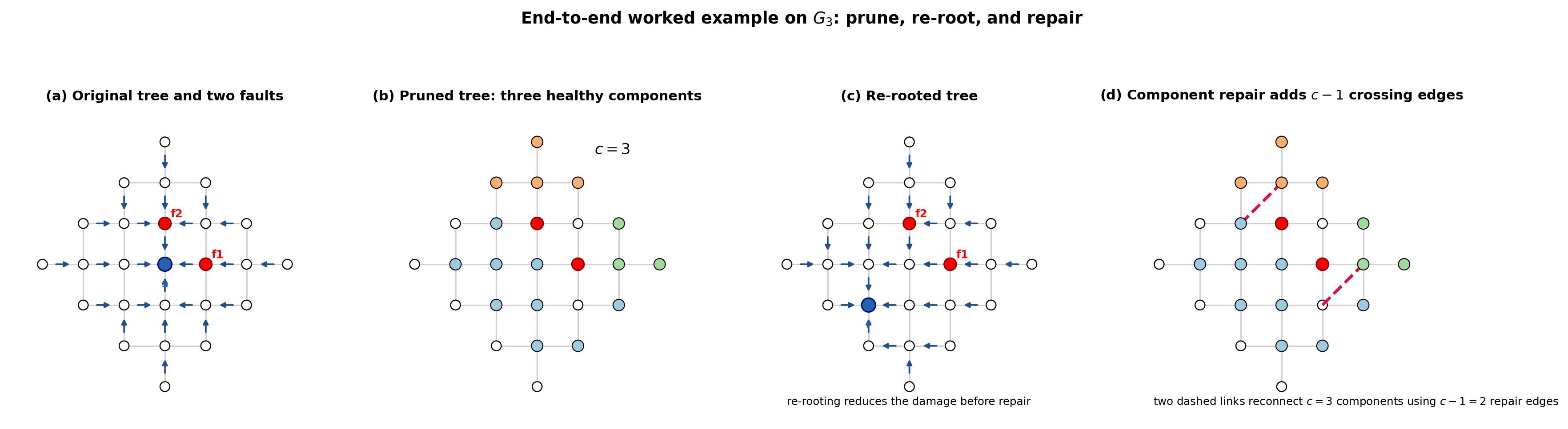
Figure 2: End-to-end workflow on N=2k2+2k+13, progressing from original tree with two failed nodes, through pruning and re-rooting, to component repair with N=2k2+2k+14 dashed repair edges.
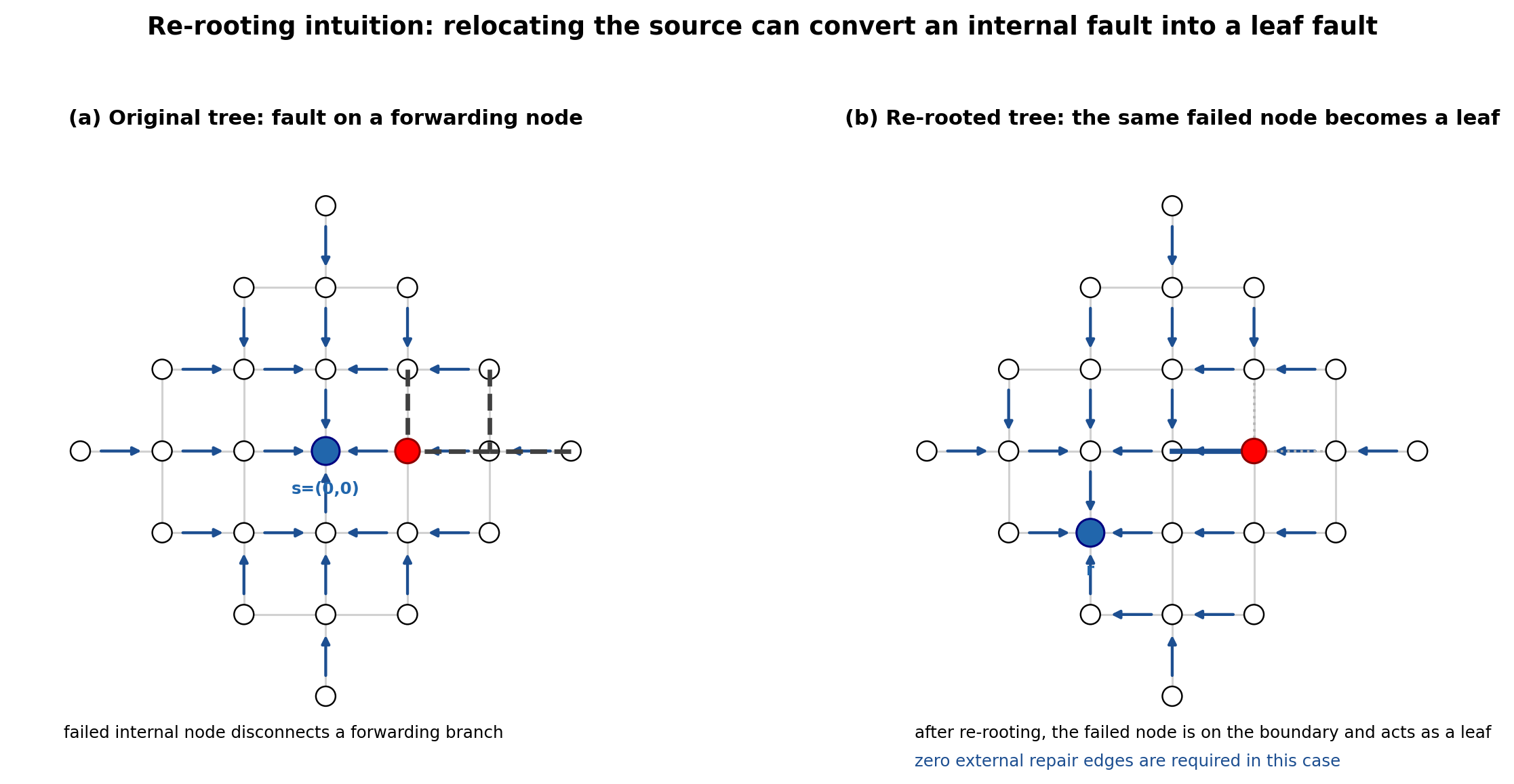
Figure 3: Re-rooting walkthrough: original tree with failed internal node disconnecting a branch; post-re-rooting, the fault moves to the boundary as a leaf, maintaining connectivity and eliminating repair-edges.
Algorithmic Primitives and Complexity
A constant-size candidate-generation primitive is introduced for two-node source selection, using a compact N=2k2+2k+15 shifted sign-case search, ensuring N=2k2+2k+16 operation in hardware. For higher-order faults (N=2k2+2k+17), heuristics prioritize roots maximizing boundary placement. Link-fault avoidance is characterized via efficient coordinate exclusion tests. For components post-pruning, every repair edge corresponds to an exceptional forwarding entry; thus, minimizing such edges directly reduces control-state and reconfiguration complexity.
Component Repair Analysis and Theoretical Guarantees
The healthy component graph N=2k2+2k+18 abstracts the post-pruning topology; its connectedness is the sole requirement for optimal repair. The principal theorem states: If N=2k2+2k+19 is connected over Bk={(x,y)∈Z2:∣x∣+∣y∣≤k}0 components, precisely Bk={(x,y)∈Z2:∣x∣+∣y∣≤k}1 repair edges suffice. Every Gaussian network edge lies on a Bk={(x,y)∈Z2:∣x∣+∣y∣≤k}2-cycle, guaranteeing deterministic repair for single-link failures.
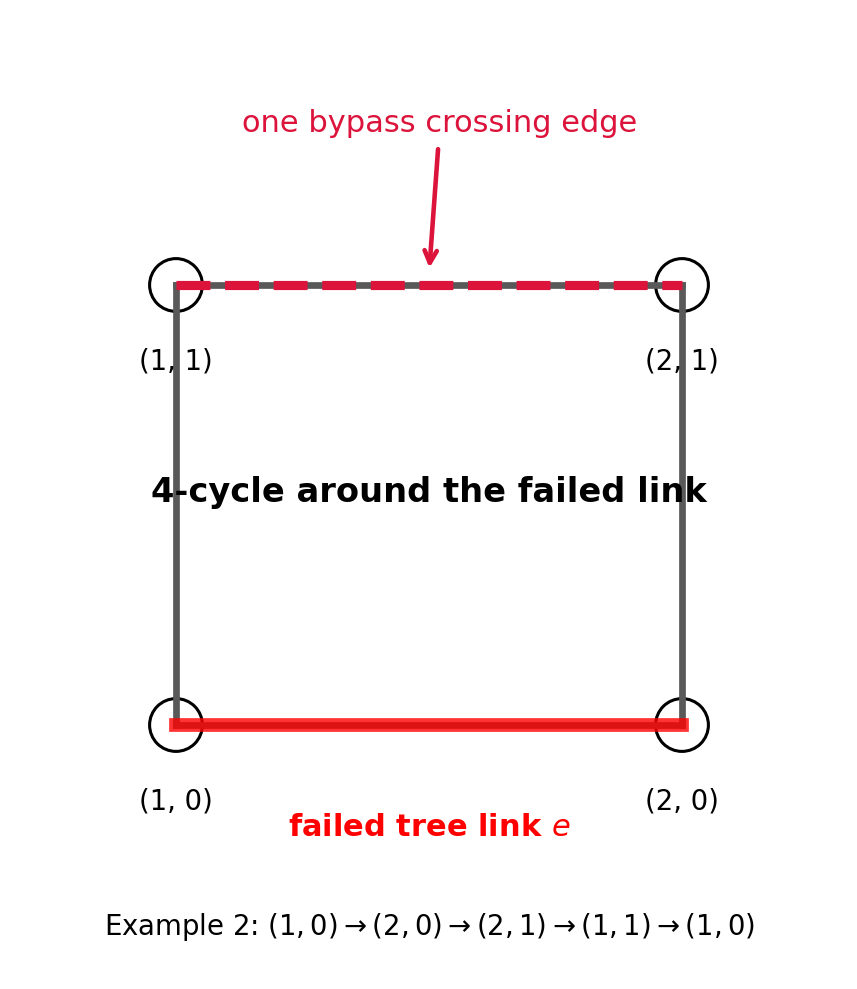
Figure 4: Single-link fault bypass—the failed tree link lies on a 4-cycle; only one crossing edge reconnects resulting components.
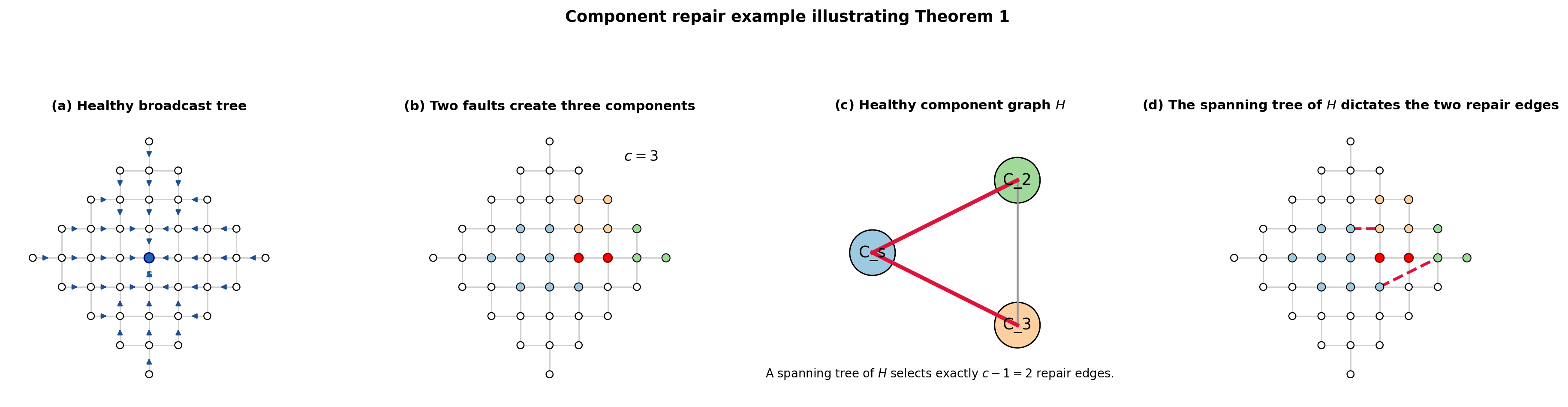
Figure 5: Component-repair example; highlighting component graph Bk={(x,y)∈Z2:∣x∣+∣y∣≤k}3, its spanning tree, and corresponding Bk={(x,y)∈Z2:∣x∣+∣y∣≤k}4 repair edges.
Bounds are established for component counts, tying worst-case fragmentation to the number of failed nodes/links, but empirical findings reveal much lower average fragmentation after re-rooting, especially for node faults.
Empirical Evaluation and Numerical Results
Experiments span Bk={(x,y)∈Z2:∣x∣+∣y∣≤k}5, covering up to Bk={(x,y)∈Z2:∣x∣+∣y∣≤k}6 nodes, Bk={(x,y)∈Z2:∣x∣+∣y∣≤k}7 static, and Bk={(x,y)∈Z2:∣x∣+∣y∣≤k}8 transient trials. Recovery success rates are: Bk={(x,y)∈Z2:∣x∣+∣y∣≤k}9 in deterministic regimes (node and single-link faults), ∣x∣+∣y∣0 multi-link, and ∣x∣+∣y∣1 high-order heuristics. Every unrecovered trial is attributable to component-graph disconnection or relocation failure.
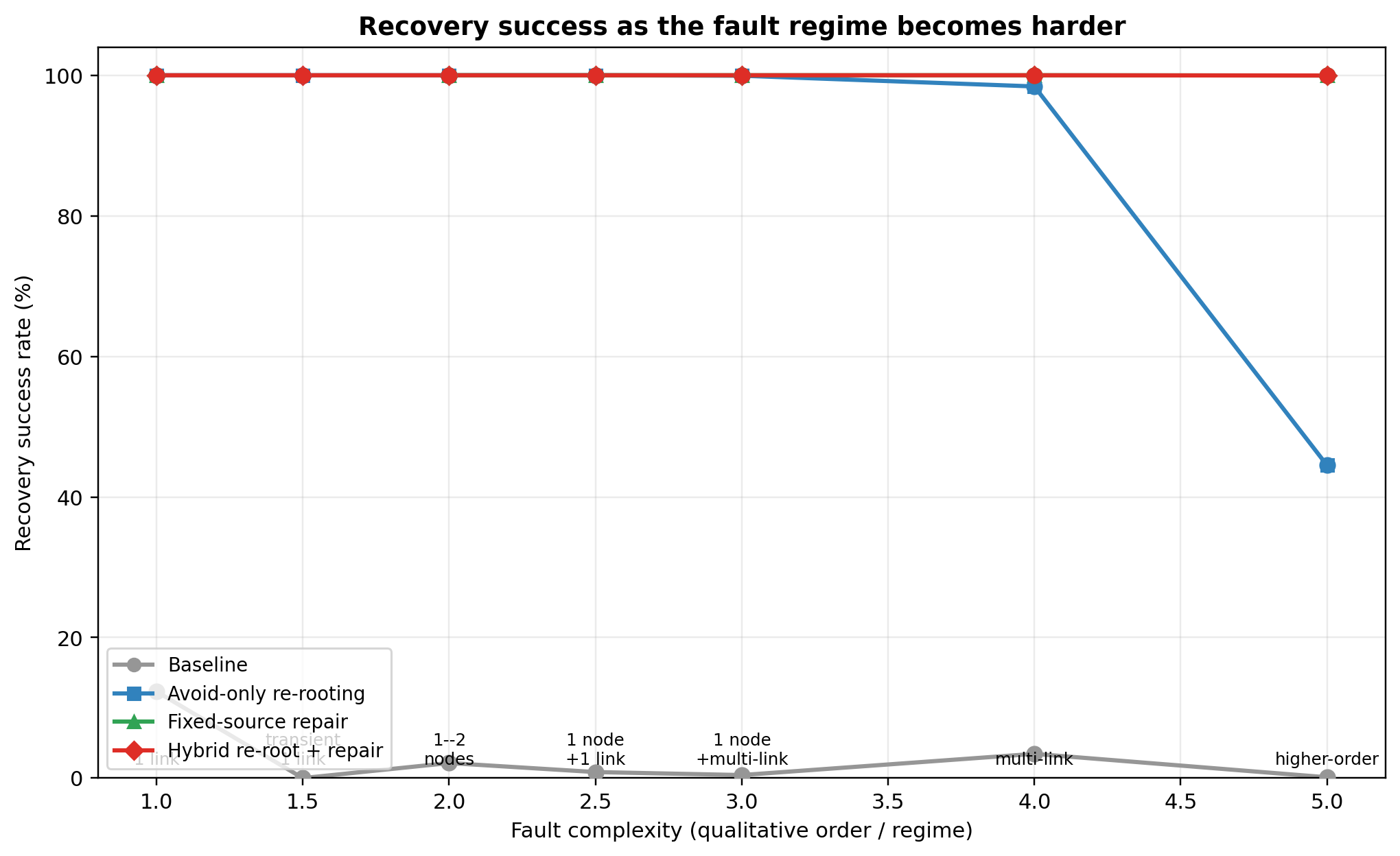
Figure 6: Recovery success as fault regime becomes harder; hybrid method curve remains near ∣x∣+∣y∣2 while avoid-only degrades sharply in higher-order regimes.
Re-rooting reduces average external repair edges by ∣x∣+∣y∣3--∣x∣+∣y∣4 versus fixed-source component repair. Patched native Gaussian-link Noxim scheduled replays validate packet-complete router-level execution, with hybrid repairs yielding shallower trees and fewer repair actions.
Practical and Theoretical Implications
Practically, the hybrid re-rooting and repair protocol addresses the minimal forwarding state and recovery latency under arbitrary fault regimes, favoring NoC implementations with efficient exception handling. The theoretical separation—root selection versus component repair—clarifies optimization objectives: state-minimality versus latency.
The conditional nature of high-order fault recovery underscores the empirical nature of component-graph connectivity; adversarial clustered faults can produce disconnected states, but density scaling rapidly increases recovery probability.
Algorithmic complexity is ∣x∣+∣y∣5 for a fixed root, enabling scalable hardware deployment. The introduced candidate-generation and link-fault exclusion primitives provide templates for future hardware communication fabrics and next-generation interconnection topologies.
Future Directions
Outstanding open problems include constant-size link-fault selectors, high-probability connectivity theorems for random high-order faults, transient node/link cascading failures, and more comprehensive cycle-accurate NoC evaluation with calibrated EDP and background traffic.
Conclusion
This paper formalizes and proves edge-minimal repair for dense Gaussian broadcast networks, integrating re-rooting and component repair into a runtime recovery protocol for static and transient node/link failures. If the component graph is connected, ∣x∣+∣y∣6 repair edges are both necessary and sufficient, with deterministic single-link recovery guaranteed. Empirical evaluation confirms near-perfect recovery and drastic reduction in repair-edge cost. The approach substantiates precise recovery mechanisms for broadcast in algebraic network topologies, providing both theoretical insights and practical algorithms suitable for scalable NoC deployment and future AI communication architectures.

