Re-Rooting-Assisted Edge-Minimum Runtime Repair for Node and Link Failures in Dense Eisenstein--Jacobi Broadcast Networks
Published 19 Jun 2026 in cs.DC, cs.IT, and cs.NI | (2606.21133v1)
Abstract: One-to-all broadcasting in dense Eisenstein--Jacobi (EJ) networks relies on diameter-level spanning trees that fragment when nodes or links fail. This paper introduces the selected triple $(r,θ,\Kcomp_{r,θ})$--a chosen root, a chosen EJ coordinate-reduction orientation, and the healthy component graph induced by that choice--as the fundamental unit of analysis for joint node/link fault recovery. The central result is a necessary and sufficient condition: hybrid repair succeeds if and only if the healthy EJ graph $G'=\Ht-\Fv-\Fe$ is connected. When $G'$ is connected, a spanning tree of $\Kcomp_{r,θ}$ maps to exactly $c-1$ component-crossing repair edges, which is minimum for the selected pruned tree. Deterministic guarantees include: one/two faulty nodes are always placed on the distance-$t$ boundary by re-rooting; a single failed link is either avoided or repaired by exactly one crossing edge; and the repaired depth satisfies $D_{r,θ}\le 2t+1$ under shallowest-layer entry selection. A 260,000-trial validation campaign confirms 100\% recovery and substantial repair-edge reduction over fixed-source repair across five network scales up to $N=120601$ nodes, while global-BFS, near-miss, and cap-sensitivity audits clarify the tradeoff between reachability, forwarding-state changes, and ranked root selection.
The paper demonstrates that repair succeeds if the healthy EJ graph remains connected, with optimal repair achieved using exactly c-1 external edges.
It employs a hybrid re-rooting strategy and component contraction method to minimize repair edges and ensure shallow broadcast depth even under mixed node and link faults.
Experimental results from over 260,000 trials confirm 100% recovery when connectivity holds, reducing routing changes and preserving local broadcast structure.
Re-Rooting-Assisted Edge-Minimum Repair in Dense Eisenstein–Jacobi Broadcast Networks
Background and Problem Formulation
Broadcast communication in parallel and distributed systems increasingly utilizes dense Eisenstein–Jacobi (EJ) networks due to their regular hexagonal topology, vertex-transitivity, and favorable diameter and degree properties. These networks support efficient diameter-level, one-to-all broadcasting via structured spanning trees. However, node or link failures—whether known ahead of time or discovered at runtime—can fragment the broadcast tree, breaking downstream delivery guarantees. Prior solutions, such as boundary node re-rooting and component-crossing repair in fixed roots, solve isolated subproblems but fail to provide unified, minimum-repair guarantees under arbitrary mixed node-link faults.
This paper introduces the core analytical unit (r,θ,Kr,θ), comprising a selected root, an EJ geometry orientation, and the induced healthy component graph. The central theoretical result is an exact characterization: hybrid repair succeeds if and only if the healthy EJ graph G′=Ht−FV−FE (with faulty nodes FV and faulty links FE removed) remains connected. When this is satisfied, optimal repair requires precisely c−1 external component-crossing edges for c components, aligning with the spanning tree lower bound for the induced component graph.
EJ Network Model and Broadcast Orientations
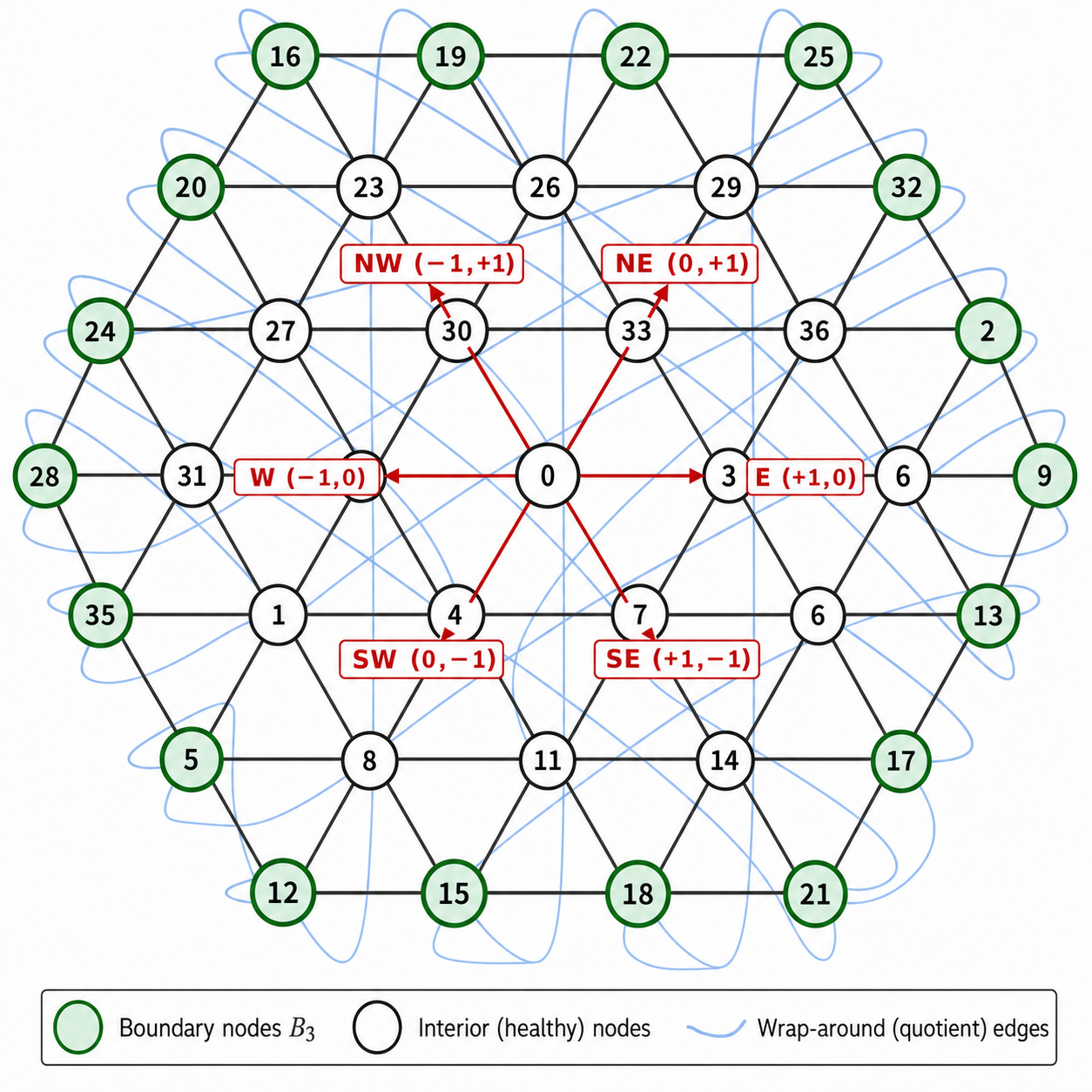
Dense EJ networks model hexagonal meshes via quotient lattices of Z[ω], ω=2−1+i3, with degree-six adjacency corresponding to the six unit directions. Nodes are labeled by axial coordinates and integer labels under ϕ(x+yω). The canonical broadcast tree is constructed via coordinate-reduction orientations, selecting a parent per node by inward-layer contraction, yielding diameter-level spanning trees.
Figure 1: Dense EJ network for t=3 (G′=Ht−FV−FE0, G′=Ht−FV−FE1) represented as an axial hexagon. Boundary nodes are at G′=Ht−FV−FE2.
The orientation family used for repair includes cyclic and anti-cyclic traversals of the six unit directions, providing a set of G′=Ht−FV−FE3 spanning broadcast trees per root. This family is critical for repair flexibility and depth reduction.
Faults, Root Selection, and Graph-Theoretic Recovery
Node and link failures are modeled as subsets G′=Ht−FV−FE4 and G′=Ht−FV−FE5 removed from the network. Broadcast repair requires healthy connectivity: reachability from the selected root to all healthy nodes using only healthy links. Recovery proceeds via candidate evaluation of root-orientation pairs, component contraction and edge selection, with a lexicographic objective prioritizing minimal number of repair edges and minimal repaired depth.
Key theoretical guarantees include:
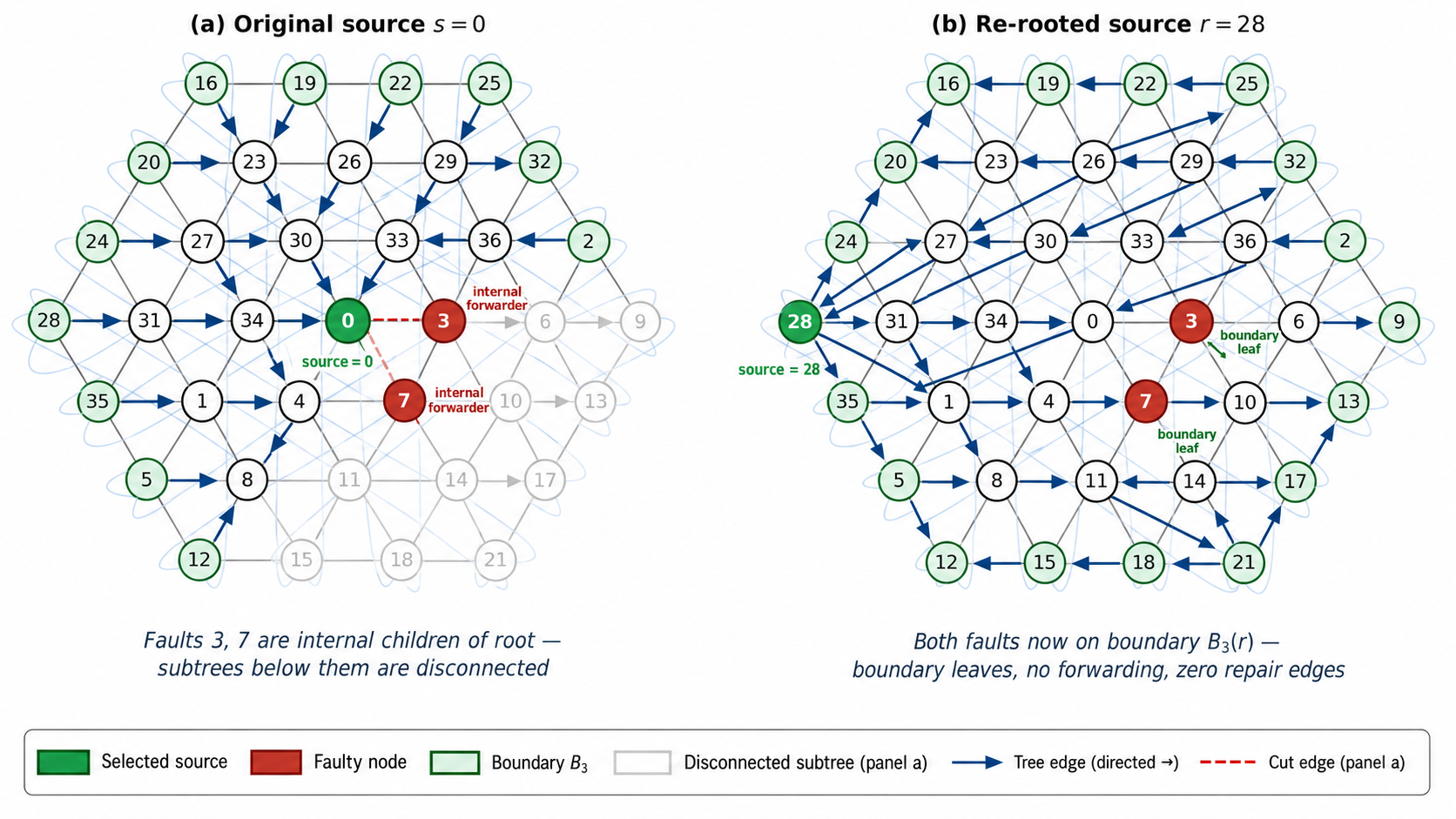
Re-rooting for one or two node faults: Any one or two faulty nodes can be placed on the distance-G′=Ht−FV−FE6 boundary by suitable source relocation, ensuring they become leaves in the broadcast tree. This eliminates the need for repair edges (Corollary: zero-repair in node-only cases for G′=Ht−FV−FE7).
Figure 2: Two-fault re-rooting converts internal faults into boundary leaves, obviating component repair in node-only cases.
Link exclusion and efficient repair: Whether a broadcast tree uses a failed link reduces to two parent coordinate comparisons. If no failed link is used, no repair edge is needed; if a single failed link is used, precisely one repair edge suffices.
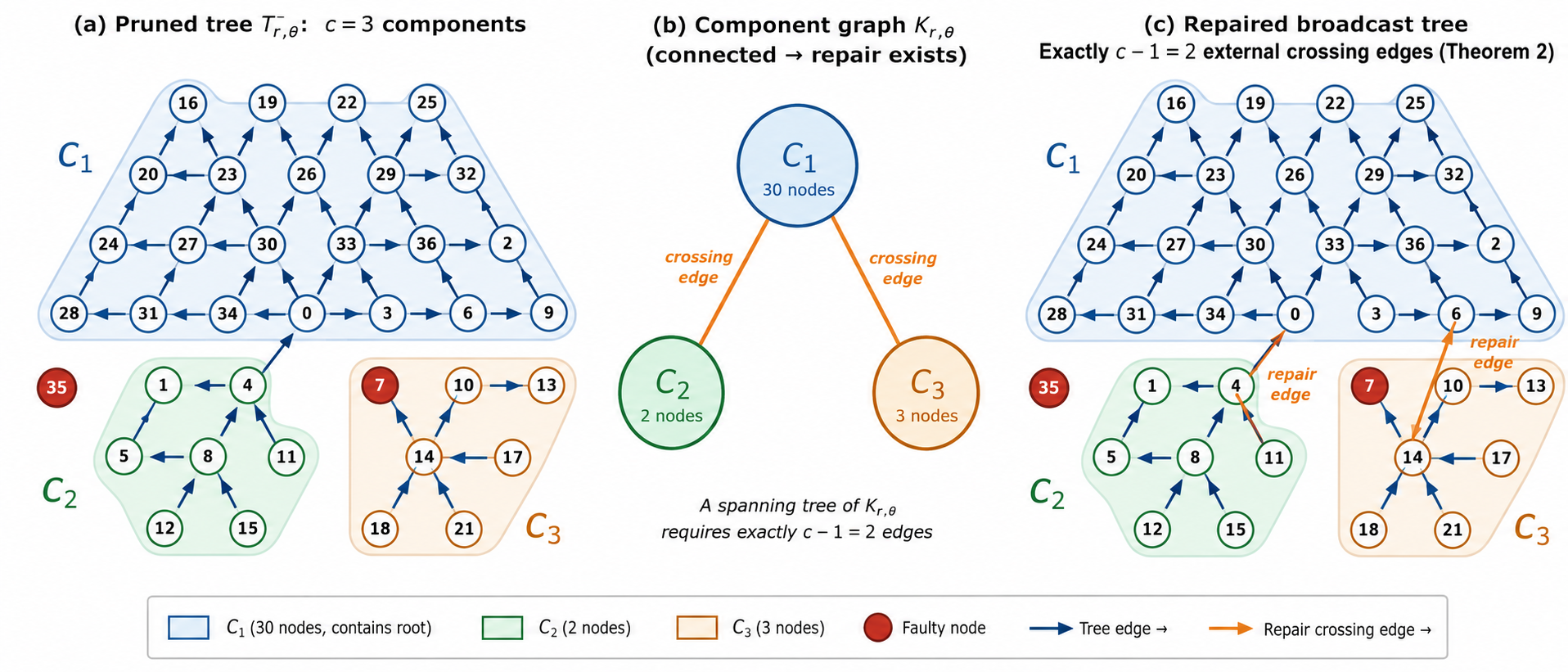
Edge-minimum component repair theorem: For any pruned tree whose healthy component graph is connected, optimal repair is achieved with G′=Ht−FV−FE8 external repair edges.
Figure 3: Component contraction and edge-minimum repair: mapping a spanning tree in the component graph to exactly G′=Ht−FV−FE9 repair edges.
Depth guarantees: Under shallowest-entry selection, repaired broadcast depth is bounded by FV0.
Necessary and Sufficient Recovery Conditions
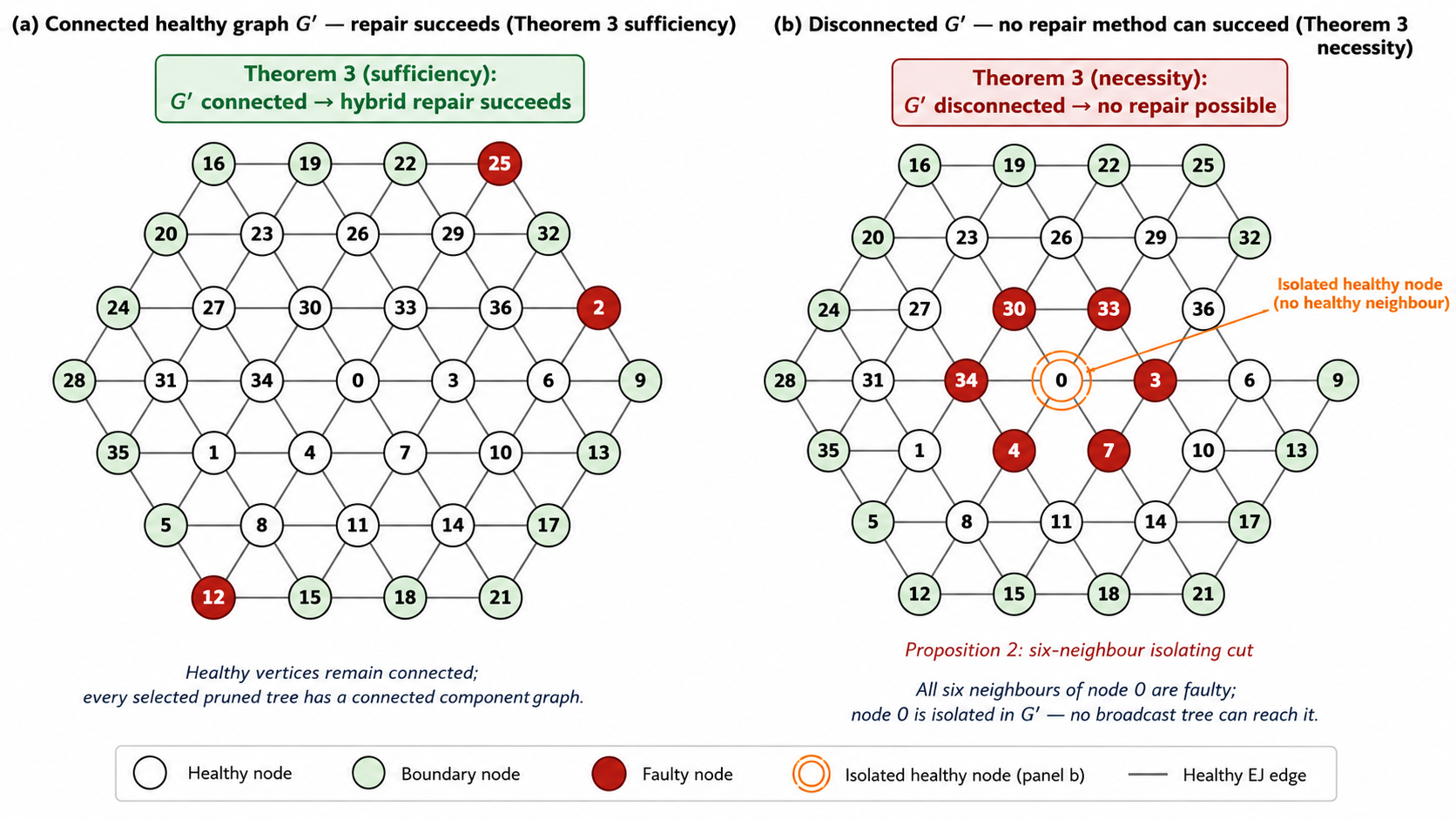
The main theoretical result provides an exact recovery criterion: repair is possible if and only if the healthy EJ graph FV1 remains connected (Theorem 3). Component graphs induced by any pruned candidate tree are connected precisely when FV2 is connected, ensuring the component repair process always succeeds in this case.
Figure 4: Healthy-graph connectivity is the exact recovery condition for repair. Isolation by six faulty neighbors results in disconnection.
Algorithmic Framework
A hybrid repair algorithm ranks and evaluates root-orientation pairs, applying link-exclusion filtering and component repair. Candidate selection is ranked via leaf score and failed-link avoidance; repair uses component contraction and spanning tree mapping for external edge placement. The methodology remains tractable, with full repair invoked only for capped top-ranked candidates and mandatory fallback roots.
Experimental Validation
A comprehensive validation campaign with 260,000 trials across network diameters up to FV3, multiple fault scenarios (node, link, mixed, runtime faults), and four placement modes demonstrates:
100% recovery rate under all tested regimes when the healthy graph is connected.
Substantial reduction in repair edges using hybrid re-rooting compared with fixed-source repair, with deterministic node/link regimes yielding zero repair edges, and the five-node high-order regime averaging only FV4 repair edges.
Shallow repaired depth: in deterministic rows repaired depth matches the original diameter, and remains close even under higher-order faults.
Global BFS rebuild comparison: While BFS achieves reachability, it modifies FV5 parent assignments, whereas hybrid repair alters only a small number of forwarding rules, preserving local broadcast structure.
Practical and Theoretical Implications
The implications are substantial for fault-tolerant scheduling in parallel architectures and Network-on-Chip fabrics:
Optimized repair state: The hybrid method minimizes the number of exceptional forwarding rules, reducing routing table overhead and state changes.
Deadlock freedom: Repaired subgraphs are acyclic, preserving broadcast-level deadlock-freedom independently of unicast protocols.
Scalability: Storage and computational complexity remain modest and scalable for practical implementation, especially in common bounded-fault cases.
Boundary limitations: Universal recovery is only guaranteed up to two node faults or a single link; six-neighbor local obstructions establish hard limits for adversarial placements.
Future Directions
Potential developments include:
Enhanced root search: Global-optimal root selection beyond capped ranking could further reduce repair edges in higher-order regimes.
Latency optimization: Integrating latency as a primary metric may yield engineering improvements in broadcast depth.
Cycle-accurate NoC evaluations: Further investigation of hybrid repair in cycle-accurate simulations could elucidate impacts on throughput and power.
Adversarial and clustered fault handling: Tighter probabilistic bounds and clustering-aware algorithms may improve robustness.
Conclusion
This work presents a unified framework for minimum-edge, runtime repair of broadcast trees in dense EJ networks. The key contribution is an exact necessary and sufficient recovery condition, with deterministic, component-level guarantees on repair edges and broadcast depth. Validation confirms major reductions in repair state and reaches practical correctness for large-scale implementations, underscoring the relevance of coupled root-orientation selection in algebraic mesh broadcasting under arbitrary node and link faults.
“Emergent Mind helps me see which AI papers have caught fire online.”
Philip
Creator, AI Explained on YouTube
Sign up for free to explore the frontiers of research
Discover trending papers, chat with arXiv, and track the latest research shaping the future of science and technology.Discover trending papers, chat with arXiv, and more.