- The paper introduces MOEM, which optimally repairs broadcast trees by reconnecting healthy components using exactly c-1 repair edges.
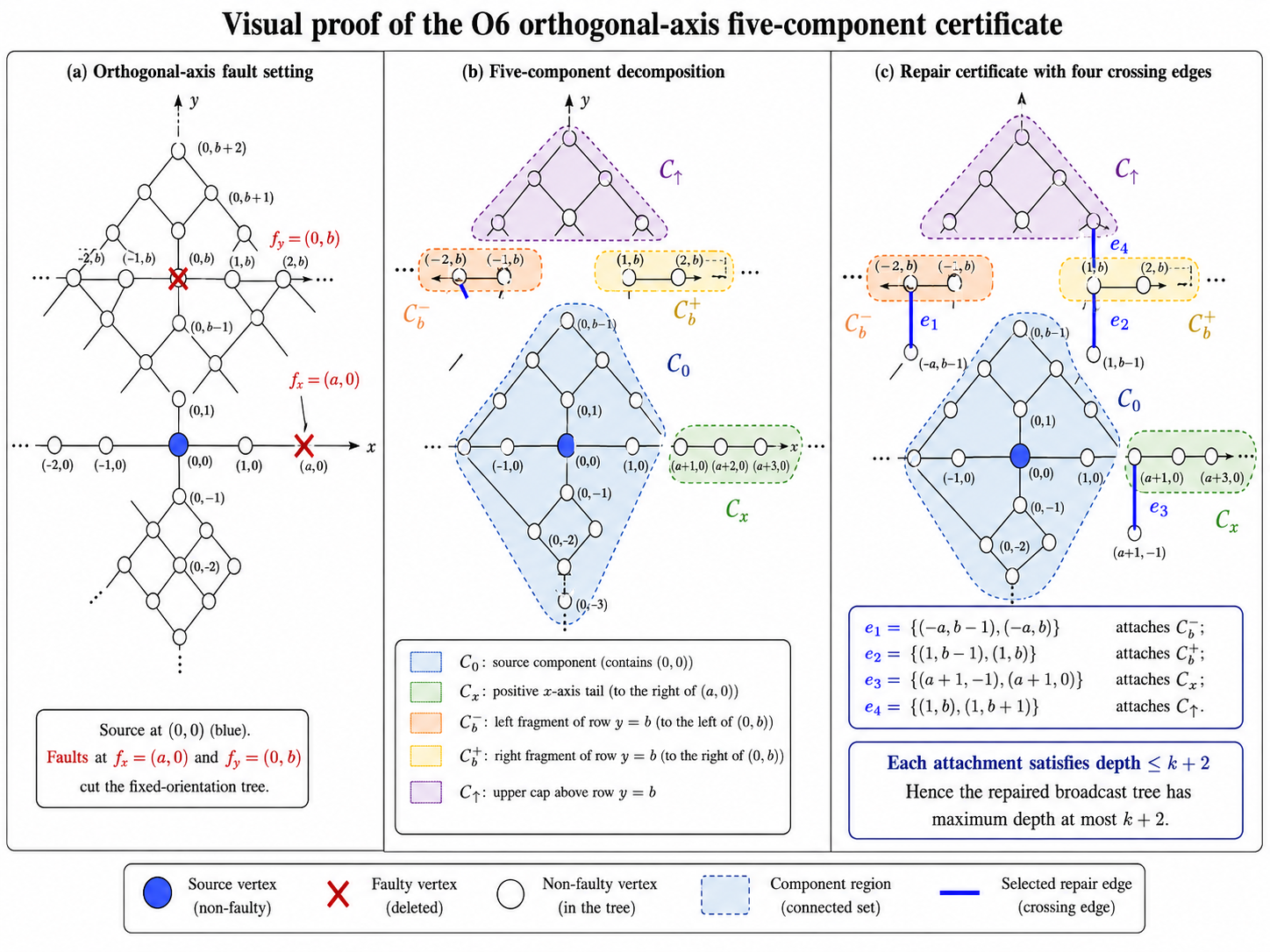
- It employs multiple deterministic orientations and certificate-based analysis to guarantee a bounded depth increase of at most two hops for one or two faults.
- Experimental validation confirms 100% repair success with minimal repair cost, highlighting MOEM’s potential for scalable, fault-tolerant network-on-chip applications.
Multi-Orientation Edge-Minimum Repair (MOEM) for Dense Gaussian Networks: Algorithmic Guarantees and Fault Model Analysis
Problem Formulation and Context
The paper addresses non-redundant one-to-all broadcast under transient processor faults in dense Gaussian networks, a class of degree-four Cayley graphs with regular algebraic structure and strong network-theoretic properties. The main objective is, given a source node s and a set of faults F⊂V(Gk) with s∈/F, to repair the rooted broadcast tree such that:
- Every healthy node receives the message exactly once,
- No path traverses a faulty node,
- The number of repair (external component-crossing) edges is minimal,
- Broadcast depth increases minimally from the fault-free diameter (k).
This operationalizes a non-redundant and localized repair paradigm suitable for parallel and distributed systems and network-on-chip architectures engaging in collective communication, where duplicate traffic and excess repair cost are to be systematically minimized.
MOEM: Algorithmic Construction and Theoretical Guarantees
MOEM (Multi-Orientation Edge-Minimum Repair) constructs a small family of deterministic, orientation-diverse Gaussian broadcast trees. For each orientation, after pruning faulty nodes and associated branches, it identifies the connected healthy components; the repair algorithm then reconnects these components via a minimum set of external component-crossing edges, forming a spanning tree of the healthy subgraph rooted at the source.
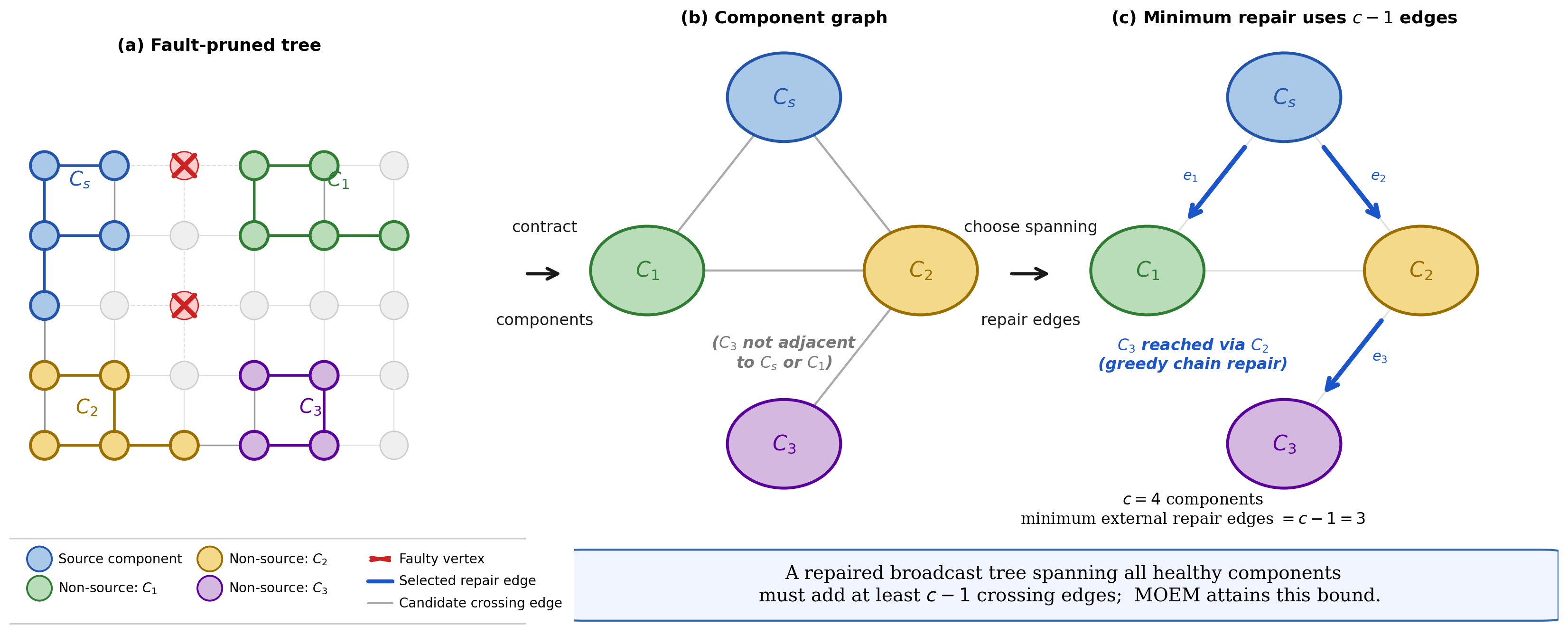
Figure 1: Component contraction view of MOEM: fault-pruned tree components, the induced component graph, and the minimum c−1 repair edges.
The selection step iterates through all candidate orientations, producing repaired trees, and returns the candidate with the lex minimal tuple prioritizing (success, depth, number of repair edges, maximum out-degree, orientation rank). Importantly, for any fault-pruned orientation with c healthy components and a connected component graph, the MOEM repair step always requires exactly c−1 external repair edges—proven to be optimal by component-contraction arguments.
Certificate Framework and Depth Characterization
The theoretical foundation for MOEM's efficiency is a rigorous certificate-based analysis. The critical claim is as follows: for ∣F∣≤2 (one or two faults), every placement admits at least one MOEM orientation whose repaired broadcast tree has depth at most k+2 (a strictly bounded overhead over the fault-free diameter). This is achieved through:
These analytical results demonstrate that the overhead in hop-depth is strictly bounded, thus maintaining efficient diameter-level communication under up to two arbitrary faults.
Experimental Validation
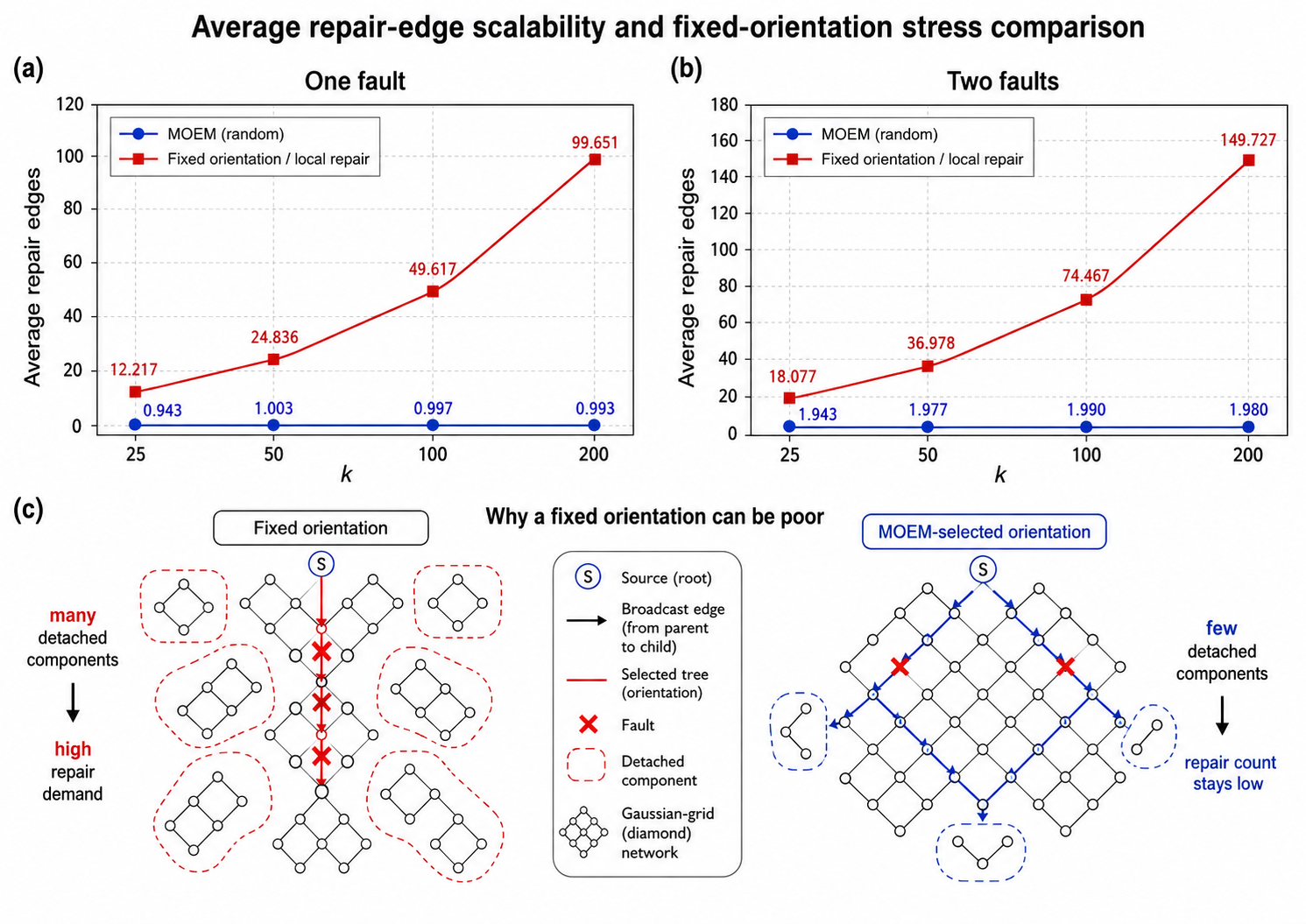
Comprehensive validation is performed across F⊂V(Gk)1 to F⊂V(Gk)2 for all single and double fault placements, as well as random and structured faults for F⊂V(Gk)3. The data verify:
Statistical analysis of large-scale random faults demonstrates that the average number of repair edges for two-fault instances converges to nearly 2, and the repair cost remains decoupled from network diameter—contrast this with fixed-orientation repair strategies where repair cost grows linearly with F⊂V(Gk)8.
Implications for Broadcast Repair in Dense Gaussian Networks
MOEM achieves minimal repair (external edge) cost, low depth increase, and non-redundant message delivery for all one- and two-fault placements. The construction leverages Cayley-graph symmetry, compact Manhattan-coordinate address maps, and a bounded orientation family to efficiently cover all possible fault scenarios. The separation of orientation selection and component-contraction repair generalizes to higher fault regimes: the repair step remains optimal whenever the healthy component graph is connected, albeit without the same depth guarantees beyond F⊂V(Gk)9.
Practically, this exposes a methodology for designing scalable, fault-tolerant communication primitives in network-on-chip systems and symmetric algebraic topologies, where traffic minimization and low local reconstruction cost are critical. Theoretically, the explicit certificate methodology provides a systematic program for extending depth-guaranteed repair to three faults and possibly higher, suggesting that a finite template set and combinatorial component analysis will suffice for sublinear depth overheads in broader fault models.
Future Directions
- Generalization to s∈/F0 faults: While component-optimality for repair edges holds, the challenge is to systematically enumerate certificate templates providing tight depth bounds in the presence of interacting, non-collinear fault sets.
- Orientation family minimization: The current 8-orientation set is sufficient but may not be minimal; formal lower bounds on the size and necessary diversity of the orientation family warrant further analysis.
- Extension to other Cayley and lattice-derived networks: The framework may generalize to Eisenstein-Jacobi, toroidal, and related algebraic graphs relevant in advanced interconnection system architectures.
Conclusion
The MOEM method provides robust and analytically characterized guarantees for non-redundant broadcast repair in dense Gaussian networks, simultaneously minimizing repair cost and bounding the increase in communication diameter. The analysis synthesizes algebraic graph symmetry, certificate-based repair strategies, and empirical validation to deliver a comprehensive and theoretically grounded solution for fault-tolerant broadcast under low-degree, large-scale network constraints (2606.17528).