- The paper introduces EJ-MOEM, a method that repairs faulty broadcast trees by reconnecting healthy fragments with exactly c-1 external edges.
- It uses a multi-orientation approach and certified depth-certificate trees, achieving repair depths of t+1 to t+2 under one or two faults.
- Empirical validation on large networks confirms that EJ-MOEM meets theoretical guarantees with O(N) complexity and minimal repair edge counts.
Multi-Orientation Edge-Minimum Repair in Eisenstein–Jacobi Networks
Introduction
Dense Eisenstein–Jacobi (EJ) networks underpin degree-six algebraic interconnection models, with their finite quotient geometry realized by discrete axial-coordinate hexagonal balls. The presented work introduces EJ-MOEM, a multi-orientation edge-minimum repair procedure for non-redundant one-to-all broadcast repair under the constraint of one or two processor faults. Unlike global tree reconstruction, EJ-MOEM minimally augments the broadcast tree post-fault by reconnecting healthy fragments with the least number of external edges, thus preserving original healthy structures and achieving optimal depth bounds.
Dense EJ Network Model and Coordinate Reduction
An EJ network of diameter t comprises N=3t2+3t+1 nodes, each indexed via axial coordinates (x,y), with six canonical unit directions (E,N,SE,W,S,NW). The underlying geometry leverages a hexagonal ball Ht per the Eisenstein metric, which defines network layers and sector boundaries.
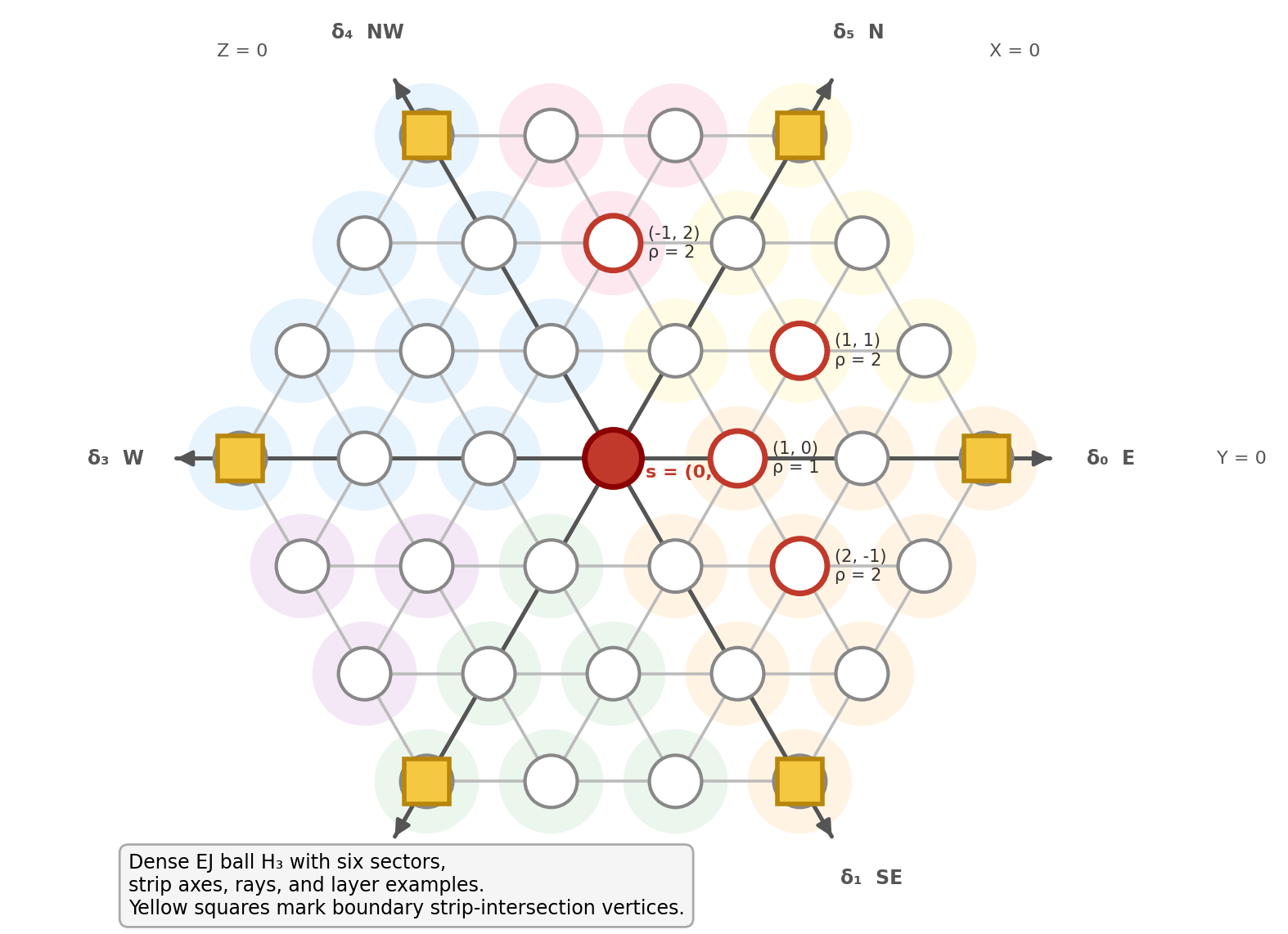
Figure 1: EJ hexagonal ball H3 partitioned into sectors, strip axes, and boundary vertices critical for repair operations.
Broadcast trees in this context are constructed by deterministic coordinate reduction, assigning each vertex a unique parent along the axis of maximal reduction until reaching the root. Priority-based orientation rules dictate the parent selection among eligible inward directions.
EJ-MOEM Procedure: Multi-Orientation Edge-Minimum Repair
EJ-MOEM evaluates a compact, exhaustive set of 15 orientation families constructed from cyclic, reverse-cyclic, and alternating priority permutations (Equation \eqref{eq:orientationfamily}). For any given fault set F, the method deletes the faulty vertices, contracts the damaged broadcast tree into components, and constructs the component graph Cθ to enumerate minimum edge repairs.
The principal theorem establishes that for connected component graphs, exactly c−1 external repair edges suffice to restore a rooted spanning tree, with c being the number of healthy fragments. The repair procedure leverages certified depth-certificate trees to guarantee acyclicity, uniqueness, and exclusion of faulty nodes.
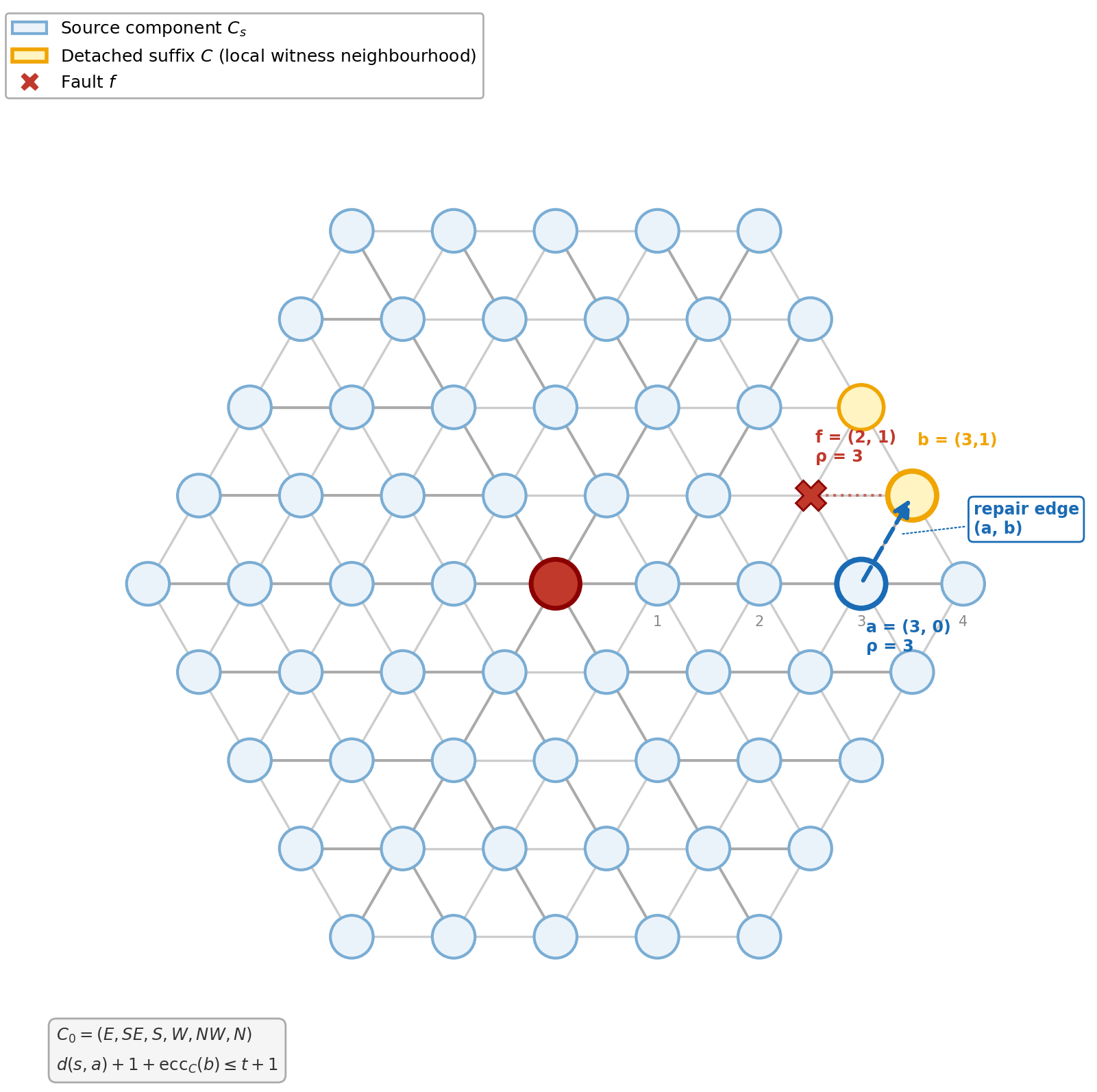
Figure 2: One-fault side-entry witness for N=3t2+3t+10 highlighting local sector suffix detachment and lateral repair edge attachment.
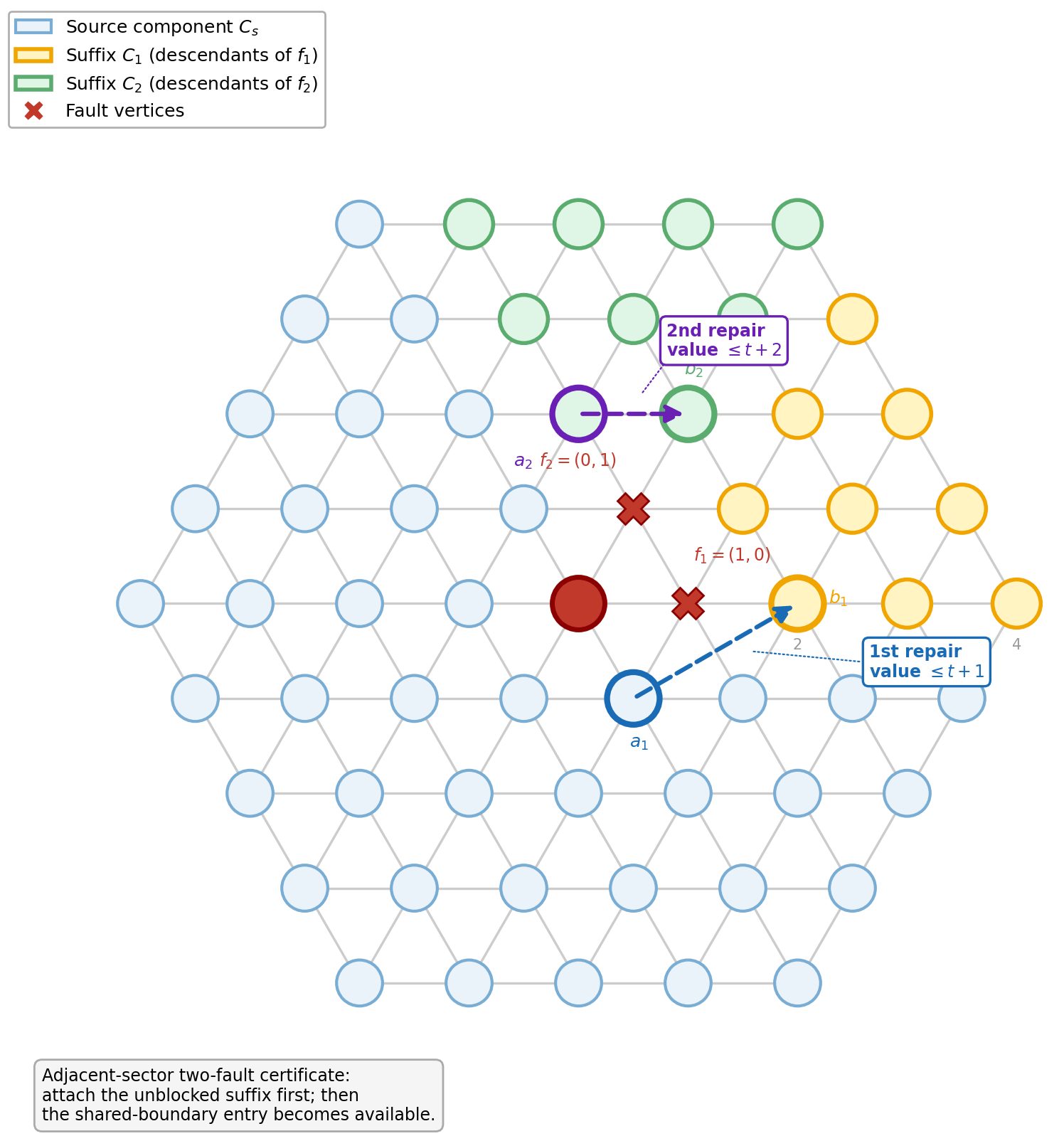
Figure 3: Schematic two-fault repair in adjacent sectors for N=3t2+3t+11—the unblocked suffix is attached first, enabling subsequent shared-boundary entry for the second.
Depth Certificate Analysis: Fault Placement and Repair Bound
The depth-certificate theorem asserts that any one-fault placement is repaired within depth N=3t2+3t+12, and two-fault placement within N=3t2+3t+13. The proof utilizes sector-suffix attachment lemmas and a six-direction shielding classification for paired cuts. At sector boundaries, repair is achieved by lateral entry, ensuring minimum eccentricity in attachment.
Notably, validation shows that while N=3t2+3t+14 is attained in small N=3t2+3t+15, for N=3t2+3t+16, empirical depth rarely exceeds N=3t2+3t+17. Fault configurations analyzed include ray-resident pairs, adjacent-sector pairs, and sector-separated faults, with sector geometry dictating the repair mechanism.
Validation and Numerical Results
The EJ-MOEM strategy is validated across exhaustive, structured, and large random trials, spanning up to N=3t2+3t+18 and 525,825 two-fault placements at N=3t2+3t+19. All tests confirm 100% realization of theoretical guarantees, with minimum repair edge count and depth bounds systematically attained.
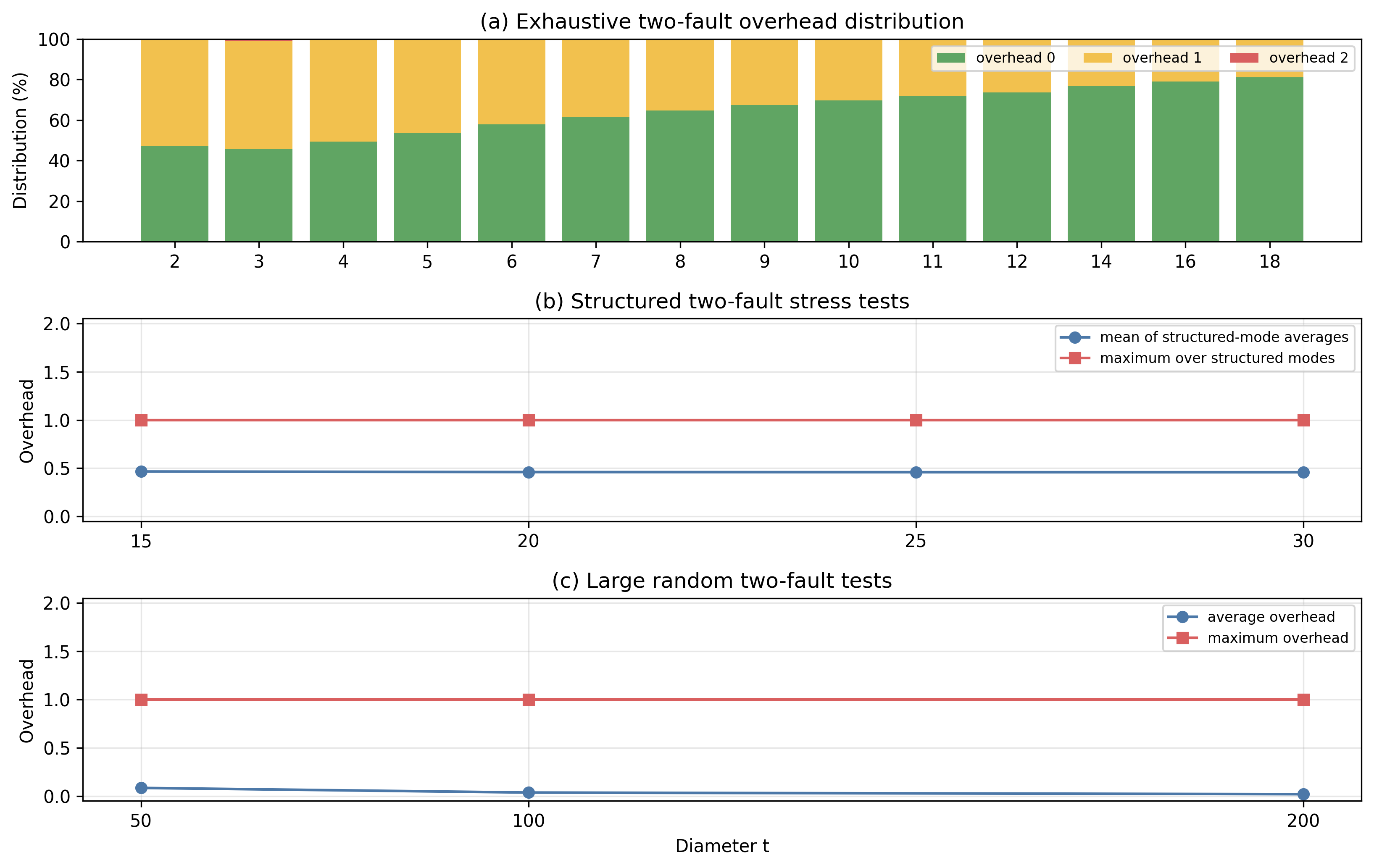
Figure 4: Validation summary—two-fault overhead distributions, structured test maximums, and random test statistics confirm empirical convergence to theoretical bounds.
Comparative analysis shows EJ-MOEM matches or outperforms natural baselines with respect to repair count and final tree depth. Unlike global breadth-first rebuilds, EJ-MOEM preserves healthy fragments, minimizes repair edges, and ensures non-redundant delivery.
Complexity and Practical Implications
For the single- and two-fault case, EJ-MOEM operates in (x,y)0 time, evaluating a constant set of orientations and linear graph traversals. The method is thus tractable for large-scale interconnection networks, with direct applicability to on-chip, hexagonal, and algebraic topologies requiring robust and non-redundant broadcast under sparse failures.
Theoretical Implications and Future Directions
The distinction between EJ and Gaussian networks is pronounced: the three-strip hexagonal structure admits unique lateral repair opportunities absent in degree-four models. Theoretical findings prompt questions about universal sufficiency of the (x,y)1 bound for two faults as (x,y)2 increases and suggest exploration into bounded-depth repair for larger fault sets or more complex lattice topologies.
Conclusion
This paper formally introduces EJ-MOEM, establishing a certified framework for minimal edge and depth repair in dense Eisenstein–Jacobi networks. The method's guarantees are rigorously validated, offering a precise approach for non-redundant, fault-tolerant broadcasting. Its implications extend to future research on scalable algebraic interconnection models as well as practical deployment in fault-tolerant communication for high-performance computing environments (2606.19834).

