- The paper introduces an algebraic, closed-form approach for constant-time new source selection in fault-tolerant broadcasting.
- It leverages Gaussian quotient-lattice symmetries to transform the boundary-intersection problem into a fixed linear system solvable in constant time.
- Experimental results confirm zero mismatches and significant runtime improvements over traditional search-based methods, ensuring scalability and robustness.
Introduction and Background
The paper "Closed-Form and Constant-Time New-Source Selection for Fault-Tolerant Broadcasting in Dense Gaussian Networks" (2606.18715) addresses the efficient recovery of broadcasting in dense Gaussian networks under node faults by advancing the mathematical and algorithmic structure of the re-rooting-based recovery paradigm. Dense Gaussian networks Gk are degree-four interconnection topologies defined over Gaussian integers, with diameter k and node count N=k2+(k+1)2. Their regular algebraic structure enables efficient paths, compact node labeling, and maximal-diameter broadcasts. Fault-tolerant broadcasting requires dynamically avoiding failed nodes, prompting the need for precise and rapid selection of alternate source nodes capable of maximal coverage post-fault.
Existing approaches relied on search-based selection of new broadcast roots (sources), which incurred O(k) complexity due to boundary traversal, or O(N) by brute force. The present paper replaces these methods with closed-form algebraic constructions and constant-time selection mechanisms exploiting Gaussian quotient-lattice symmetries and piecewise combinatorial boundary intersection analysis.
Selection of a valid new source post-fault is framed as a boundary-intersection problem. For faulty nodes A and B, the task is to find a node NS with maximal graph distance (k) from both A and k0:
k1
The problem is reduced by translation invariance: the difference node k2 allows formulation as selection of k3 satisfying k4, then reconstructing k5. This reduces the problem to a canonical intersection of boundary sets within the Gaussian quotient.
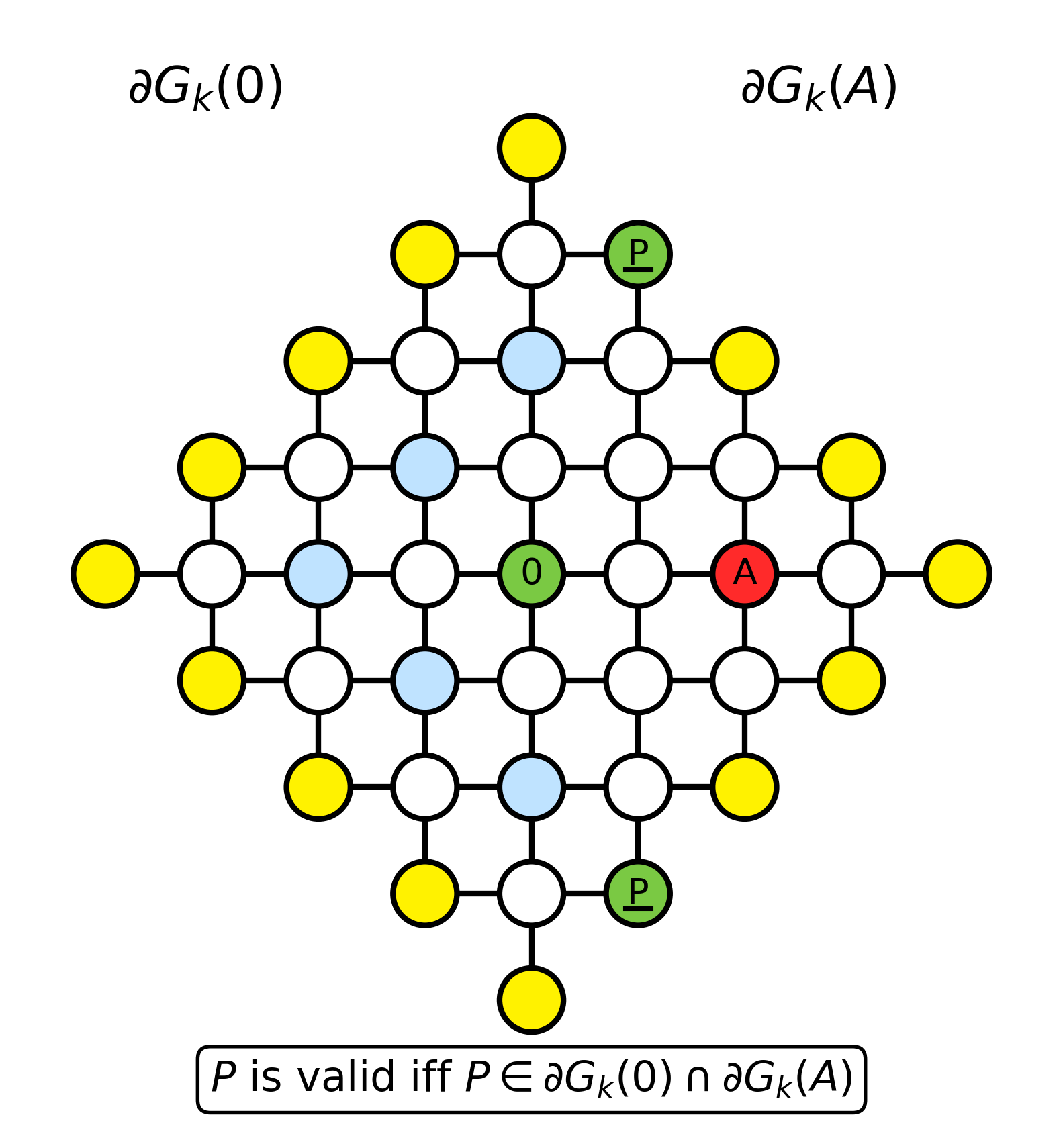
Figure 1: Boundary-intersection view in k6, visualizing valid new source candidates as the intersection of central and shifted boundary sets.
The paper rigorously partitions the k7-step boundary of the canonical diamond into four disjoint directed sides, analyzing all geometric overlap patterns between local and shifted boundaries. It provides a piecewise compact formula for the local (unshifted) intersection count and extends this to account for wrap-around intersections induced by lattice translations. The exact valid-source count utilizes a fixed union of side-pair intervals across the nine relevant quotient-lattice shifts, yielding a closed-form constant-size counting procedure.
Constant-Time Direct Algebraic Source Selection
Beyond enumeration, the paper establishes a direct selection algorithm for two arbitrary faults. By shifting k8 over nine quotient-lattice vectors, and considering all k9 sign combinations for the coordinates, the system N=k2+(k+1)20, N=k2+(k+1)21 (with N=k2+(k+1)22 shifted difference coordinates) is solved for integer candidates using linear algebra (Cramer's rule for nonparallel cases, interval-endpoint selection for parallel cases). Each candidate is verified for boundary membership. The method is independent of network parameters (N=k2+(k+1)23, N=k2+(k+1)24), requiring at most N=k2+(k+1)25 constant-time algebraic cases.
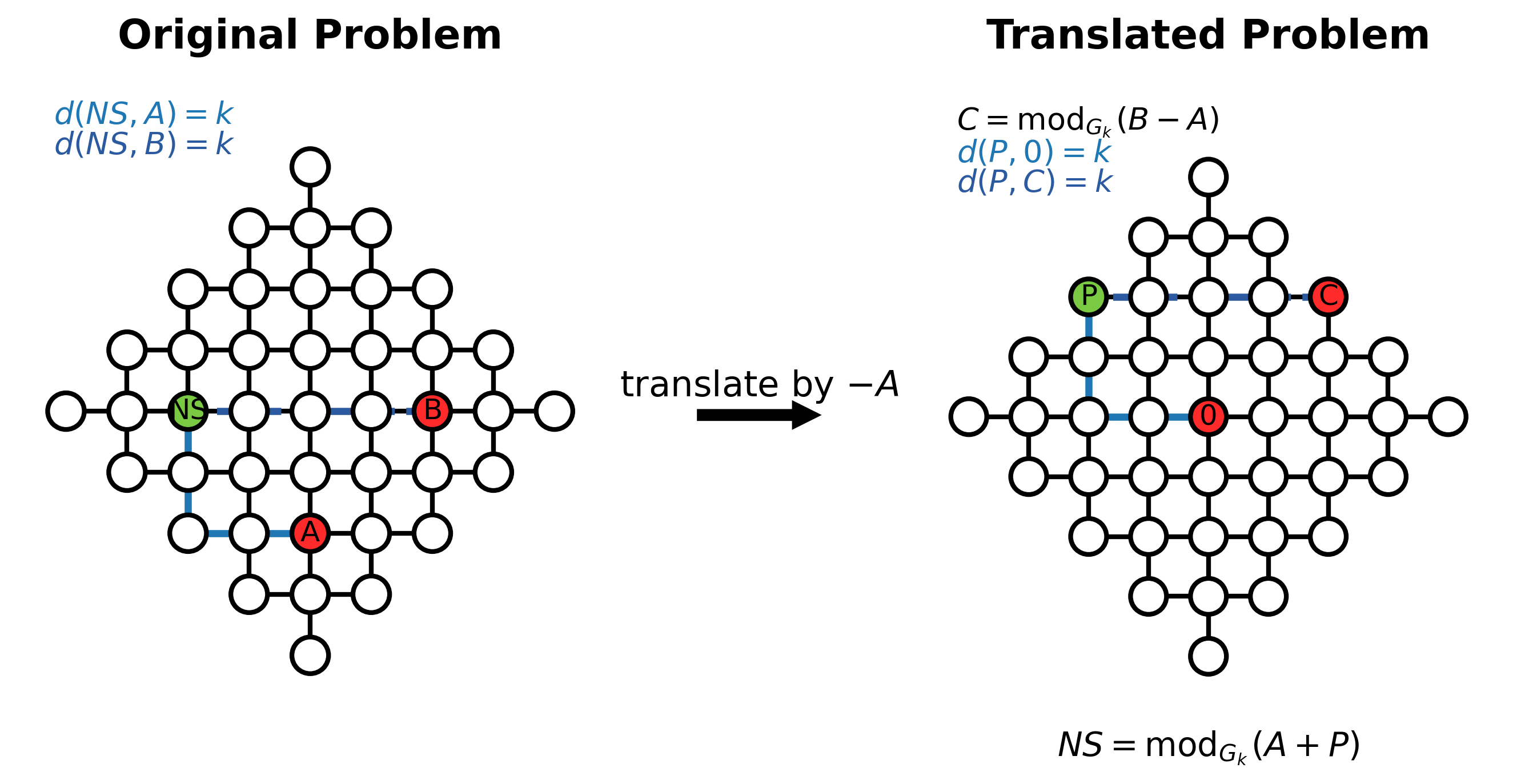
Figure 2: Translation of the two-fault new-source problem via difference node N=k2+(k+1)26, enabling reduction to a canonical boundary intersection.
Strong numerical results are reported: zero mismatches across 26,623 tested nodes for counting, 500,000/500,000 valid source selections for two-fault scenarios, and 40,000/40,000 successful re-rooted broadcast trials, confirming method correctness and coverage. The selector's runtime becomes increasingly superior with network size, achieving N=k2+(k+1)27 speedup over boundary search at N=k2+(k+1)28.
Practical and Theoretical Implications
This closed-form and constant-time re-rooting extension has several practical implications:
- Scalability: The algebraic approach maintains constant complexity, making it agnostic to network scaling, suitable for large N=k2+(k+1)29 and modern NoC architectures.
- Robustness: It guarantees at least four valid sources for any nonzero node, strengthening resilience claims for Gaussian networks.
- Implementation: Integer labeling and modular reduction integrate naturally into hardware/firmware, avoiding network scans or adaptive pathfinding.
- Algebraic Generalization: Future lattice-based interconnection topologies may inherit similar constant-time recovery paradigms, with direct construction replacing search.
Potential theoretical advancements include source ranking strategies among multiple valid candidates, adaptation to dynamic/link faults, and extension to more complex algebraic network types (e.g., Eisenstein--Jacobi lattices).
Conclusion
The paper delivers a significant step in fault-tolerant broadcasting in dense Gaussian networks by providing an algebraic, bounded, and network-size-independent source selection mechanism. The boundary-intersection count and shifted selector not only validate complete recovery for one- and two-fault cases but also establish constant-time complexity regardless of O(k)0, with rigorous computational corroboration across all tested scenarios. These results directly enhance the reliability and efficiency of interconnection network communication protocols and provide a mathematical foundation for future developments in algebraic network robustness and recovery algorithms.

