Re-Rooting-Based Fault-Tolerant One-to-All Broadcasting in Dense Eisenstein--Jacobi Networks
Published 17 Jun 2026 in cs.DC, cs.IT, and cs.NI | (2606.18712v1)
Abstract: Dense Eisenstein--Jacobi networks are degree-six algebraic interconnection topologies with regular structure, vertex symmetry, small diameter, and efficient communication algorithms. These properties make them suitable for parallel and on-chip communication systems in which collective operations such as one-to-all broadcasting are frequent. Existing optimal broadcasting algorithms for dense hexagonal/Eisenstein--Jacobi networks assume fault-free operation. However, a faulty internal forwarding node may interrupt message propagation and prevent complete delivery. This paper proposes a lightweight re-rooting-based fault-tolerant broadcasting method for dense Eisenstein--Jacobi networks. The main idea is to relocate the effective broadcast source to a new source node such that each faulty node is located at graph distance equal to the network diameter from the new source. Consequently, faulty nodes become leaf-level nodes in the broadcast process and are not required to forward the message. We present source-selection algorithms for one- and two-node failures and prove that for any pair of faulty nodes in a dense Eisenstein--Jacobi network there exists a common distance-diameter node that can serve as a valid re-rooted source. The source-selection procedure requires linear time in the network diameter. Equivalently, since $N=3t2+3t+1$, the selection cost is $O(\sqrt{N})$ in the number of nodes. Since the standard one-to-all broadcast completes in one diameter time and the relocation phase is also bounded by one diameter, the proposed method completes in at most twice the network diameter. We also show that the two-fault guarantee does not generally extend to arbitrary three-fault configurations by giving an explicit counterexample. The proposed approach improves broadcast reliability without constructing redundant spanning trees, backup paths, or additional broadcast structures.
The paper introduces a re-rooting method that relocates the broadcast source to ensure that one- and two-node failures occur as leaves, maintaining message delivery.
It leverages the degree-six hexagonal topology of Eisenstein–Jacobi networks to achieve efficient broadcasting within 2t steps and linear source-selection time.
Empirical evaluations demonstrate 100% broadcast success in fault-tolerant scenarios, showcasing its practical applicability in on-chip and distributed systems.
Fault-Tolerant One-to-All Broadcasting via Re-Rooting in Dense Eisenstein–Jacobi Networks
Network Architecture and Geometric Foundations
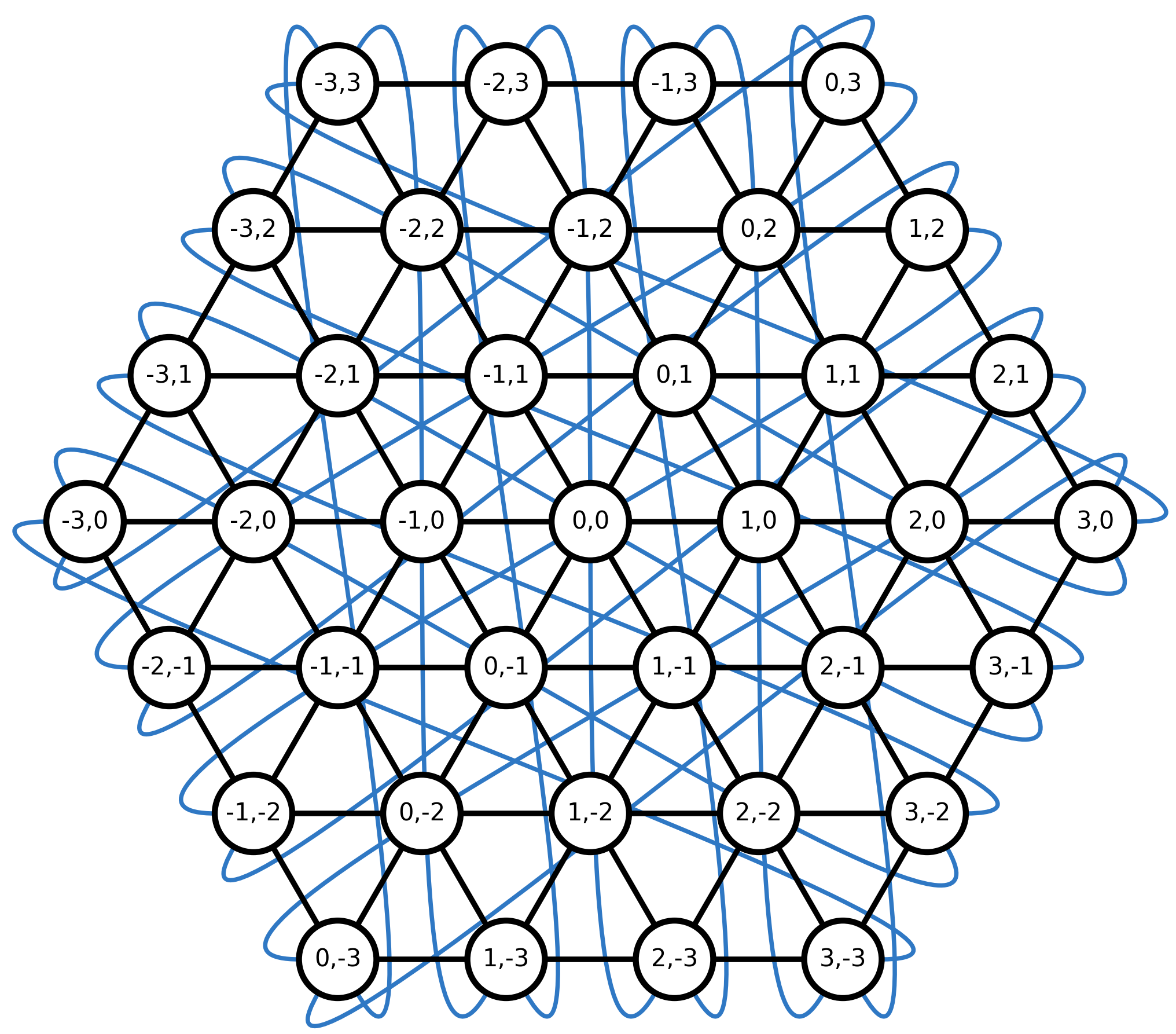
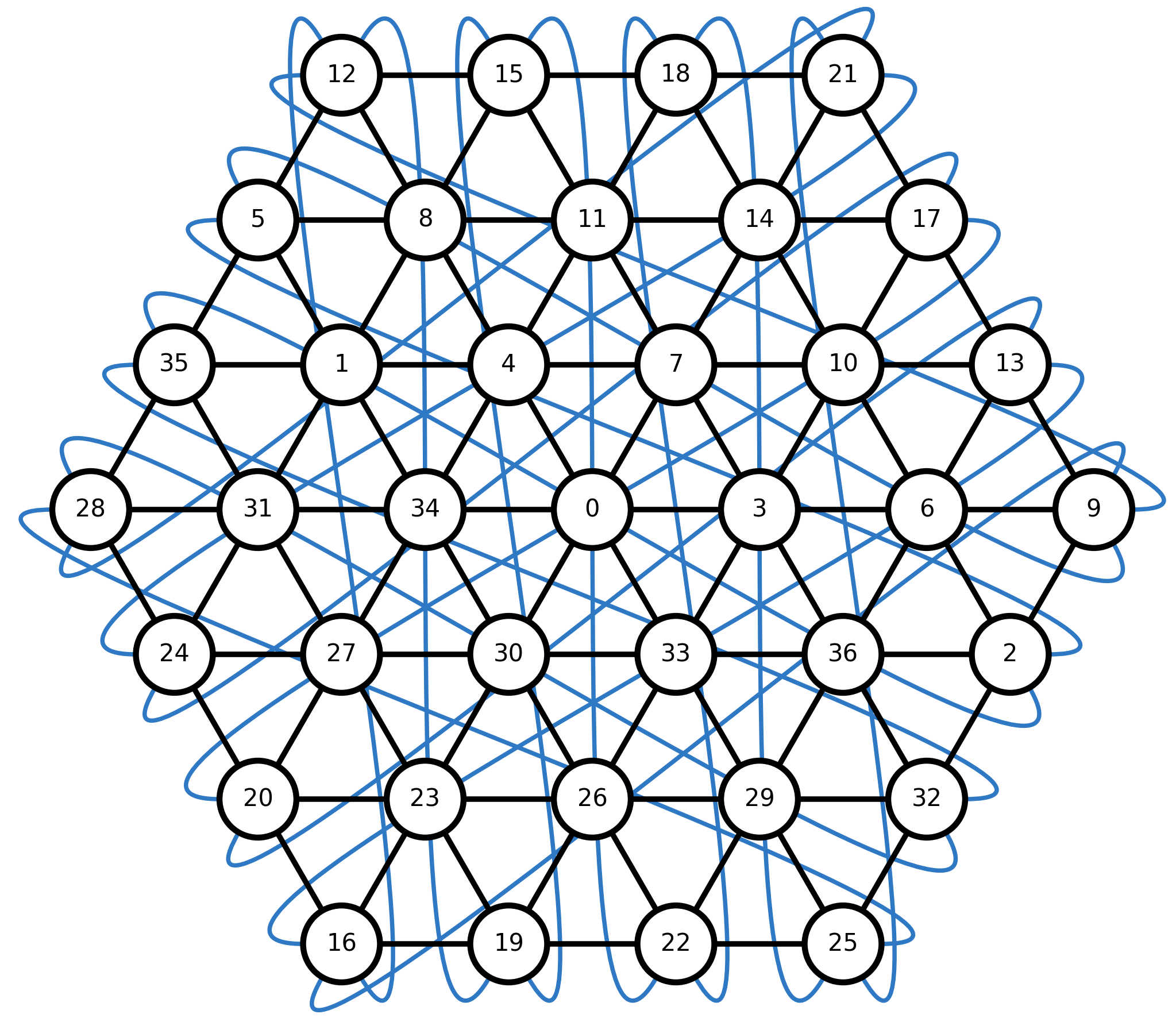
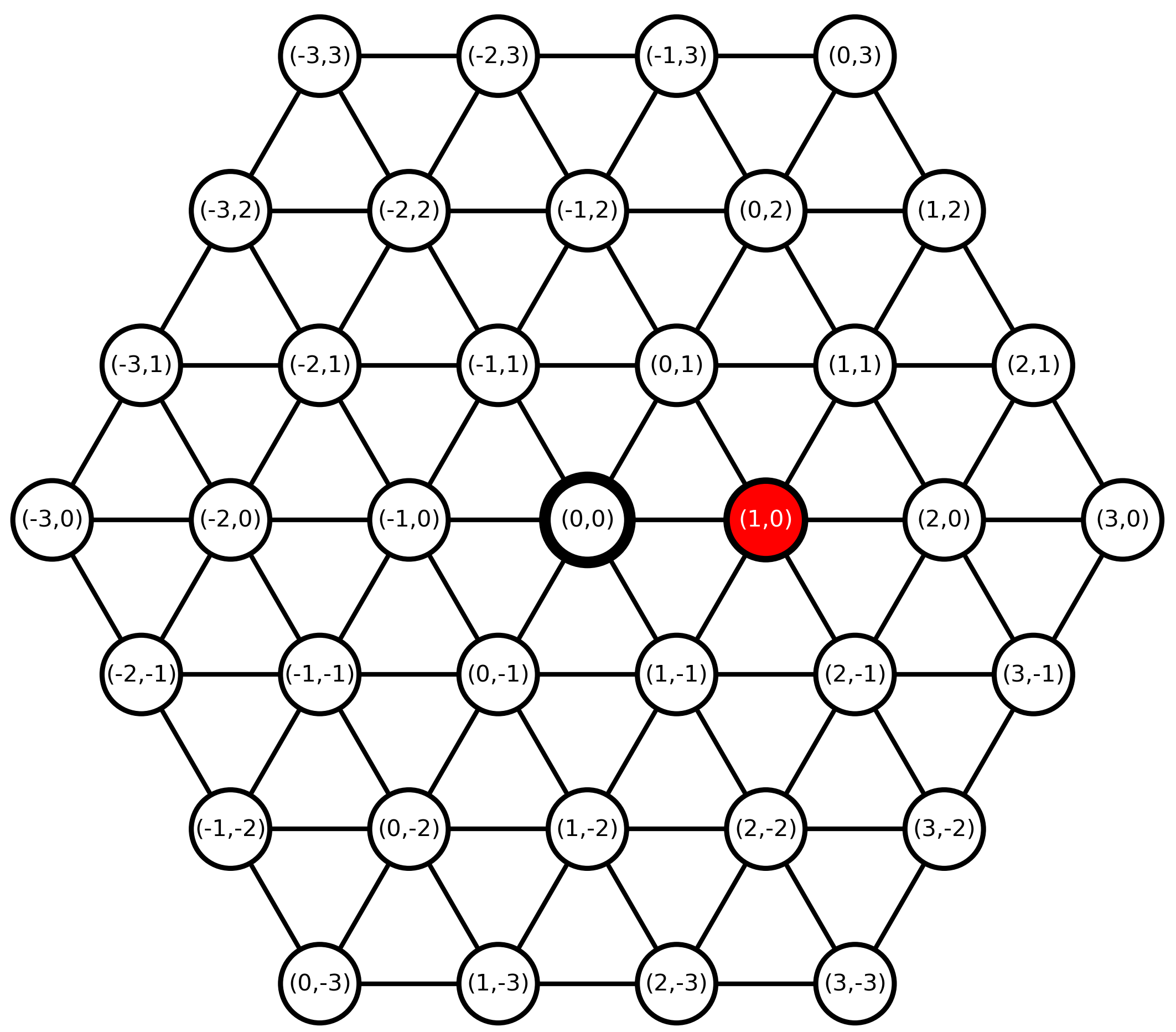
Dense Eisenstein–Jacobi (EJ) networks constitute degree-six hexagonal mesh topologies defined over the algebra of Eisenstein–Jacobi integers x+yω, where ω=21+i3. EJ networks are generated by α=n+(n−1)ω, yielding N=3n2−3n+1 nodes with diameter t=n−1. The network exhibits vertex-transitivity, high symmetry, and wrap-around connectivity, and every node is adjacent to six neighbors along the directions ±1, ±ω, and ±ω2. The hexagonal geometry facilitates regular broadcasting and efficient routing.
Figure 1: EJ coordinate representation of a dense hexagonal topology, highlighting node symmetry and sector directions.
Standard One-to-All Broadcasting Algorithm
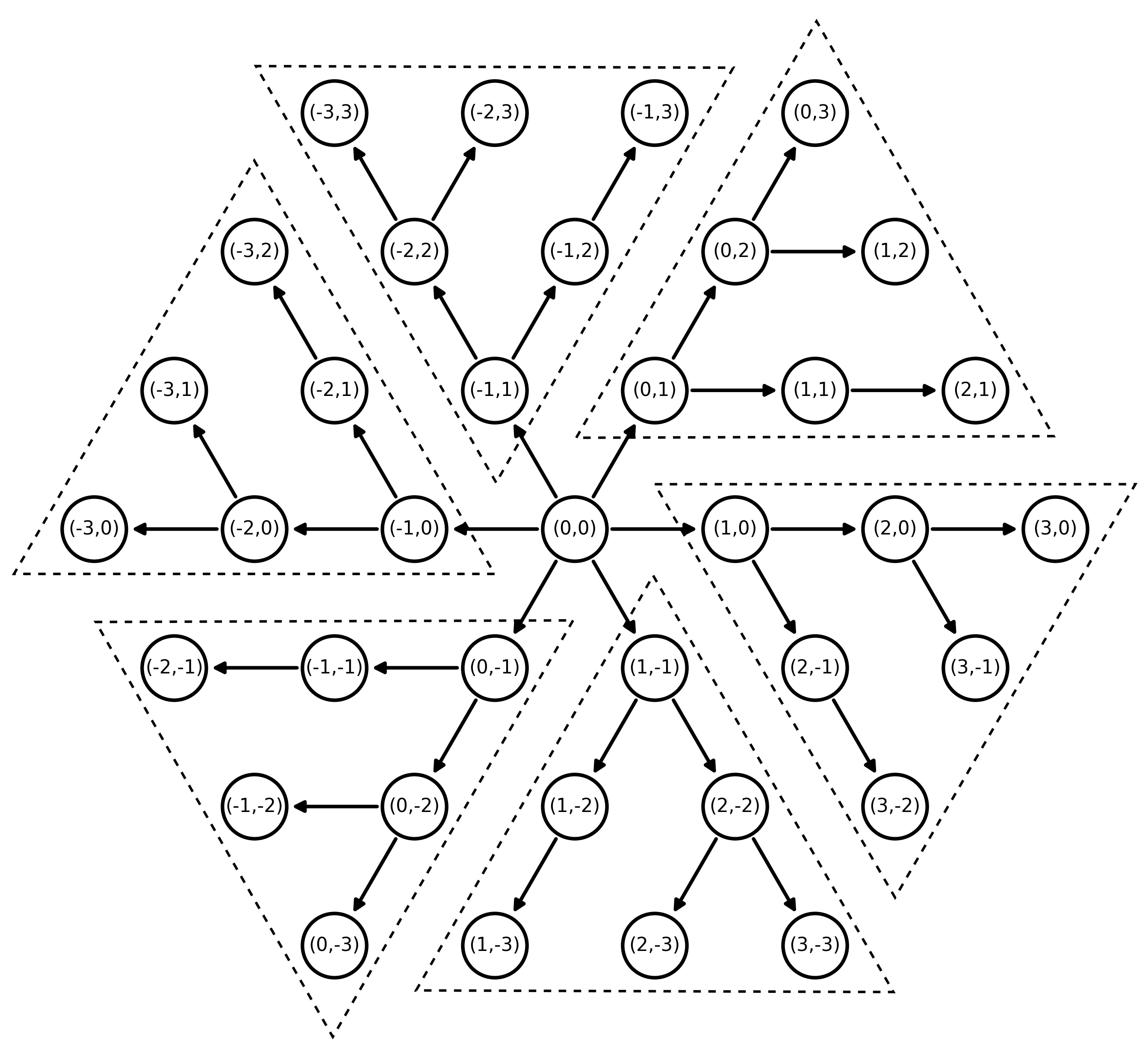
The baseline one-to-all broadcast algorithm exploits the degree-six structure by expanding the message through six directional sectors. The broadcast propagates in parallel, reaching nodes at increasing graph distances. At graph distance t, all boundary nodes are leaves—these nodes do not forward the broadcast further, preserving delivery without requiring redundant transmissions.
Figure 2: Tree-based broadcast in H4 proceeds sector-wise, with boundary nodes at distance ω=21+i30 acting as leaves.
The algorithm is optimal for the fault-free scenario, completing in ω=21+i31 steps, with exactly ω=21+i32 tree edges and no duplicate messages.
Vulnerability to Node Failures
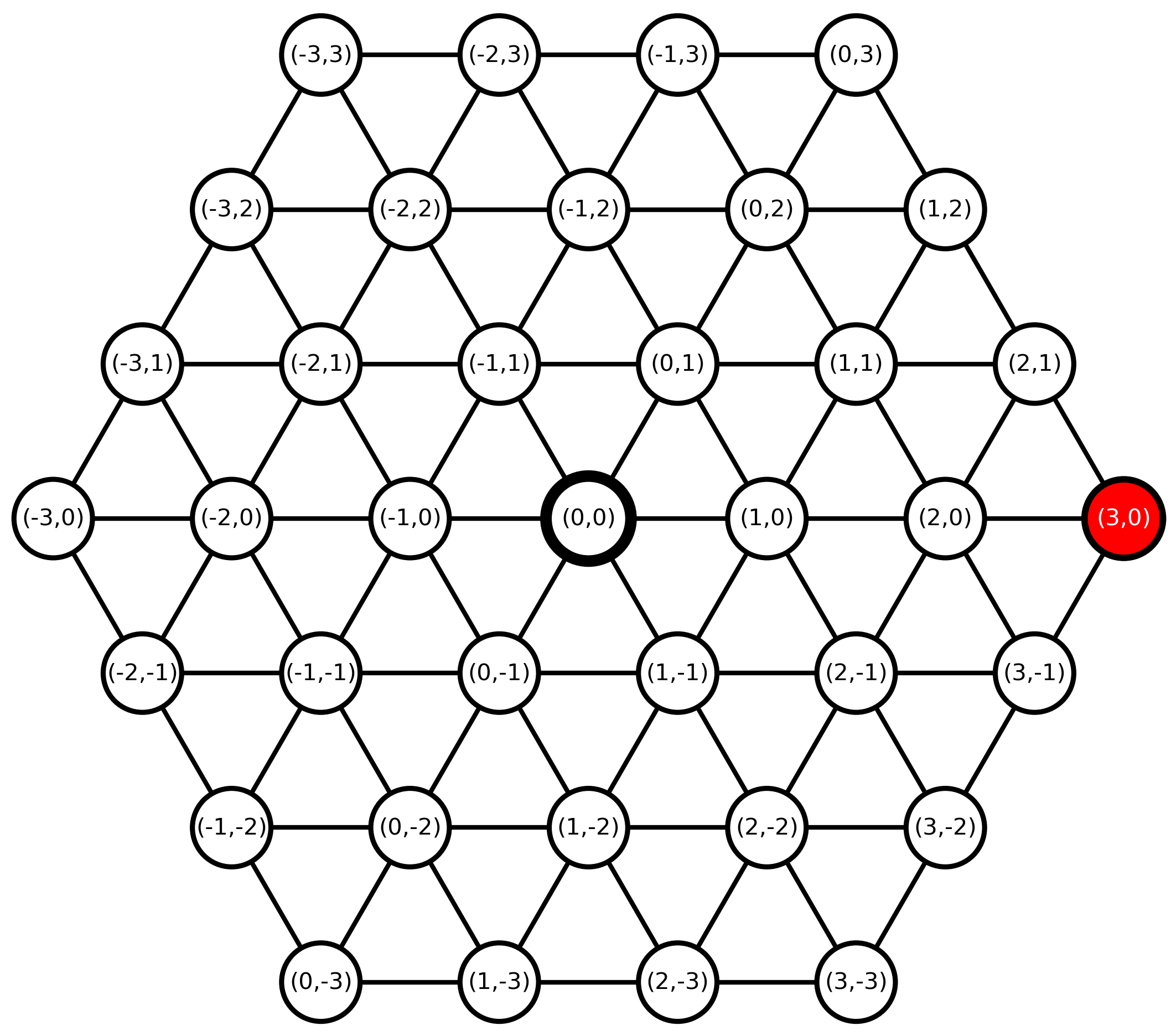
Under node failures, baseline broadcasting is susceptible to disruptions; if a faulty node resides at distance ω=21+i33 from the source, it may occupy an internal position in the broadcast tree, thus potentially interrupting message propagation to downstream nodes.
Figure 3: Classification of faulty node positions—boundary faults are harmless while internal faults disrupt propagation.
Re-Rooting Approach: Fault-Tolerant Broadcasting
This work introduces a topology-specific, lightweight re-rooting method for fault tolerance in EJ networks. The core idea is to relocate the broadcast source ω=21+i34 such that every faulty node ω=21+i35 is at graph distance ω=21+i36 from ω=21+i37. The relocated source ensures all faults occur at leaves of the broadcast tree, eliminating the necessity for the faulty nodes to forward messages and thereby maintaining broadcast integrity.
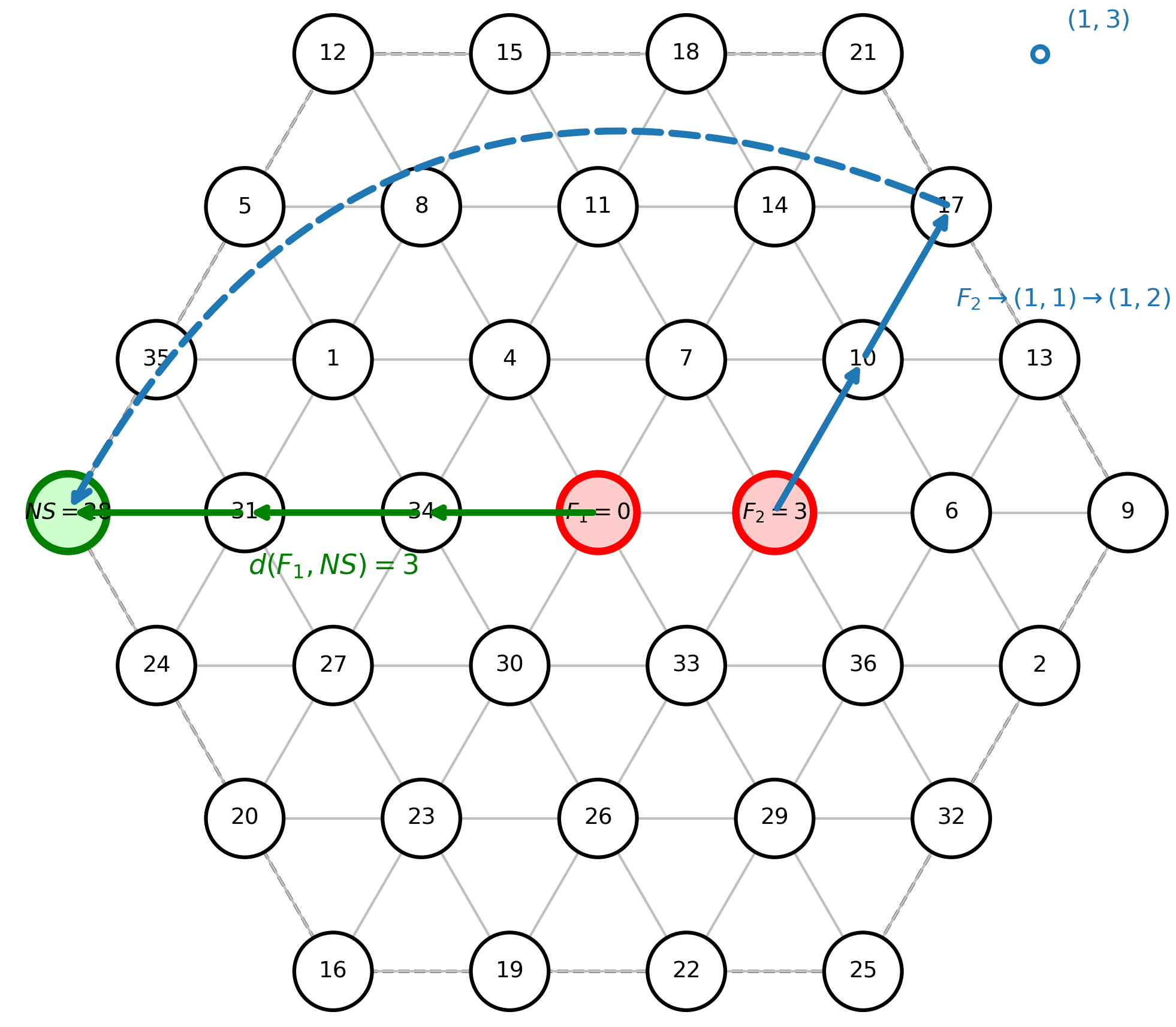
For a single fault ω=21+i38, a new source is any node in ω=21+i39, the distance-α=n+(n−1)ω0 boundary of α=n+(n−1)ω1. For two faults α=n+(n−1)ω2, the procedure leverages the boundary-difference property: for any pair, there exists an α=n+(n−1)ω3 such that α=n+(n−1)ω4. This is achieved by identifying α=n+(n−1)ω5 and constructing α=n+(n−1)ω6, where α=n+(n−1)ω7 is a boundary node solution to α=n+(n−1)ω8 for some α=n+(n−1)ω9.
Figure 4: Worked example of two-fault re-rooting in N=3n2−3n+10, demonstrating modular wrap-around and boundary placement.
Theoretical Results: Boundary-Difference Coverage and Guarantees
The efficacy is supported by a boundary-difference coverage theorem: in the dense EJ network, N=3n2−3n+11, allowing any node displacement to be represented as the difference between two boundary nodes. This foundation guarantees existence of a suitable N=3n2−3n+12 for any one or two-fault configuration.
However, this guarantee cannot generally be extended to three arbitrary faults; an explicit counterexample in N=3n2−3n+13 demonstrates that the intersection of three boundaries can be empty, precluding the existence of a single source with all three faults at distance N=3n2−3n+14.
Complexity Analysis
The source-selection algorithm for single- or double-fault scenarios is linear in the network diameter (N=3n2−3n+15) as it scans the N=3n2−3n+16 boundary nodes. Communication cost comprises delivering the message from the original source to N=3n2−3n+17 (at most N=3n2−3n+18 steps) plus the standard N=3n2−3n+19-step broadcast from t=n−10, giving a total worst-case time of t=n−11.
Experimental Evaluation
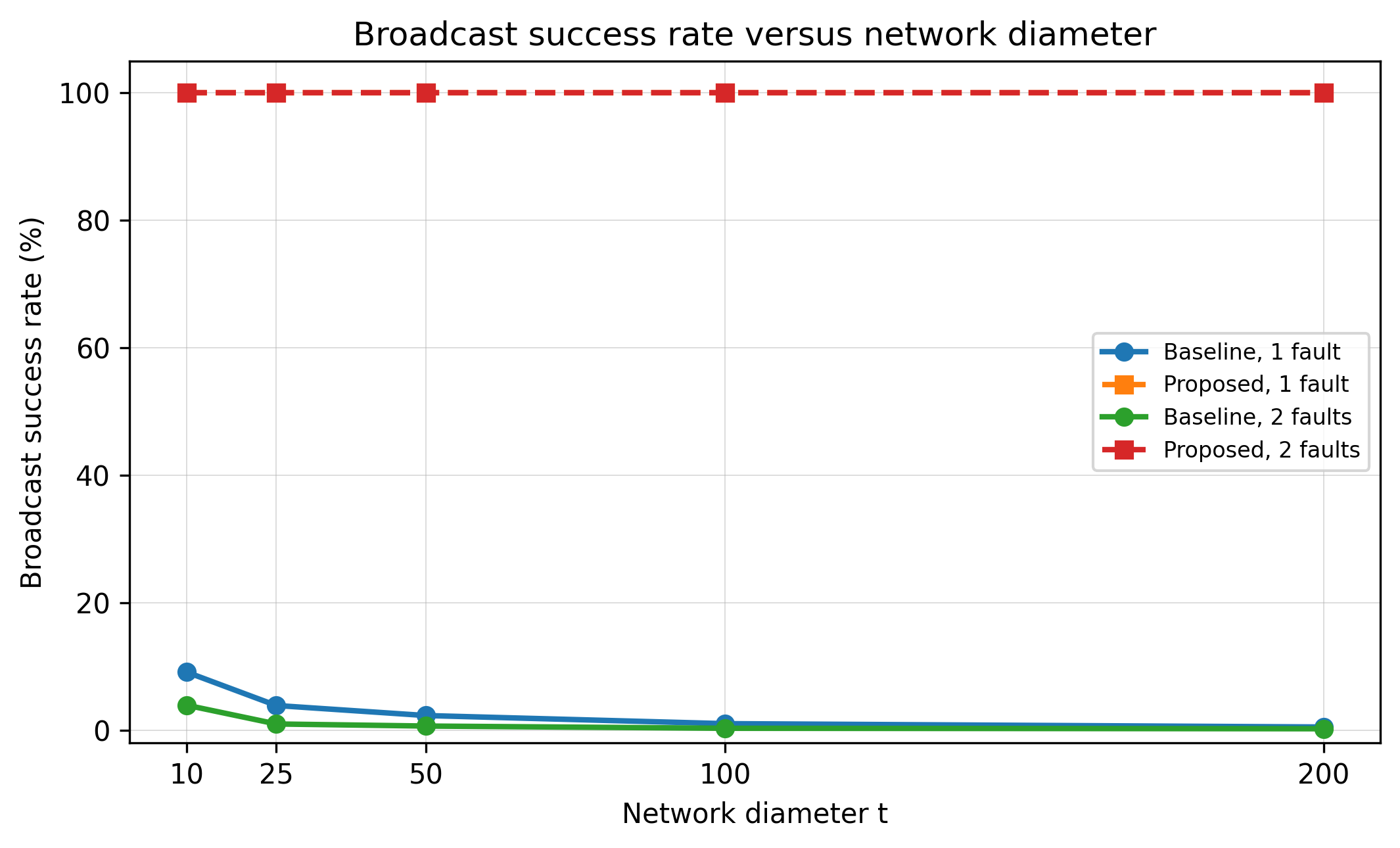
Simulations across t=n−12 (up to t=n−13) validate the practical effectiveness. In both one- and two-fault cases, the re-rooting method achieves t=n−14 broadcast success, while the baseline success rate drops as network diameter increases. No redundant path or spanning tree construction is required; delivery is deterministic under tested configurations, and reachability variation is zero for the re-rooting method.
Figure 5: Broadcast success rate remains at t=n−15 for the re-rooting method, but baseline reliability diminishes with network growth.
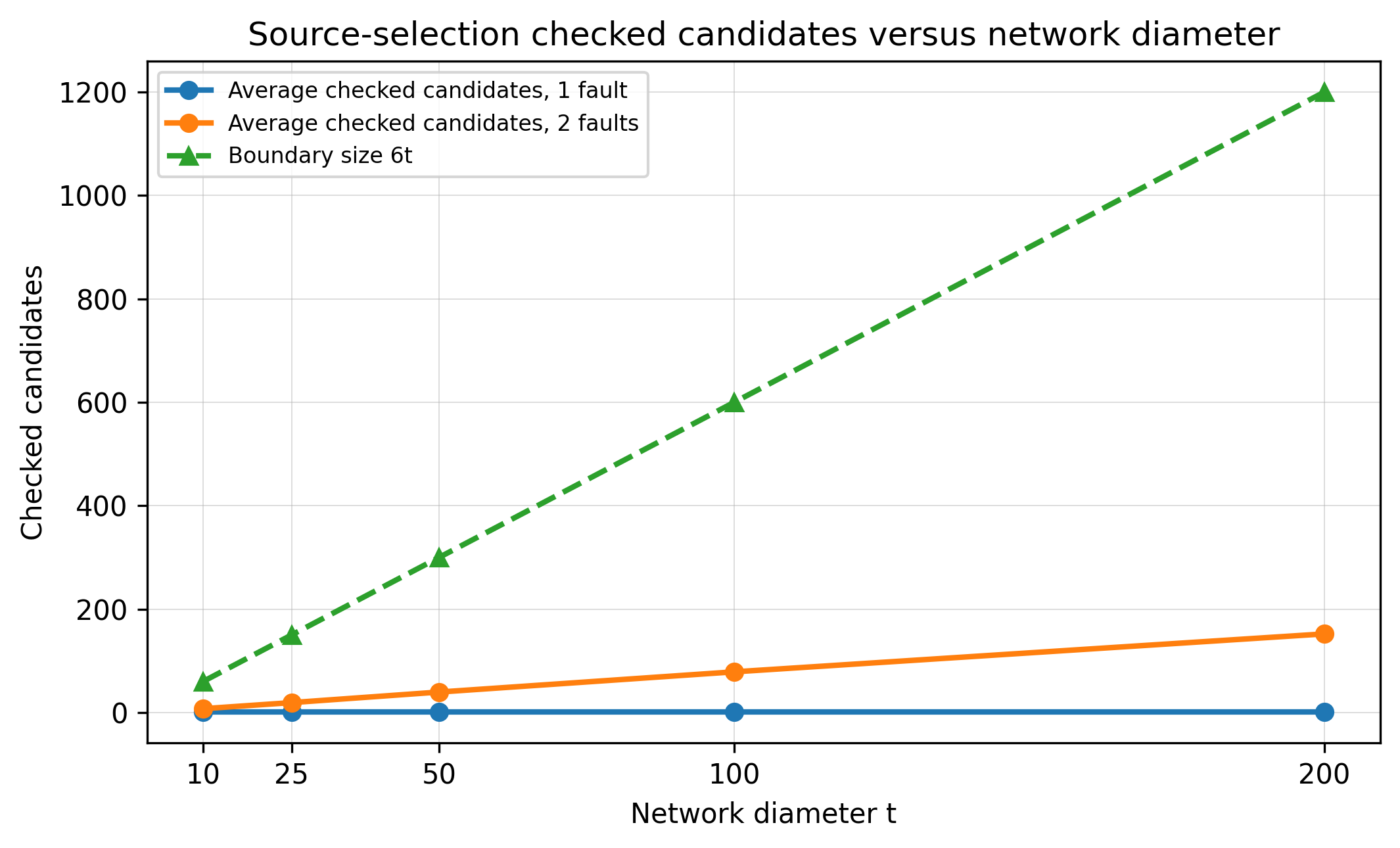
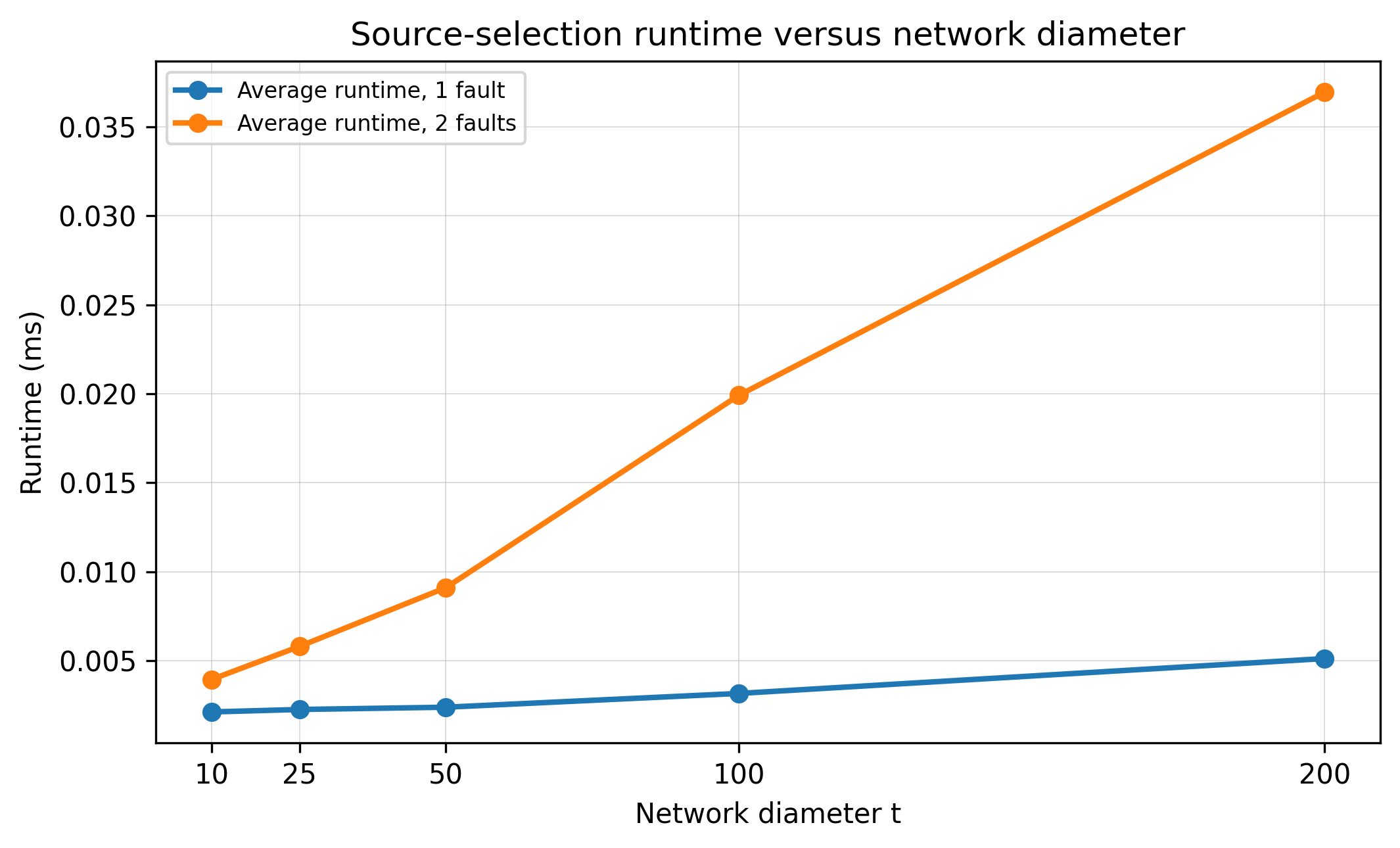
Computational overhead remains minimal. The number of checked candidates for t=n−16 is bounded by t=n−17, confirming algorithmic efficiency.
Figure 6: Empirical count of checked candidates for source selection across increasing diameter values remains linear.
Practical and Theoretical Implications
The re-rooting method offers deterministic, minimal-overhead fault tolerance in regular degree-six hexagonal meshes. Practical implications include simplified implementation and guaranteed reliability for on-chip-system and parallel-distributed architectures where static node failures of up to two nodes are common. There is no need for precomputed backup trees or runtime route adaptation, distinguishing the method from conventional fault-tolerant broadcasting strategies. The approach is limited in handling higher-order or dynamic failures, as well as link faults, but its algebraic-geometric underpinning opens avenues for further exploration in specialized topologies.
Conclusion
The paper establishes a re-rooting-based scheme for fault-tolerant broadcasting in dense Eisenstein–Jacobi networks, leveraging boundary-difference algebraic coverage to provide deterministic guarantees against one- and two-node failures, with formal proofs and empirical validation. The method exhibits sublinear source-selection time and bounded communication overhead. Limitations in handling higher-order faults are rigorously characterized. Future directions include algorithmic extension to link failures, partial three-fault configurations, and integration with hardware-level implementation benchmarks for comprehensive comparative analysis (2606.18712).
“Emergent Mind helps me see which AI papers have caught fire online.”
Philip
Creator, AI Explained on YouTube
Sign up for free to explore the frontiers of research
Discover trending papers, chat with arXiv, and track the latest research shaping the future of science and technology.Discover trending papers, chat with arXiv, and more.