- The paper’s main contribution is the execution-state capsule abstraction that checkpoint, restore, fork, and rollback LLM and embodied AI states.
- It demonstrates a methodology achieving flat time-to-first-token with up to 26.94x speedup over traditional KV-cache techniques like vLLM.
- The approach enables byte-exact state recovery and efficient multi-session branching, ensuring reliable low-latency physical-AI serving.
Execution-State Capsules: System-Level Checkpointing for Low-Latency Physical-AI Serving
Conceptual Framework and System Design
The paper introduces a new paradigm for LLM and physical-AI serving centered around the "execution-state capsule" abstraction (2606.20537). The principal innovation is explicit system-level state management for LLMs, embodied agents, and multimodal pipelines in interactive, low-latency, small-batch, and on-device deployment contexts.
Prior art such as vLLM's PagedAttention and SGLang's RadixAttention optimize for aggregate throughput via token-indexed KV-cache management. These mechanisms rely on block-table or radix-tree indirection for positional reuse, which precludes freezing the execution state as a self-contained object. Capsules move the unit of reuse from token-addressed KV fragments to graph-bound execution-state boundaries: a fixed set of contiguous static buffers representing KV, recurrent, convolutional, and metadata states, bound to the captured CUDA graph(s) and checkpointed as a binary blob.
FlashRT, the kernel-level runtime evaluated here, establishes a latency-focused substrate—a backend-facing pipeline with aggressive graph-capture, static buffer allocation, and hand-written CUDA kernels. Its cold time-to-first-token (TTFT) is $2.6$--2.8× lower than vLLM’s on identical hardware/model, defining a single-stream latency floor.
Capsule Mechanism and Operational Semantics
Capsules support four verbs: snapshot, restore, fork, and rollback. Snapshot freezes the entire graph-bound buffer set at a meaningful boundary (e.g., after a long prefix). Restore re-copies the buffer set, avoiding expensive recompute. Fork clones a boundary into N independent sessions with token-exact equivalence. Rollback restores a previous boundary, enabling state reversal for retry or undo.
The capsule abstraction turns prefix reuse from an expensive compute-bottleneck into a bandwidth-limited copy-and-rebuild operation, scaling linearly with capsule size rather than prefix length. The graph executable is strictly decoupled from the state blob; it's the combination that renders restore operations both cheap and byte-exact.
(Figure 1)
Figure 1: Runtime floor and state-reuse floor, identical model/GPU, single-stream; capsule preserves the latency floor across explicit boundaries.
Correctness Envelope and State Restoration
Correctness is multilayered: byte-wise buffer restoration, completeness (every buffer the forward pass depends on is checkpointed), and end-to-end token/action equivalence. The hybrid LLM model relies on non-positional recurrent and convolutional state (folds with no addressable block slices); ablation shows KV-only restoration diverges immediately (97.9% token mismatch). Exact replay requires chunk-alignment: boundary positions must be multiples of the chunk size, matching model-specific constraints for deterministic state recovery.
(Figure 2)
Figure 2: Embodied loop, single-stream, under comparable reported device residency; capsule TTFT remains flat as working set grows.
Numerical Results and Comparative Analysis
Single-stream TTFT/TTFA: On a 5090 GPU, capsule TTFT remains flat ($51$--$57$ ms) as prefix grows from $2$k to $16$k tokens (max speedup 26.94×), while cold prefill grows linearly ($200$--2.8×0 ms). Capsule restore and snapshot are sub-millisecond bandwidth-bound copies; append is a flat 2.8×1--2.8×2 ms.
vLLM Comparison: Capsule TTFT consistently beats vLLM APC under reuse (2.8×3--2.8×4 lower), and holds explicit pinning rather than ephemeral cache residency. Under typical physical-AI workloads (skill cycling, interrupts, branch/re-entry), vLLM falls back to cold latency when cache eviction occurs or session mismatches arise, while capsules preserve their performance envelope via explicit buffer management.
(Figure 3)
Figure 3: LLM+TTS barge-in, composed latency; capsule restores pinned persona, yielding 2.8×5 faster pipeline entry vs naive re-prefill.
Embodied Working Set: Capsules hold flat TTFT across large context sets (up to 2.8×6k tokens), leveraging explicit device residency. vLLM APC collapses under VRAM exhaustion or hybrid block-retention limits.
On-Device Replication: Results on Jetson AGX Thor and DGX Spark confirm the mechanism's architectural independence. Thor’s cold-to-capsule speedup ranges 2.8×7--2.8×8, Spark 2.8×9--N0, both maintaining flat capsule TTFT (N10.2 s).
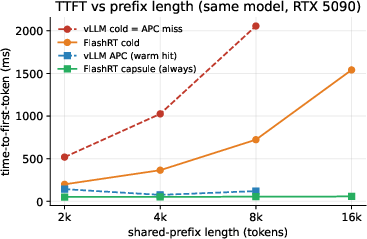
Figure 4: Cross-device, single-stream TTFT scaling; capsule speedup increases with prefix length, flat across hardware.
Implications and Structural Distinctions
This work shifts the serving design axis, privileging explicit execution-state retention/pinning/forking/rollback over automatic cache policy. Capsules enable scenarios—multi-turn coding agents with pinned long prefixes, embodied episode resets, tree-of-thought branching, planner-actor hand-offs—that block/radix KV caches cannot express as first-class operations without significant architecture augmentation.
Persistent, device-tiered capsules unify warm start, multi-session branching, and hybrid recurrent state recovery in one object, robust to cache eviction, process churn, or session interruption. Fork and rollback become byte-exact primitives, not dependent on positional-token heuristics.
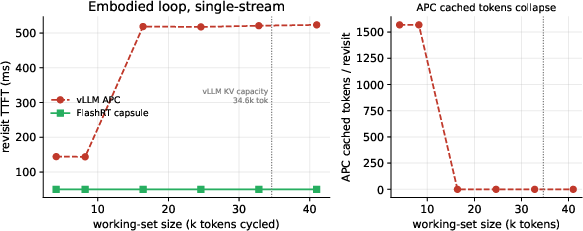
Figure 5: Embodied working set across hardware; capsule TTFT remains flat, APC retention collapses under VRAM constraints.
Limitations and Future Directions
Capsules are deployment-specific binary blobs, tightly bound to weights, quantization, and graph bucketing; portability is limited to identical deployments. Static buffer allocation and graph capture require bounded shape variants and fixed sequence lengths, unsuited to high-concurrency variable batching. Distributed cluster serving and decode throughput optimization remain out of scope.
Future research includes production-grade agent serving with dynamic prefix matching, broader serving-layer pinning policies, and full on-device/robotic evaluation, especially for safety-critical or irreversible physical-world settings.
Conclusion
By reifying the execution-state buffer set as a checkpointable capsule, the serving regime for interactive, low-latency, small-batch, and on-device AI gains explicit control of state persistence, recovery, and multi-session branching. The capsule mechanism is validated structurally and numerically, preserving hard responsiveness guarantees (TTFT/TTFA) across diverse domains under rigorous correctness criteria. The abstraction unifies LLM and embodied AI serving systems around explicit state management, providing a formal foundation for future low-latency, high-resilience interactive applications.