- The paper introduces a disk-backed, scalable retrieval framework that combines sparse lexical filtering with efficient late interaction to optimize memory and latency.
- It demonstrates a significant reduction in memory usage by 1–2 orders of magnitude and maintains sub-150 ms query latency on large-scale corpora.
- Empirical evaluations on multiple benchmarks confirm Stellar’s competitive recall and retrieval effectiveness compared to state-of-the-art multi-vector methods.
Stellar: A Scalable Framework for Multimodal Document Retrieval
Retrieval-Augmented Generation (RAG) systems require effective retrieval from multimodal document corpora in response to natural language queries. Existing state-of-the-art methods employ multi-vector representations and late interaction mechanisms for high retrieval effectiveness, but incur significant memory and latency costs—especially at scale—due to the necessity of keeping extensive token-level embeddings in memory. Stellar is introduced to address these deficiencies by enabling scalable, efficient, and effective multimodal document retrieval for large-scale corpora, leveraging disk-backed storage and sparse lexical filtering.
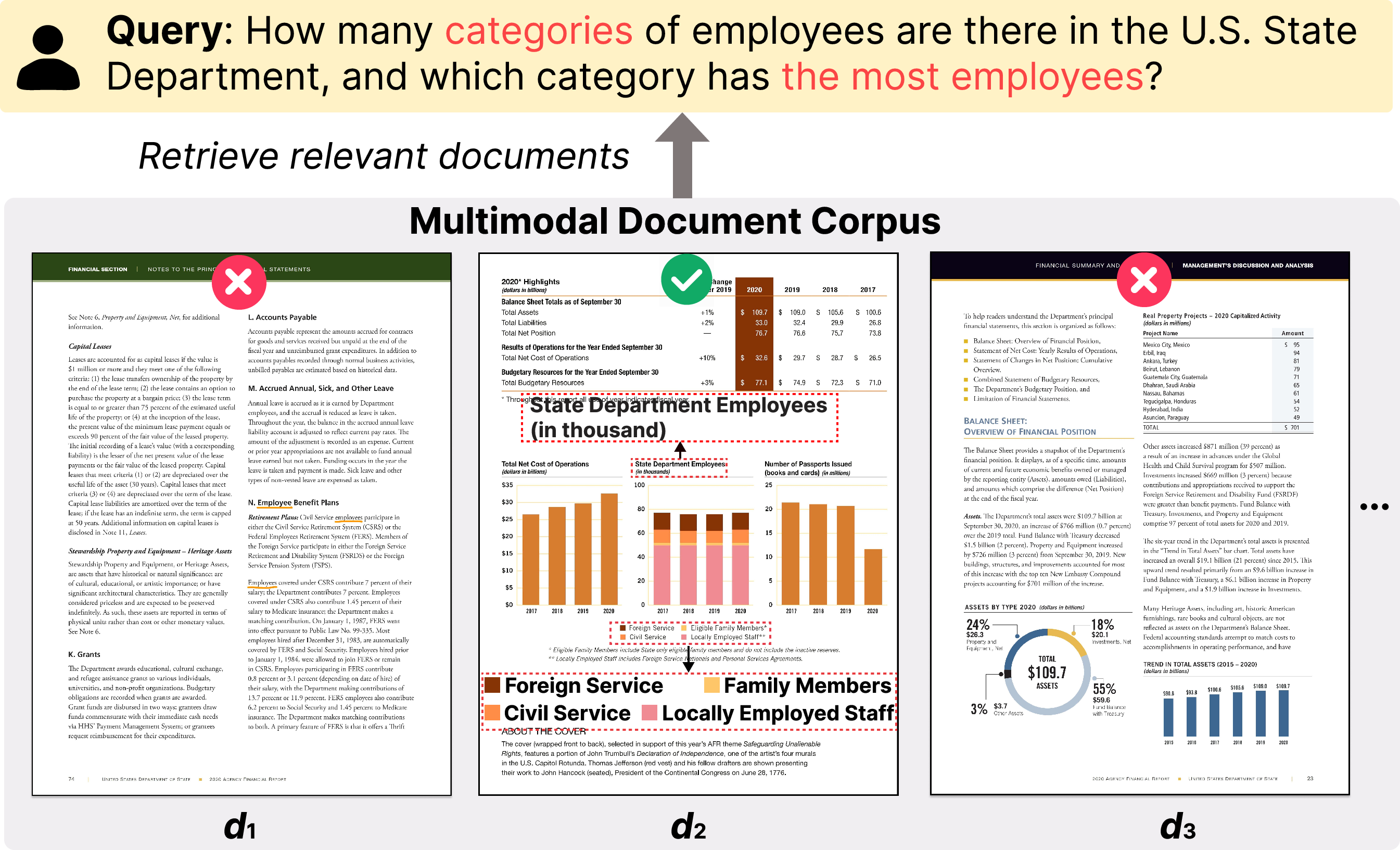
Figure 1: Multimodal document retrieval for NL queries.
Prior Representational Paradigms
Conventional approaches either rely on single-vector representations, which lack semantic granularity, or multi-vector late interaction models, which are memory-intensive. The latter, as exemplified by ColPali, require all token embeddings resident in memory, resulting in unsustainable costs for large corpora. Attempts to mitigate these drawbacks with quantization-based retrieval trade off accuracy and still exhibit scaling inefficiencies. Stellar proposes a paradigm shift: embeddings are stored on disk and selectively loaded into memory, fundamentally optimizing both retrieval and infrastructure constraints.
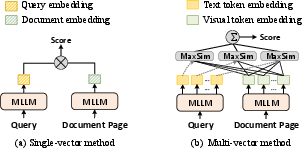
Figure 2: Single-vector vs. multi-vector (late interaction) methods; multi-vector models capture fine-grained semantics but are memory-intensive.
Stellar Framework Architecture
Stellar consists of two synergistic components:
- Lexical Representation-based Filtering (LRF): Documents and queries are projected into a unified sparse lexical space using a fine-tuned MLLM. The sparse encoder leverages the model's pre-trained language head, and achieves high sparsity through contrastive learning and FLOPs-based regularization, supporting efficient in-memory inverted index-based filtering.
- Efficient Disk-backed Late Interaction (DLI): Token-level embeddings are organized on disk via balanced clustering in semantic space, maximizing sequential I/O and load efficiency. A cost-aware loading strategy dynamically chooses between full block loading and selective vector access based on corpus, query, and candidate distributions. Sparse-dense score fusion integrates retrieval signals for final ranking.
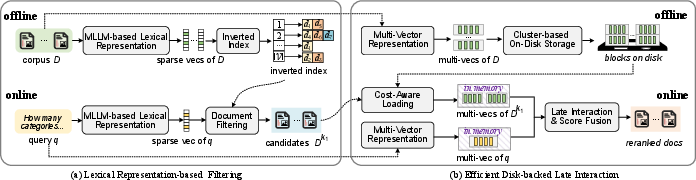
Figure 3: Overview of Stellar showing components for lexical filtering and disk-backed late interaction.
Lexical Representation-based Filtering
The lexical encoder maps documents and queries to high-sparsity vectors in the vocabulary space of the MLLM, enabling effective filtering in milliseconds via compact inverted indexes. Max pooling extracts salient lexical features; in-batch contrastive learning aligns representations for retrieval. Empirical results indicate typical sparsity rates above 99.8% (see Figure 4), enabling large-scale filtering with minimal memory footprint.
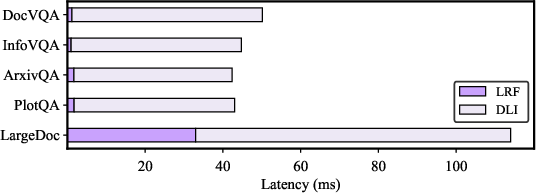
Figure 5: Runtime of LRF and DLI shows consistently low latency, even at scale.
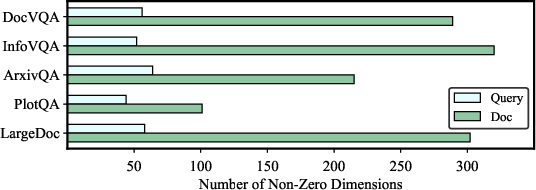
Figure 4: Average non-zero dimensions (~200/151,936) in sparse lexical representations; high sparsity facilitates efficient filtering.
Disk-backed Late Interaction and Storage Optimization
Stellar organizes token embeddings on disk using balanced clustering, ensuring semantic locality and uniform block sizes. The cost-aware data loading model, leveraging on-disk index structures, chooses optimal I/O strategies per query and candidate subset. This enables low-latency retrieval and scalable token-level late interaction without memory blowup.
Empirical Evaluation and Scalability
Stellar was evaluated on four established multimodal document benchmarks and the LargeDoc benchmark, encompassing 400,000 documents. Across Recall@1, Recall@10, and MRR@10 metrics, Stellar consistently matches or exceeds prior state-of-the-art multi-vector models, even while reducing peak memory usage by 1–2 orders of magnitude. Query latency is similarly improved, achieving sub-150 ms even at 400K scale.

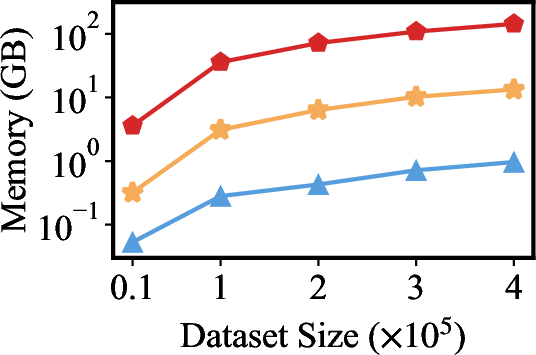
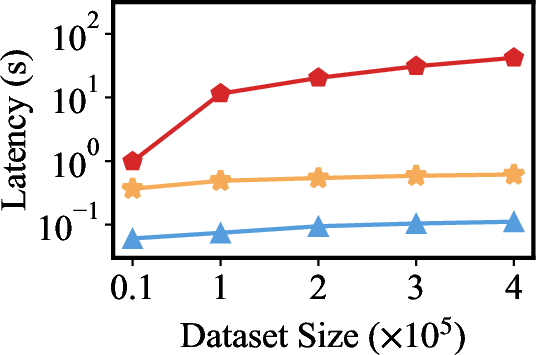
Figure 6: Scalability study—Stellar exhibits sublinear growth in memory and latency with corpus size; contrasting sharply with prior multi-vector methods.
Filtering Efficiency and Score Fusion
Stellar's lexical filtering outperforms dense filtering baselines in recall while using less memory and runtime, as seen in experimental comparisons. Sparse-dense score fusion is validated by ablation studies: removing fusion reduces accuracy substantially, affirming the complementary nature of lexical and dense token signals.

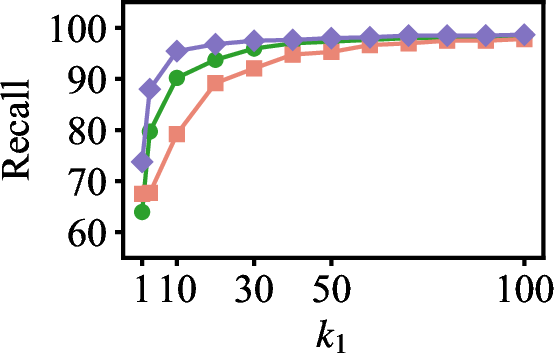
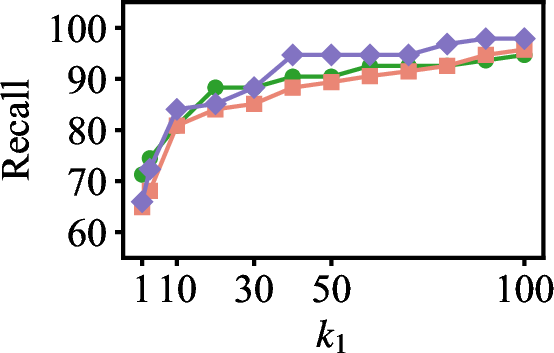

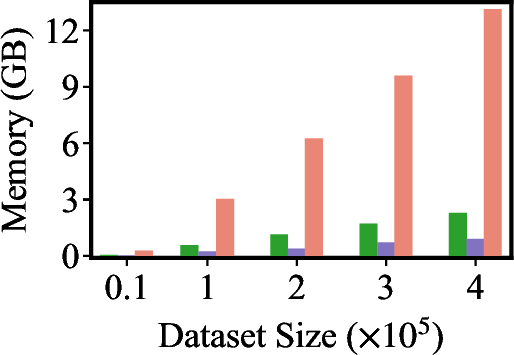
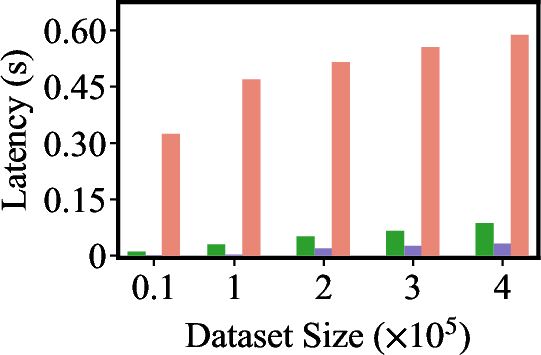
Figure 7: Filtering methods—lexical filtering achieves higher recall and lower resource usage compared to dense baselines.
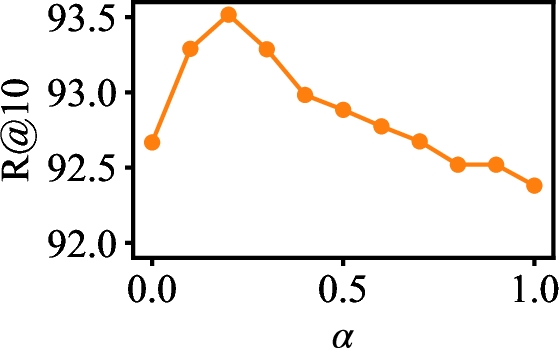
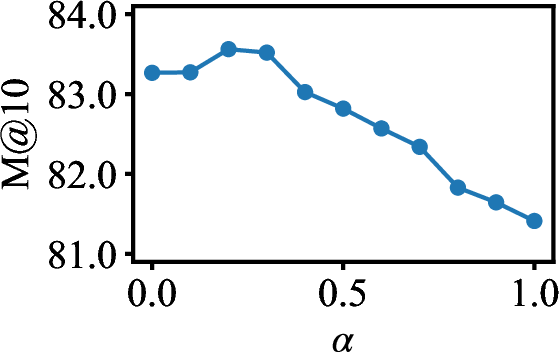
Figure 8: Sensitivity analysis of fusion weight α; optimal retrieval balances sparse and dense scores.
Practical and Theoretical Implications
Stellar demonstrates that disk-backed retrieval with sparse lexical filtering enables practical deployment of late interaction multi-vector models at unprecedented scale, obviating memory constraints and reducing infrastructure costs for large RAG systems. The representational and storage co-design is transferable to other multimodal retrieval tasks and can be extended for multi-document retrieval, hardware-aware optimizations, and real-time inference scenarios.
Conclusion
Stellar provides a scalable solution for multimodal document retrieval, combining sparse lexical filtering and efficient disk-backed late interaction. The empirical results confirm its superiority in scalability and competitiveness in retrieval effectiveness. Future research may focus on further optimizing disk-to-memory transfer, adaptive caching strategies, and expansion to multi-document and cross-modal retrieval settings.
Reference: "Stellar: Scalable Multimodal Document Retrieval for Natural Language Queries" (2606.19960)