- The paper introduces a rigorous framework for shared-relay fault tolerance by formalizing the shared-relay multiplicity metric and cyclic difference multiplicity in circulant networks.
- It presents algorithmic strategies including greedy generator construction and relay-table lookup techniques to optimize relay redundancy within practical degree constraints.
- Empirical studies confirm that optimized relay sets yield strong adversarial and random-failure guarantees, enhancing robustness for on-chip and distributed network applications.
Fault-Tolerant Shared-Relay Communication in Circulant Interconnection Networks
Overview
The paper "Fault-Tolerant Shared-Relay Communication in Circulant Interconnection Networks" (2606.19833) introduces a rigorous framework for relay-assisted local robustness in directed circulant networks. The authors formalize the shared-relay multiplicity metric as a degree–redundancy landscape, define operational parameters for worst-case relay redundancy, and establish the equivalence between network-layer relay-fault tolerance and cyclic difference multiplicity. Extensive empirical studies and algorithmic techniques are developed to quantify and optimize relay sets for robust communication.
Shared-Relay Multiplicity and Degree–Redundancy Landscape
The central primitive is the shared relay: for any ordered pair of terminals (u,v), a relay r is shared if r→u and r→v. The key operational metrics are:
- R(n,m): The best worst-case shared-relay multiplicity achievable on n nodes with circulant degree m.
- Df(n): The minimum degree required to guarantee f-relay-fault tolerance, i.e., at least f+1 shared relays for every terminal pair.
The network design objective is to maximize r0 or minimize r1 under practical degree constraints.
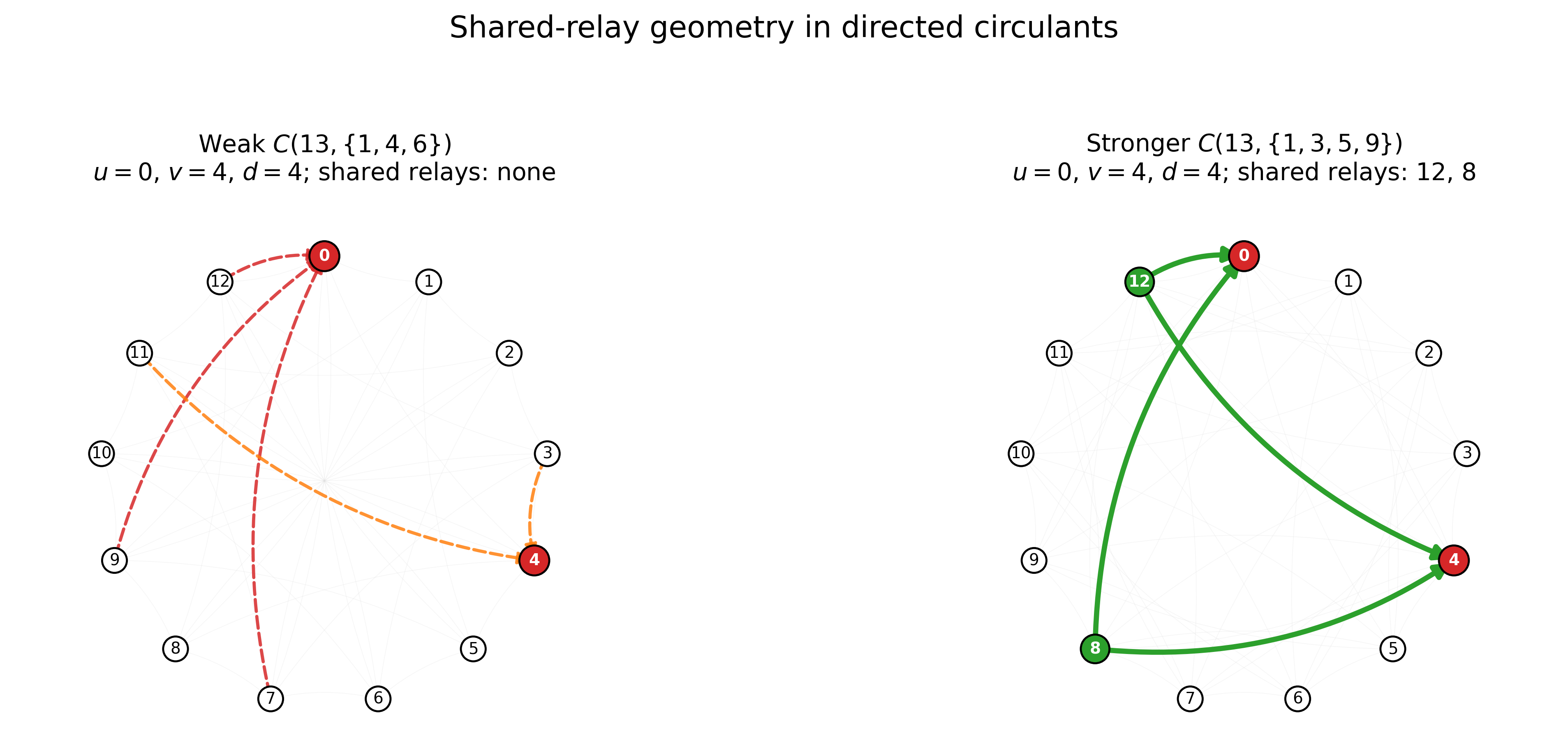
Figure 1: Shared relay sets in small directed circulant networks, illustrating how generator choice affects relay redundancy for the same terminal offset.
Relay-fault tolerance is shown to be equivalent to cyclic difference multiplicity: for circulant generator set r2, the count r3 of ordered pairs r4 with r5 gives the number of relays for offset r6 (Theorem 1). Thus, optimal relay sets are intimately connected to explicit difference bases in r7.
Structural Results and Generator Set Analysis
A negative theorem is proven for interval generators: if r8, simple interval sets r9 leave r→u0 nonzero offsets with zero relay coverage. Therefore, interval sets are poor for worst-case relay redundancy.
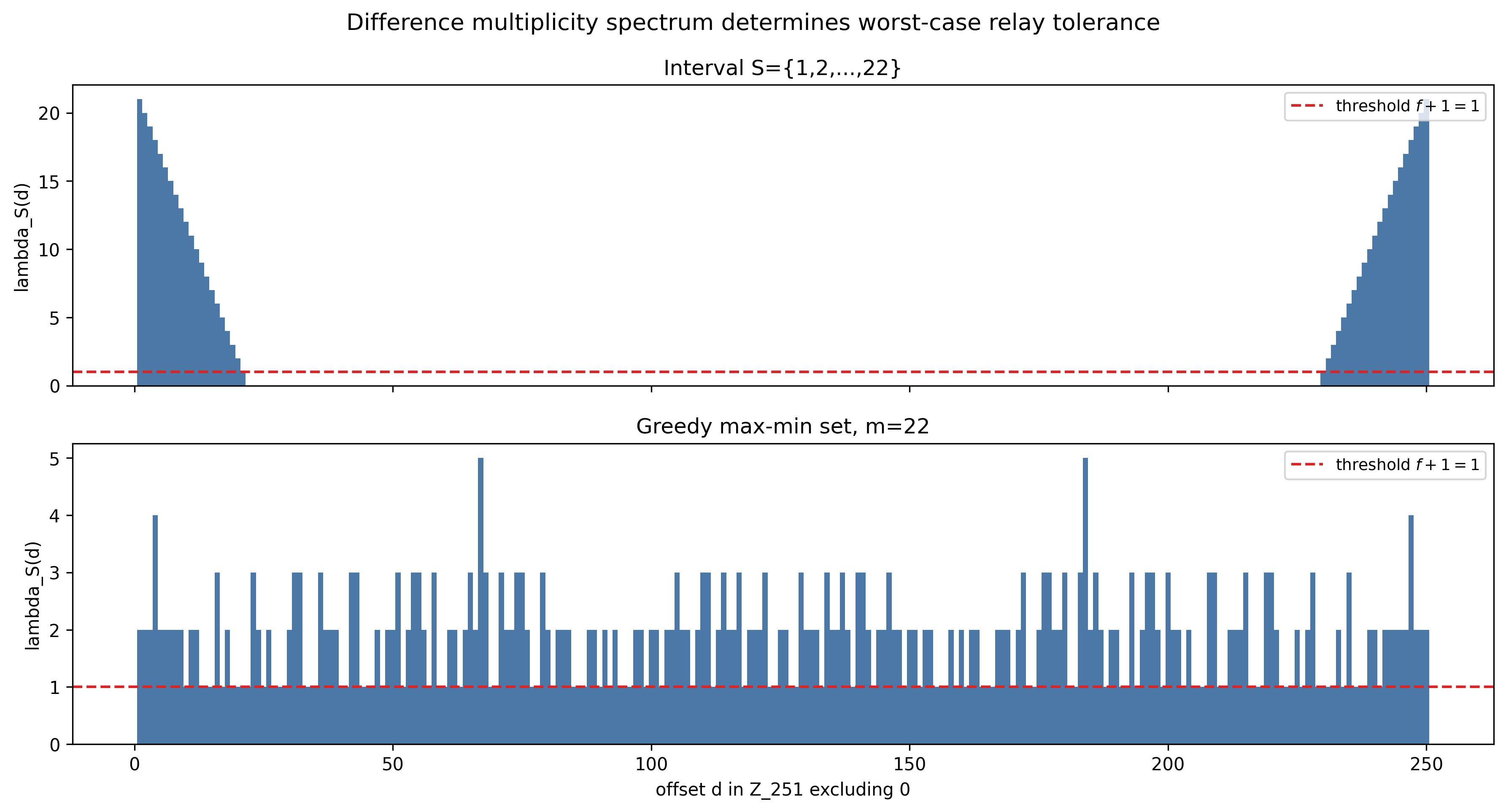
Figure 2: Difference-multiplicity spectra for degree-22 generator sets on r→u1: interval sets leave many offsets below threshold, while optimized greedy sets ensure every offset is covered.
Certified upper bounds (Corollary 11) can be verified in polynomial time. Greedy heuristics are effective for practical design, and their outputs are validated exactly. Empirical results show that optimized generator choices yield worst-case relay multiplicity within r→u2–r→u3 times the counting lower bound r→u4, substantially outperforming interval families.
Failure Models: Adversarial and Random
The deterministic adversarial guarantee is that with r→u5, at most r→u6 relay failures cannot disconnect any terminal pair, guaranteeing a surviving relay per pair (Theorem 7). Random relay failures are analyzed: survival probability for terminal pair with r→u7 relays and r→u8 random failures is r→u9; independent node failures yield pairwise failure probability r→v0. Empirical simulations demonstrate mean survival probabilities above r→v1, even with up to r→v2 random relay failures. However, the adversarial threshold r→v3 remains the safety-critical guarantee.
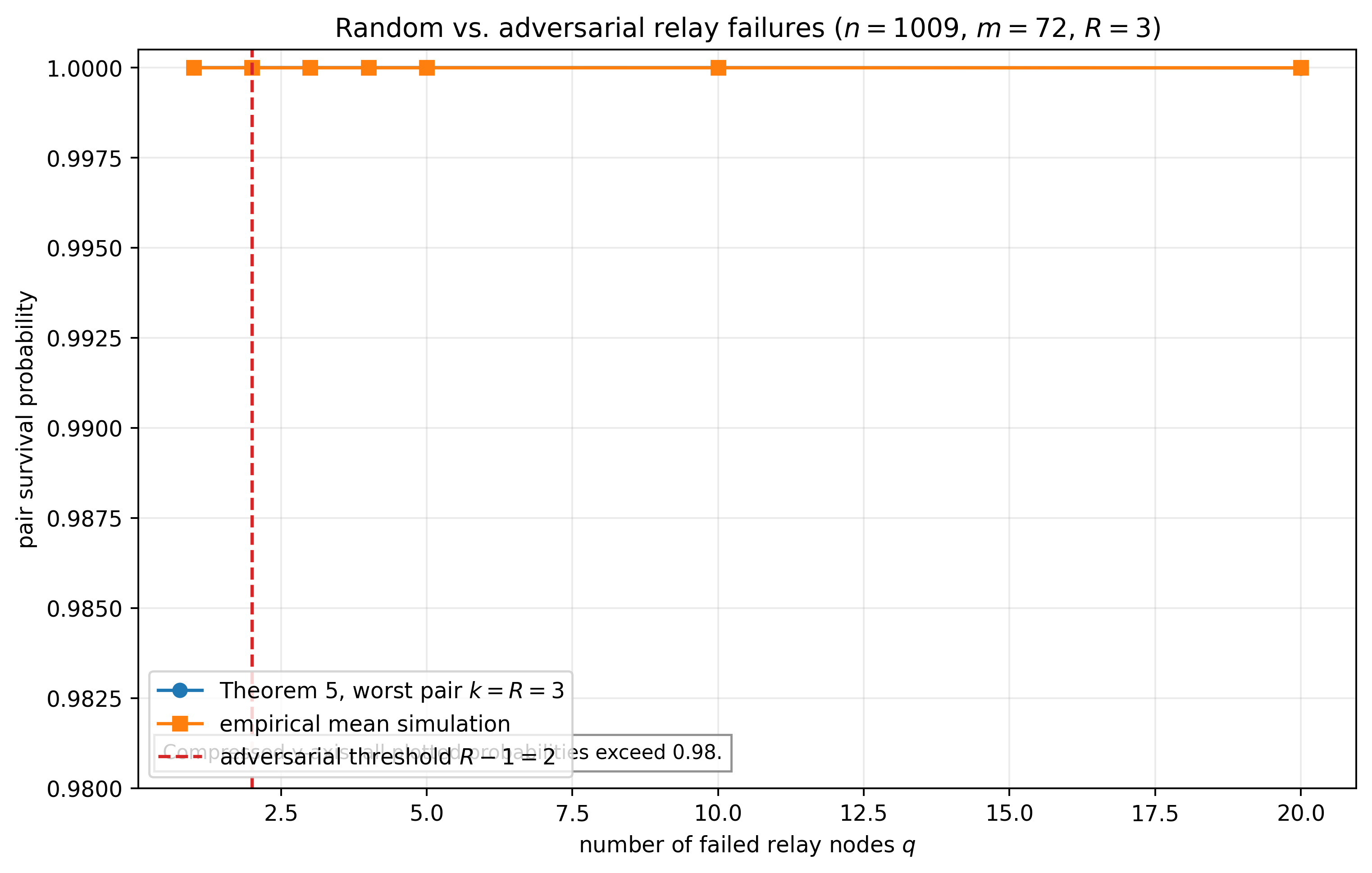
Figure 3: Probability of terminal pair survival under random versus adversarial relay failures for a greedy r→v4 design; random failure survival remains high past adversarial threshold.
Relay Tables, Lookup, and Load-Balancing Algorithms
Efficient relay recovery via precomputed relay-offset tables is proposed: for offset r→v5, table r→v6 stores all relay generator pairs. Lookup cost is r→v7, much lower than graph-search rerouting (r→v8), supporting fast recovery of surviving relays. Load-aware selection and translation-invariant balance policies are formalized for relay assignment.
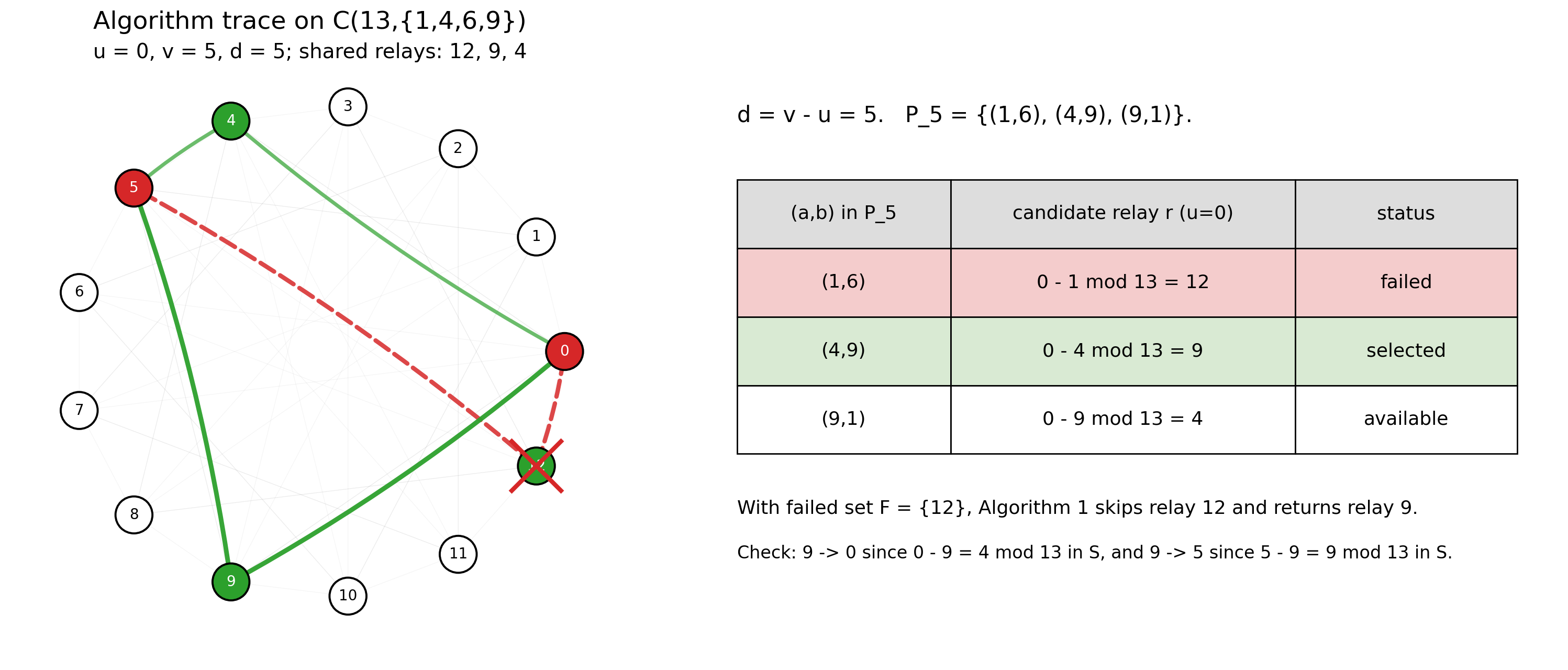
Figure 4: Worked algorithm trace for relay lookup: failed relays are skipped, and the first surviving relay is determined.
Greedy Generator Construction and Empirical Calibration
A vectorized greedy heuristic is used to construct optimized generator sets, prioritizing coverage of minimum-multiplicity offsets. Empirical studies across r→v9 and R(n,m)0 show convergence traces and demonstrate that greedy designs achieve threshold multiplicity efficiently.
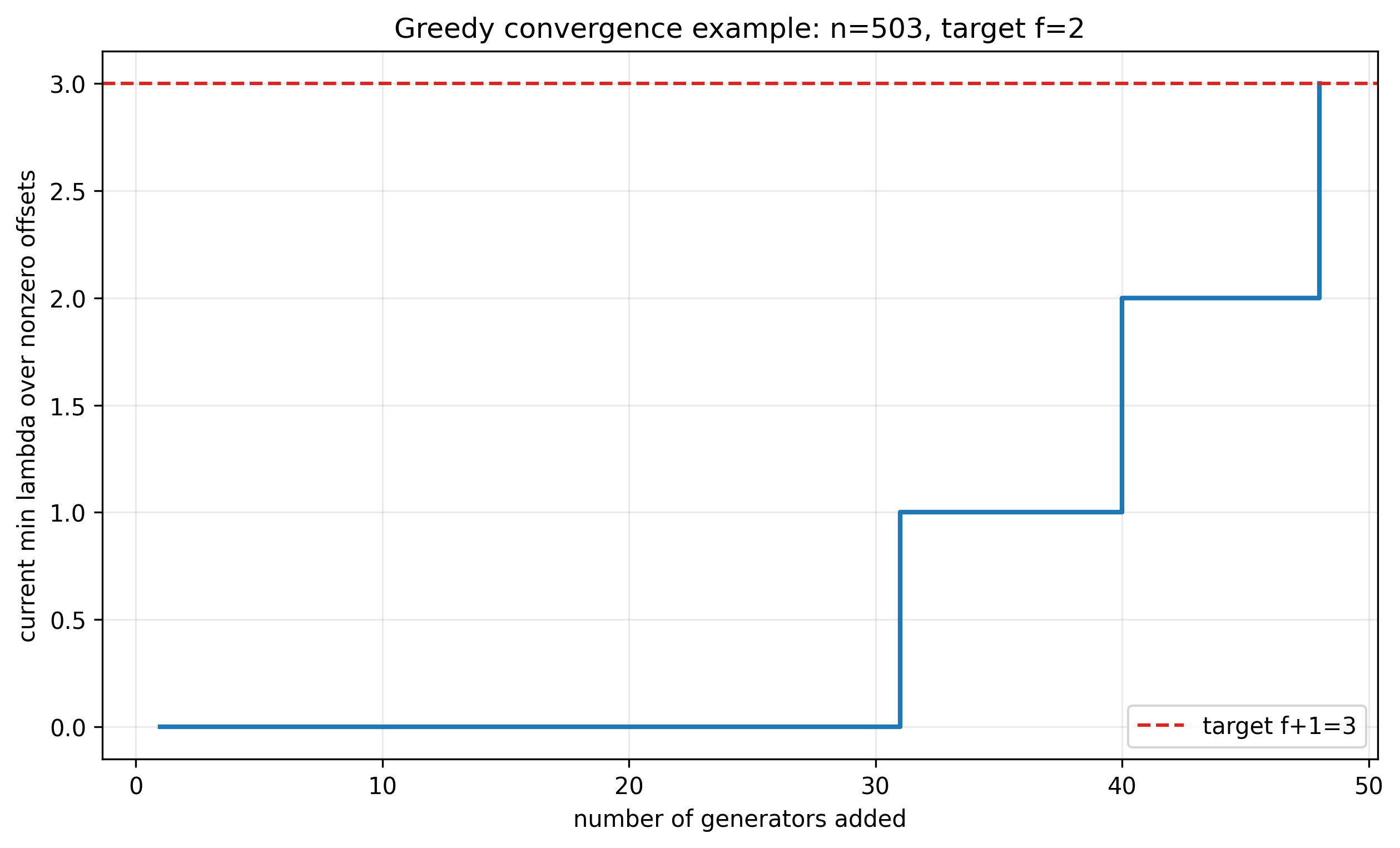
Figure 5: Greedy convergence for R(n,m)1, showing minimum multiplicity rise as generators are added, reaching target R(n,m)2.
Degree scaling for greedy sets closely tracks the theoretical lower bound R(n,m)3, confirming practical achievability of robust redundancy with moderate degree overhead.
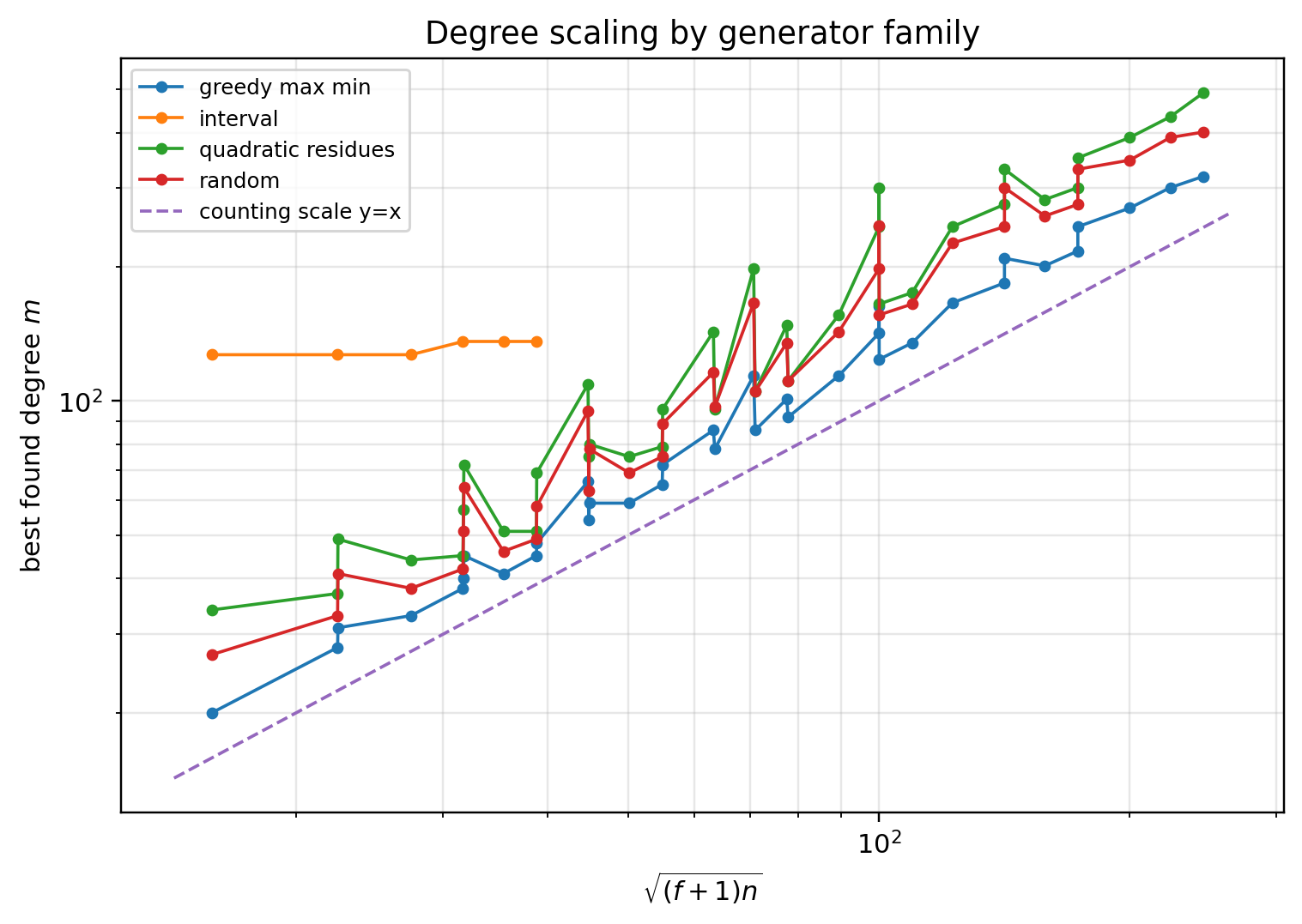
Figure 6: Degree scaling comparison: greedy sets outperform interval sets and track counting lower bound; quadratic-residue designs occasionally surpass greedy for large degrees.
High-Redundancy Distribution and Random Survival
High-degree designs (R(n,m)4) yield high redundancy, with mean offset multiplicity near R(n,m)5 but worst-case relay multiplicity R(n,m)6 significantly below the mean. Distribution shape impacts random-failure survival; empirical simulations confirm robust recovery.
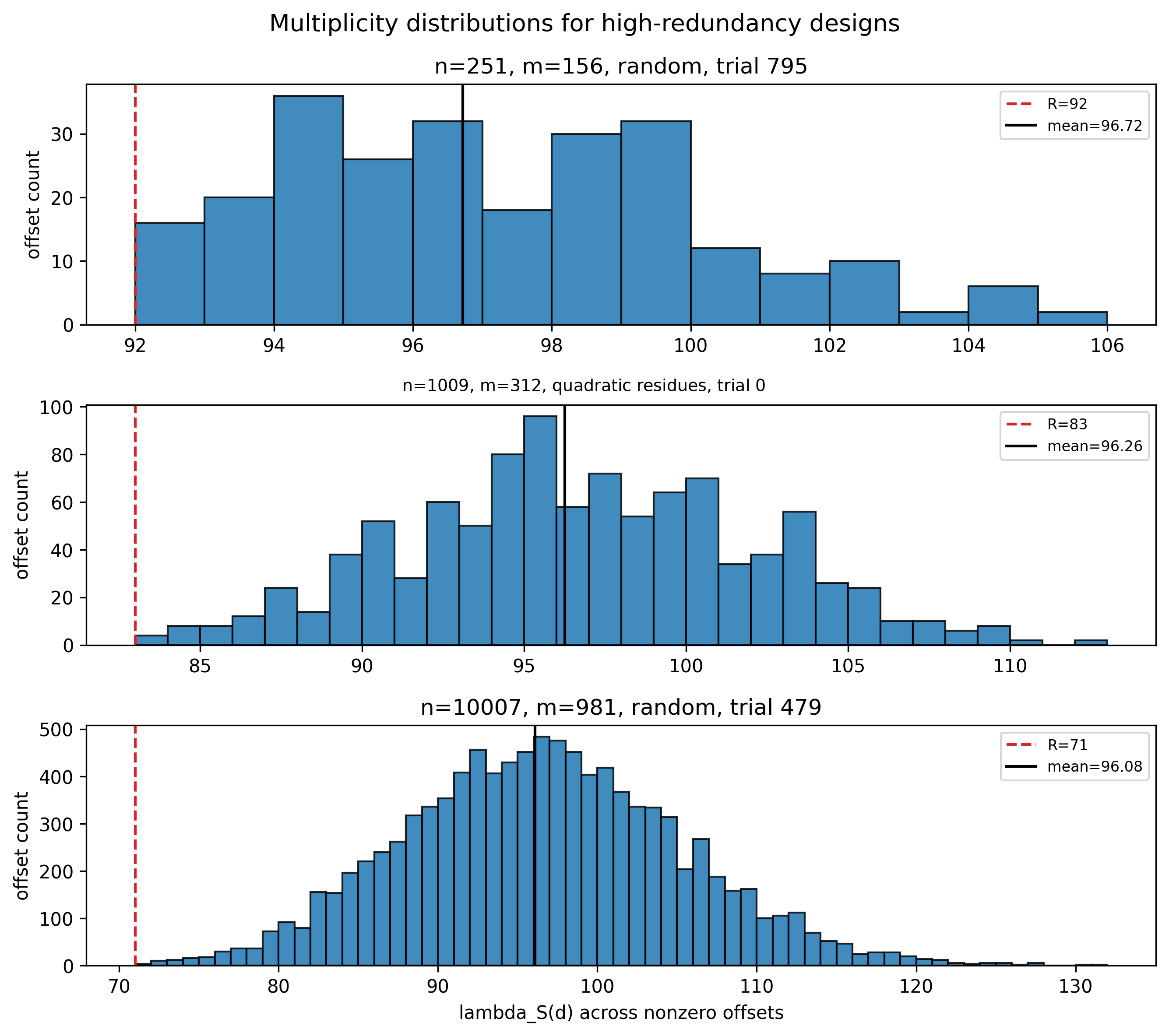
Figure 7: Multiplicity distributions for high-redundancy designs; average redundancy far exceeds worst-case, underscoring need for reporting both metrics.
Practical Implications for Interconnection and On-Chip Networks
The framework supports fast, table-driven local recovery in symmetric overlays and structured on-chip fabrics, where immediate two-hop relay alternatives are valuable for local rendezvous, acknowledgement aggregation, and duplicated signaling. Preprocessing and memory costs scale as R(n,m)7, and relay lookup is an efficient R(n,m)8 operation.
Concrete microbenchmarks confirm that relay-table lookup significantly outperforms rerouting search in latency for typical values of R(n,m)9 and n0. The model is particularly relevant for networks-on-chip with constrained degree budgets.
Theoretical and Algorithmic Implications
The equivalence between relay-fault tolerance and cyclic difference multiplicity is operationalized, enabling explicit combinatorial optimization for generator sets in circulant networks. The decision problem is shown to be in NP, but no NP-hardness or approximation bound is claimed for the greedy algorithm. Generator set design remains an open combinatorial problem for n1 beyond reported heuristics; future work may transfer explicit n2-difference-basis constructions once peer-reviewed bounds become available.
Conclusion
This paper rigorously formulates and operationalizes shared-relay fault tolerance in directed circulant interconnection networks, connecting network-layer resiliency to cyclic difference multiplicity. Empirical generator set design, efficient relay recovery algorithms, and extensive simulations underpin strong adversarial and random-failure guarantees. While generator choice critically determines worst-case relay survivability and average redundancy, optimized greedy constructions practically realize robust relay redundancy with moderate degree overhead. The framework enables scalable and resilient relay-assisted communication in symmetric distributed and on-chip topologies, setting a foundation for further algorithmic and combinatorial advances in relay-fault tolerance.