Looped World Models
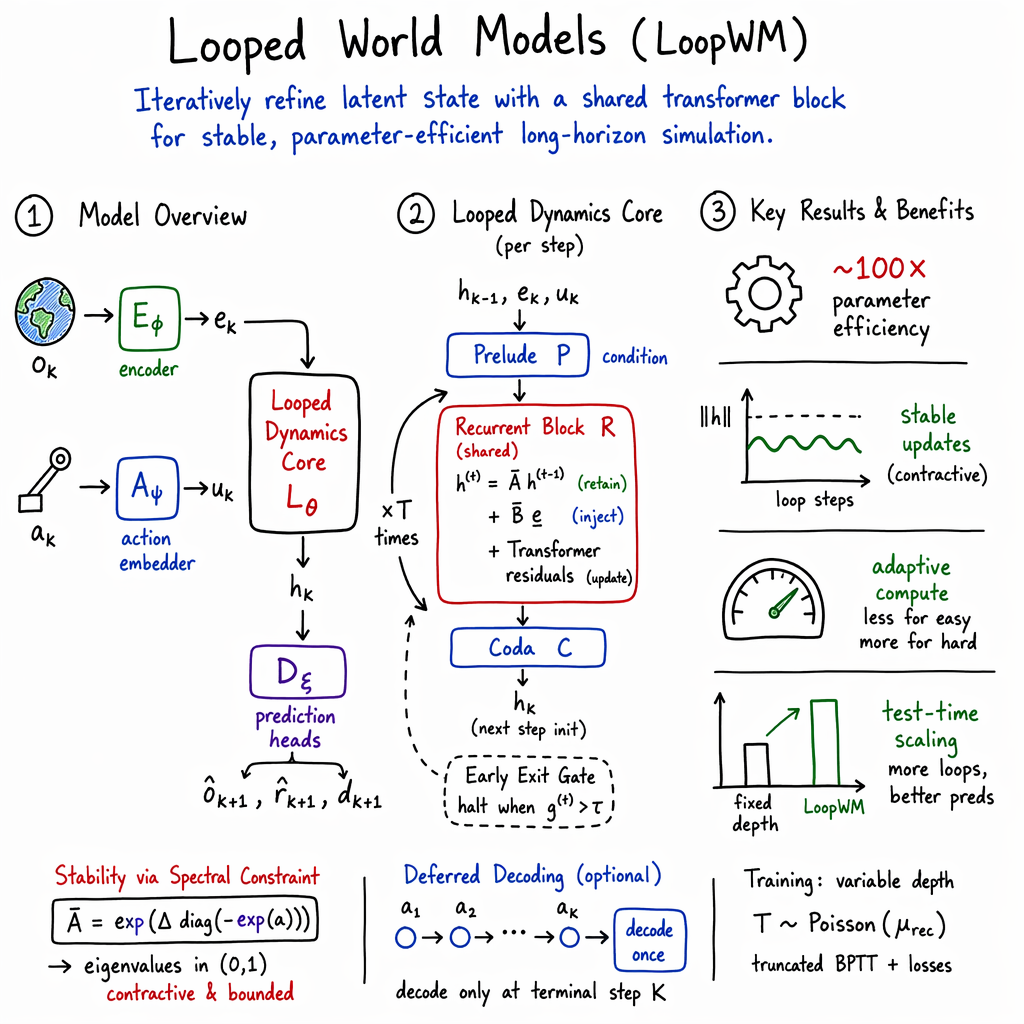
Abstract: Current world models face a fundamental tension: faithful long-horizon simulation demands deep computation, but deeper models are expensive to deploy and prone to compounding errors. We resolve this by introducing Looped World Models (LoopWM), which are the first looped architectures for world modelling. Our method iteratively refines latent environment states through a parameter-shared transformer block. This yield up to 100x parameter efficiency over conventional approaches with adaptive computation that automatically scales depth to match the complexity of each prediction step. Orthogonal to scaling model size and training data, LoopWM establishes iterative latent depth as a new scaling axis for world simulation, which might significantly push the community forward.
Paper Prompts
Sign up for free to create and run prompts on this paper using GPT-5.
Top Community Prompts
Explain it Like I'm 14
Explaining “Looped World Models” in Simple Terms
What is this paper about?
This paper is about teaching computers to imagine what will happen next in a world, like predicting the next frames in a game or the next situation a robot will face. The authors introduce a new kind of brain for these predictions called a Looped World Model (LoopWM). It “thinks” in short, repeated steps using the same tools over and over, instead of stacking lots of different tools. This makes it both smarter over long time spans and much smaller and cheaper to run.
What questions are they trying to answer?
The paper focuses on three simple questions:
- How can a model make accurate predictions many steps into the future without getting confused or drifting off?
- Can we make these models smaller and faster while keeping (or improving) their quality?
- Can the model choose to “think more” about hard moments (like collisions) and “think less” about easy moments (like steady motion)?
How does their method work?
First, a couple of quick ideas in everyday language:
- World model: A computer’s “mental simulator” that guesses what happens next based on what it sees and what action it takes.
- Latent state: The model’s internal notes or mental sketch of the world (not pictures, but compact information).
- Transformer: A powerful tool for understanding and transforming information (used in many AI systems).
- Looped/iterative computation: Reusing the same tool several times in a row to refine an answer, like tightening a screw with several small turns instead of one big twist.
Here’s the approach, step by step:
1) World model basics
- The model looks at the current observation (like an image) and the chosen action (like “move left”).
- It turns them into compact vectors (like short summaries).
- It updates its internal “latent state” to represent the next moment in time.
2) Looped dynamics core (the main idea)
- Instead of a tall stack of many different transformer layers, LoopWM uses a small transformer block again and again in a loop to refine its guess.
- Think of it like sketching lightly, erasing, and redrawing a few times until the picture looks right—using the same pencil each time.
- Because it reuses the same block, the model can be much smaller but still think deeply when needed.
3) Keeping it stable (no runaway calculations)
- Repeating the same update many times can make numbers blow up (go unstable).
- The authors add a built-in “safety knob” that gently pulls the hidden state back into a reasonable range each loop, like a rubber band that keeps the model from drifting too far. This gives a mathematical guarantee that the model stays stable even for very long predictions.
4) Using the right amount of thinking (adaptive early exit)
- The model includes a simple “stop” signal that says, “I’m confident enough—stop looping now.”
- For easy steps (like steady motion), it stops early to save time. For tricky steps (like collision or contact), it keeps looping longer.
- This lets the model spend compute where it matters most.
5) Deferred decoding (think first, speak later)
- Usually, models “decode” (turn their internal notes back into pixels or words) at every step. That’s expensive and distracts from deeper thinking.
- LoopWM often avoids decoding after each step and only decodes at the end of a sequence. It’s like doing the math in your head first and only writing the final answer.
- This makes planning faster and encourages the model to form better long-term internal plans.
6) Training strategy
- During training, the number of inner loops is varied randomly so the model learns to handle different “thinking depths.”
- When using deferred decoding, they add light guidance so the internal notes don’t drift into nonsense, and they slowly increase how many steps they defer to keep training stable.
What did they find, and why is it important?
- Smaller yet strong: By reusing the same transformer block, LoopWM can match or beat other approaches while using far fewer parameters—up to about 100x more parameter-efficient in favorable cases. Smaller models are cheaper and faster to run, especially over long rollouts.
- Long-horizon stability: The built-in stability rule keeps predictions from blowing up, so the model can simulate further into the future without the usual error snowball.
- Adaptive compute: The early-exit rule lets the model spend more time on hard moments and less on easy ones, often saving a lot of compute in practice.
- Better performance on benchmarks: On tasks like ScienceWorld and AlfWorld (standard tests for “world understanding” and action prediction), their small ~1B-parameter model outperforms strong baselines in many metrics. This suggests the design is not just clever—it works.
- Deferred decoding helps: Waiting to decode until the end often improves quality and reduces cost, especially over longer sequences.
Why this matters:
- Robots, game AIs, and self-driving cars all need to predict the future quickly and reliably. LoopWM makes this more accurate, more stable, and cheaper.
- It introduces a new “scaling axis”: instead of only making models bigger or feeding them more data, we can scale “latent thinking depth” by looping the same block more times. That’s a fresh way to get better performance without huge models.
What’s the bigger impact?
- Practical deployment: Because it’s smaller and adaptive, LoopWM could run on devices with limited compute (like drones or home robots) while still making good long-term predictions.
- Safer, steadier planning: The stability guarantee helps prevent weird failures during long simulations, useful in safety-critical settings.
- New research direction: Iterative “latent depth” gives researchers another powerful knob to turn, alongside model size and data, potentially unlocking better and more efficient simulators.
- Future improvements: The paper notes places to get even better, like tracking “entities” more precisely and exploring fuller scaling laws and broader tasks.
In short: Looped World Models reuse the same thinking step multiple times, stop early when they’re done, and keep their thoughts stable. This makes long-term prediction more accurate, more efficient, and more reliable—important for any AI that needs to plan ahead in the real world.
Knowledge Gaps
Knowledge Gaps, Limitations, and Open Questions
Below is a focused list of concrete gaps and open questions that remain unresolved and that future work could address:
- External validity across domains: Evaluate LoopWM beyond text-based interactive environments (ScienceWorld, AlfWorld) on standard pixel-based control (DM Control, Atari, Procgen), robotics (Meta-World, Real Robot suites), and video prediction datasets to substantiate claims about physical dynamics and visual fidelity.
- Missing comparisons to world-model baselines: Provide head-to-head evaluations against DreamerV3, PlaNet/RSSM, IRIS/Δ-IRIS, TransDreamer, EMERALD, MuZero, and video simulators (e.g., DIAMOND) under matched compute and parameter budgets.
- Metric suitability: Replace or complement NLP metrics (EM, F1, BLEU, Entity) with world-modeling metrics such as open-loop state/observation prediction error versus horizon, trajectory FVD/KVD for video, planning returns, and roll-out stability measures.
- Long-horizon robustness: Quantify compounding error and stability with explicit error-vs-horizon curves and failure case analyses against fixed-depth baselines; report maximum stable rollout lengths.
- Adaptive-depth efficacy: Empirically verify that exit depth correlates with transition complexity (e.g., collisions, contacts) via annotated datasets; report per-step exit-depth distributions and calibration quality.
- Compute–quality trade-offs: Provide Pareto curves of accuracy versus FLOPs/latency, and fairness analyses at matched compute (not just parameter count); include ablations of threshold τ, entropy regularizer α, and exit strategies (ACT, convergence-based).
- Test-time scaling behavior: Characterize accuracy monotonicity and saturation when increasing loop iterations beyond training (T > μrec); identify regimes where extra iterations harm or help.
- Stability guarantees for the full update: The spectral constraint applies to the linear retention term, but the nonlinear residual transformer is unconstrained; derive and/or bound total Lipschitz constants to justify global stability of the full recurrent update.
- Expressivity vs stability trade-off: Assess whether restricting A to (negative) diagonal reduces modeling power; compare against spectrally constrained full A (e.g., orthogonal, low-rank plus diagonal) and report performance impacts.
- Stochasticity and multi-modal futures: Incorporate stochastic latent variables (as in RSSM) or diffusion-style noise to handle multi-modal next states; evaluate on environments with inherent randomness.
- End-to-end control performance: Integrate LoopWM into RL (Dreamer-style imagination or MPC) and report sample efficiency, asymptotic returns, and planning speed on standard control benchmarks.
- Deferred Decoding validation: Provide empirical results for the deferred-decoding variant (LoopWM-DD) including accuracy, planning performance, horizon generalization, and compute savings; ablate latent-consistency and contraction penalties, and the curriculum over K.
- Sensitivity and stability of training: Report sensitivity to μrec, μbwd, Lprelude/Lrecur/Lcoda, learning rates, spectral parameterization hyperparameters, and initialization; document failure modes and mitigations (e.g., loss spikes).
- Memory footprint analysis: Quantify training and inference memory usage versus fixed-depth baselines (activation checkpointing, truncation effects); include edge-device feasibility studies.
- Real-time deployment: Measure wall-clock latency, energy, and throughput on resource-constrained hardware; quantify gating overhead and end-to-end savings in real workloads.
- Partial observability and belief tracking: Evaluate performance under POMDP settings; compare to explicit belief-state models; incorporate uncertainty estimation and report calibration under observation noise/missing data.
- OOD generalization: Test robustness to dynamics shifts, novel objects, changes in action semantics, and significantly longer horizons than training; analyze how exit depth adapts under shift.
- Interpretability of iterative refinement: Analyze latent trajectories, convergence behavior, fixed points, and how iterations relate to physical subproblems; visualize per-iteration updates and attention patterns.
- Latent structure and attention scope: Clarify whether the recurrent transformer attends over a single vector or spatial/temporal tokens; if single-vector, justify the role of attention; if tokenized, evaluate per-token adaptive depth.
- Action space coverage: Validate on continuous, high-dimensional action spaces; ablate action embedding designs and their effect on controllability and stability.
- Planner integration: Benchmark MPC (CEM/MPPI) using LoopWM as the simulator; measure solution quality and speedups from adaptive depth across candidate trajectories.
- Video-generation grounding: Test claims about visually faithful simulation by evaluating on video prediction with standard metrics (FVD/PSNR/SSIM) and comparisons to diffusion-based approaches.
- Theoretical compute savings: Provide a formal analysis of expected compute savings under a model of transition difficulty; estimate under realistic task distributions and verify empirically.
- Early-exit safety: Develop guardrails for safety-critical deployment (e.g., non-degradation constraints, abstention/fallback when exit confidence is low or entropy is high).
- Reproducibility and specification clarity: Release code, configs, and seeds; specify all hyperparameters (τ, α, μrec schedules, Tmax), hardware, and data splits; address equation typos/omissions to eliminate ambiguity.
- Mixture-of-experts and capacity: Explore combining looped depth with MoE to recover specialization while maintaining parameter efficiency; study routing stability with loops.
- Implicit/fixed-point training: Compare to DEQ/implicit-layer training for infinite-depth behavior with implicit differentiation; study convergence and stability benefits or drawbacks.
- Cross-timestep state carryover: Quantify drift and accumulation effects when reusing h(T) as the next-step initialization; compare to alternatives (e.g., learned resets, gating carry-over).
- Compute-aware learning: Add explicit compute penalties or budgets during training so the halting policy learns accuracy–compute trade-offs aligned with deployment constraints.
Practical Applications
Immediate Applications
The following applications can be built or piloted now by leveraging LoopWM’s parameter efficiency, spectral stability, adaptive depth, and deferred decoding for planning.
- Edge model-based planning for mobile manipulators and drones [Robotics]
- Description: Use LoopWM as the on-device dynamics model inside MPC/MCTS for short-horizon navigation, grasping, or drone path tracking. Adaptive early-exit allocates more compute to contact/collision events and less to free flight, enabling real-time control on resource-constrained hardware (e.g., Jetson-class).
- Potential tools/products/workflows: ROS2 package “LoopWM-Planner” (CEM/MPPI ready), TensorRT/ONNX-optimized inference with early-exit gating, budget-conditioned inference knobs in mission planners.
- Assumptions/Dependencies: Quality logged trajectories or sim-to-real datasets; calibrated exit thresholds; hardware support for dynamic control flow; controller integration and latency budgets met.
- Cost-efficient simulation for model-based RL training [Software/AI]
- Description: Replace RSSM backbones (e.g., Dreamer) with LoopWM to reduce parameters/FLOPs per rollout while maintaining long-horizon stability, cutting cloud costs for large-scale RL sweeps.
- Potential tools/products/workflows: “LoopWM plugin” for Dreamer-style pipelines; Poisson depth training recipes; compute-scaled evaluation (increase loop count for validation only).
- Assumptions/Dependencies: Training codepaths that support variable loop depth and truncated backprop; hyperparameter tuning for µrec and stability losses.
- Lightweight world models for text-based agents (ScienceWorld, AlfWorld) [Education/Gaming/Research]
- Description: Deploy small (~1B) LoopWMs as environment simulators to improve action-outcome prediction for curriculum learning, tutoring games, and benchmarking agentic systems.
- Potential tools/products/workflows: Hugging Face-compatible checkpoints; adapters for ScienceWorld/AlfWorld; LLM tool plugin “simulate_step()” backed by LoopWM.
- Assumptions/Dependencies: Task-specific tokenization/encoders; evaluation harnesses; alignment between agent policy and simulator.
- Compute-adaptive digital twin prototyping for operations [Manufacturing/Logistics/Energy Ops]
- Description: Use LoopWM to prototype light digital twins for warehouse flows, process lines, or microgrid control where long rollouts need stability but average transitions are simple.
- Potential tools/products/workflows: “Adaptive Twin Sandbox” that adjusts loop iterations by scenario complexity; dashboards showing compute vs accuracy curves.
- Assumptions/Dependencies: Representative historical sequences; simplified observation encoders; acceptance of approximate simulations for what-if analysis.
- Offline prediction and scenario generation for ADAS/AV simulation [Automotive]
- Description: Improve long-horizon trajectory simulation in scenario libraries (merges, cut-ins, pedestrians) at a fraction of the compute by using LoopWM’s recurrent-depth scaling.
- Potential tools/products/workflows: Data-driven scenario synthesizer with variable loop depth; HIL/SiL integration for rare corner-case amplification.
- Assumptions/Dependencies: Access to high-quality logged AV datasets; not for safety-critical online deployment yet; domain-specific encoders (BEV, rasterized scenes).
- Planning with deferred decoding to cut inference cost [Robotics/Automation]
- Description: Run multi-step latent rollouts and decode only at the terminal step to score candidate action sequences, reducing decoder invocations and latency in MPC loops.
- Potential tools/products/workflows: “Encode–Think–Decode” planner mode; terminal-only scoring API; compatibility with sampling-based planners (CEM/MPPI).
- Assumptions/Dependencies: Tasks where terminal or sparse objectives suffice; optional latent consistency regularizers if intermediate observables are needed.
- Safety monitoring via contraction metrics [Safety/Policy/Compliance]
- Description: Use spectral-contraction measures (e.g., ∥h_{k+1}−h_k∥ budgets) as runtime monitors to flag unstable predictions or OOD transitions in simulators.
- Potential tools/products/workflows: “Stability Guard” library emitting alerts/metrics; CI checks for model updates with compute–stability dashboards.
- Assumptions/Dependencies: Threshold calibration on in-domain data; complementary OOD detectors for observables.
- Cloud cost and latency optimization for large simulation farms [Software/Infrastructure]
- Description: Serve LoopWM with dynamic early exit and per-request compute budgets, lowering average FLOPs for massive batched simulations (A/B tests, policy evaluation).
- Potential tools/products/workflows: Autoscalers that modulate loop caps by SLA; early-exit-aware batch schedulers; cost observability by iteration histograms.
- Assumptions/Dependencies: Inference runtimes supporting dynamic shapes/control flow; revenue-neutral SLOs under compute variability.
- Vision/lidar predictive models with adaptive computation [Robotics/Autonomy]
- Description: Wrap high-dimensional encoders/decoders around the looped core for video/lidar predictive modeling, using more inner iterations near complex dynamics.
- Potential tools/products/workflows: Vision-LoopWM for ego-motion and occupancy prediction; KITTI/nuScenes fine-tuning scripts.
- Assumptions/Dependencies: Strong, task-specific encoders; careful training of deferred decoding if using terminal-only supervision.
- Reproducible research baselines for long-horizon stability [Academia]
- Description: Adopt LoopWM as a stable, parameter-efficient baseline for studies of compounding error, test-time compute scaling, or DEQ/Neural-ODE connections.
- Potential tools/products/workflows: Open-source reference with spectral parameterization; ablation harnesses for loop count, exit gates, and stability penalties.
- Assumptions/Dependencies: Public code and datasets; benchmark consensus (rollout length, metrics).
Long-Term Applications
The following opportunities require additional research, scaling, safety cases, or domain integration before broad deployment.
- Core world model for fully autonomous robots and vehicles [Robotics/Automotive]
- Description: Use LoopWM as the principal dynamics predictor in perception–prediction–planning stacks with budget-conditioned compute and certifiable stability.
- Potential tools/products/workflows: Safety-certified early-exit policies; joint training with sensor fusion; compute-aware MPC/MCTS schedulers.
- Assumptions/Dependencies: Closed-loop validation at scale; regulatory approvals; robust OOD generalization and fail-safes.
- Physiology and clinical pathway digital twins [Healthcare]
- Description: Iterative latent refinement for patient-state simulation with dynamic compute spikes during acute events; support planning of interventions.
- Potential tools/products/workflows: Hospital “twin” planners for ICU/ED flow; counterfactual policy evaluation tools.
- Assumptions/Dependencies: High-quality, longitudinal multimodal data; interpretability and bias audits; stringent regulatory compliance.
- City-scale and industrial digital twins with compute-aware rollouts [Energy/Smart Cities/Manufacturing]
- Description: Multi-timescale simulation where LoopWM allocates depth by event complexity (e.g., outages, congestion), maintaining long-horizon stability at tractable cost.
- Potential tools/products/workflows: Grid control co-simulators; dynamic compute allocation across regions; emergency response trainers.
- Assumptions/Dependencies: Hierarchical encoders; multi-domain calibration; HPC–edge hybrid deployment.
- Multimodal generalist world model (video, text, action, audio) [Software/AI]
- Description: Foundation world models unifying generative video (Sora/Genie-like) with action-conditioned rollouts using recurrent depth as a new scaling axis.
- Potential tools/products/workflows: “Generalist Simulator” SDK; tool-use agents with internal simulation loops; latent-thought planning interfaces.
- Assumptions/Dependencies: Large-scale pretraining; robust deferred decoding across modalities; substantial compute and data.
- Market and policy simulators for sequential decision-making [Finance/Public Policy]
- Description: Adaptive-depth simulation that expends more compute during volatility or regime shifts to stress-test policies and trading strategies.
- Potential tools/products/workflows: “Volatility-aware Simulator” for policy backtesting; Monte Carlo rollouts with compute budgets.
- Assumptions/Dependencies: Nonstationarity modeling; stringent model risk management; transparency requirements.
- Home assistant robots with on-device planning [Consumer Robotics/Daily Life]
- Description: Battery- and compute-efficient world models that adaptively plan household tasks, escalating depth for hard manipulation or safety-critical moments.
- Potential tools/products/workflows: Appliance-ready planning stack; app-level controls for accuracy–battery trade-offs.
- Assumptions/Dependencies: Affordable sensors/actuators; robust grasp/contact modeling; consumer safety and privacy standards.
- Standards for compute-aware AI and energy reporting [Policy/Sustainability]
- Description: Formalize “compute budgeting” and early-exit reporting as part of AI system disclosures and sustainability audits.
- Potential tools/products/workflows: Compliance toolkits exposing loop-iteration telemetry; certs for stability-constrained models.
- Assumptions/Dependencies: Consensus on metrics; industry–regulator collaboration; auditable inference runtimes.
- Education-scale interactive labs [Education]
- Description: Classrooms use generalist LoopWM-based simulators to teach physics, chemistry, and systems thinking with stable long-horizon rollouts on modest hardware.
- Potential tools/products/workflows: “LoopLab” curricula; educator dashboards controlling compute–fidelity trade-offs.
- Assumptions/Dependencies: Age-appropriate interfaces; content validation; affordable devices.
- Simulation-as-a-Service with dynamic pricing per compute step [Software/Cloud]
- Description: Offer simulation APIs charging by effective loop iterations and exit depth, optimizing cost–accuracy contracts.
- Potential tools/products/workflows: SLAs with target accuracy/latency pairs; smart brokers that modulate depth by scenario risk.
- Assumptions/Dependencies: Market adoption of compute-aware billing; transparent quality guarantees.
- Verified stability and safety for mission-critical rollouts [Academia/Certification]
- Description: Formal verification pipelines that couple spectral constraints with certified bounds on compounding error over long horizons.
- Potential tools/products/workflows: Proof-carrying models; verification-aware training; regulators’ evaluation suites.
- Assumptions/Dependencies: Advances in formal methods for deep models; scalable certification workflows.
Cross-cutting Assumptions and Dependencies
- Data and encoders: Success hinges on high-quality logged transitions and task-appropriate encoders/decoders (vision, lidar, text), especially for high-dimensional observations.
- Stability and gating: Spectral constraints must be correctly implemented; exit thresholds need calibration to avoid under-/over-computation.
- Generalization and safety: Additional OOD detection, interpretability, and fail-safe mechanisms are required for high-stakes deployments.
- Tooling and runtime: Inference stacks must support dynamic loop counts and early exit (control flow, dynamic shapes, batching).
- Claims scope: Reported parameter/FLOP savings (e.g., “up to 100×”) are task- and architecture-dependent; reproduce and re-calibrate per domain.
Glossary
- Adaptive Computation Time (ACT): A mechanism that allows a model to dynamically decide how many computational steps to allocate per input. "The Universal Transformer \citep{dehghani2019universal} first proposed this idea, combining weight sharing with Adaptive Computation Time (ACT) \citep{graves2016act} for input-dependent halting."
- Adaptive depth: The capacity of a model to vary its effective depth (number of iterations) based on input difficulty. "Furthermore, the adaptive-depth property of looped models, allocating more iterations to complex transitions (e.g., collisions, contact events) and fewer to simple dynamics (e.g., free flight), maps directly onto the non-uniform computational demands of physical simulation."
- Adaptive early exit: A strategy that terminates iterative computation once a confidence or convergence criterion is met to save compute. "When adaptive early exit is enabled (see \S\ref{sec:earlyexit}), we augment the loss with an entropy-regularisation term that prevents the exit gate from collapsing to trivial solutions (always exiting at the first iteration or never exiting)."
- Adaptive halting mechanism: A learned controller that decides when to stop iterative processing based on the input. "The Universal Transformer \citep{dehghani2019universal} first proposed this idea, combining weight sharing with Adaptive Computation Time (ACT) \citep{graves2016act} for input-dependent halting."
- Autoregressive transformer: A transformer that predicts each token conditioned on previously generated tokens in sequence. "IRIS \citep{micheli2023iris} showed that an autoregressive transformer over discrete latent tokens can serve as a highly data-efficient world model."
- Budget-conditioned latent reasoning: Training a model to reason under a specified compute budget, adapting its depth to resource limits. "LoopFormer \citep{jeddi2025loopformer} introduced elastic-depth training with shortcut modulation for budget-conditioned latent reasoning."
- Compounding prediction error: The phenomenon where small step-wise prediction errors accumulate over time, degrading long-horizon predictions. "A persistent challenge across all these approaches is compounding prediction error: small inaccuracies at each rollout step accumulate exponentially over long horizons, degrading trajectory fidelity \citep{xiao2019compoundingerror, talvitie2017self, lambert2022survey}."
- Contractive: Describes a transformation that reduces distances (has spectral radius < 1), ensuring stability over iterations. "This construction ensures that the linear retention component remains contractive, which helps keep recurrent latent updates bounded as the number of inner-loop iterations increases."
- Deep Equilibrium Models: Implicit-depth models that solve for a fixed point of a transformation rather than stacking many explicit layers. "These developments connect looped transformers to a broader family of depth-continuous and implicit-layer models, including Neural ODEs \citep{chen2018neuralode} and Deep Equilibrium Models \citep{bai2019deq}, which likewise iterate a shared function toward a fixed point."
- Deferred Decoding: A procedure that performs multi-step latent computation first and decodes outputs only at the end. "We propose Deferred Decoding, a modification to the Looped World Model that eliminates all intermediate observation decoding during multi-step rollouts."
- Diffusion models: Generative models that learn to transform noise into data via iterative denoising steps. "DIAMOND \citep{alonso2024diamond} demonstrated that diffusion models can produce visually faithful world simulations, and EMERALD \citep{burchi2025emerald} achieved state-of-the-art Crafter performance by combining masked generative transformers with spatial latent states."
- Discretization via zero-order hold: A method to discretize continuous-time systems by holding inputs constant over intervals. "discretizing via zero-order hold,"
- Elastic-depth training: Training that encourages models to function well under varying numbers of iterative steps. "LoopFormer \citep{jeddi2025loopformer} introduced elastic-depth training with shortcut modulation for budget-conditioned latent reasoning."
- Eigenvalues: Scalars describing how a linear transformation scales vectors in particular directions; key for stability analysis. "which constrains all eigenvalues of to the interval , ensuring bounded residual dynamics regardless of rollout length"
- Entropy-regularised early exit: An early-exit method regularized by entropy to prevent trivial halting behavior. "Ouro \citep{zhu2025ouro} introduced entropy-regularised early exit, where a token exits the loop when its prediction entropy drops below a learned threshold."
- Exit gate: A learned module that decides whether to halt further iterations during inference. "We implement this via a lightweight exit gate, a single-layer MLP followed by a sigmoid:"
- Fixed point: A state that remains unchanged under a given transformation; iterative methods often aim to reach it. "including Neural ODEs \citep{chen2018neuralode} and Deep Equilibrium Models \citep{bai2019deq}, which likewise iterate a shared function toward a fixed point."
- Hyper-connected residual streams: Enhanced residual pathways that use matrix-valued connections to improve information flow. "Most recently, Hyperloop Transformers \citep{zeitoun2026hyperloop} augmented the looped block with matrix-valued hyper-connected residual streams."
- Implicit-layer models: Architectures that compute outputs by solving implicit equations rather than applying a fixed stack of layers. "These developments connect looped transformers to a broader family of depth-continuous and implicit-layer models, including Neural ODEs \citep{chen2018neuralode} and Deep Equilibrium Models \citep{bai2019deq}, which likewise iterate a shared function toward a fixed point."
- Input-injection matrix: A matrix that controls how conditioning inputs are added into the hidden state update. "where is the state-retention matrix controlling how much of the previous hidden state is preserved, is the input-injection matrix controlling the influence of the conditioning signal ,"
- Iterative latent depth: The number of repeated applications of a shared block to refine latent states within a step. "LoopWM establishes iterative latent depth as a new scaling axis for world simulation, which might significantly push the community forward."
- Latent dynamics: The evolution of hidden (unobserved) state representations that summarize environment state. "Remarkably, the Deep Planning Network (PlaNet) is a WM \citep{hafner2019planet} first demonstrated that agents can learn latent dynamics entirely from pixels and plan via online optimisation."
- Latent thoughts: Internal iterative computations that improve reasoning without explicit external steps. "\citet{saunshi2025latentthoughts} provided theoretical and empirical evidence that looped models implicitly generate latent thoughts."
- Layer normalization: A normalization technique applied across features within a layer to stabilize training. "where denotes layer normalization."
- Length generalisation: The ability to handle much longer sequences at test time than seen during training. "\citet{fan2024lengthgen} demonstrated that looped transformers with adaptive stopping significantly improve length generalisation."
- Looped transformers: Transformers that reuse the same block multiple times, decoupling compute from parameters. "Looped transformers reuse a shared set of transformer blocks across depth, decoupling effective computation from parameter count."
- Looped World Models (LoopWM): World models that use looped transformer computation to iteratively refine latent states. "In this work, we introduce Looped World Models (LoopWM), the first looped transformer architectures for environment simulation and dynamics prediction."
- Masked generative transformers: Transformers trained with masked-token objectives to model distributions over sequences. "EMERALD \citep{burchi2025emerald} achieved state-of-the-art Crafter performance by combining masked generative transformers with spatial latent states."
- Mixture-of-experts: A technique where multiple expert submodels are selectively routed to handle different inputs. "MoEUT \citep{csordas2024moeut} combined mixture-of-experts with universal transformers."
- Monte-Carlo tree search: A planning algorithm that builds a search tree using random sampling and statistical estimates. "MuZero \citep{schrittwieser2020muzero} showed that a learned dynamics model with Monte-Carlo tree search can master board games and Atari without access to the ground-truth rules."
- Negative-diagonal parameterisation: A parametrization ensuring negative diagonal entries to guarantee contraction after discretization. "addressed the training instability of looped models by recasting the looped forward pass as a nonlinear dynamical system over the residual stream and constraining the spectral norm of the state-transition matrix through a negative-diagonal parameterisation."
- Neural ODEs: Continuous-depth models that define transformations via ordinary differential equations. "These developments connect looped transformers to a broader family of depth-continuous and implicit-layer models, including Neural ODEs \citep{chen2018neuralode} and Deep Equilibrium Models \citep{bai2019deq}, which likewise iterate a shared function toward a fixed point."
- Nonlinear dynamical system: A system where the next state depends nonlinearly on the current state, often studied for stability. "\citet{prairie2026parcae} addressed the training instability of looped models by recasting the looped forward pass as a nonlinear dynamical system over the residual stream"
- Parameter efficiency: Achieving similar quality with fewer parameters by reusing computation or structure. "\citet{zhu2025ouro} demonstrated that a looped LLM can achieve about 2 to 3 parameter efficiency through iterative latent computation."
- Prelude–recurrent–coda design: An architectural pattern splitting processing into an initial block, a shared iterative core, and a final block. "Following the prelude recurrent coda design \citep{geiping2025rdm, prairie2026parcae, zeitoun2026hyperloop}, we partition the dynamics core into three blocks:"
- Recurrent state-space model (RSSM): A latent dynamics model that maintains and updates a hidden state over time. "This establishes the recurrent state-space model (RSSM) as a foundational architecture for world modelling."
- Recurrent-depth models (RDMs): Models that increase depth by looping a shared block, enabling variable test-time compute. "\citet{geiping2025rdm} demonstrated that recurrent-depth models (RDMs) scale test-time compute by increasing loop count at inference, following predictable quality improvements."
- Residual stream: The running representation in residual networks/transformers to which updates are added. "\citet{prairie2026parcae} addressed the training instability of looped models by recasting the looped forward pass as a nonlinear dynamical system over the residual stream"
- Rollout: Simulated trajectory generation by iteratively applying a dynamics model. "Practically, the parameter efficiency of looped architectures is uniquely valuable for world models, because long-horizon rollouts require executing the dynamics model hundreds or thousands of times in sequence;"
- Spectral norm: The largest singular value of a matrix; constraining it controls stability of linear components. "we constrain the spectral norm of to be strictly less than 1."
- Spectrally-constrained residual dynamics: Residual updates designed with spectral constraints to ensure stability across iterations. "Our approach combines a parameter-shared recurrent transformer block with spectrally-constrained residual dynamics, enabling provably stable state transitions across arbitrary rollout lengths."
- State-retention matrix: A matrix that determines how much of the previous hidden state persists to the next iteration. "where is the state-retention matrix controlling how much of the previous hidden state is preserved,"
- Stochastic depth sampling: Randomizing the number of looped iterations during training to improve robustness to variable depth. "\citet{geiping2025rdm} trained with stochastic depth sampling (Poisson-distributed loop counts) to induce robustness to variable test-time depth."
- Test-time compute scaling: Increasing the number of inference iterations to improve quality without changing parameters. "\citet{geiping2025rdm} showed that recurrent-depth models can scale test-time compute by simply increasing the number of loop iterations at inference."
- Transformer State-Space Model: A model combining transformers with state-space dynamics for long-range memory tasks. "TransDreamer \citep{chen2022transdreamer} introduced a Transformer State-Space Model for tasks demanding long-range memory."
- Two-scale structure: A dynamical pattern with fast changes within loops and slower changes across tokens or time. "\citet{pappone2025twoscale} analysed the geometry of latent dynamics in recurrent-depth transformers, identifying two-scale structure with fast intra-loop and slow inter-token dynamics."
- Universal Transformer: A transformer variant that shares parameters across layers and can adapt its depth per input. "The Universal Transformer \citep{dehghani2019universal} first proposed this idea, combining weight sharing with Adaptive Computation Time (ACT) \citep{graves2016act} for input-dependent halting."
Collections
Sign up for free to add this paper to one or more collections.

