- The paper introduces FlowRAG, a framework that integrates quad-level heterogeneous graph construction and frequency-aware weighted flow to enhance explicit multi-hop reasoning.
- It employs dual-granularity activation by leveraging both summary and sentence representations to overcome semantic sparsity in large-scale, unstructured corpora.
- Experimental results demonstrate improved GPT-Acc across benchmarks, with notable gains such as a 2.5% increase on 2WikiMultiHopQA and an average recall of 92.9%.
FlowRAG: Synergizing Explicit Reasoning with Frequency-Aware Multi-Granularity Graph Flow
Introduction
The FlowRAG framework presents a methodological advance in retrieval-augmented generation (RAG) for knowledge-intensive reasoning tasks, particularly addressing failures of prior approaches in multi-hop reasoning over large-scale, unstructured corpora. The core proposition integrates dense semantic representation with explicit information flow through a quad-level heterogeneous graph augmented by a novel frequency-aware weighted flow algorithm. This system is motivated by the persistent limitations of entity-based graph retrieval, especially when dealing with abstract or semantically sparse queries and the resulting brittleness of implicit reasoning propagation.
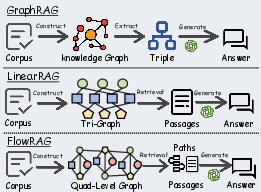
Figure 1: Conceptual comparison; FlowRAG constructs explicit reasoning paths, compared to GraphRAG’s reliance on triple extraction and LinearRAG’s static, passage-level ranking.
Framework and Methodology
Quad-Level Heterogeneous Graph Construction
At FlowRAG's foundation lies a heterogeneous graph G=(V,E), hierarchically structuring information across four levels: passages, summary nodes (contextualized via LLM-generated abstractive summaries), sentences, and entities. This design bridges the granularity gap typical of entity-centric models, allowing both fine-grained (sentence/entity) and coarse-grained (summary) matching. Edges correspond to summary-passage, summary-entity, sentence-entity, and passage-entity relations, the last parameterized by normalized term frequency (TF), thus encoding salience for downstream flow computations.
Dual-Granularity Activation
To mitigate semantic sparsity, retrieval is initialized through dual-granularity activation, scoring candidate entities via a maximum over cosine similarities between the query and both summary and sentence representations. This hybrid strategy encourages activation from both explicit text and implicit thematic connections, ensuring that queries lacking direct entity mentions can still successfully engage the retrieval apparatus.
Frequency-Aware Weighted Flow
FlowRAG departs from implicit random-walk or PageRank paradigms and instead adopts an explicit weighted flow propagation. Query energy is dynamically routed through entity-passage edges, modulated by in-passage TF weights. This mechanism prunes low-confidence (low-support) links, generating interpretable, high-confidence multi-hop reasoning paths. These paths serve as logic skeletons, directly supplied to the LLM for evidence-grounded text generation.
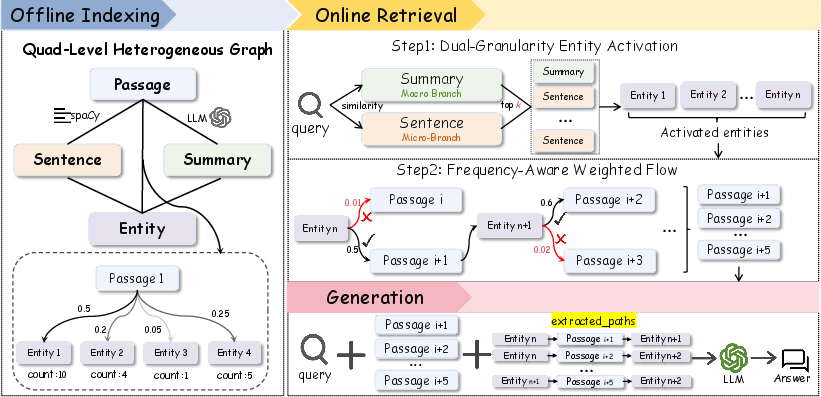
Figure 2: FlowRAG’s system pipeline: quad-level graph construction, joint summary/sentence activation, and structured, TF-weighted flow for path extraction.
Experimental Results
FlowRAG establishes new benchmarks on four multi-hop QA datasets (HotpotQA, 2WikiMultiHopQA, MuSiQue, and a domain-specific Medical QA corpus), outperforming state-of-the-art alternatives, including both entity-graph systems (e.g., LightRAG, HippoRAG, GFM-RAG) and the linear, relation-free LinearRAG baseline. Notable findings include:
- On 2WikiMultiHopQA, FlowRAG achieves 65.2% GPT-Acc, surpassing LinearRAG by 2.5%.
- FlowRAG yields a 1.72% absolute improvement in average GPT-Acc across datasets.
- Despite a negligible drop in raw span recall (Contain-Acc.), GPT-Acc on MuSiQue exceeds LinearRAG by 2.0%, highlighting robustness against context noise.
In retrieval quality analysis, FlowRAG secures the highest Recall values (Avg 92.9%) across diverse question types, especially in contextual and creative generation tasks, where dense or static methods’ performance degrades due to their limited capacity for evidence aggregation.
Ablation studies provide empirical support for both the dual-granularity activation and TF-weighted flow mechanism: removing either component yields pronounced accuracy drops (up to 2.7% on multi-hop benchmarks) and increased vulnerability to noise or abstraction mismatch.
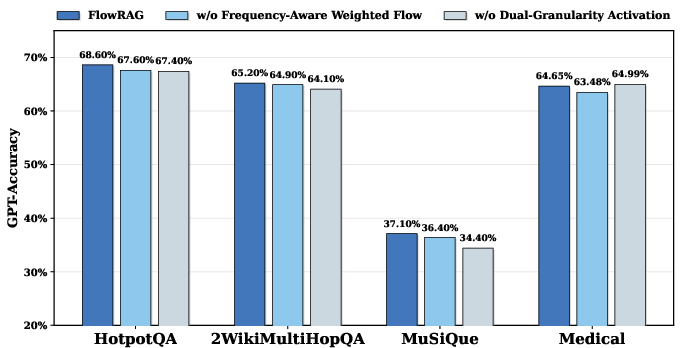
Figure 3: Ablation sensitivity analysis; each module’s impact quantified across four benchmark datasets.
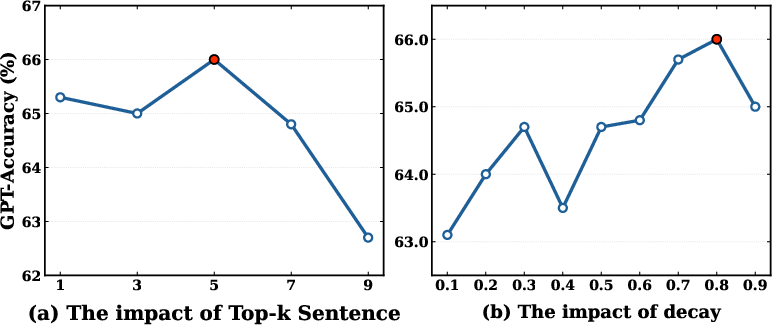
Figure 4: Hyperparameter effects (top-k, decay factor) on FlowRAG performance over the 2WikiMultiHopQA task.
Analysis and Case Study
A qualitative case on lineage resolution from 2WikiMultiHopQA demonstrates FlowRAG’s superiority over LinearRAG in disambiguating relational path queries where entity prominence and semantic proximity would otherwise induce distractor errors. FlowRAG’s explicit path tracing anchored the reasoning chain through the correct intermediate entity, overcoming biases present in dense-only retrieval and enforcing logical consistency—even when the answer entity is less prominent semantically.
Practical and Theoretical Implications
FlowRAG’s construction and results reveal several implications for future RAG systems:
- Explicit Path Extraction: The explicit, TF-weighted path generation enables LLMs to reason over interpretable evidence chains, mitigating context noise and reducing hallucination rates.
- Semantic-Structural Fusion: Bringing together both dense semantic activation (for abstraction robustness) and structured graph traversal (for logical depth and completeness) offers a potent architecture for generalizing across both open-domain and highly specialized corpus scenarios.
- Scalability and Efficiency: Despite the added depth and structural complexity, FlowRAG demonstrates significantly lower indexing and retrieval runtimes compared to neuro-inspired systems such as HippoRAG and LightRAG, while also reducing the LLM’s prompt budget and achieving higher accuracy.
Theoretically, FlowRAG advances the argument that hybridizing semantic and topological axioms is necessary for high-fidelity, multi-hop reasoning in LLM-augmented systems. The frequency-based filtering principle provides a probabilistically-grounded method for extracting factually robust evidence subgraphs.
Limitations and Future Directions
The authors identify several limitations:
- Quad-level graph construction and weighted flow incur moderate computational overhead, mainly from summary generation and flow propagation.
- In hyperspecialized domains, the frequency attenuation may miss rare but crucial entities, suggesting future work in adaptive TF weighting or graph augmentation.
- Extension to streaming or dynamically updated corpora remains an open direction, alongside applications to open-ended or dialog-based conversational retrieval.
Conclusion
FlowRAG demonstrates that synergizing coarse- and fine-grained semantic signals with explicit, TF-guided information flow produces state-of-the-art performance in multi-hop reasoning and generation over unstructured corpora. This architecture advances both interpretability and factual reliability, setting a new standard for high-coverage, logic-informed retrieval-augmented generation. Future work should focus on adaptive graph construction, efficient incremental updates, and the integration with ever-stronger LLMs for robust open-domain reasoning.