$\texttt{WEAVER}$, Better, Faster, Longer: An Effective World Model for Robotic Manipulation
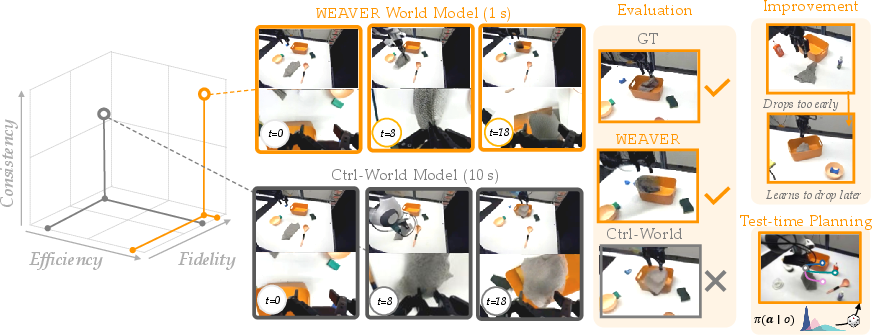
Abstract: The potential impacts of world models (WMs, i.e., learned simulators) on robotics are far-reaching -- policy evaluation, policy improvement, and test-time planning -- all with limited real-world interaction. To unlock these downstream capabilities, a WM needs to jointly satisfy three desiderata: $\textit{(i)}$ fidelity (i.e., producing simulated trajectories that correlate with reality), $\textit{(ii)}$ consistency (i.e., producing simulated trajectories that are coherent over long horizons), and $\textit{(iii)}$ efficiency (i.e., producing simulated trajectories quickly). We propose $\texttt{WEAVER}$ (World Estimation Across Views for Embodied Reasoning): a WM architecture that simultaneously achieves all three desiderata, providing state-of-the-art results on robotic manipulation tasks. $\texttt{WEAVER}$ is a multi-view WM trained to predict future latents and reward values via a flow-matching loss. We distill the key design decisions across model architecture, memory, and prediction objectives required to unlock the kinds of long-horizon dynamic manipulation tasks that have confounded prior world modeling approaches. We apply $\texttt{WEAVER}$ in robotic hardware, demonstrating its effectiveness at policy evaluation ($ρ$=0.870 correlation with real-world success rate), policy improvement (real-world success rate improvement of $38\%$ on top of the $π_{0.5}$ robot foundation model), and test-time planning (real-world success rate improvement of $14\%$ with a $5-10\times$ speedup over prior WMs). $\texttt{WEAVER}$ also demonstrates better performance than prior WMs when evaluated on out-of-distribution scenarios. Code, models, and videos at: https://arnavkj1995.github.io/WEAVER/ .
Paper Prompts
Sign up for free to create and run prompts on this paper using GPT-5.
Top Community Prompts
Explain it Like I'm 14
What this paper is about
Robots learn by trying things in the real world, but that can be slow, expensive, and sometimes unsafe. This paper builds a “world model” for robots called black. Think of a world model like a video game simulator inside the robot’s head: it imagines what will happen next if the robot takes certain actions. With a good simulator, a robot can:
- check if its current strategy (policy) is good,
- practice and improve its strategy without touching the real world, and
- plan smarter at the moment of action by trying out ideas in its head first.
The main point: black aims to be accurate, stay consistent over long tasks, and be fast enough to use during real robot work.
What the researchers wanted to achieve
They set three clear goals for a robot’s world model:
- Fidelity (accuracy): Imagined futures should match what really happens.
- Consistency over time: The imagined story should stay coherent for long tasks (many steps), even when objects get hidden from view for a while.
- Efficiency (speed): Imaginations should be quick, so the robot can use them while it’s working.
They also asked: Can one model do all three well enough to help with policy evaluation, policy improvement, and test-time planning on real robot manipulation tasks?
How the method works (in plain language)
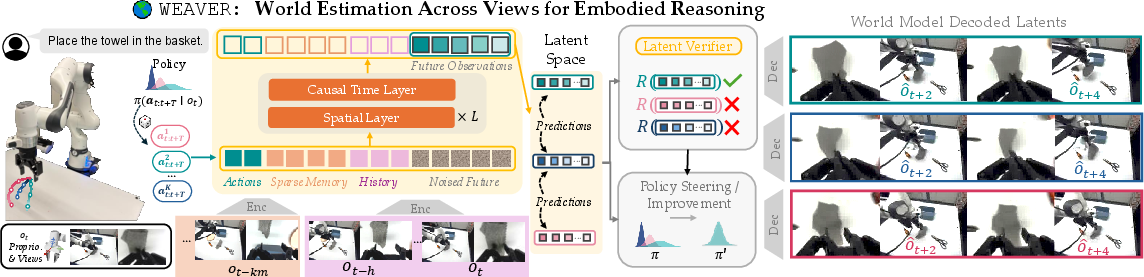
Here’s the big idea: black predicts the future in a compact “code” space (called latents) instead of full images, then decodes to pictures only when needed. It blends techniques from video generation and robot world modeling to be accurate, stable over time, and fast.
Key pieces, with everyday analogies:
- Multi-view vision: The robot looks through more than one camera (like having both a wrist cam and a room cam). This helps when something is hidden in one view (occlusion) but visible in another, making long sequences more consistent.
- Memory + recent history: The model remembers a few snapshots from far back (sparse memory) plus the very recent frames (short-term history). Think of this like a scrapbook (long-term) and a live feed (short-term) so it can track objects even when they temporarily disappear or the camera moves.
- Proprioception: The robot also predicts its own body state (like joint angles and gripper width), not just images. This is crucial for contact-rich skills (e.g., folding towels, placing markers) where exact arm and gripper positions matter.
- Latent space prediction: Instead of predicting entire high-res images frame by frame, black predicts a compact representation (latents). Imagine describing a scene with a shorthand code rather than full drawings; it’s faster and still detailed enough.
- Pretrained encoder/decoder: The model uses a vision encoder and decoder learned from huge image/video datasets. This gives it strong general visual understanding and better robustness to new scenes.
- Flow matching and diffusion forcing: These are training tricks from modern video generation that help the model learn to “denoise” its guesses into realistic futures quickly and consistently. In simple terms, the model practices turning a rough sketch into a clean, believable sequence in a small number of steps.
- Speed-ups under the hood: They add software optimizations and a “rectified flow” distillation step so the model can generate good futures in fewer passes. In short: it becomes much quicker without losing quality.
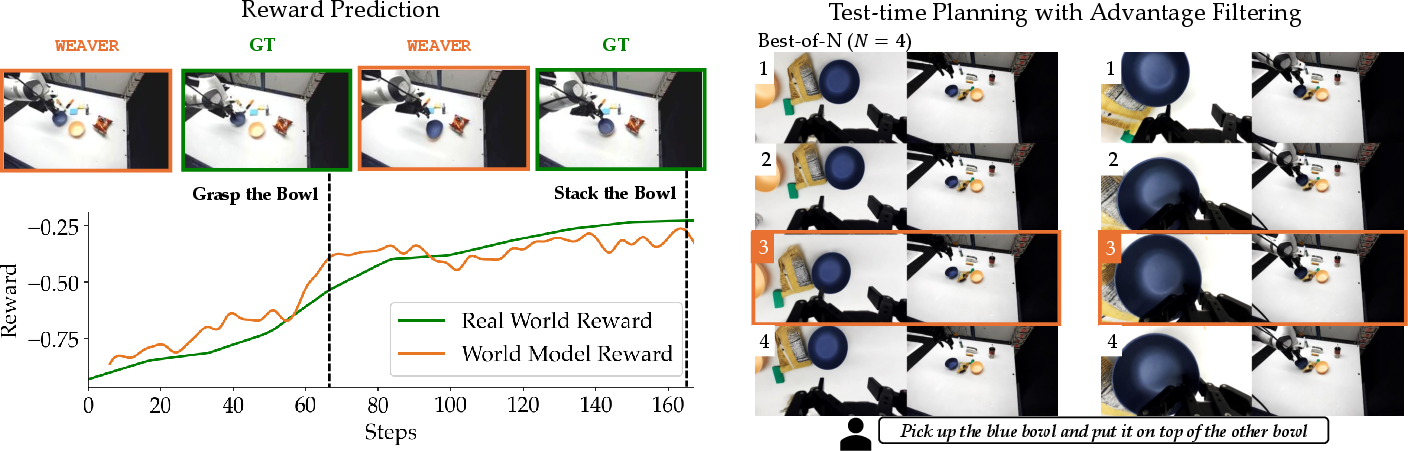
- Built-in scoring (reward and critic) in latents: To avoid slow judging with external LLMs, black has its own lightweight “judge” heads. The reward head scores how well the imagined future matches the instruction (“Did I put the marker in the cup?”). The critic estimates how good things will be beyond the current look-ahead, helping with planning.
How it’s used:
- Policy evaluation: Replays a policy’s actions inside the simulator to estimate how well it would do in reality.
- Policy improvement: Samples several action mini-plans, imagines what happens, keeps the promising ones (high advantage), and distills them back into the policy—like practicing smartly based on feedback.
- Test-time planning: At each step, try a few candidate action chunks in imagination, score them quickly in latent space, then execute the best one on the real robot.
What they found and why it matters
They tested black on five real robot tasks (stacking bowls, placing a bag on a plate, inserting a marker into a cup, placing a towel into a basket, and pouring coffee beans into a bowl) using a Franka Panda arm with multiple cameras. Key results:
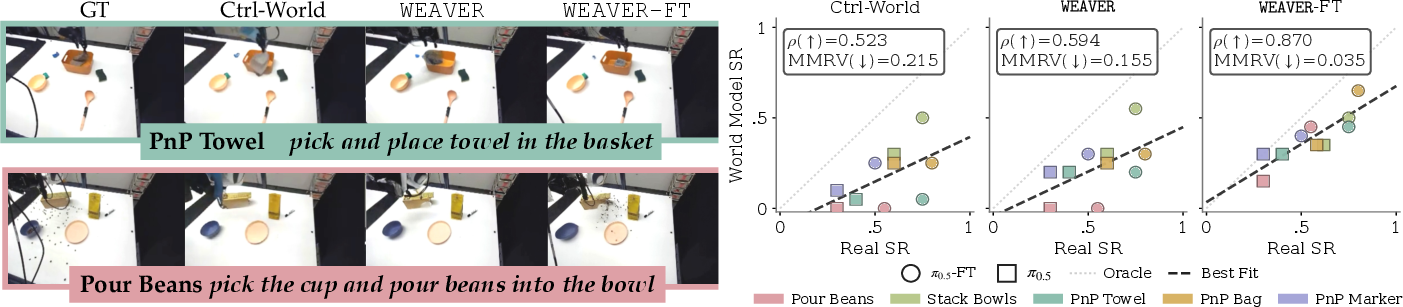
- Strong evaluation accuracy: The simulator’s success predictions correlated very well with real outcomes (correlation ρ = 0.870). This means you can trust the simulator to tell you if a policy is good without always running the robot.
- Policy improvement without extra real data: Using only imagined rollouts, black boosted the real robot’s success rate by 38% on top of a strong baseline policy (called π0.5). That’s a big improvement without additional real-world trials.
- Faster, practical planning: For test-time planning, black improved success rates by about 14–15% and ran 5–10× faster than prior world models designed for manipulation. This makes it feasible to use during real tasks where time matters.
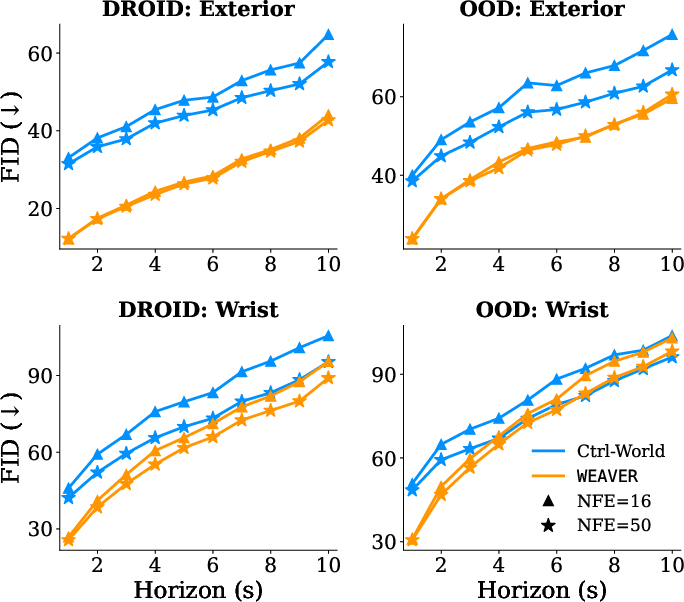
- Better long-horizon quality: black kept its predictions more accurate farther into the future than competing models, and it handled out-of-distribution scenarios (new setups not seen in training) better.
Why it matters: These results show a single world model can be good enough to evaluate, improve, and plan for real robot manipulation—saving time, reducing wear-and-tear, and accelerating progress.
What this could change in the future
- Safer, cheaper robot learning: Robots can practice “in their heads,” reducing the need for risky or expensive real-world trials.
- Faster iteration: Engineers can test, debug, and improve policies more quickly by simulating many possibilities, then transferring only the best ideas to the real robot.
- More general robots: Multi-view consistency and pretrained vision help robots handle new scenes and objects more robustly.
A few practical limits remain: cameras don’t capture everything (touch sensing could help), modeling deformable or granular materials is still hard, and planning is currently limited to short chunks due to time constraints. But overall, black is a strong step toward robots that learn and plan effectively using a fast, trustworthy internal simulator.
Knowledge Gaps
Knowledge gaps, limitations, and open questions
Below is a concise list of concrete gaps and open questions the paper leaves unresolved, intended to guide follow-up research.
- Limited sensing modalities: The WM is vision- and proprioception-only; how to integrate tactile/force sensing and train multi-modal latents to reduce ambiguity in contact-rich manipulation?
- Missing physics priors: No explicit physics constraints are used, especially for deformable and granular materials; can differentiable physics, hybrid simulators, or constraint-regularized objectives improve fidelity and stability?
- Latency still constrains planning: Test-time planning is restricted to a single, short action chunk; what distillation, caching, or architectural changes enable reliable multi-chunk (receding-horizon) planning under strict real-time budgets?
- Reward supervision reliability: The latent reward head is distilled from RoboMeter progress signals (notoriously noisy and task-specific); how well does it generalize to unseen tasks/instructions, and can we develop task-agnostic or self-supervised reward models with better calibration?
- Uncertainty quantification: There is no mechanism to estimate or propagate epistemic/aleatoric uncertainty through predictions, reward, or value; how can calibrated uncertainty be incorporated to prevent model exploitation in planning and policy improvement?
- Evaluation protocol mismatch: Policy evaluation replays recorded actions open-loop in the WM; how does this correlate with true closed-loop policy behavior, and can interactive, closed-loop evaluation inside the WM yield more faithful estimates?
- Automated evaluation vs. human labels: The paper reports human-judged imagined rollout success but does not measure end-to-end automatic success prediction from the latent reward/critic; what is the accuracy and calibration of fully automated evaluation versus human labels and VLM judges?
- Breadth of generalization: Experiments cover five table-top tasks on one robot; how does the method transfer to new robots, grippers, bimanual setups, locomotion+manipulation, and long-horizon multi-stage tasks with significantly different dynamics?
- OOD robustness scope: The “OOD” dataset is collected with the same hardware/policy; robustness to genuinely out-of-domain factors (new objects, textures, lighting, camera failures/miscalibration, background shifts) remains untested.
- Multi-view geometry consistency: Multi-view predictions are not constrained by explicit 3D geometry; does enforcing cross-view consistency (e.g., 3D-aware latents, scene graphs, NeRF/GS-based representations) reduce view-specific failures and occlusion brittleness?
- Component ablations: The individual contributions of multi-view prediction, proprioceptive prediction, sparse memory/history, diffusion forcing, rectified flow, KV caching, SPRINT, and noise schedules are not quantified; which are essential for long-horizon consistency and speed?
- Action representation/adaptation: An action adapter converts velocities to positions, but its errors and impact on long-horizon planning are not analyzed; which action parameterizations (joint vs. Cartesian vs. SE(3) trajectories) minimize compounding error?
- Horizon-wise task metrics: Beyond FID/FVD, there is no horizon-conditioned, task-relevant accuracy (e.g., grasp/contact timing, object pose error, success prediction accuracy vs. rollout length); how do these degrade with horizon and across views?
- Scaling laws and data efficiency: The paper does not study how performance scales with model size, pretraining data, or fine-tuning data; what are the compute–data–performance trade-offs and inflection points?
- Dependence on pretrained VAE: Robustness to domain shift from the Stable Diffusion 3 VAE encoder/decoder is untested; do alternative encoders (video-specific or robotics-focused) or fine-tuned VAEs improve OOD robustness and decoding artifacts?
- Memory and retrieval design: Fixed sparse memory/history (k, m) is used; can adaptive memory, learned retrieval, or key–value memory networks better handle occlusions and long-range dependencies?
- View-specific failure modes: Wrist-view predictions are identified as hardest but not addressed; can view-dependent weighting, attention routing, or specialized wrist-view decoders reduce errors under severe occlusion and fast egomotion?
- Planning algorithms: Planning is best-of-N for a single chunk; how do CEM/MCTS, multi-chunk receding-horizon, or differentiable trajectory optimization in latent space compare under the same latency budget?
- Real-time deployment constraints: End-to-end latency on typical robot compute (CPU-bound or embedded GPUs), scheduling with 10–20 Hz control loops, and power/thermal limits are not evaluated; what system-level optimizations are needed for on-robot deployment?
- Safety and exploitation: There are no safeguards against exploiting WM/reward errors during planning or synthetic data generation; how to incorporate conservatism, adversarial stress tests, anomaly detection, or uncertainty-aware penalties?
- Policy/space interoperability: Can the WM evaluate/improve policies with different observation/action spaces than π0.5 (e.g., different camera layouts, state-only policies, or higher-rate controllers), and how robust are the adapters?
- Language grounding in the WM: The extent to which instruction semantics shape latent predictions and reward is unclear; how well does the WM handle ambiguous or out-of-domain instructions, and can it disambiguate goals over time?
- Reward/value bias under model error: The critic and advantage filter rely on imagined rollouts; how biased are multi-step value estimates under model error, and can techniques like model-based off-policy corrections or pessimism reduce bias?
- Dynamics beyond 5 Hz: Imagination is downsampled to 5 Hz; how does increased frequency affect stability and accuracy for fast dynamics (e.g., pouring, collisions), and are variable-step or event-driven rollouts beneficial?
Practical Applications
Immediate Applications
Below are specific, deployable use cases that leverage the paper’s demonstrated fidelity, long-horizon consistency, and efficient generation (including the reported 5–10× speedup vs. prior WMs, ρ=0.87 evaluation correlation with real outcomes, +38% policy improvement via synthetic data, and +14–15% improvement via test-time planning).
- Policy evaluation at scale for manipulation robots
- Sector: Robotics, Manufacturing, Logistics, Software
- What: Run recorded action sequences through the world model to predict success/failure and rank policies before real deployment; gate releases with a “simulator-first” check.
- Tools/Workflows: Policy Evaluator dashboard (batch rollout, latent reward scoring, correlation metrics); CI/CD integration for robot skills.
- Assumptions/Dependencies:
- Multi-view camera setup compatible with the WM encoder; initial fine-tuning on target workspace for best accuracy.
- Availability of a base VLA policy and synchronized action logs.
- Test-time planning plugin (“best-of-N” chunk selection)
- Sector: Robotics, Manufacturing, Logistics, Warehousing
- What: Add a low-latency, single-chunk planner that samples several candidate action segments from the base policy, imagines outcomes with the WM, and executes the highest-advantage one.
- Tools/Workflows: Edge-deployable planning module using latent reward and critic heads (no VLM judge); ROS2 node or SDK plugin.
- Assumptions/Dependencies:
- Latency budget accommodates short-horizon imagination (KV caching/rectified flow enabled).
- Action-space compatibility via the provided action adapter (velocity-to-position).
- Synthetic data generation for policy fine-tuning
- Sector: Robotics, Software (ML Ops)
- What: Generate and filter high-value imagined segments using latent advantage, then distill into the policy (shown to yield improvements close to real data, and +38% overall in experiments).
- Tools/Workflows: Synthetic Data Generator with advantage filtering; training loop integration (offline RL/behavior cloning).
- Assumptions/Dependencies:
- Reward/critic heads distilled for the target tasks; periodic validation against real rollouts to avoid reward/model exploitation.
- Multi-view, proprioception-aware skill debugging
- Sector: Robotics R&D, Academia
- What: Diagnose failure modes in contact-rich tasks (e.g., reorientation, insertion, deformable manipulation) by imagining counterfactual action chunks and visualizing wrist/external views plus joint states.
- Tools/Workflows: Failure Analyzer that replays imagined futures and surfaces latent rewards over time.
- Assumptions/Dependencies:
- Accurate calibration of multi-view cameras and proprioceptive sensors.
- OOD scenario stress testing and workspace change impact analysis
- Sector: Manufacturing/Logistics Ops, Robotics QA
- What: Rapidly assess how new placements, containers, or lighting affect policy success by running imagined trials; prioritize real-world tests based on predicted deltas.
- Tools/Workflows: Scenario Stress Tester that batches WM rollouts across environment variants.
- Assumptions/Dependencies:
- WM fine-tuning on representative scenes; out-of-distribution generalization benefits from pretrained encoder but may still require light adaptation.
- Course and lab teaching aid for manipulation
- Sector: Education, Academia
- What: Let students prototype policies and test them in a learned simulator that supports multi-view and proprioceptive predictions with realistic long-horizon coherence.
- Tools/Workflows: Classroom-ready WM-in-the-loop notebooks, datasets (DROID), and baseline policies (π0.5).
- Assumptions/Dependencies:
- Modest GPU for inference (RTX-class) and adherence to dataset/model licenses.
- Rapid iteration for startups and systems integrators (RaaS)
- Sector: Robotics-as-a-Service, System Integration
- What: Use the WM to pre-qualify task variants for new client sites, cut down on on-site trials, and deliver faster deployments.
- Tools/Workflows: WM-as-a-service or on-prem appliance; project-specific fine-tune followed by evaluation/planning modules.
- Assumptions/Dependencies:
- Data-sharing agreements for limited fine-tuning; consistent camera rigs and action interfaces.
- Unit testing and regression checks for robot policies
- Sector: Software/DevOps for Robotics
- What: Create a suite of “unit tests” (scripted initial states + action chunks) to detect policy regressions when updating models or hardware.
- Tools/Workflows: Policy Unit Test Pack with batch rollout, reward/advantage thresholds, change detection.
- Assumptions/Dependencies:
- Versioned WM and policy assets; reproducible environment snapshots.
- Process optimization for pick-and-place, kitting, and insertion
- Sector: Manufacturing, Warehousing
- What: Evaluate and select micro-strategies (e.g., grasp approach, pouring angle) via imagined rollouts, then push the best to production.
- Tools/Workflows: Micro-strategy Selector embedded in standard robot task runners; advantage-based scoring.
- Assumptions/Dependencies:
- Accurate task segmentation into short chunks; alignment of language instructions with operational goals.
- Academic benchmarking and ablation studies on world models
- Sector: Academia/Research
- What: Use black as a reference point for studying flow matching, diffusion forcing, rectified flow, and multi-view memory architectures in robotics WMs.
- Tools/Workflows: Open code/models; ablation scripts for architecture, noise schedules, inference speed vs. quality.
- Assumptions/Dependencies:
- Compute availability for pretraining/fine-tuning; dataset accessibility (DROID + task data).
Long-Term Applications
These applications likely require further research, scaling, integration of new sensors/priors, or regulatory acceptance.
- Real-time, long-horizon planning beyond a single chunk
- Sector: Robotics, Manufacturing, Service Robotics
- What: Move from single-chunk best-of-N to multi-chunk/model-predictive planning with uncertainty estimates and safety constraints.
- Potential Products: WM-powered MPC library; MCTS-style planners in latent space.
- Key Dependencies:
- Additional inference speedups; uncertainty-aware scoring; improved reward models; robust failure detection and recovery.
- Tactile-augmented world models for contact-rich tasks
- Sector: Healthcare (assistive/surgical), Advanced Manufacturing
- What: Fuse tactile sensing with multi-view visual/proprioceptive latents for better modeling of occlusions, slip, and deformable interactions.
- Potential Products: Vision–tactile WM SDKs; gripper skins integrated into the WM encoder.
- Key Dependencies:
- Tactile hardware; multimodal encoder training; physics priors; safety validation.
- Digital twin “policy proving grounds” for enterprise operations
- Sector: Warehousing, Fulfillment, Retail, Manufacturing
- What: Continuous A/B testing and policy optimization in a WM-backed digital twin that mirrors fleet sites; rollout gates for enterprise-scale changes.
- Potential Products: Cloud WM platform with site-specific fine-tuning, scenario libraries, automated policy suggestion.
- Key Dependencies:
- Scalable data pipelines; continuous domain adaptation; enterprise IT integration; governance of model updates.
- Autonomous data flywheels (synthetic-first training loops)
- Sector: Robotics, Software/ML Ops
- What: Use high-quality imagined data to pretrain/finetune policies at scale, with periodic real-world calibration—reducing expensive data collection.
- Potential Products: Auto-RL pipelines that synthesize, filter, and distill imagined segments; drift monitors.
- Key Dependencies:
- Strong reward models/critics; robust OOD detection; safeguards against exploitation of WM/reward errors.
- Safety certification frameworks that accept WM-based evidence
- Sector: Policy/Regulation, Insurance, Safety Compliance
- What: Formalize evaluation protocols where WM-based testing counts toward certification/pre-approval of updates.
- Potential Products: Auditable WM evaluation suites; standardized correlation and ranking violation metrics.
- Key Dependencies:
- Regulatory buy-in; reproducibility and traceability; uncertainty quantification and calibration evidence.
- Household service robots with personalized planning
- Sector: Consumer Robotics, Elder Care
- What: Customize policies to individual homes via fast, on-device imagination of candidate behaviors; plan with user-specified language goals.
- Potential Products: On-device WM copilot for task planning (folding, pouring, tidying).
- Key Dependencies:
- Efficient edge inference; broad OOD robustness; privacy-preserving local adaptation; intuitive instruction interfaces.
- Construction and field robotics “what-if” planners
- Sector: Construction, Energy (inspection/maintenance), Agriculture
- What: Simulate manipulation sequences (e.g., fastening, wiring, valve turning) under incomplete observability and plan safely before execution.
- Potential Products: Field-robust WM modules with domain-specific priors and sensor fusion (thermal, depth, force).
- Key Dependencies:
- Strong domain adaptation; harsh-condition sensors; physics-informed dynamics for non-rigid and granular materials.
- Surgical and assistive robot rehearsal and safety buffers
- Sector: Healthcare
- What: Pre-execution validation of candidate action segments in a patient/task-specific WM to reduce risk.
- Potential Products: WM rehearsal studio integrated into surgical planning; assistive robot safeguard plans.
- Key Dependencies:
- Regulatory-grade fidelity; multimodal sensing (vision, force, imaging); rigorous safety and ethics oversight.
- Rare-event and failure-mode generation for robustness
- Sector: Safety, Insurance, QA
- What: Curate synthetic “edge case” datasets (slips, spills, near-collisions) to harden policies against rare but critical failures.
- Potential Products: Edge-case dataset marketplace; automated failure synthesis tools.
- Key Dependencies:
- Calibrated uncertainty; mechanisms to avoid overfitting to synthetic anomalies; validation protocols.
- Cross-robot generalization and multi-robot coordination
- Sector: Robotics, Warehousing, Manufacturing
- What: WM layers that abstract across arms/grippers and coordinate multiple agents through shared latent rollouts.
- Potential Products: Cross-platform WM with adapters for different robots; coordination planners in latent space.
- Key Dependencies:
- Standardized action/state adapters; multi-agent training data; communication-aware planning.
Common Assumptions and Dependencies Across Applications
- Sensor setup: Multi-view cameras (including wrist) and synchronized proprioception; calibration quality materially affects fidelity and consistency.
- Base policy availability: The WM is most useful when paired with a competent VLA policy (e.g., π0.5) and task language instructions.
- Compute constraints: Inference accelerations (KV caching, cosine schedules, rectified flow) reduce latency, but real-time, long-horizon planning may still require further optimization or stronger hardware.
- Data alignment: Pretraining on DROID and light fine-tuning on target environments improves correlation and OOD robustness; larger domain shifts may demand more adaptation.
- Reward modeling: Latent reward/critic heads must be well-calibrated; noisy supervision (e.g., RoboMeter) should be complemented with validation and uncertainty estimation.
- Risk of exploitation: Policies may exploit WM/reward artifacts; guardrails (cross-checks with real rollouts, conservative thresholds, and anomaly detection) are advisable.
- Licensing and governance: Use of pretrained encoders/decoders (e.g., Stable Diffusion VAE) and datasets must respect licenses and organizational compliance policies.
Glossary
- AdaPool: An adaptive pooling operation used to aggregate variable-length token features into a fixed-size representation. "The reward head R aggregates latent tokens with AdaPool~\cite{brothers2026robust}, followed by MLP layers."
- Advantage: In reinforcement learning, the excess value of an action compared to a baseline value function, used to guide policy updates. "We then compute a Monte-Carlo estimate of the -step advantage along each rollout:"
- Autoregressively: A sequential generation process where each output step conditions on previously generated outputs. "the models are rolled out autoregressively to generate 10s long sequences"
- Bootstrapped λ-returns: A temporal-difference target that mixes multi-step returns with parameter λ to trade off bias and variance. "is trained with an MSE objective to predict bootstrapped -returns~\citep{sutton1998reinforcement}."
- Causal temporal attention: An attention mechanism constrained to attend only to past (not future) timesteps to preserve causality. "with dynamics blocks composed of spatial attention and causal temporal attention."
- Critic: A value-function estimator that predicts expected return, used for bootstrapping and advantage computation. "black learns a critic network that estimates the value beyond the imagined horizon."
- Diffusion Forcing: A training strategy for diffusion-like models that samples independent noise levels across future steps to improve long-horizon consistency. "we adopt Diffusion Forcing~\citep{chen2024diffusion}, which trains the latent dynamics model with independently sampled noise levels across future timesteps."
- FID: Fréchet Inception Distance; a metric for perceptual similarity between generated and real images. "we measure the visual fidelity of the decoded generations using FID~\cite{heusel2017gans}"
- Flow matching: A training objective that learns a vector field transporting noise to data, enabling fast generative sampling. "we train our latent dynamics model $f_$ with a flow-matching loss ~\cite{lipman2022flow} to predict future latents."
- FVD: Fréchet Video Distance; a metric assessing perceptual quality and temporal coherence of generated videos. "and FVD~\cite{unterthiner2018towards} computed with the ground-truth videos."
- JEPA: Joint-Embedding Predictive Architecture; models that predict future latent embeddings instead of reconstructing pixels. "JEPA-style WMs \cite{assran2023self} have latent states that may not be decodable into the images required to evaluate arbitrary visuomotor robot policies."
- KV caching: Reusing cached key/value attention tensors across steps to reduce compute during iterative generation. "We reduce cost (a) via the use of KV caching to memory and history tokens across denoising steps."
- Latent dynamics model: A model that predicts future latent states conditioned on history, memory, and actions. "The latent dynamics model predicts future latent states conditioned on memory, history, and a candidate action plan."
- Latent space: A compressed representation space (e.g., tokens) where the model simulates future trajectories efficiently. "to image future rollouts in latent space."
- Maximum Matrix Ranking Violation (MMRV): A metric that quantifies ranking inconsistencies between predicted and ground-truth performance matrices. "We report Pearson Correlation coefficient~\citep{pearson1920notes} and maximum matrix ranking violation (MMRV)~\citep{team2025evaluating}"
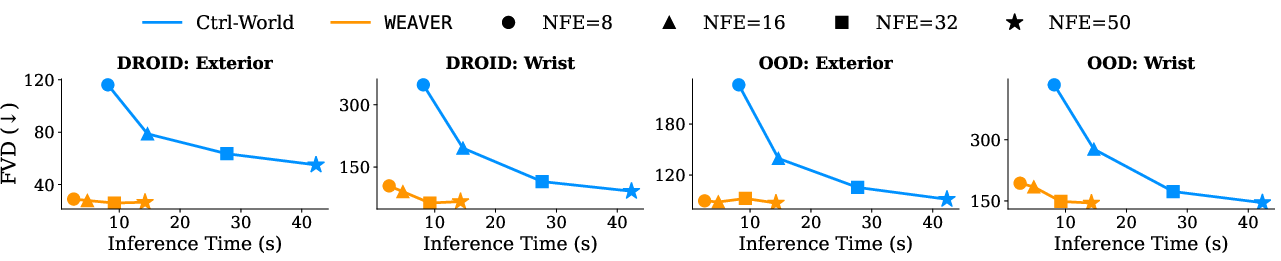
- Number of function evaluations (NFE): The count of denoising steps/evaluations in diffusion-style sampling; lower NFE reduces latency but may hurt quality. "As we decrease the number of function evaluations (NFE) to decrease the latency, we find that"
- Out-of-distribution (OOD): Data or scenarios that differ from the training distribution. "black also demonstrates better performance than prior WMs when evaluated on out-of-distribution scenarios."
- Pareto-dominating: Being strictly better on at least one metric and no worse on others in a multi-objective comparison. "By pareto-dominating Ctrl-World \citep{guo2026ctrlworld}, black unlocks faster evaluation and planning as we explore below in Section~\ref{subsec:results-downstream}."
- Pearson correlation coefficient: A statistic measuring linear correlation between two variables (here, predicted and real success). "We report Pearson Correlation coefficient~\citep{pearson1920notes} and maximum matrix ranking violation (MMRV)~\citep{team2025evaluating}"
- Proprioceptive: Relating to internal robot state sensing, such as joint positions or gripper width. "Let the robot's proprioceptive state (e.g., joint angles) be denoted by ."
- QKNorm: A normalization method applied to query/key projections in attention to stabilize training. "each block uses RMSNorm~\citep{zhang2019root}, RoPE~\citep{su2024roformer}, QKNorm~\citep{henry2020query}, and SwiGLU feed-forward layers~\citep{shazeer2020glu}"
- Rectified flow: A distillation-style flow objective enabling high-quality samples with very few steps. "we post-train black with a rectified flow objective~\cite{liu2022flow} to enable high-quality generation within a few forward passes."
- RMSNorm: Root Mean Square Layer Normalization; a normalization technique used in transformer blocks. "each block uses RMSNorm~\citep{zhang2019root}, RoPE~\citep{su2024roformer}, QKNorm~\citep{henry2020query}, and SwiGLU feed-forward layers~\citep{shazeer2020glu}"
- RoPE: Rotary Position Embeddings; a positional encoding method for attention mechanisms. "each block uses RMSNorm~\citep{zhang2019root}, RoPE~\citep{su2024roformer}, QKNorm~\citep{henry2020query}, and SwiGLU feed-forward layers~\citep{shazeer2020glu}"
- SPRINT blocks: Token-dropping modules that reduce computation by aggressively pruning patch tokens during training/inference. "We also use SPRINT blocks~\citep{park2025sprint}, which aggressively drop patch tokens in the latents to improve (iii) efficiency."
- SwiGLU: A gated activation function variant improving transformer feed-forward expressiveness and stability. "each block uses RMSNorm~\citep{zhang2019root}, RoPE~\citep{su2024roformer}, QKNorm~\citep{henry2020query}, and SwiGLU feed-forward layers~\citep{shazeer2020glu}"
- Test-time planning: Selecting actions at execution by imagining and scoring candidate sequences with the model. "test-time planning (real-world success rate improvement of with a speedup over prior WMs)"
- Truncated-horizon rollouts: Imagined trajectories of limited length that rely on a value estimate to account for future beyond the horizon. "To support truncated-horizon rollouts with the WM, black learns a critic network that estimates the value beyond the imagined horizon."
- VAE: Variational Autoencoder; a generative model whose encoder/decoder map observations to/from latent codes. "Stable Diffusion 3 VAE encoder~\citep{esser2024scaling}."
- Vision-Language-Action (VLA): Policies conditioned on visual observations and language instructions that output robot actions. "a state-of-the-art vision-language-action (VLA) policy trained on the DROID dataset~\cite{droid}."
- VLM judge: An external Vision-LLM used to score or verify outcomes from generated images/videos. "without the need to pass decoded images to an external and often slow VLM judge like in \cite{guo2026vlaw}"
Collections
Sign up for free to add this paper to one or more collections.