MARS: Margin-Adversarial Risk-controlled Stopping for Parallel LLM Test-time Scaling
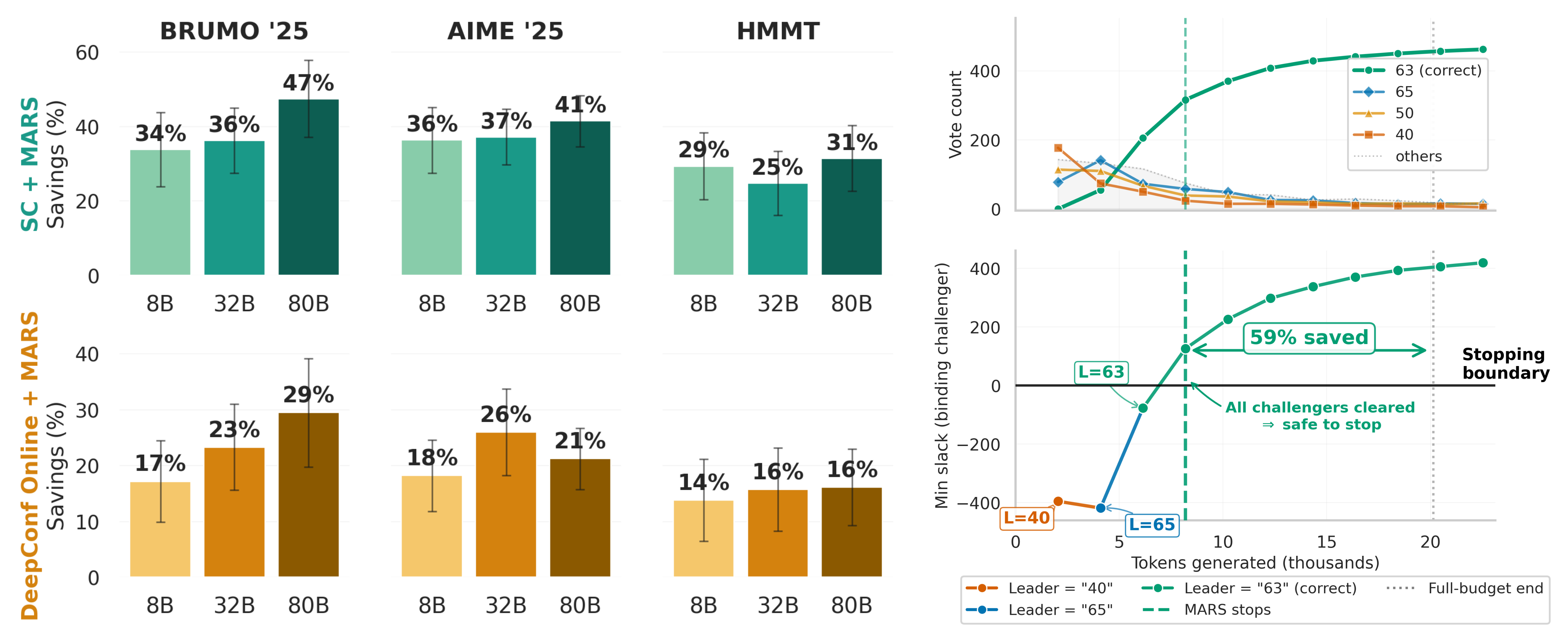
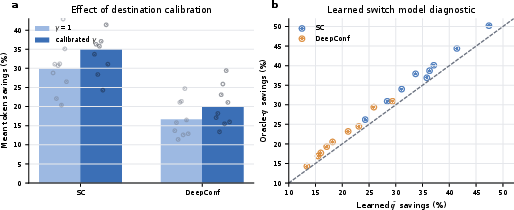
Abstract: Parallel test-time scaling samples many reasoning traces and majority-votes their answers, improving LLM accuracy but requiring traces to run to completion, incurring substantial computational overhead. We observe that probing partial traces at intermediate checkpoints can extract current answers without disrupting generation, revealing an evolving aggregate vote. Based on this observation, we introduce MARS, a margin-adversarial stopping rule that estimates which active traces are likely to change their answers and stops once the leader remains safe under a conservative bound on future vote movement. The rule separates two sources of uncertainty. It learns the trace-level switch probabilities that determine how much of the current margin is likely to be retained, while handling the harder question of where switching traces land through an adversarial bound calibrated from warmup traces. With true switch probabilities, MARS guarantees with high probability that the early-stopped answer matches the full-budget vote. In practice, a five-feature logistic model closely matches oracle switching behavior. Across three reasoning models and three competition-math benchmarks, MARS saves 25-47% of self-consistency tokens and 14-29% on top of DeepConf Online, a strong confidence-weighted baseline that already filters and truncates weak traces, while matching the accuracy of the corresponding full-budget baselines.
Paper Prompts
Sign up for free to create and run prompts on this paper.
Top Community Prompts
Explain it Like I'm 14
A simple explanation of “MARS: Margin‑Adversarial Risk‑controlled Stopping for Parallel LLM Test‑time Scaling”
What is this paper about?
This paper is about making big AI models (LLMs) solve hard problems faster and cheaper without losing accuracy. Today, a reliable way to get better answers is to run many copies of the model in parallel, let each “think out loud,” and then take a majority vote. That works well, but it’s expensive because you normally wait for every copy to finish writing its full reasoning.
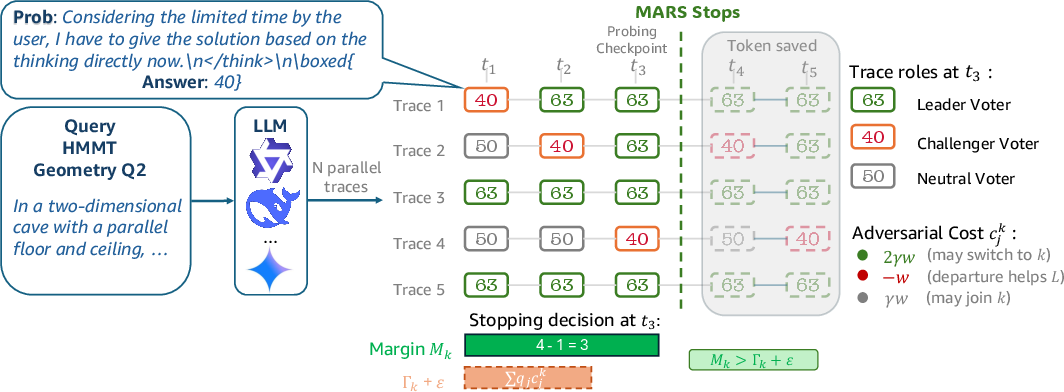
The authors introduce MARS, a smart way to stop early. It peeks at partial progress from each copy, estimates how likely answers are to change, and only stops when it’s very unlikely the current leader can be overtaken later. In tests on tough math contests, MARS cuts the amount of text generated by 25–47% (and still keeps accuracy).
What questions does the paper try to answer?
- Can we safely stop early while many parallel model runs are still “thinking,” yet still get the same final majority answer we would have gotten by waiting to the end?
- How do we tell the difference between a lead that’s truly safe and one that only looks stable for the moment?
- Can we do this with clear, practical rules that work across different models and problem sets?
How does it work? (In everyday terms)
Imagine a classroom where 512 students are solving the same tricky math problem. They write out their reasoning step by step. Every few minutes, you quietly ask each one, “If you had to answer now, what would you say?” without making them stop working. You track the votes over time.
The big idea: don’t stop just because the vote hasn’t changed for a while. Instead, stop only when the current leader is “safe,” meaning even if some students change their minds later, the leader would still win.
To do that, MARS does three things at each checkpoint:
- Probe current answers without disrupting thinking
- The system quickly extracts the “current best answer” from each ongoing reasoning trace (like peeking at a draft answer) and then lets the reasoning continue normally.
- Predict who might change their answer
- It trains a tiny, per-question predictor (a simple logistic model) using a few early “warmup” runs to estimate, for each trace, the chance it will flip to a different answer before the end.
- The prediction uses five easy-to-measure signs from the trace so far (for example, how far along it is and how stable its answer has been).
- Check if the leader’s margin is safe
- Margin means “how far ahead the leader is compared to each challenger.”
- MARS then asks a safety question: even if future flips go in the worst possible way (hurting the leader and helping a challenger), is the leader still far enough ahead?
- If yes for every challenger (including a “new, unseen challenger” that could appear later), MARS stops and declares the leader the winner.
A helpful analogy: Think of a sports game. A team leading by 10 might still be at risk if there’s lots of time left and the other team has momentum. MARS takes into account both the current score difference (margin) and how much “time and uncertainty” is left (who might still switch sides).
Two kinds of uncertainty, handled differently:
- Whether a trace will switch answers: learned from simple features of that trace (this is the part MARS predicts).
- Where a switching trace will land: hard to predict exactly, so MARS assumes a careful worst case. In practice, not all flips help the same challenger, so MARS uses a safety “shrink factor” called γ (gamma), calibrated from a few warmup traces, to be realistic but still conservative.
What about guarantees?
- If the model knew the true switch chances perfectly and used the strict worst case, MARS gives a high‑probability guarantee: the early-stopped winner will match the winner you’d get if you ran everything to the end.
What did they find, and why does it matter?
Across three reasoning models and three math-competition benchmarks (AIME 2025, HMMT, BRUMO 2025):
- With standard majority voting (self-consistency), MARS saved about 25–47% of the tokens (tokens are the chunks of text the model generates; fewer tokens means faster and cheaper).
- On top of a stronger baseline that already filters weak traces (DeepConf Online), MARS saved an extra 14–29%.
- Accuracy stayed essentially the same as the full-budget baseline in all 18 tested settings (differences were within about 0.6 percentage points, and sometimes even improved slightly).
They also compared to a “consensus” method that stops when the majority looks stable for a while. On hard problems, that approach often stopped too early and locked in the wrong answer (big accuracy drops). MARS avoided this by asking a better question: “Can the leader still be caught?” rather than “Has the leader been stable recently?”
Why it matters:
- Real-world systems care about both quality and cost. MARS keeps the quality of the final vote while cutting compute time and money.
- It works as an add-on to different voting styles (plain majority or confidence‑weighted) and different models.
A few practical details (kept simple)
- Probing: The system asks for the current answer at regular checkpoints while traces keep going. This turns a “black box” process into a live scoreboard.
- Switch predictor: A tiny logistic model per question uses warmup traces to learn which traces are likely to flip. The five features include how far along the trace is, its current confidence, how many times it flipped before, how long it’s held the same answer, and whether confidence is rising or falling.
- γ (gamma) calibration: A per-question factor that says “how much of the worst-case we really need to plan for,” estimated from warmup traces.
- Unseen challengers: MARS also guards against the possibility that a brand-new answer appears later and gains votes.
What’s the impact and what could come next?
Impact:
- Faster, cheaper reasoning at test time without sacrificing accuracy.
- Safer early stopping on hard problems, where “stable for a moment” can be dangerously misleading.
Possible next steps:
- Probe more often when the race is tight and less when it’s a blowout (adaptive probing).
- Try MARS beyond math, like code generation or complex multi-step tasks.
- Improve how we predict where switching traces will land, not just whether they will switch.
In short: MARS is a careful referee that watches the score and the remaining risk. It only blows the whistle to end the game early when it’s truly safe—saving time and cost while preserving the win.
Knowledge Gaps
Below is a single, concrete list of the paper’s unresolved knowledge gaps, limitations, and open questions that future work could address.
- Lack of formal guarantees under practical settings: the risk guarantee holds only with true and ; with learned and the procedure is heuristic. Quantify and control the resulting failure probability in practice.
- Sensitivity to switch-probability misspecification: analyze how under/overestimation of affects stopping time, error rate, and savings; derive robust bounds or correction factors when is biased.
- Independence assumption across traces: the theory assumes conditional independence of switch events, which is unlikely given shared prompts and model. Develop guarantees that allow dependence (e.g., martingale, exchangeable, or block-dependent concentration).
- Looseness of concentration and union bounds: the Hoeffding + union-bound correction may be conservative, especially with many challengers. Explore tighter variance-aware (Bernstein/Freedman) or self-normalized bounds to reduce conservatism and increase savings.
- Destination modeling vs. scalar contraction: the contraction coarsely captures destination dispersion. Investigate structured destination models (e.g., answer-to-answer switch matrices, cluster-level destinations, or learned uncertainty sets) that retain safety while reducing conservatism.
- Theoretical calibration of : provide finite-sample or PAC-style guarantees for using based on warmup evidence, including how many warmup checkpoints/traces are needed to achieve a target risk level.
- Unseen-challenger guard tightness: the unseen challenger is modeled via a coarse worst-case cost. Study refined treatments of new-answer emergence (e.g., tail modeling for novel answers, normalization-aware equivalence classes) to avoid undue conservatism.
- Feature sufficiency for switch prediction: the 5-feature logistic model may miss predictive signals (e.g., per-step entropy, token-level logits, local contradictions). Benchmark richer models and features, and assess domain transferability of learned predictors.
- Data efficiency of warmup: determine how savings and error vary with warmup size; design meta-learned or cross-question calibrated models that reduce per-question warmup while maintaining performance.
- Probe-induced perturbation: the method assumes probing does not alter subsequent generation. Quantify any downstream effects of probes across models (e.g., A/B tests on continuation distributions, accuracy shifts, and switch rates).
- Probe interval design: only fixed 2,048-token intervals are tested. Study adaptive probing policies that densify around tight margins and sparsify otherwise, and quantify their cost–benefit and stability.
- Accounting for probe overhead: probe tokens (excluded in reported savings) may be non-negligible for frequent probing. Report total cost including probe tokens and wall-clock overhead; optimize probe length and frequency accordingly.
- Wall-clock latency in real deployments: experiments use pre-generated pools and report token savings, not real-time latency or throughput on hardware. Measure end-to-end latency improvements under realistic runtimes, batching, and scheduling.
- Scalability with many unique answers: when is large, computing margins for all challengers can be expensive. Investigate top-k challenger screening, approximate certification, or streaming updates to keep overhead low.
- Robustness with weighted voting: theory requires bounded weights . Study performance when weights have heavier tails or are misspecified, and develop robust bounds under weight uncertainty or clipping schemes.
- Interaction with per-trace pruning/truncation: MARS is layered atop DeepConf (with adaptive sampling removed). Evaluate interactions with other dynamic policies (e.g., ThinkPrune, entropy-based exits) and whether joint design yields additive benefits without breaking parallelism.
- Generality beyond math: dynamics of switching and destination dispersion may differ in coding, open-domain QA, tool-use, or multi-turn agentic settings. Validate MARS and re-learn / in these domains and identify domain-specific features.
- Smaller budgets and extreme regimes: results are for and three models. Characterize how benefits/risks scale with , model size, and problem difficulty (e.g., low , highly ambiguous tasks).
- Choice of risk level : the paper does not empirically evaluate calibration vs. a target (e.g., realized mismatch rate between and ). Provide calibration curves and target-controlled stopping policies.
- Tie-breaking and near-tie behavior: deterministic tie-breaking may mask fragility. Study how small margins and frequent lead swaps affect certification and whether alternative aggregations (e.g., soft margins) improve robustness.
- Normalization and answer canonicalization: string-based voting can inflate challenger counts due to formatting variants. Assess sensitivity to normalization choices and their impact on and the margin test.
- Handling discarded traces: the pipeline treats discarded traces as zero-weight, but discard policies may be imperfect. Analyze how mis-discarding informative traces affects switching risk and margins.
- Alternative certification targets: MARS certifies agreement with the full-budget vote, not ground truth. Investigate conditions where early stopping can improve ground-truth accuracy (e.g., filtering late-phase degradations) and how to certify that.
- Tighter per-question certification: develop time-uniform or anytime-valid certification (confidence sequences) for to replace per-checkpoint fixed- tests, reducing multiple-testing concerns.
- Resource-aware scheduling: integrate MARS with inference engines (e.g., SGLang) to co-schedule probing and generation, measure GPU utilization, and optimize wall-clock gains under real parallel loads.
- Adversarial or worst-case prompts: evaluate robustness when many leader supporters are volatile or when prompts induce synchronized late switches; identify detectable precursors and defensive calibrations.
- Destination-aware priors from history: use historical question/task statistics to inform priors on destination dispersion (per-dataset , answer clusters), reducing warmup needs and improving safety.
- Combining with sequential-budget methods: compare MARS (parallel) against or alongside sequential adaptive-sampling methods (e.g., certified self-consistency) to understand trade-offs between sample count and within-trace truncation.
- Reporting of failure modes: report empirical frequency of mismatches between early-stopped and full-budget winners, not just benchmark accuracy, to directly assess the intended guarantee in practice.
Practical Applications
Immediate Applications
Below are concrete, deployable use cases that can adopt MARS now, along with likely sectors, integration touchpoints, and feasibility notes.
- Cloud inference cost and latency reduction for parallel self-consistency
- Sector: Software/AI infrastructure, Cloud platforms
- What to deploy: Add a “MARS early-stopping” module to inference servers (e.g., vLLM/SGLang) that:
- Launches N parallel reasoning traces
- Probes at checkpoints (e.g., every 1–2k tokens)
- Fits the 5-feature logistic switch model on 16 warmup traces per prompt
- Applies the margin-adversarial rule with calibrated γ to stop all traces when the leader is certified
- Expected impact: 25–47% token savings for self-consistency and 14–29% additional savings on top of confidence-weighted pipelines (DeepConf Online) while matching full-budget accuracy in math reasoning benchmarks
- Assumptions/dependencies:
- Model supports mid-trace probing that doesn’t perturb generation (thinking-mode or stop-thinking instruction)
- Orchestration permits frequent probing/checkpointing and per-trace weights
- Throughput-friendly parallel launch is already in place (benefits scale with N)
- Enterprise copilots for code, data analytics, and planning that already run multiple candidates in parallel
- Sector: Software engineering, Business analytics, Product design
- What to deploy: Wrap the existing multi-sample inference with MARS to decide when the majority answer is robust enough to stop; optionally use domain-specific weights (e.g., unit-test pass/fail, static analysis, lint results) as per-trace weights wj
- Expected impact: Faster turnaround on complex tasks (code generation, SQL synthesis, multi-step planning) under the same quality targets; lowers inference bill for ensemble-based copilots
- Assumptions/dependencies:
- Access to per-candidate confidence signals or proxy weights (e.g., test results)
- Warmup traces per prompt or per-task template to fit the switch model and calibrate γ
- Guarantee is to match the full-budget vote, not ground truth; combine with verifiers/tests when correctness is critical
- STEM tutoring and math Q&A apps that use self-consistency
- Sector: Education, Consumer apps
- What to deploy: Integrate MARS into existing CoT + majority-vote solvers (especially math), maintaining accuracy while cutting tokens; expose a “fast mode” that applies MARS to reduce latency
- Expected impact: Higher throughput and shorter response times in peak periods without materially affecting solution quality
- Assumptions/dependencies:
- Reasoning traces are sufficiently long to benefit from probing (and to show late switches)
- The 5-feature logistic switch model trained on warmup samples generalizes to question types in production
- LLM research pipelines and benchmark evaluations
- Sector: Academia/Industry Research
- What to deploy: Use MARS to reduce the cost of large-scale evaluation that relies on many parallel traces (e.g., for ablations, sampling policies, chain-of-thought studies)
- Expected impact: More experiments per GPU-hour; reduces energy use for benchmark campaigns
- Assumptions/dependencies:
- Evaluation harness can surface and log per-checkpoint votes and apply MARS’ margin test
- Warmup traces per prompt or per benchmark family to calibrate γ
- Confidence-weighted ensemble serving (e.g., DeepConf Online + MARS)
- Sector: Software/AI infrastructure, Model-serving platforms
- What to deploy: Layer MARS atop confidence-weighted voting/trace filtering so that even after pruning weak traces, the aggregator stops when margins are robust
- Expected impact: Additional 14–29% token savings beyond confidence-based pruning, with preserved accuracy on tested math benchmarks
- Assumptions/dependencies:
- Access to per-trace confidence and the ability to down-weight/discard traces
- MARS works with any weighting scheme; ensure max-weight bound (wmax) is known
- Multi-agent/parallel tool-use orchestrators (LangChain/LlamaIndex/DSPy-style pipelines)
- Sector: Software/AI orchestration
- What to deploy: Treat each agent/tool chain as a “trace”; probe partial conclusions and use MARS to halt the ensemble when an answer lead is certified
- Expected impact: Reduces wall-clock time by stopping secondary chains early once the majority outcome is safe
- Assumptions/dependencies:
- Ability to non-disruptively query intermediate agent outputs
- Independence assumption in the paper is approximate; strong inter-agent coupling may reduce the tightness of guarantees
- On-device/edge parallel reasoning for battery and compute savings
- Sector: Mobile/Edge AI
- What to deploy: For small-N self-consistency on device, apply MARS with fewer probes and smaller N to cut cost while retaining quality
- Expected impact: Reduced energy consumption and latency in local math/logic tasks
- Assumptions/dependencies:
- Edge models must support probing; fewer traces means smaller absolute savings but still meaningful for latency/battery
- Ensemble-based data labeling and content moderation
- Sector: Content platforms, Data operations
- What to deploy: When using multiple parallel LLM judgments per item, apply MARS to stop when the margin is robust, optionally with per-judge weights (e.g., past consistency, rule-based checks)
- Expected impact: Cuts labeling costs and time while preserving the ensemble’s final decision
- Assumptions/dependencies:
- The task must tolerate “vote-equivalence” as a stopping target (full-budget vs. early-stopped vote)
- Consider adding human-in-the-loop or verifiers for high-stakes items
Long-Term Applications
These applications need additional research, domain adaptation, or systems work before deployment at scale.
- Safety-critical decision support (healthcare, finance, legal)
- Sector: Healthcare diagnostics, Clinical decision support; Finance risk/credit; Legal drafting
- Future workflow: Use MARS to reduce compute for ensembles while pairing with strong verifiers or domain-specific adjudication so the stopping criterion references a validated surrogate of correctness
- R&D needs:
- Guarantees to ground truth, not just to full-budget vote (e.g., combine MARS with process- or outcome-based verifiers)
- Robustness under domain shift and tighter auditing of the independence assumption
- Dependencies/assumptions:
- Regulatory approvals; risk management frameworks for compute-correctness tradeoffs
- Proven ability to probe without altering the reasoning path in domain-tuned models
- Code generation with unit-test–aware stopping
- Sector: Software engineering
- Future workflow: Use test outcomes and static analysis to define weights; probe partial solutions and stop when the “passing variant” is margin-certified
- R&D needs:
- Mapping partial code to interim “answers” that are probeable without derailing generation
- Destination modeling beyond γ to exploit structure in how failing candidates evolve
- Dependencies/assumptions:
- Fast sandboxing to run tests during checkpoints; reliable confidence proxies
- Robotics and operations research planning
- Sector: Robotics, Supply-chain/logistics
- Future workflow: Run multiple planner chains in parallel (plans as answers) and stop when the leading plan is margin-safe; optionally certify submodules (per-subgoal margins)
- R&D needs:
- Define stable, probeable intermediate “answers” for plans
- Integrate safety constraints and downstream simulators as weights or verifiers
- Dependencies/assumptions:
- Real-time constraints may require adaptive probing frequencies and low-overhead probing
- Tree-of-Thoughts/graph search with hierarchical stopping
- Sector: Advanced reasoning systems
- Future workflow: Apply MARS at multiple granularity levels (node, subtree, final answer), turning margin certification into a pruning policy that preserves solution quality
- R&D needs:
- Theoretical extensions from flat voting to tree-structured dependencies
- Handling stronger correlations between traces (violations of conditional independence)
- Multimodal reasoning (vision-language, radiology reports, scientific figures)
- Sector: Healthcare imaging, Document intelligence, Industrial inspection
- Future workflow: Probe intermediate multimodal answers (e.g., preliminary diagnoses, caption candidates) and stop when margins are certified
- R&D needs:
- Reliable multimodal probing that doesn’t perturb subsequent generation
- Calibrated switch models for multimodal traces; domain-adapted features beyond the current five
- Adaptive probing and destination modeling
- Sector: AI infrastructure, Research
- Future workflow: Make probing frequency adaptive to margin “slack”; replace γ with learned destination distributions when statistically justified
- R&D needs:
- Online learning of switch probabilities and destinations with anytime-valid guarantees
- Better concentration bounds under dependence and non-uniform weights
- Carbon-aware scheduling and policy tooling
- Sector: Cloud/Sustainability, Public policy
- Future workflow: Use MARS-driven savings to schedule heavy reasoning jobs in carbon-friendly windows; report “risk-controlled compute savings” in sustainability dashboards
- R&D needs:
- Standardized telemetry and reporting for early-stopping risk (δ), token savings, and accuracy deltas
- Procurement and compliance templates that recognize certified early stopping
- Federated and privacy-sensitive deployments
- Sector: Healthcare, Finance, Edge AI
- Future workflow: Apply local margins with encrypted or anonymized vote shares; stop collaboratively without exchanging raw traces
- R&D needs:
- Secure aggregation of vote and margin statistics at checkpoints
- Private calibration of γ and switch models across clients
Notes on Assumptions and Dependencies That Affect Feasibility
- Probing must be non-disruptive: The model should support extracting intermediate answers without altering subsequent generation (as observed in thinking-mode LLMs). If probing perturbs trajectories, guarantees weaken.
- Guarantee target: MARS certifies agreement with the full-budget vote, not ground truth. For high-stakes domains, combine with verifiers/tests or human review.
- Switch-model calibration: Per-prompt (or per-template) warmup traces are required to fit the 5-feature logistic model and calibrate γ. If warmup traces are scarce or unrepresentative, conservatism increases and savings may shrink.
- Conditional independence and bounded weights: Theoretical guarantees assume conditional independence of switch events given observed features and bounded per-trace weights. Strong correlations (e.g., identical prompts with shared randomness) reduce tightness.
- Infrastructure requirements: Parallel launch of traces, periodic checkpointing/probing, per-trace weighting (optionally from confidence or external signals), and integration into serving stacks (e.g., SGLang, vLLM) are needed.
- Workload scale: Benefits rise with the number and length of traces. For small N and very short traces, savings exist but are proportionally smaller.
- Domain adaptation: The 5-feature switch model works well on math reasoning; other domains may need additional or different features (e.g., code test outcomes, planner consistency metrics).
Glossary
- Active set: The set of traces still generating at a checkpoint. Example: "The active set is "
- Adversarial bound: A conservative, worst-case bound assuming future changes coordinate against the current leader. Example: "an adversarial bound calibrated from warmup traces."
- Adversarial switch cost: The worst-case margin impact assigned to a trace if it switches answers, used to certify safety against challengers. Example: "Adversarial switch cost"
- Anytime-valid guarantees: Statistical guarantees that hold uniformly over time (across stopping times). Example: "derive anytime-valid guarantees;"
- Bayes-optimal rule: The stopping policy that minimizes expected risk by halting as soon as the probability of a future change is below a threshold. Example: "The Bayes-optimal rule stops at the earliest where ."
- Bootstrap sampling: Resampling with replacement from a pool to simulate multiple runs. Example: "We simulate 512-trace parallel runs by bootstrap sampling from the 4{,}096-trace pool"
- Chain-of-thought: Prompting strategy that elicits step-by-step reasoning in LLMs. Example: "Chain-of-thought and related decomposition prompts improve multi-step reasoning"
- Concentration correction: An additive safety margin derived from concentration inequalities to control tail risk in stopping. Example: "MARS stops when the current margin exceeds this expected damage plus a concentration correction for every challenger:"
- Confidence-weighted voting: Aggregation where each trace’s vote is weighted by a confidence signal. Example: "uses model-internal confidence for confidence-weighted voting, filtering, and online truncation,"
- Conditional independence: An assumption that random variables are independent given observed information. Example: "Conditional on , the switch indicators are independent."
- Contraction parameter γ: A calibration factor that relaxes fully adversarial costs to reflect realistic dispersion of switching destinations. Example: "We relax the adversarial costs with a contraction parameter :"
- Consensus stopping: A heuristic that halts when the majority answer remains unchanged for several probes. Example: "Consensus stopping fails on hard questions."
- DeepConf Online: A confidence-based pipeline that weights, filters, and truncates traces during voting. Example: "DeepConf Online (DCO) weights and filters traces by confidence;"
- Hoeffding's inequality: A concentration bound used to control the probability of large deviations of bounded sums. Example: "The proof applies Hoeffding's inequality to and takes a union bound over challengers;"
- Logistic regression: A probabilistic classification model used here to estimate per-trace switch probabilities. Example: "We fit a per-question logistic regression on (trace, checkpoint) pairs."
- Majority vote: Selecting the answer with the largest number of votes among traces. Example: "sampling many reasoning traces and aggregating their answers by majority vote,"
- Margin (vote margin): The difference in votes between the leader and a challenger used to assess safety. Example: "At checkpoint , define the margin of the leader over each challenger as"
- MARS (Margin-Adversarial Risk-controlled Stopping): A stopping rule that certifies the leader by comparing margins to adversarial switch risks. Example: "We introduce MARS (Margin-Adversarial Risk-controlled Stopping), a principled early-stopping rule"
- Oracle-: An idealized diagnostic using true switch outcomes instead of estimated probabilities. Example: "an oracle- diagnostic that replaces the learned switch model with the retrospective indicator ."
- Parallel test-time scaling: Running many reasoning traces in parallel and aggregating them to improve accuracy. Example: "Parallel test-time scaling, sampling many reasoning traces and aggregating their answers by majority vote,"
- Probing (LLM probing): Eliciting intermediate answers from partial traces without interrupting ongoing generation. Example: "Probing transforms parallel decoding from opaque to observable."
- Risk level δ: The user-specified maximum probability of returning a different answer than the full-budget vote. Example: "For a user-specified risk level :"
- Self-consistency: A voting approach that samples multiple reasoning paths and uses uniform-weight majority voting. Example: "Self-consistency (SC) uses uniform weights and majority vote"
- Speculative decoding: A technique to accelerate generation by drafting tokens with a smaller model and verifying them with a larger one. Example: "such as speculative decoding~\citep{leviathan2023fast, chen2023accelerating}"
- Stopping time: A random time at which a process is halted based on information available up to that time. Example: "We seek a stopping time "
- Synthetic unseen challenger ⊥: A placeholder answer representing any new answer that may appear later. Example: "plus a synthetic unseen challenger with ."
- Time-uniform inference: Statistical inference whose guarantees hold at any time during sequential analysis. Example: "connecting LLM self-consistency to classical sequential testing and time-uniform inference"
- Union bound: A probability inequality bounding the probability of a union of events by the sum of their probabilities. Example: "and takes a union bound over challengers;"
- Upper-confidence correction: An adjustment that increases conservatism based on uncertainty in calibration. Example: "We add an upper-confidence correction:"
- Warmup traces: A small set of traces run to completion to fit switch models and calibrate parameters before stopping the main run. Example: "calibrated from warmup traces."