What Fits (Into Few Tokens) Doesn't Overfit: Compression and Generalization in ML Research Agents
Published 9 Jun 2026 in cs.AI and cs.LG | (2606.11045v1)
Abstract: Reusing a held-out benchmark adaptively should, in principle, invite overfitting. Yet benchmark-driven ML has produced surprisingly little overfitting in practice. An attractive hypothesis is that successful ML strategies are highly compressible. We study this in the setting of LLM-driven research agents, where the hypothesis becomes directly testable via two complementary information bottlenecks. In \emph{output compression}, an exploration agent adaptively searches for high-performance models using a validation set, and we test whether a fresh ``reproducer agent'' can reproduce its performance given only an extremely short prompt and the training data. In \emph{input compression}, the explorer receives only one-bit feedback indicating whether each submitted model improves on the running best. Across 8 datasets spanning tabular classification, vision, language modeling, diffusion modeling, and reward modeling, we find that these bottlenecks have little effect on performance: short prompts and compressible feedback are sufficient to reproduce and find high-performance models. The hypothesis is falsifiable: when we deliberately induce validation-set overfitting, the results fail to reproduce with short prompts. Taken together, our results support a description-length explanation for the lack of overfitting in benchmark-driven ML: successful strategies occupy a low-complexity region of strategy space.
The paper demonstrates that ML strategies are highly compressible, with 32-token prompts achieving over 90% of the original performance.
It employs both output and input compression techniques, including binary feedback, to restrict information flow and prevent overfitting.
The study links description length to generalization bounds, providing a practical diagnostic for detecting validation data exploitation in ML research.
Compression and Generalization in ML Research Agents
Overview
The paper "What Fits (Into Few Tokens) Doesn't Overfit: Compression and Generalization in ML Research Agents" (2606.11045) provides a rigorous investigation into the empirical phenomenon that, despite extensive adaptive reuse of validation benchmarks in machine learning, overfitting is less prevalent than worst-case theory predicts. The authors formalize and experimentally test a compressibility-based explanation: the effective information content of successful ML strategies is low and can be encoded succinctly. Using autonomous LLM-based research agents, they instantiate and verify this hypothesis empirically, providing both formal theoretical results and strong empirical support across a diverse set of ML domains. The study introduces two independent information bottlenecks—output compression and input compression—and demonstrates that limiting the information flow from the validation set does not meaningfully degrade agent performance unless the agent exploits validation-specific information.
Methodology
The central thesis is that overfitting can be mitigated by ensuring that the information channel from validation data to the selected hypothesis is of low capacity. This is instantiated in two main experimental paradigms:
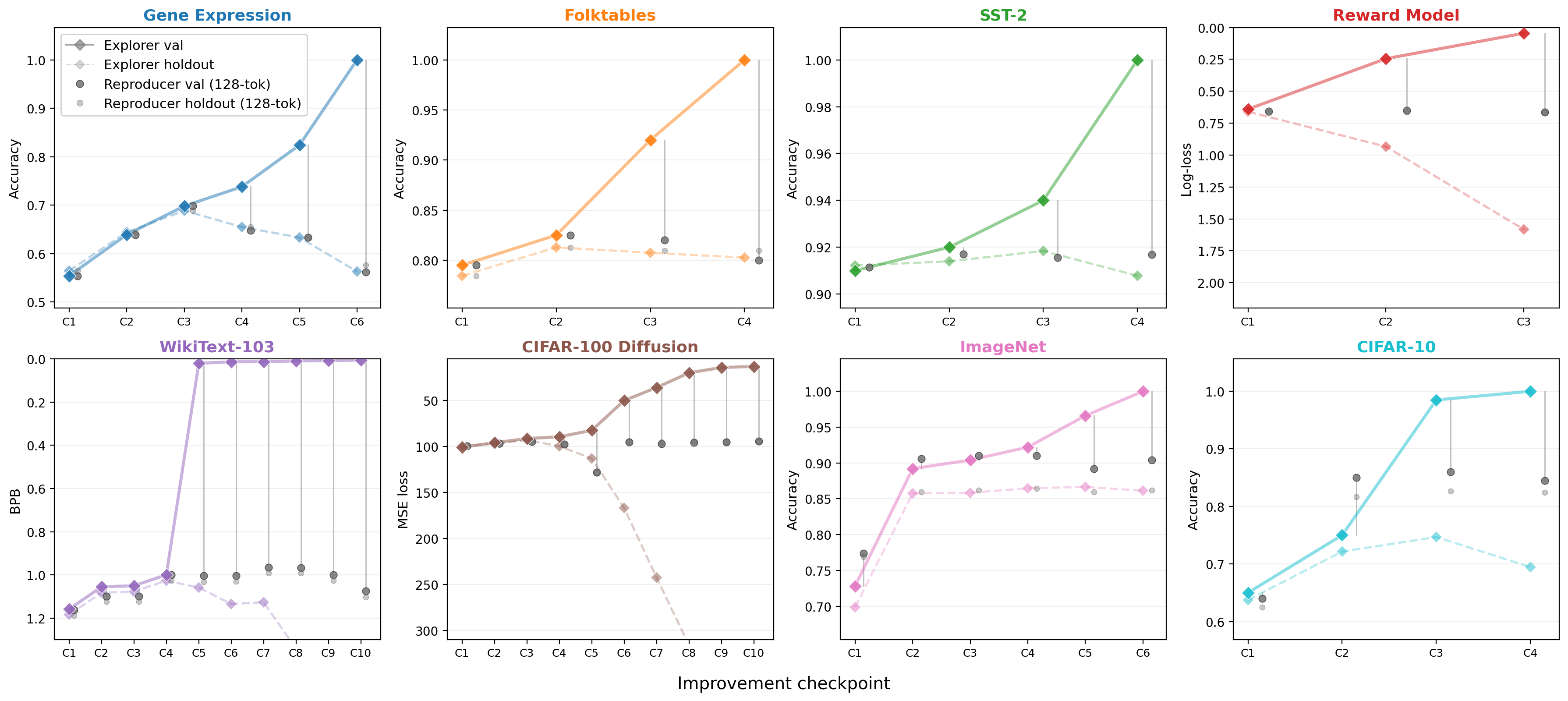
1. Output Compression: An "explorer" agent interacts adaptively with the training and validation data to develop a successful strategy. A distinct "reproducer" agent receives only a compressed, token-limited prompt summarizing the explorer's strategy and the training data. The core question is whether this compressed prompt suffices for the reproducer to recover the explorer's performance without access to the validation set or explorer's code.
2. Input Compression (Ladder Mechanism): Instead of giving the explorer the full validation metric, feedback is restricted to a single bit ("improved"/"not improved" over prior best) per query. The effective information about the validation set is thus encoded as a short binary string, bounding the description length and directly controlling generalization.
Both bottlenecks are implemented on state-of-the-art LLM agents, evaluated across eight diverse datasets spanning classification, vision, language modeling, diffusion, and reward modeling.
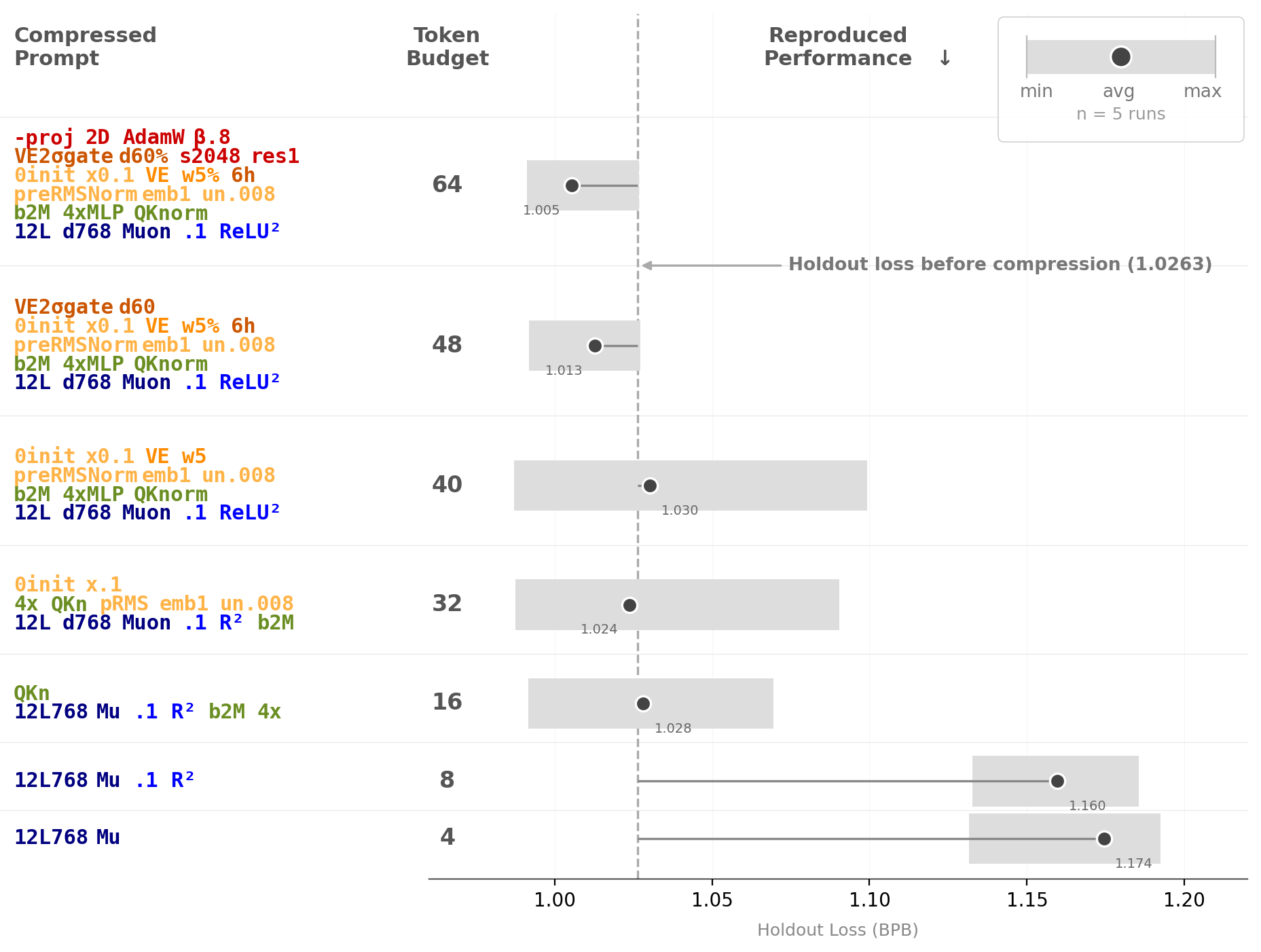
Figure 1: Compressibility of an autonomous agent's strategy for language modeling, showing no holdout performance degradation down to a 16-token prompt, with significant collapse only below this threshold.
Empirical Evidence
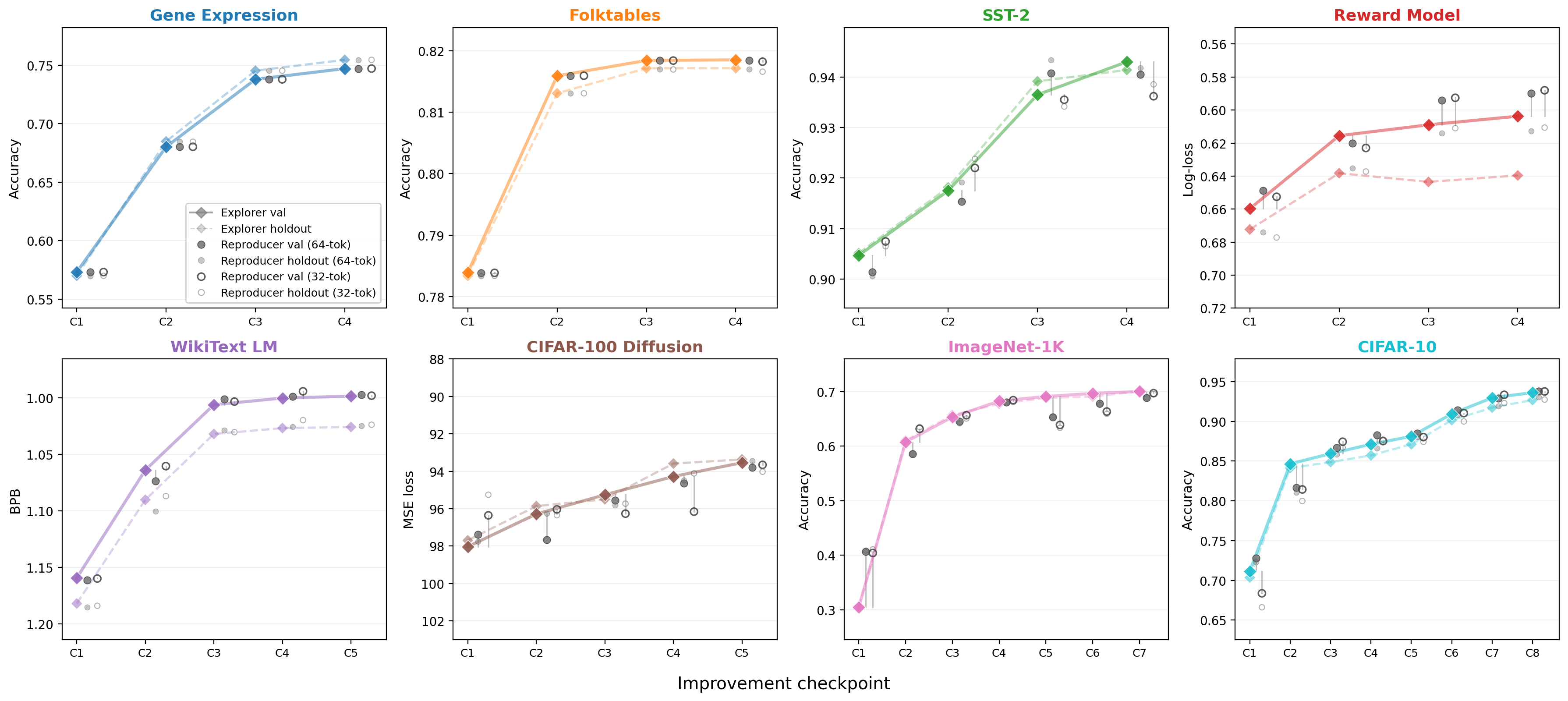
On all evaluated domains, short tokens prompts—down to as little as 32 tokens—are sufficient for reproducibility of adaptively discovered high-performing strategies. Output compression experiments show that 32-token prompts allow reproducer agents to track explorer performance within a negligible margin in more than 90% of checkpoints across all datasets, including complex domains like vision and language modeling.
Figure 2: Explorer trajectory and reproducer performance across datasets; compressed prompts allow reproducers to match explorers’ validation and holdout performance at all checkpoints.
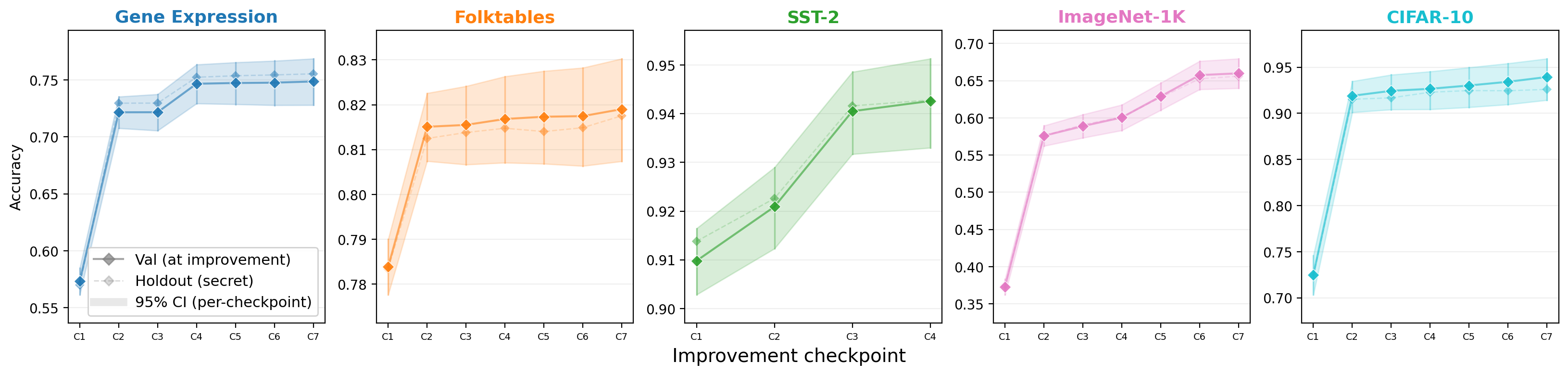
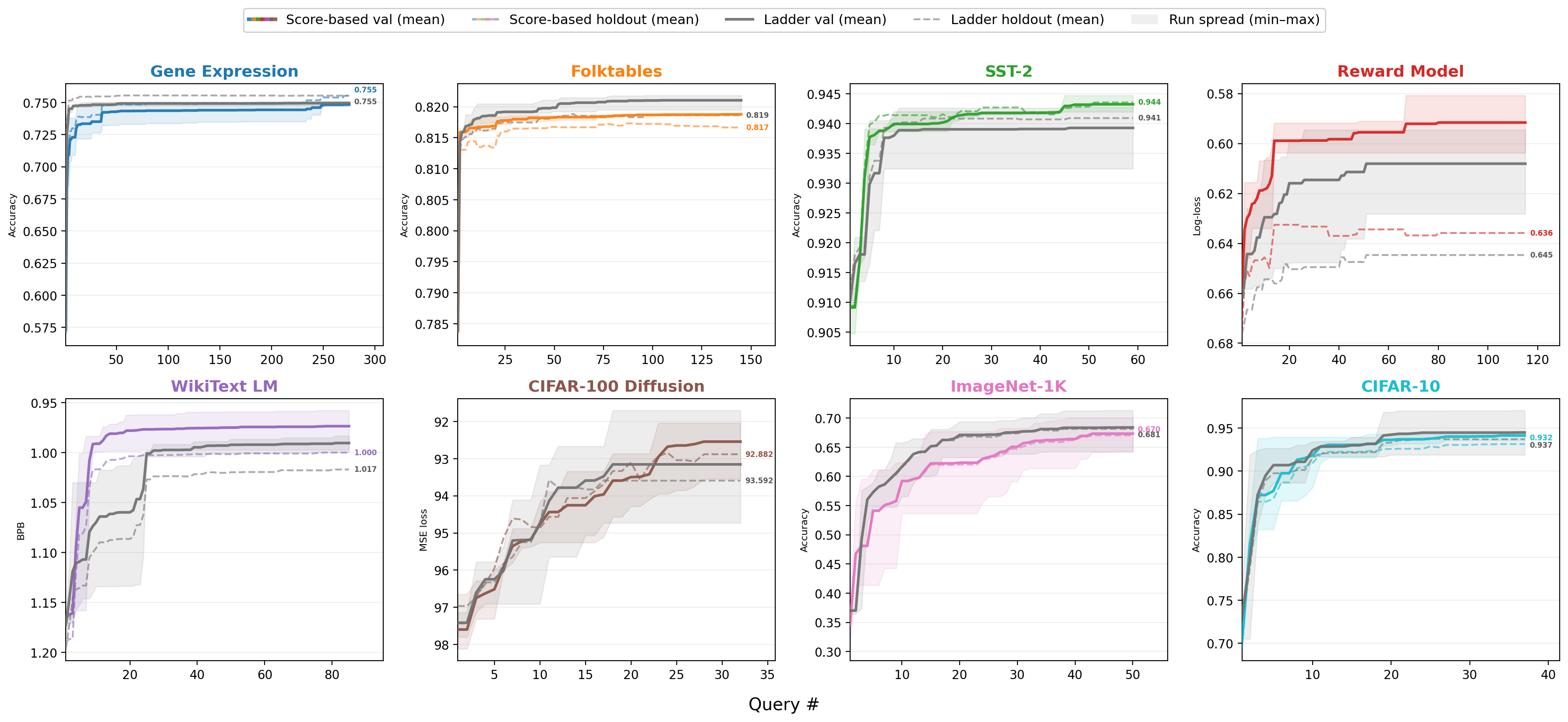
Input compression using the ladder mechanism shows that agents receiving only binary improvement feedback can reach performance essentially equivalent to agents receiving full numerical feedback, with tight confidence intervals demarcating generalization gaps.
Figure 3: Per-checkpoint ladder generalization bounds; holdout performance closely tracks validation for all checkpoints, confirming the bottleneck’s protection against overfitting.
Figure 4: Comparison of score-based and binary (ladder) feedback agents; both protocols yield nearly identical final performance across all domains, with minimal variability.
Theoretical Analysis
The analysis employs adaptive description-length generalization bounds, connecting the information-theoretic capacity of the communication channel (prompt length or ladder transcript) to uniform generalization guarantees. The output compression bound shows that for a prompt of B tokens, test risk deviation from empirical risk is controlled by (B+1)ln∣V∣/(2n), with V the vocabulary size and n the validation set size. For the ladder mechanism, the population risk of all improvement checkpoints is simultaneously bounded by the number of improvement events and the validation set size, with stratified union bounds providing rigorous confidence intervals.
Detecting and Certifying Overfitting
A critical component of the paper is its falsification of the compression hypothesis: when agents are intentionally induced to overfit (via direct access to or aggressive exploitation of validation data), validation-specific performance gains do not survive the output compression bottleneck. Specifically, in scenarios with strong validation-data leakage, the reproducer's performance strictly tracks the holdout set rather than the explorer's inflated validation metric.
Figure 5: On intentionally overfit runs, validation-specific gains evaporate under compression; reproducer performance matches holdout rather than explorer validation, precisely separating genuine gains from overfitting.
This demonstrates that the compression certificate is both necessary and sufficient for detecting validation exploitation, with experiments yielding 100% sensitivity and 91% specificity in distinguishing genuine improvements from overfit checkpoints.
Implications
The results have notable implications for both theoretical understanding and practical validation of ML benchmarks:
Empirical justification for benchmark reuse: The compressibility of effective ML strategies explains the robustness of widely reused validation sets, as only a small volume of validation-specific information actually flows into the final model selection.
Desiderata for benchmark and contest protocols: Description-length (in tokens or bits) becomes a practical metric for enforcing or certifying generalization. Token-limited prompts or binary feedback mechanisms can be used as reproducibility checks or to guard against adaptive overfitting in long-lived public benchmarks.
Autonomous agent science workflows: In agent-driven ML science, explicit information bottlenecks offer both controllable generalization bounds and diagnostic tools for detecting validation exploitation.
PAC-Bayes perspectives: The work motivates sharper, prior-weighted analyses that go beyond token counts, leveraging pretrained LMs as priors and enabling non-vacuous, instance-specific bounds.
Limitations and Future Directions
The analysis presumes that all communication with the validation set flows through the controlled bottleneck (compression prompt or ladder transcript). Pretraining contamination or external information channels remain potential side-channels and must be stringently isolated or controlled, potentially via the use of post-training datasets or strictly partitioned data. Additionally, the operationalization of description-length via token budget is a proxy; an LLM-based, field-specific prior over model strategies would refine and potentially tighten generalization guarantees.
Future work is likely to extend these description-length certificates to human agent workflows, design improved benchmarks and meta-learning protocols with built-in compression tests, and investigate structured priors or hierarchical coding for more efficient or reliable certifications.
Conclusion
This work provides a formal and empirical framework for understanding why pervasive benchmark reuse in machine learning does not induce catastrophic overfitting: effective strategies are highly compressible and generalize well as a result. The findings are robust across domains, agents, and feedback channels, and the explicit information bottlenecks—output and input compression—serve both as empirical probes and as practical mechanisms for certifying genuine progress. The compression certificate thus emerges as a powerful diagnostic and assurance tool for adaptively selected machine learning strategies.
“Emergent Mind helps me see which AI papers have caught fire online.”
Philip
Creator, AI Explained on YouTube
Sign up for free to explore the frontiers of research
Discover trending papers, chat with arXiv, and track the latest research shaping the future of science and technology.Discover trending papers, chat with arXiv, and more.