Flow-DPPO: Divergence Proximal Policy Optimization for Flow Matching Models
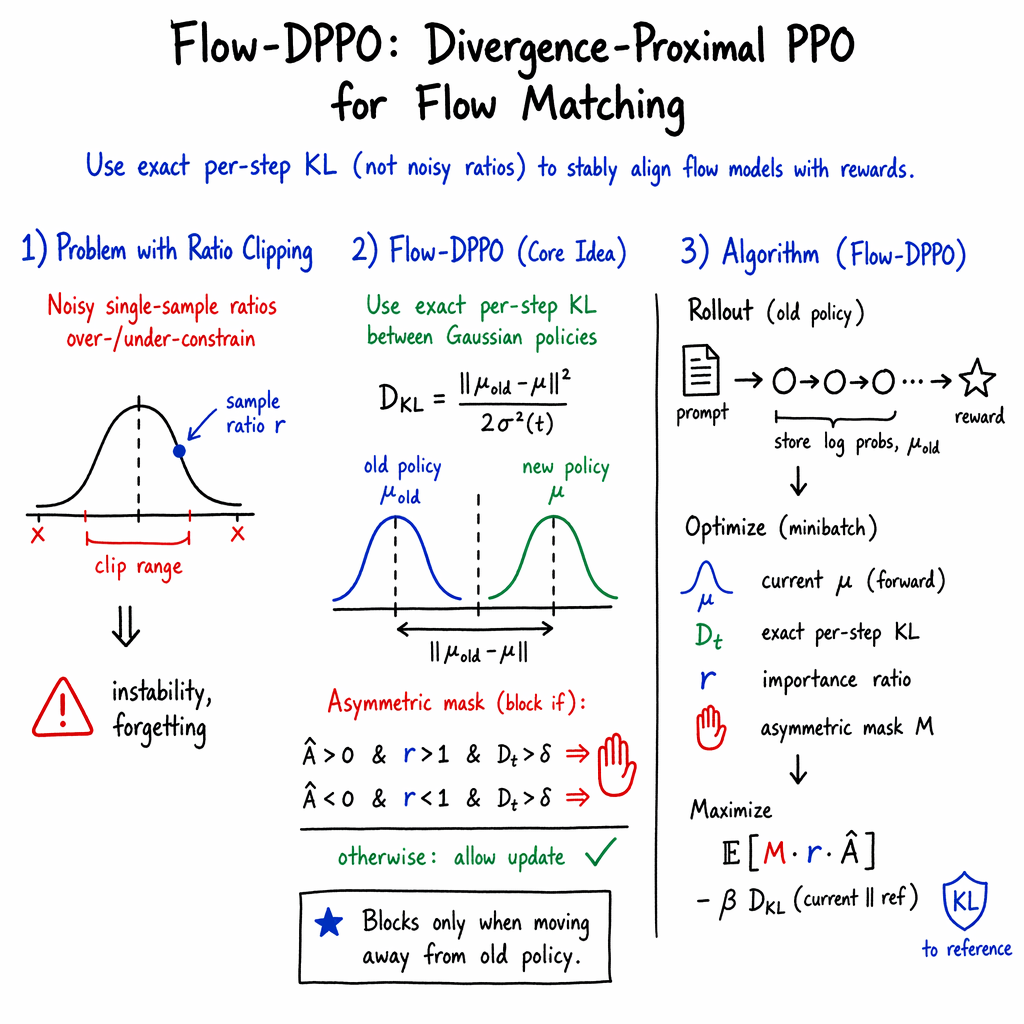
Abstract: Recent work has demonstrated that online reinforcement learning (RL) can substantially improve the quality and alignment of flow matching models for image and video generation. Methods such as Flow-GRPO and CPS cast the denoising process as a Markov Decision Process and apply PPO-style ratio clipping to enforce a trust region. However, we argue that ratio clipping is structurally ill-suited for flow models: the probability ratio between new and old policies is a noisy, single-sample estimate of the true policy divergence, leading to over-constraining in some regions of the trajectory and under-constraining in others. We propose Flow-DPPO (Flow Divergence Proximal Policy Optimization), which replaces ratio clipping with a divergence proximal constraint. A key observation is that the per-step policy in flow models is Gaussian, enabling exact and cheap computation of the KL divergence between old and new policies. Flow-DPPO employs an asymmetric divergence mask that blocks gradient updates only when they simultaneously move away from the trusted region and violate the divergence threshold. Experiments show that Flow-DPPO achieves higher rewards with better KL-proximal efficiency, alleviates catastrophic forgetting, promotes balanced multi-objective optimization, and enables stable multi-epoch training where ratio clipping degrades. Code and models are available at https://github.com/Tencent-Hunyuan/UniRL/tree/main/FlowDPPO.
Paper Prompts
Sign up for free to create and run prompts on this paper using GPT-5.
Top Community Prompts
Explain it Like I'm 14
What This Paper Is About
This paper is about teaching image and video generators to follow instructions better using reinforcement learning (RL). It focuses on a popular kind of generator called a “flow matching model,” which turns random noise into a picture step by step. The authors introduce a new training method called Flow-DPPO that makes this RL training more stable and effective, so the models become better at following complex prompts without losing their original image quality.
The Big Questions the Paper Tries to Answer
- How can we safely improve flow-based image/video generators with RL so they get better at following prompts without breaking what they already do well?
- Why do popular training tricks (like PPO’s “ratio clipping”) sometimes make flow models learn in a shaky or unfair way?
- Can we use information that’s naturally available in flow models to control training more precisely?
How the Method Works (Explained Simply)
First, a few ideas in everyday language:
- Flow matching model: Imagine sculpting a statue from a block of marble. The model starts with “noise” (the block) and makes many tiny chisels (steps) until a clean image (the statue) appears.
- Reinforcement learning (RL): Think of giving the sculptor a score at the end—“Does the final statue match the request?” The sculptor then learns to make better chisels next time.
- Policy: The sculptor’s step-by-step plan for chiseling.
- Trust region: A “safe zone” that keeps each learning step from changing the sculptor’s plan too much at once—like staying inside your lane while learning to drive.
What current methods do:
- Older methods (like Flow-GRPO and Flow-CPS) use a trick from PPO called “ratio clipping.” They compare how likely a step is under the new plan versus the old plan and force this ratio to stay within a small band (like between 0.9 and 1.1). This is supposed to keep updates “safe.”
Why that’s a problem for flow models:
- In flow models, each step involves randomness in a big, continuous space. Judging safety from a single noisy sample is like measuring your distance from home using one blurry photo—it’s unreliable. Sometimes it overreacts (blocks good steps) and sometimes it underreacts (lets risky steps through).
The key insight of Flow-DPPO:
- In flow models, each step’s decision is a bell-curve (a Gaussian). That means we can compute the exact distance between the old plan and the new plan (called KL divergence) cheaply and precisely—no guessing.
- Instead of “ratio clipping,” Flow-DPPO uses a simple rule (a mask):
- If you’re already too far from the old plan and the next step would push you even farther, block that step.
- If the step moves you back toward the old plan, always allow it.
- Think of it like this: If you drift out of your lane, the system blocks steering that drifts further out—but it never blocks steering that brings you back into the lane. This keeps learning safe without slowing down useful corrections.
A tiny bit of math intuition (no details needed):
- Because each step is Gaussian with a known spread (variance), the KL divergence is basically “how far the new mean is from the old mean,” scaled by that spread. This can be computed exactly from the model’s own outputs, so it’s reliable and cheap.
What They Did to Test It
- They tried Flow-DPPO on several strong image models: Stable Diffusion 3.5 Medium, FLUX.2-klein-base-9B, and FLUX.1-dev.
- They compared against leading baselines: Flow-GRPO, Flow-CPS, GRPO-Guard, and Diffusion-NFT.
- They measured:
- In-domain following: GenEval2 (how well images match prompt instructions, like counting objects).
- Out-of-domain quality: PickScore, CLIP score, HPSv2 (how humans tend to prefer images overall).
- They tested both single goals (optimize GenEval2 only) and multiple goals at once (multi-reward).
- They also checked how well the model remembers its general skills (avoids “catastrophic forgetting”) and whether longer training stays stable.
Main Findings and Why They Matter
Here are the key results from their experiments:
- Better prompt following with less damage to image quality:
- Flow-DPPO scored higher on GenEval2 (better at compositions like “a blue dog on top of three white sheep”) while keeping visuals cleaner and more realistic compared to other methods.
- Less “catastrophic forgetting”:
- While pushing hard on in-domain rewards, many methods slowly forget how to make generally good images on new prompts. Flow-DPPO kept out-of-domain scores (PickScore, CLIP, HPSv2) higher for longer, meaning it learned new skills without losing old ones.
- More stable, more efficient training:
- Flow-DPPO stayed stable over many training rounds (multi-epoch), where other methods often plateaued or got worse. This is useful when generation is expensive (like videos), because you can safely reuse the same training samples for multiple updates.
- Stronger safety boundary, less reward hacking:
- The divergence mask acted like a guardrail. It reduced the chance the model would “game the reward” (produce images that trick the score but look bad to humans) and kept updates within a trustworthy range.
- Theory that matches practice:
- The authors adapted a known RL guarantee (policy improvement bound) to the flow-model setting. It says: if you keep each step’s change within a divergence limit, learning improves monotonically. Flow-DPPO directly enforces this with exact KL, which helps explain its stability.
In short, the method raises scores where it counts (following instructions), reduces unwanted side effects (blurry or weird images), and keeps training steady and efficient.
What This Could Mean Going Forward
- Better aligned image and video generators: Models can follow complex, structured prompts more accurately without ruining overall image quality.
- Safer, longer training: Because it stays stable across many updates, Flow-DPPO could make it practical to train on costly tasks (like long videos) or reuse data more efficiently.
- Less reward hacking, more balance: When optimizing multiple goals (e.g., prompt following, realism, style), Flow-DPPO helps avoid “overfitting” to one metric at the cost of others.
- A natural fit for flow models: Since exact divergence is cheap to compute for Gaussians, this approach maps cleanly onto the way these models already work.
Overall, Flow-DPPO is like upgrading from a shaky ruler to a precise measuring tool for keeping learning steps safe. That precision leads to better images, more reliable training, and models that improve without forgetting what they already know.
Knowledge Gaps
Knowledge gaps, limitations, and open questions
Below is a concise, actionable list of what remains missing, uncertain, or unexplored in the paper, aimed to guide future research.
- Missing end-to-end trust-region guarantee: the asymmetric divergence mask blocks gradients when Dt exceeds a threshold, but it does not ensure the post-update policy remains within the per-step trust region. Investigate predictive or line-search-based mechanisms that directly constrain the updated policy’s maximum per-step divergence (e.g., projected updates or adaptive step sizes ensuring Dmax ≤ δ after the update).
- KL-to-TV mapping and bound tightness: the policy improvement bound is stated in terms of TV divergence with a quadratic horizon dependence. Derive tighter, practical bounds tailored to flow denoising horizons and provide explicit mappings from per-step KL thresholds to TV constraints that yield non-vacuous guarantees across timesteps and model scales.
- Adaptive, time-dependent divergence thresholds: thresholds were explored as fixed scalars (e.g., 1e-5, 1e-7). Develop principled schedules for δ(t) that adapt to time-dependent variance σ(t), step size Δt, and latent dimension, or use normalized per-dimension thresholds to avoid over-/under-blocking at early/late steps.
- Exploration–constraint trade-off: quantify whether the mask reduces beneficial exploration in high-advantage regions by blocking updates at large divergence. Measure coverage metrics (e.g., diversity, novelty) and analyze exploration dynamics under varying δ and stochasticity levels (α in Flow-SDE, n in CPS).
- Post-update divergence prediction: Appendix E sketches predictive masks but is not validated. Evaluate predictive divergence estimators (e.g., linearized Fisher or Hessian approximations, trust-region Newton steps) that bound Dt after the optimizer step, and compare their stability and sample efficiency to the current mask.
- Off-policy drift and sample reuse: multi-epoch training reuses stale rollouts, yet the mask is computed on old states. Assess importance sampling corrections, state-distribution mismatch, and whether the mask remains effective when the on-policy distribution has substantially shifted over inner-loop updates.
- Generalization beyond equal-covariance Gaussians: the exact KL closed form assumes identical isotropic covariance. Extend Flow-DPPO to anisotropic or learned covariances, non-Gaussian samplers, or schedulers that induce unequal variances across dimensions or conditionings, and verify the mask’s robustness.
- Broader sampler coverage: only Flow-SDE and CPS are tested. Evaluate other stochastic ODE/SDE samplers (e.g., noise-tuned interpolants, MixGRPO ODE–SDE hybrids) and sophisticated discretizations, analyzing how sampler noise and step-size interact with divergence thresholds.
- Video generation claims vs evidence: the paper motivates long-video scenarios but presents image-only experiments. Benchmark Flow-DPPO on video flow models with long horizons, measure sample efficiency under multi-epoch reuse, and characterize failure modes unique to temporal coherence.
- Reward design and multi-reward aggregation: multi-reward training uses equal weights via GDPO. Explore adaptive or learned weighting, constrained multi-objective formulations (e.g., Pareto front maintenance), and the impact on reward hacking and catastrophic forgetting.
- Advantage estimation and credit assignment: advantages are group-relative and terminal (trajectory-level). Test per-step credit assignment, variance reduction baselines (e.g., generalized advantage estimators adapted to terminal rewards), and the sensitivity of the mask to noisy or biased advantage signals.
- Combined effect of mask and reference KL penalty: provide guidance and theory on setting the reference KL coefficient β jointly with δ, and analyze the interplay between the proximal mask and reference regularization in preventing reward hacking and preserving capabilities.
- CFG interactions: classifier-free guidance changes the effective policy mean. Systematically study how CFG scales affect Dt, whether mask thresholds should be adjusted under varying CFG, and how guidance interacts with trust-region constraints.
- Baseline tuning fairness: include stronger PPO variants (adaptive ε clipping, per-sample normalization beyond GRPO-Guard, advantage-weighted matching, MixGRPO) and exhaustive hyperparameter sweeps to isolate the contribution of divergence masking from baseline under-tuning.
- Compute and memory overheads: the “zero-cost” claim for KL relies on already-computed means, but storing old means and log-probs per step can increase memory footprint. Report wall-clock throughput, memory usage, and scaling behavior across batch sizes and horizons, and optimize storage/compute trade-offs.
- Threshold calibration across model scales and latent dimensions: determine whether δ should be dimension-normalized or model-specific. Provide calibration procedures that transfer across architectures (e.g., SD3.5 vs FLUX variants) without manual tuning.
- OOD robustness and safety: OOD evaluation relies on PickScore, CLIP, and HPSv2. Add human preference studies, adversarial and safety-focused prompt sets, and explicit stress tests for reward hacking to validate claims about reduced forgetting and safer optimization.
- Coverage of broader perceptual metrics: beyond CLIP/HPS/PickScore, include FID/KID, aesthetic scores, and compositional correctness breakdowns to quantify trade-offs between alignment and image quality across diverse conditions.
- Failure case analysis: identify scenarios in which masking harms in-domain reward gains or compositional accuracy (e.g., highly complex compositional prompts), and characterize conditions where the mask over-constrains learning.
- Horizon dependence and K-scaling: empirically test how performance and stability vary with the number of denoising steps K, and validate the theoretical bounds’ relevance across short-step fast samplers and long-step regimes.
- State-dependent trust regions: investigate conditioning-aware masks where δ depends on prompt c or state s (e.g., tighter bounds for risky prompts), potentially improving safety and reducing reward hacking for specific content categories.
- Theoretical sensitivity to reward bounds: the improvement bound depends on a global reward absolute bound ξ, which may be loose. Derive bounds under empirical advantage distributions or sub-Gaussian reward assumptions to obtain tighter, actionable guarantees.
- Extension to other modalities: evaluate Flow-DPPO for audio, 3D, and multimodal flows, confirming that Gaussian per-step policies (and exact KL) remain applicable and that masking improves alignment without degrading modality-specific quality.
Practical Applications
Immediate Applications
Below are concrete use cases that can be deployed now by leveraging the paper’s divergence-proximal optimization (Flow-DPPO) for flow matching models, together with noted sector links, product/workflow ideas, and feasibility dependencies.
- Industry: higher prompt adherence with less quality loss in text-to-image/video
- Sectors: media/entertainment, gaming, advertising, e-commerce, design tools
- What to deploy: swap ratio clipping with the divergence mask in existing RL fine-tuning pipelines for flow models (e.g., SD3.5, FLUX families) to improve compositional accuracy (e.g., GenEval2-style constraints) while preserving visual fidelity
- Products/workflows:
- “Flow-DPPO fine-tuning recipe” for Diffusers/ComfyUI/A1111 training stacks
- A/B testing harness that reports in-domain reward vs OOD quality metrics (CLIP, HPSv2, PickScore) during training
- Multi-reward training templates (e.g., composition + aesthetics + safety) with GDPO-style aggregation
- Dependencies/assumptions:
- Availability of a pretrained flow model and reward models tuned to your objectives
- Ability to induce Gaussian per-step policies via Flow-SDE or CPS; code integration with the provided GitHub implementation
- Proper calibration of the divergence threshold (empirically near 1e-6 to 1e-7 in the paper) and KL-to-reference coefficient
- Industry: safer alignment and reduced reward hacking during RLFT
- Sectors: UGC platforms, ad platforms, brand safety teams
- What to deploy: use the exact per-step KL mask plus a reference-model KL penalty to bound policy drift and maintain OOD quality, reducing catastrophic forgetting and over-optimization on narrow rewards
- Products/workflows:
- “Safety alignment pack” combining Flow-DPPO with safety reward models (content policy, NSFW, bias) and real-time divergence dashboards
- Dependencies/assumptions:
- Reference model storage and versioning for KL regularization
- Availability/quality of safety reward models
- Cost reduction via multi-epoch sample reuse
- Sectors: any team with expensive rollouts (long video, high-resolution image generation)
- What to deploy: reuse rollout batches across multiple inner-loop optimization epochs (e.g., G32-I2 or G64-I2) enabled by the divergence mask’s stable trust region, reducing GPU-hours for the same or better reward improvements
- Products/workflows:
- Training scheduler that automatically tunes groups/inner-loops under a target KL budget
- Dependencies/assumptions:
- Monitoring to avoid data staleness in baselines; Flow-DPPO mitigates but still needs threshold tuning
- Reliable logging of per-step KL and mask hit rates
- Balanced multi-objective optimization without quality collapse
- Sectors: consumer creative tools, ad creative optimization, marketplaces for generative content
- What to deploy: Flow-DPPO with multiple reward heads (composition, photorealism, brand style, safety) to prevent one reward from dominating; reduces degradation of OOD metrics
- Products/workflows:
- Multi-objective “reward mixer” with real-time tracking of divergence and objective trade-offs
- Dependencies/assumptions:
- Clear weighting strategy (e.g., GDPO with equal weights or adaptive weights)
- Validation prompts that reflect downstream use
- Training-time governance and observability
- Sectors: MLOps, compliance
- What to deploy: exact per-step KL telemetry as a first-class metric during RLFT to detect drift/collapse and enforce hard trust regions
- Products/workflows:
- “Trust-region dashboard” displaying per-step KL distributions, mask gating statistics, and OOD metric trends
- Dependencies/assumptions:
- Integration with existing experiment tracking (Weights & Biases, MLflow)
- Academic use: reproducible RLFT for flow models with theoretical guarantees
- Sectors: academia, research labs
- What to deploy: use the provided code to reproduce and extend the policy improvement bound experiments; benchmark Flow-DPPO against GRPO variants under standard datasets (GenEval2, PickScore)
- Products/workflows:
- Teaching labs comparing ratio clipping vs divergence masks; ablations for thresholds/asymmetry
- Dependencies/assumptions:
- Access to GPUs; adherence to the CPS/Flow-SDE samplers for Gaussian per-step policies
- Daily life: improved prompt-following in creator apps
- Sectors: consumer apps
- What to deploy: ship models fine-tuned with Flow-DPPO so users see better compositional accuracy with fewer artifacts, without regressions on general visual quality
- Dependencies/assumptions:
- App integration with updated checkpoints; telemetry to ensure no regression in safety/quality
Long-Term Applications
These opportunities are promising but require further research, scaling, or ecosystem development before broad deployment.
- Interactive, on-device, or personalized RL alignment
- Sectors: consumer creative tools, productivity suites
- Vision: continual, user-in-the-loop preference optimization (thumbs up/down or pairwise preferences) with Flow-DPPO’s trust region to safely personalize models without catastrophic forgetting
- Potential tools/workflows:
- Lightweight on-device RLFT loops that use small batches and multi-epoch reuse under strict divergence thresholds
- Dependencies/assumptions:
- Efficient on-device training kernels; privacy-preserving preference collection; robust reward models for subjective preferences
- Long-video generation alignment with constrained compute
- Sectors: advertising, film previsualization, education content, social media
- Vision: RLFT at video length scales where rollouts are extremely costly; multi-epoch reuse with divergence masks to maintain stability and reduce compute by 2–4x
- Potential tools/workflows:
- Video-oriented reward suites (temporal consistency, narrative adherence, safety) and curriculum schedules
- Dependencies/assumptions:
- Strong video reward models; scalable flow-based video backbones; scheduler tuning for long horizons
- Scientific and medical generative modeling with safety guarantees
- Sectors: healthcare (synthetic medical imaging), pharma (molecular/structure generation), science (simulation surrogates)
- Vision: RLFT to optimize domain-specific rewards (diagnostic utility, physical constraints) while bounding drift from a vetted reference, preserving essential priors and limiting hallucinations
- Potential tools/workflows:
- Regulated training pipelines with divergence thresholds as auditable safety constraints; domain reward model marketplaces
- Dependencies/assumptions:
- High-quality, validated reward functions; regulatory acceptance of divergence-based safeguards; careful data governance
- Enterprise governance and standards for RLFT trust regions
- Sectors: policy, compliance, industry consortia
- Vision: standardize per-step KL thresholds and reporting as part of safety certifications for generative model training; require training-time drift budgets
- Potential tools/workflows:
- Compliance reports attaching KL distributions, OOD metric trajectories, and reward-overfitting diagnostics
- Dependencies/assumptions:
- Cross-organization agreement on metrics/thresholds; third-party auditing infrastructure
- Cross-modal extension: audio, TTS, 3D assets, CAD
- Sectors: media, gaming, AR/VR, manufacturing
- Vision: apply divergence-proximal RLFT to other flow-matching modalities to optimize user preference rewards (naturalness, intelligibility, physical plausibility) while preserving base-model quality
- Potential tools/workflows:
- Modality-specific samplers retaining Gaussian per-step policies; multi-objective rewards (e.g., intelligibility + speaker identity preservation for TTS)
- Dependencies/assumptions:
- Availability of flow-based backbones for the modality and calibrated reward models; confirmation that Gaussian equal-covariance assumptions hold
- Predictive divergence masks and smarter trust-region controllers
- Sectors: software tooling, research
- Vision: use predictive masks (Appendix E) to anticipate post-update divergence and schedule step sizes/thresholds adaptively for faster, safer convergence
- Potential tools/workflows:
- Auto-tuners that optimize divergence thresholds, KL coeffs, and inner-loop counts given a compute/reward budget
- Dependencies/assumptions:
- Reliable predictors of post-update KL; robust control strategies that generalize across datasets and models
- Managed RLFT services for generative models
- Sectors: cloud providers, ML platforms
- Vision: “RLFT-as-a-service” with Flow-DPPO under the hood, offering pluggable reward packs and SLAs on drift bounds and OOD quality retention
- Potential tools/workflows:
- Turnkey pipelines with dashboards, alerts, and rollback on divergence spikes
- Dependencies/assumptions:
- Secure customer model handling; standardized reward packs; cost-effective compute management
Notes on Key Assumptions and Dependencies (common across applications)
- Gaussian per-step policy requirement: Flow-DPPO’s exact KL relies on Gaussian, equal-covariance per-step policies (as induced by Flow-SDE or CPS); extensions to non-Gaussian policies would need adaptations.
- Reward model quality: Practical success hinges on reliable, non-gamed rewards; multi-reward setups mitigate reward hacking but require careful weighting and validation.
- Hyperparameter calibration: Divergence threshold and KL-to-reference coefficient strongly influence stability/speed; initial grid search with live KL and OOD monitoring is recommended.
- Compute and data: Although multi-epoch reuse improves efficiency, RLFT for large flow models remains compute-intensive; robust data curation for both in-domain training prompts and OOD eval is necessary.
- Safety and governance: Maintaining a reference model and logging per-step KL/mask decisions are important for rollback, audits, and policy compliance.
Glossary
- Advantage: An estimate of how much better an action or trajectory is relative to a baseline. "advantages are estimated at the trajectory level rather than per step."
- Asymmetric divergence mask: A gating rule that blocks gradient updates only when they move away from the old policy and exceed a divergence threshold, allowing corrective moves. "Flow-DPPO employs an asymmetric divergence mask that blocks gradient updates only when they simultaneously move away from the trusted region and violate the divergence threshold."
- Catastrophic forgetting: The loss of previously learned capabilities as a model overfits to new objectives during fine-tuning. "alleviates catastrophic forgetting, promotes balanced multi-objective optimization, and enables stable multi-epoch training where ratio clipping degrades."
- Coefficients-Preserving Sampling (CPS): A flow-model sampler that preserves scheduler coefficients to reduce excessive noise injection. "Coefficients-Preserving Sampling (CPS) (Wang and Yu, 2025), which reduces the excessive noise injection in Flow-SDE and better preserves the interpolation structure of the scheduler."
- Direct Preference Optimization (DPO): An RL-style alignment method that directly optimizes from preference data without explicit reward modeling. "In LLMs, RL methods such as DPO (Rafailov et al., 2023) and GRPO (Shao et al., 2024) have substantially improved alignment"
- Divergence proximal constraint: A trust-region constraint that directly limits updates using a divergence (e.g., KL) measure rather than ratio clipping. "replaces ratio clipping with a divergence proximal constraint."
- Divergence-based mask: A binary mask using exact per-step divergence (e.g., KL) to decide whether to apply a gradient update. "where the divergence-based mask is:"
- Euler discretization: A first-order numerical method for integrating ordinary differential equations in sampling. "simple numerical solvers such as Euler discretization are often sufficient for high-quality sampling"
- Euler–Maruyama discretization: A numerical scheme for simulating stochastic differential equations by extending Euler’s method with noise. "Applying Euler-Maruyama discretization yields the Flow-SDE sampler:"
- Flow matching: A generative modeling framework that learns a continuous-time velocity field to transport noise to data. "Flow matching (Lipman et al., 2023; Liu et al., 2023) learns a continuous-time velocity field that transports samples from a simple source distribution to the data distribution."
- Flow-SDE: A stochastic sampler for flow models obtained via ODE-to-SDE conversion. "yields the Flow-SDE sampler:"
- GenEval2: A benchmark for evaluating compositional text-to-image generation. "GenEval2 (Kamath et al., 2025) and PickScore (Kirstain et al., 2023) are selected as in-domain and out-of-domain (OOD) datasets"
- GRPO (Group Relative Policy Optimization): A PPO-style algorithm that uses group-normalized rewards to compute relative advantages. "Flow-GRPO (Liu et al., 2025) applies GRPO to the above MDP."
- Group-relative advantage estimation: Computing advantages by normalizing rewards within a group of samples for the same prompt. "uses group-relative advantage estimation"
- Importance ratio: The ratio of probabilities under new and old policies used to reweight off-policy data in PPO-like methods. "the per-step importance ratio is defined as rk (0) ="
- KL-proximal efficiency: The effectiveness of improving rewards per unit of KL divergence budget from the reference policy. "achieves higher rewards with better KL-proximal efficiency"
- KL regularization term: A penalty added during RL fine-tuning to keep the policy close to a pretrained reference via KL divergence. "a KL regularization term that penalizes deviation from the pretrained reference policy"
- Kullback–Leibler (KL) divergence: A measure of dissimilarity between probability distributions; here computed exactly for Gaussian policies. "the KL divergence between old and new policies reduces to"
- Markov Decision Process (MDP): A formal framework for sequential decision making with states, actions, and transitions. "can be formulated as a finite-horizon Markov Decision Process (MDP)"
- ODE-to-SDE conversion: Transforming the probability-flow ODE into an equivalent SDE with identical marginals to induce stochastic policies. "Flow-GRPO (Liu et al., 2025) constructs such a policy via an ODE-to-SDE conversion"
- Ordinary Differential Equation (ODE): A deterministic differential equation used to describe probability-flow sampling paths. "transforming deterministic ODE sampling into stochastic SDE trajectories"
- Out-of-domain (OOD): Data or prompts drawn from a distribution different from the training set’s distribution. "GenEval2 (Kamath et al., 2025) and PickScore (Kirstain et al., 2023) are selected as in-domain and out-of-domain (OOD) datasets"
- Pinsker inequality: A bound connecting total variation distance to KL divergence. "Moreover, the Pinsker inequality DTV (pllq)2 ≤ _DKL (plq) ensures that our KL-based constraint also upper-bounds the TV divergence"
- Policy improvement bound: A theoretical guarantee that performance improves when updates stay within a divergence-based trust region. "establishes a policy improvement bound: monotonic improvement is guaranteed when policy updates remain within a trust region"
- Probability-flow ODE: The deterministic ODE whose solution matches the marginals of a corresponding SDE used for generation. "transforms the probability-flow ODE into an equivalent SDE with the same marginals"
- Proximal Policy Optimization (PPO): A policy gradient algorithm using ratio clipping as a first-order approximation to TRPO. "PPO (Schulman et al., 2017) later introduced ratio clipping as a computationally efficient first-order approximation to TRPO."
- Rectified flow: A special case of flow matching with a linear schedule simplifying the target velocity. "A notable special case is rectified flow (Liu et al., 2023), which uses the linear conditional path"
- Reinforcement learning (RL) fine-tuning: Using RL to adjust a pretrained generative model to maximize rewards with regularization. "RL fine-tuning maximizes the expected terminal reward with a KL regularization term"
- Reward hacking: Undesired behavior where the model exploits the reward signal in ways that reduce true quality or generalization. "This KL penalty discourages reward hacking and mitigates catastrophic forgetting"
- Stochastic Differential Equation (SDE): A differential equation with a stochastic noise term used to define sampling trajectories. "stochastic SDE trajectories"
- Total Variation (TV) divergence: A measure of distributional difference equal to the maximum absolute probability discrepancy across events. "By definition of the Total Variation divergence,"
- Trust region: A divergence-bounded neighborhood limiting how far the policy may move per update to ensure stability. "enforce a trust region."
- Trust Region Policy Optimization (TRPO): An algorithm that enforces a KL-based trust-region constraint to guarantee monotonic improvement. "Trust Region Policy Optimization (TRPO) (Schulman et al., 2015)"
- Velocity field: The time-dependent vector field that directs the transport of samples along the probability path. "learns a continuous-time velocity field that transports samples from a simple source distribution to the data distribution."
- Wiener process: A continuous-time stochastic process with Gaussian increments driving the diffusion term in SDEs. "where dw denotes Wiener process increments"
Collections
Sign up for free to add this paper to one or more collections.

