- The paper demonstrates that multimodal physiological supervision during pretraining significantly improves PPG representation learning for noisy, real-world data.
- It employs a 1D ResNet-26 encoder with contrastive learning, leveraging ECG and RESP-derived metrics to achieve superior performance on 15 downstream tasks.
- The approach enables robust, unimodal PPG inference on wearables while addressing challenges in fairness and demographic bias mitigation.
A Robust PPG Foundation Model Using Multimodal Physiological Supervision
Introduction and Motivation
This paper addresses the challenge of learning robust, generalizable photoplethysmography (PPG) representations for health monitoring using wearable devices. PPG signals—although ubiquitous in consumer-grade and clinical biosensing—are prone to noise due to practical hardware constraints and motion artifacts, impairing downstream vital sign estimation. Existing PPG foundation models typically rely on curated or denoised datasets and/or proprietary field data, hampering generalization and reproducibility. In response, this work introduces a PPG foundation model that leverages multimodal physiological supervision during pretraining—specifically, using co-recorded electrocardiogram (ECG) and respiratory (RESP) signals in large ICU datasets to define physiologically grounded contrastive targets. This strategy enables pretraining on noisy, uncurated PPG data while requiring only unimodal PPG input at inference, making the model broadly deployable on resource-constrained devices.
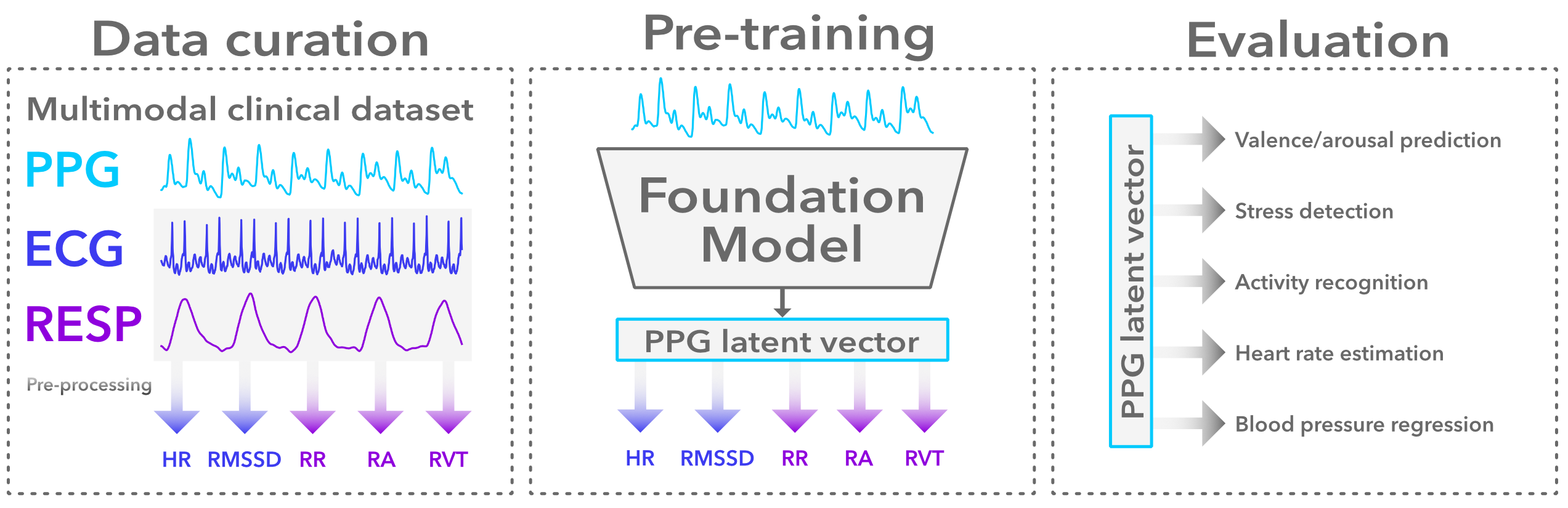
Figure 1: Multimodal contrastive supervision framework: ECG and RESP provide 5-dimensional physiological metrics to select contrastive PPG samples, guiding representation learning. Only PPG is required at inference.
Methodology
The proposed framework segments multimodal ICU recordings into 10s windows. For each segment, five domain-specific physiological metrics—heart rate (HR), root mean square of successive differences (RMSSD), respiratory rate (RR), respiratory amplitude (RA), and respiratory volume per time (RVT)—are extracted from ECG and RESP. These metrics define a stable, denoised metric space for contrastive sample selection, serving as the "anchor" for representation learning. During pretraining, two augmented views are generated per PPG segment and encoded via a 1D ResNet-26 encoder. Contrastive learning employs the rank-n-contrast (RNC) loss, ranking anchor-positive pairs by physiological similarity in metric space rather than noisy PPG morphology.
Unimodal deployment is achieved since the multimodal supervision signal is utilized exclusively during pretraining for representation alignment. Only PPG is supplied at inference, making the model compatible with commodity wearables.
Experimental Evaluation
The model is pretrained on the MIMIC-III Waveform Database's matched subset, reducing the dependency on field-like or heavily curated data. Pretraining uses roughly 20 million 10s PPG segments from 4,998 subjects (approximately 56,000 hours of data)—notably, just one-third the number of subjects used in prior state-of-the-art models.
Evaluation spans 15 downstream tasks covering both classification (e.g., stress, affect, hypertension) and regression (e.g., heart rate, blood pressure) on six unseen datasets, including those with clinically realistic field noise (DaLiA, WildPPG) and multiple PPG sensor types/locations.
Linear probing protocols are executed both across and within subjects. The within-subject regime provides fine-grained insights into learned representations under personalized, subject-specific distributions, highly relevant to real-world wearable deployment.
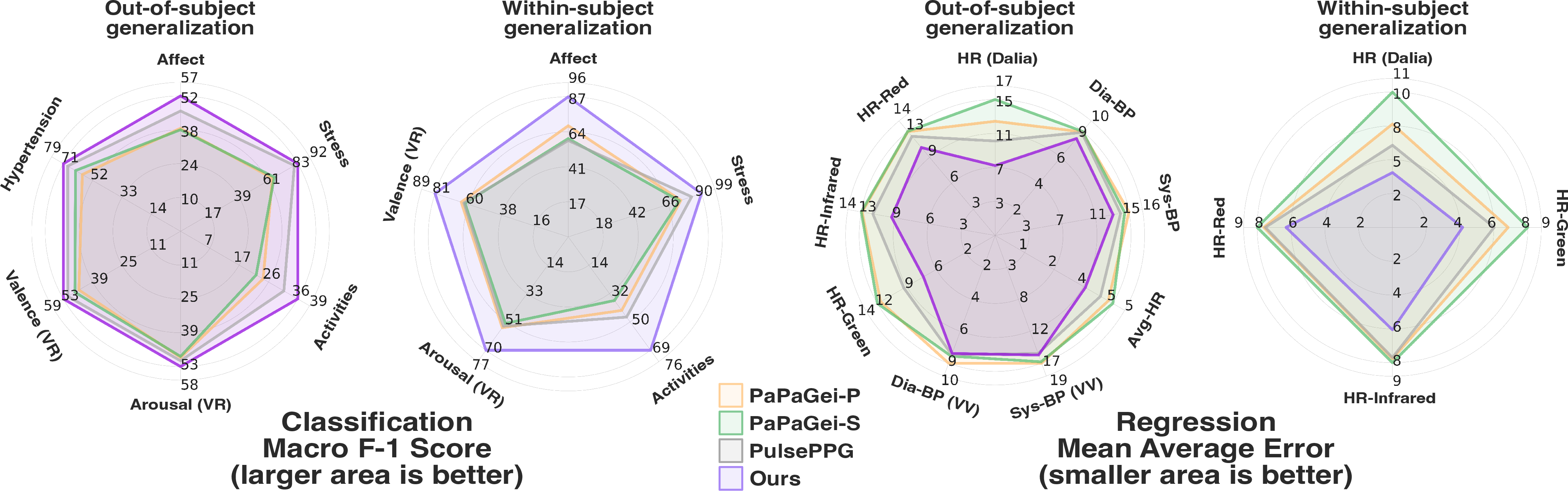
Figure 2: Model achieves superior macro F1 (classification, left) and reduced MAE (regression, right) across subject and within subject linear probing compared to state-of-the-art baselines.
Results
The proposed multimodal-pretrained PPG foundation model achieves strong empirical performance:
UMAP visualization demonstrates superior structure in learned embeddings with respect to physiological targets:
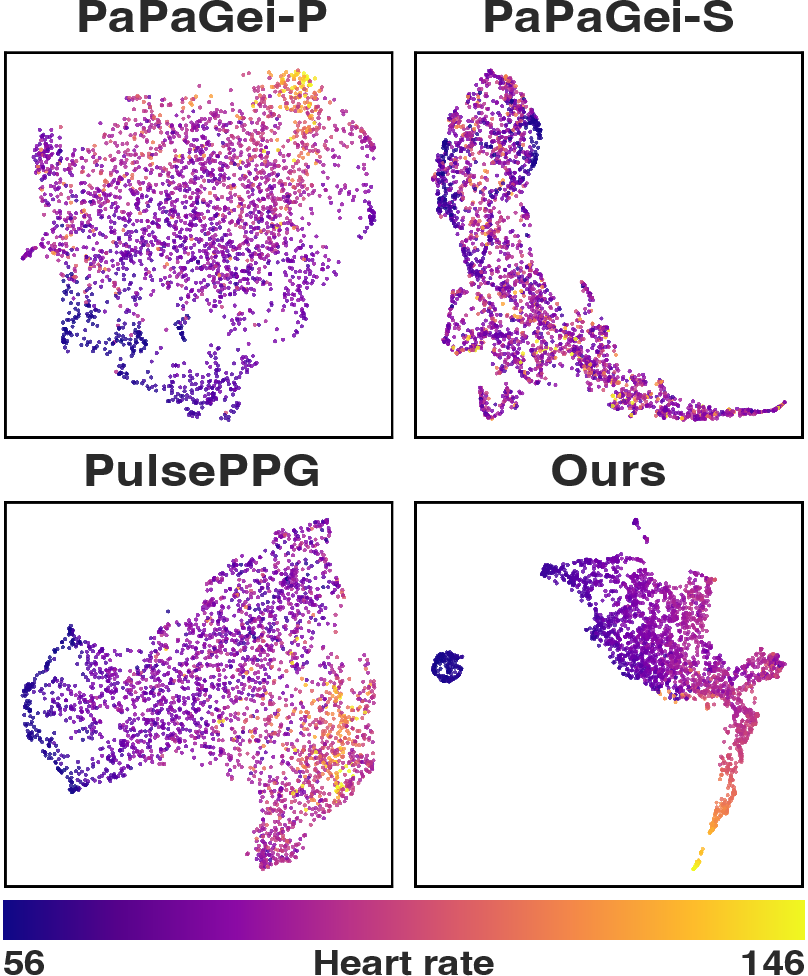
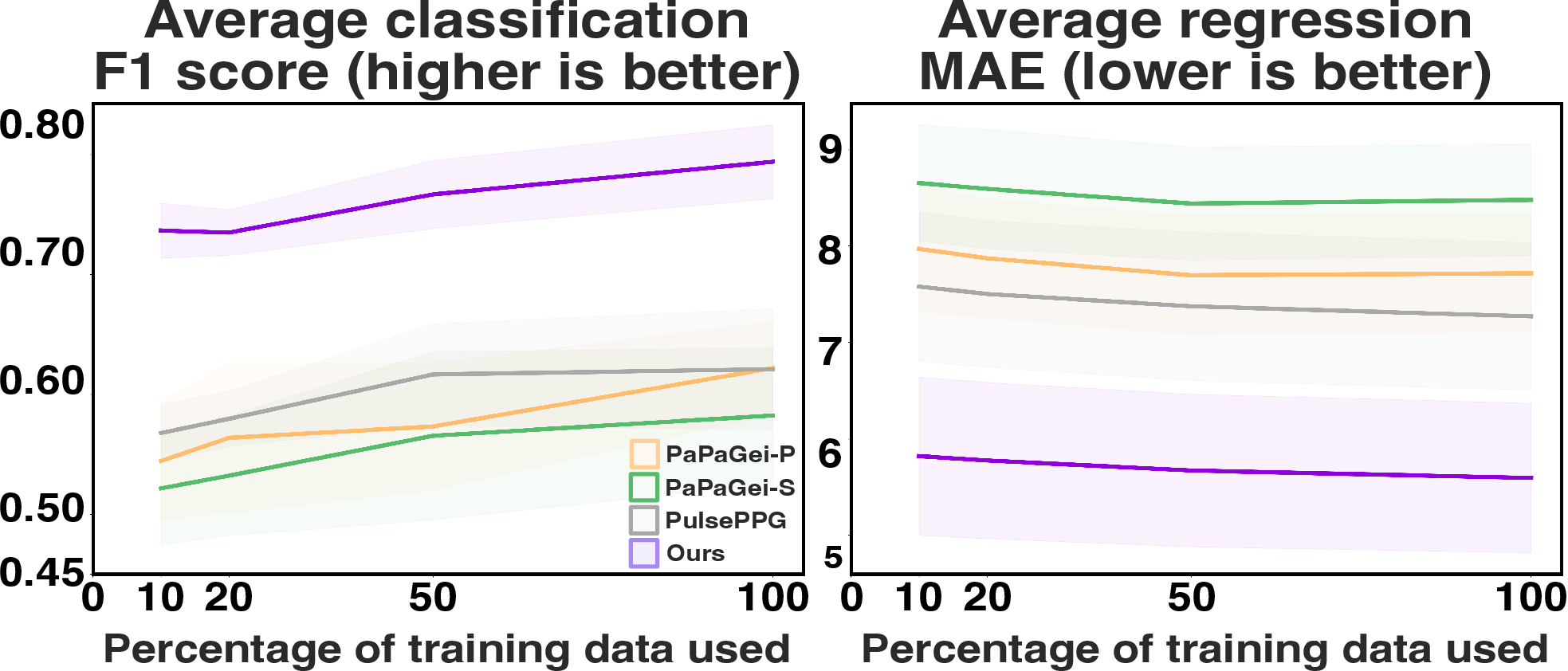
Figure 4: UMAP plots of learned embeddings, colored by heart rate, reveal well-organized representation with the proposed method.
Noise robustness analysis (on DaLiA using IMU-derived energy) indicates that this framework maintains high predictive accuracy across a broad spectrum of noise regimes:
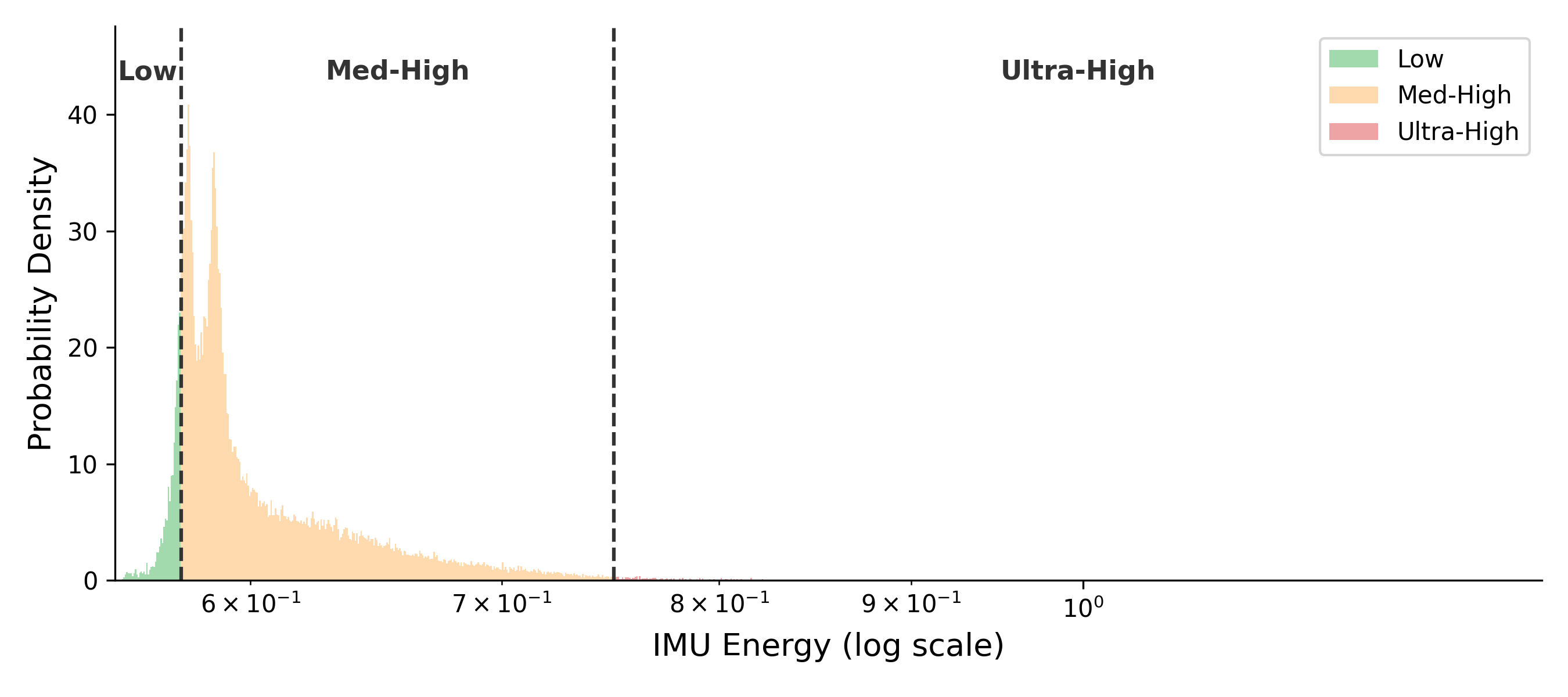
Figure 5: Distribution of IMU energy in the DaLiA dataset characterizes motion-induced noise regimes for robustness analysis.
Analysis and Implications
The introduction of multimodal supervision overcomes core limitations in prior work, which either discarded noisy segments or risked amplifying noise in contrastive targets. By grounding supervision in denoised physiological metrics derived from auxiliary ECG and RESP channels, this model robustly integrates clinically relevant variability and artifact conditions. This approach attains high generalizability without requiring proprietary or field-specific PPG data and demonstrates that information from multimodal sources during pretraining can substitute for increased dataset diversity, especially under real-world wearable conditions.
A demographic analysis highlights persistent challenges in fairness and bias—evidence of performance gaps across skin tone, age, and sex. While these findings are not unique to this method, they underscore the need for systematic bias mitigation and diversified pretraining corpora in health-related foundation model research.
Methodological ablations indicate that ECG-only and RESP-only supervision both contribute meaningfully, with their combination yielding optimal classification/generalization.
Limitations and Future Directions
Principal limitations include potential overfitting to ICU patient demographics and conditions due to pretraining data composition and the use of only a single session per subject, which may underrepresent within-subject temporal variability. Additionally, blood pressure estimation performance remains closer to baseline, suggesting the need for further integration of hemodynamic signals during pretraining or richer multimodal targets (e.g., inclusion of BP in contrastive metric space).
The fairness analysis reveals important demographic biases that motivate dataset curation with broader population diversity and further post-hoc bias correction. Window size and feature choices in the physiological metric extraction stage could also be extended to capture long-range or high-variance physiological fluctuations.
Potential future directions include:
- Scaling pretraining to more heterogeneous sources (ambulatory, hospital, wearable, occupation-, and field-specific datasets).
- Expanding the metric space with richer or more specific physiological and activity signals.
- Model personalization and subject-adaptive fine-tuning to further bridge the gap between population-level foundation models and individual user deployment.
- Rigorous, large-scale fairness and distribution-shift evaluations to provide guarantees on equitable model behavior.
Conclusion
This work demonstrates that multimodal physiological supervision enables the learning of robust, highly generalizable PPG representations, outperforming prior methods on diverse downstream tasks and noise regimes using less curated training data. The results indicate that auxiliary biosignal guidance during pretraining is a scalable and practical alternative to the curation of massive field-like datasets. However, demographic fairness and downstream hemodynamic task performance remain open challenges, motivating further research into data diversity, multi-phase pretraining, and model adaptation for deployment in sensitive, heterogeneous health monitoring applications.


