Efficient and Training-Free Single-Image Diffusion Models
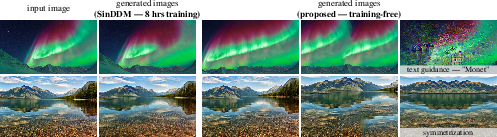
Abstract: We consider the problem of generating images whose internal structure -- defined by the distribution of patches across multiple scales -- matches that of a single reference image. Recent approaches address this problem by training a diffusion model on a single image. But even in this setting, training is computationally expensive and requires hours of optimization. Instead, we model the image using a dataset of its patches at different scales. As this dataset is finite and the dimensionality of its patches is small, the score function for a noisy patch can be computed tractably using an optimal, closed-form denoiser, eliminating the need for neural network training. We integrate this patch-based denoiser into an efficient, training-free image diffusion model, and we describe how our method connects to classical patch-based image restoration techniques. Our approach achieves state-of-the-art generation quality and diversity compared to trained single-image diffusion models, and we demonstrate applications, including unconditional image generation, text-guided stylization, image symmetrization, and retargeting. Further, we show that our approach is compatible with latent space diffusion, and we show multiple additional acceleration techniques to achieve megapixel single-image generation in one second, and gigapixel generation in minutes.

Paper Prompts
Sign up for free to create and run prompts on this paper using GPT-5.
Top Community Prompts
Explain it Like I'm 14
Overview
This paper shows a fast and simple way to make new images that “feel” like a given picture, without training a big neural network. It uses a single photo as a source, studies its tiny parts (called patches), and then builds new images that have the same look and texture as the original. The key idea: because the photo only has a limited number of patches, you can use a direct formula (no training needed) to clean up noisy patches and guide the image-making process.
The big questions
- How can we generate new images that have the same style and internal patterns as one input picture?
- Can we avoid hours of training, even when we only have one image?
- Can we keep the good parts of modern diffusion models (quality, control, text guidance) while being much faster?
How the method works (in simple steps)
Think of an image as a quilt made of many small square pieces (patches). This method builds new quilts that look like the original by smartly picking and blending these pieces.
- Step 1: Make a patch library
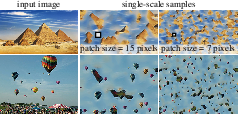
- Cut the input image into many overlapping small squares at several sizes (from coarse to fine). This is your “patch library.”
- Step 2: Start from noise and repeatedly “clean” it
- Diffusion models usually add noise to an image and then learn to remove it. Here, we skip the learning. Because we already have the exact list of patches, the best way to clean a noisy patch can be computed directly.
- In plain words: for each noisy piece, look through the library and take a weighted average of the most similar clean patches. The more similar a library patch is, the more influence it has. This is like a super-smart “find similar pieces and blend” rule, and it has a closed-form solution (a direct formula) so it needs no training.
- Step 3: Go from coarse to fine (keep big shapes and small details)
- First, build the image at a low resolution (coarse scale) so big shapes line up.
- Then move to higher resolutions. Each time, you reuse the coarse result for structure and add finer details using the patch library. This keeps the overall layout while adding realistic textures.
- Speed-ups (so it runs really fast)
- Fused attention: Rewriting the patch-lookup math to use fast “attention” operations that GPUs handle well.
- Latent space: Do the denoising in a compressed version of the image (like a zip file for pictures), then decode it back. This is faster while keeping quality.
- Approximate nearest neighbors: Instead of checking every patch in the library, quickly search only the most promising ones. This makes the method scale to huge images.
Main findings and why they matter
Here are the main takeaways from the experiments and tests:
- State-of-the-art quality without training:
- The method matches or beats the quality of single-image diffusion models that require hours of training.
- It also makes more diverse samples (more variety between outputs) than many prior methods.
- Very fast at high resolution:
- Megapixel images can be generated in about one second.
- Gigapixel images (extremely large) can be generated in minutes with the speed-ups.
- Works with many tasks:
- Unconditional generation: Make new images that look like the original picture’s style.
- Text-guided stylization: Use a text prompt to nudge the look, thanks to plug-and-play vision–LLMs (like CLIP).
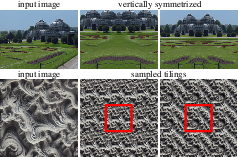
- Symmetrization and tiling: Produce perfectly symmetric or seamlessly repeating images.
- Retargeting: Change the size or aspect ratio while keeping the image’s style.
- Bridges old and new ideas:
- The “closed-form denoiser” is closely related to classic patch-based denoising methods (like non-local means), but used inside a modern diffusion framework. So it combines the strengths of both worlds.
What this could mean going forward
Because it is training-free, fast, and flexible, this approach lowers the barrier to generating high-quality images from a single example. That’s useful for:
- Creative tools: Quickly re-style, resize, or tile images for design, art, and games.
- Large-scale imagery: Make huge textures and backgrounds for films or virtual worlds.
- Practical deployment: Less compute and time required, making it easier to run on limited hardware.
- Research: A clean, mathematical connection between classic patch methods and diffusion could inspire new hybrid techniques for image editing and generation.
In short, the paper shows that you can get the power of diffusion models from just one image—without training—by using a smart, direct way to denoise patches and a coarse-to-fine strategy to keep both structure and detail.
Knowledge Gaps
Knowledge gaps, limitations, and open questions
Below is a concise list of concrete gaps and unresolved questions that could guide future research.
- Global structure modeling: Coarse-to-fine guidance is implemented via simple high-pass blending, not a principled joint multi-scale probabilistic model. How to formulate and analyze a hierarchical/patch-based prior that jointly couples scales and preserves long-range structure without heuristic blending?
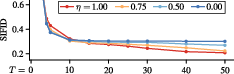
- Convergence and stability: There is no theoretical analysis of convergence/stability of the closed-form patch denoiser when embedded in a DDIM sampler, especially under stochastic sampling (η>0), multi-scale blending, or with ANN approximations. Under what conditions does the procedure converge to a fixed point, and how does noise scheduling affect stability?
- KDE bandwidth and covariance: The denoiser assumes isotropic Gaussian kernels (σ2 I). There is no study of adaptive bandwidth selection, anisotropic/patch-specific covariances, or data-driven preconditioning (e.g., PCA/whitening, Mahalanobis distances). Can adaptive or learned covariances improve fidelity and seam coherence?
- Curse of dimensionality: Patch KDE in high-dimensional spaces (e.g., 15×15×3) can be sample-inefficient and unstable. What is the effect of patch dimensionality on quality and diversity, and can learned low-dimensional embeddings or feature-space KDEs (perceptual spaces) mitigate this?
- Patch aggregation and seams: Reconstruction uses fixed Gaussian weighting (ρ) and overlap-add. There is no analysis of seam artifacts, blur, or ghosting at patch boundaries, nor adaptive or optimization-based consensus (e.g., Poisson/gradient-domain or consistency constraints). How to enforce cross-patch consistency explicitly?
- Cross-scale correspondences: Coarse information is injected by blending upsampled coarse images; cross-scale patch correspondences or shared codebooks are not modeled. Can joint cross-scale nearest-neighboring or coupled denoising improve global coherence?
- Noise schedule choice: The method uses a linear flow-matching schedule (α(t)=1−t/T, σ(t)=t/T) without comparison to alternatives (cosine/exponential) or data-adaptive annealing. Which schedule optimally balances fidelity/diversity for internal patch KDE?
- Initial noise and inversion heuristics: Structural analogies and editing rely on DDIM inversion with a heuristic t′ (e.g., T/10 or T/2). Can t′ be chosen automatically (e.g., via reconstruction error, perceptual similarity) and how sensitive are results to t′?
- ANN approximation bias: ANN reduces complexity but introduces approximation error. There is no quantitative analysis of quality-speed trade-offs (k, number of clusters/probes), nor theoretical error bounds. What is the impact of ANN hyperparameters on artifacts/diversity across scales?
- Latent-space artifacts: The approach relies on a third-party VAE (compression 8×); the effect of VAE reconstruction errors on patch statistics, texture fidelity, and color shifts is not measured. How do different VAEs/compression rates affect quality and internal statistics preservation?
- Memory and streaming for very large images: While timings are reported, VRAM usage, out-of-core streaming, and boundary-consistent tiling for gigapixel generation are not detailed. Can block-wise/streaming inference with overlap constraints scale further on commodity GPUs?
- Diversity–fidelity control: Diversity is largely controlled via η and T; there is no mechanism to target a desired diversity level or prevent near-duplicates systematically. Can explicit entropy regularization, anti-duplication constraints, or diversity-conditioned sampling be introduced?
- Failure modes and robustness: Limited analysis of when the method fails (e.g., images with low self-similarity, strong semantics like faces/text, small images, or highly structured man-made scenes). A taxonomy of failures and stress tests is missing.
- Evaluation scope: Benchmarks are small (15 inputs) with automatic metrics (SIFID, NIQE/NIMA/MUSIQ) and no human studies. How do results compare in controlled user evaluations, and how sensitive are metrics to near-duplicates and patch-level overfitting?
- Novelty/duplication quantification: While competitor duplication is discussed, the paper does not quantify duplicate/near-duplicate rates for its own samples. Can novelty metrics (e.g., duplication detectors, patch-overlap analysis) be reported for all methods?
- Text-guided stylization details: The integration with CLIP is only sketched and may drift patch statistics. How to weight CLIP guidance vs. internal prior, measure the resulting style/content trade-off, and avoid adversarial/unnatural CLIP artifacts?
- Symmetry and tiling constraints: Implemented via hard image-level operations; no probabilistic formulation of symmetry groups or near-symmetries. Can symmetry be encoded in the patch prior or sampling dynamics to better preserve realism while enforcing constraints?
- Color space and distance metric: L2 in RGB is used for patch distances; no exploration of perceptual color spaces or learned feature spaces. Do perceptual distances or feature-normalized metrics improve denoising and matching, especially for textures/edges?
- Sensitivity to input noise/artifacts: Because the internal dataset is the input image, sensor noise, compression artifacts, or watermarks can be replicated. Should pre-denoising/robust patch filtering be applied, and how to suppress undesirable patches?
- Hyperparameter selection: Patch size, stride, ρ, number of scales S, number of steps T, η, ANN k/clusters are set heuristically. Can automatic selection, validation criteria, or meta-optimization produce more reliable defaults across images/resolutions?
- Statistical dependence of overlapping patches: The score estimator treats patches as i.i.d. samples though they are highly overlapping and correlated. What bias does this induce, and can subsampling or de-correlation improve the statistical validity?
- Theoretical link to score estimation: The supplement claims MMSE optimality for the closed-form denoiser under a mixture prior of delta centers with Gaussian noise, but the paper lacks a full analysis under overlap, finite-sample effects, and annealed σ(t). Can error bounds vs. the true internal score be derived?
- Extensibility beyond 2D images: Application to video (temporal consistency), 3D/NeRFs, or multimodal signals is not addressed. How to incorporate temporal/spatial coherence constraints and cross-view consistency in the closed-form framework?
- Conditioning beyond text and coarse layout: The method does not support structured conditioning (e.g., segmentation maps, edge maps, depth) within the closed-form prior. Can conditioning be integrated as constraints or via conditional patch sets?
- Comparisons to alternative ANN/backends: Only an inverted file index (IVF) is explored. How do HNSW, PQ/OPQ, or GPU FAISS variants compare in quality/latency, and can multi-stage coarse-to-fine ANN search reduce artifacts further?
- Reproducibility across hardware: Speedups rely on fused attention kernels and BF16; cross-hardware reproducibility (e.g., consumer GPUs without FlashAttention) and numerical stability are not analyzed. What are the portability and precision trade-offs?
- Ethical/safety considerations: Since the method recombines internal patches, it can reproduce sensitive/identifying elements (faces, watermarks) verbatim. Are safeguards or filtering strategies needed for responsible use?
Practical Applications
Immediate Applications
Below are specific, deployable use cases that can be implemented now using the paper’s training-free, patch-based closed-form diffusion, coarse-to-fine sampling, and acceleration techniques (fused attention, latent-space diffusion, approximate nearest neighbors).
- Texture and material creation for digital content
- Sector: software, graphics/VFX, gaming, AR/VR
- Use cases:
- One-click generation of seamless, tileable materials from a single photo (e.g., wood, fabric, stone) for Unity/Unreal/Blender toolchains
- Gigapixel wallpaper/skybox/background textures for large-format rendering and virtual production
- Tools/products/workflows: editor plug-ins (Photoshop, GIMP, Substance 3D Sampler), DCC/engine nodes that wrap closed-form patch denoiser + tiling/symmetry constraints
- Assumptions/dependencies: best performance on images with strong patch self-similarity; GPU/NPUs help; ANN speedups trade slight quality; copyright clearance for the reference image
- Aspect-ratio retargeting without content loss
- Sector: media, e-commerce, marketing, publishing
- Use cases:
- Automatically retarget product/lifestyle photos to platform-specific aspect ratios (web banners, social posts) while preserving local appearance
- Tools/products/workflows: batch retargeting microservice that runs coarse-to-fine sampler with structure constraints; integrates into DAM/CMS
- Assumptions/dependencies: coarse structural guidance (pyramid blending) preserves layout; works best when global composition is not highly semantic (e.g., not centered faces)
- Fast, on-device style-preserving content generation
- Sector: mobile/consumer apps, privacy-first computing
- Use cases:
- Create new wallpapers/backgrounds from a single user image; generate variations offline, preserving privacy (no model training or cloud upload)
- Tools/products/workflows: mobile SDK using latent-space denoising and fused attention; deterministic DDIM sampling for reproducibility
- Assumptions/dependencies: mobile accelerators preferred; smaller patch sizes in latent space; battery/runtime constraints
- Text-guided stylization with a single style image
- Sector: creative tools, advertising
- Use cases:
- Apply text-guided adjustments (e.g., “more watercolor”, “brighter colors”) while keeping the reference style’s patch statistics
- Tools/products/workflows: CLIP-guided update loop inside single-scale sampler; promptable presets in design apps
- Assumptions/dependencies: CLIP (or similar VLM) dependency; prompt engineering; works best when text edits correlate with patch-level cues
- Structural analogies (style/structure disentangling)
- Sector: design, visualization, education
- Use cases:
- Combine the “style” (patch distribution) of image A with the “structure” (coarse composition) of image B via DDIM inversion + coarse-to-fine sampling
- Tools/products/workflows: “Apply style A to layout B” feature; storyboard/layout exploration
- Assumptions/dependencies: structure must be recoverable via partial inversion; success improves with clear multi-scale structure
- Symmetry and tileability constraints at generation time
- Sector: product design, textiles, UI/UX themes
- Use cases:
- Generate perfectly symmetric posters/logos; produce edge-consistent tiles for fabrics, wallpapers, UI textures
- Tools/products/workflows: generation-time constraints (flip-copy blending; circular shifts per step) packaged as toggles in plugins
- Assumptions/dependencies: constraint enforcement may reduce diversity; simple to implement as per paper’s three-pass denoising scheme
- Production-ready speedups for large images
- Sector: high-resolution printing, virtual production, mapping
- Use cases:
- Megapixel-to-gigapixel texture expansion in seconds/minutes using latent-space diffusion + ANN + fused attention
- Tools/products/workflows: render farm job that runs latent VAE encode/denoise/decode; scale-aware scheduling to enable ANN only at finer scales
- Assumptions/dependencies: VAE (e.g., FLUX) availability; quality-speed trade-offs when using ANN; VRAM and I/O capacity at scale
- Procedural asset diversification for A/B testing
- Sector: marketing, web design, game asset pipelines
- Use cases:
- Generate multiple, style-consistent UI backgrounds or level tiles from a single hero image to test variants quickly
- Tools/products/workflows: deterministic and stochastic (η>0) sampling modes with seed control; CI-integrated asset generation
- Assumptions/dependencies: diversity strongest for textures/regular patterns; semantic diversity limited by the single-image prior
- Teaching and research prototyping
- Sector: academia, edtech
- Use cases:
- Classroom labs connecting non-local means, GMM patch priors, and diffusion via a single executable method; empirical studies on closed-form denoisers
- Tools/products/workflows: open-source PyTorch implementation; small-scale experiments without GPU clusters
- Assumptions/dependencies: clear documentation and open data; reproducible schedulers (α, σ)
- Privacy, governance, and cost-sensitive deployments
- Sector: enterprise IT, policy/compliance
- Use cases:
- On-prem/offline content tools that avoid training on proprietary data; minimize energy/compute for sustainability targets
- Tools/products/workflows: internal portals using training-free diffusion for approved assets; green-AI reporting (inference-only energy)
- Assumptions/dependencies: governance around derivative works from the single source image; audit logs for source attribution
Long-Term Applications
These opportunities are credible but require further R&D for robustness, scaling, or domain-specific validation.
- Temporally consistent single-video diffusion
- Sector: film/VFX, social media, broadcasting
- Use cases:
- Extend single-image patch modeling to spatiotemporal patches for video stylization and texture synthesis with temporal coherence
- Tools/products/workflows: 3D (x,y,t) patch denoiser; multi-scale temporal guidance; ANN indices over video volumes
- Assumptions/dependencies: temporal stability and flicker control; larger memory footprints
- Physically based material generation (multi-channel maps)
- Sector: gaming, CAD, digital twins
- Use cases:
- Predict coherent albedo/normal/roughness maps from a single photograph by multi-channel patch modeling
- Tools/products/workflows: joint-channel closed-form denoising; photometric consistency constraints; optional shallow learned priors
- Assumptions/dependencies: requires channel correlation modeling; data or priors for physically correct shading
- Texture-aware compression and synthesis codecs
- Sector: media delivery, edge compute
- Use cases:
- Transmit compact latents and reconstruct large textures via patch-diffusion on client devices
- Tools/products/workflows: codec with VAE latent + closed-form denoiser at the receiver; adaptive patch schedules
- Assumptions/dependencies: standardization, latency constraints, perceptual quality benchmarks
- Camera and device firmware features
- Sector: consumer electronics, IoT
- Use cases:
- On-device theme/wallpaper generation from a single photo; style-preserving retargeting built into cameras/printers
- Tools/products/workflows: NPU-optimized kernels for fused attention/ANN; low-power diffusion schedules
- Assumptions/dependencies: hardware acceleration; UX to prevent misuse and clarify derivatives
- Scientific and geospatial mosaicking/fill
- Sector: remote sensing, astronomy, microscopy
- Use cases:
- Fill small missing regions or synthesize large, homogeneous areas (cloud gaps, background textures) from single exemplars
- Tools/products/workflows: masked generation + structural constraints; audit trails for scientific integrity
- Assumptions/dependencies: strict provenance; domain validation to avoid hallucinating artifacts
- Industrial pattern and textile manufacturing
- Sector: fashion, interiors, packaging
- Use cases:
- From a single swatch, generate repeatable, symmetric, and scalable designs across SKUs and substrates
- Tools/products/workflows: CAD plug-ins with tiling, symmetry, and colorway prompts; gigapixel batch production
- Assumptions/dependencies: color management, print calibration, licensing
- Robust semantic guidance beyond patch cues
- Sector: creative AI platforms
- Use cases:
- Blend training-free patch priors with large VLM/segmentation guidance for layout-aware edits while preserving style patches
- Tools/products/workflows: hybrid pipeline (frozen VLM + closed-form denoiser); region-aware masks
- Assumptions/dependencies: research on resolving conflicts between global semantic constraints and local patch priors
- Safe data augmentation in low-data domains
- Sector: healthcare, manufacturing QA, scientific ML
- Use cases:
- Generate style-consistent micro-variation from a single approved image to augment models
- Tools/products/workflows: policy-controlled augmentation service using training-free diffusion; metadata labels
- Assumptions/dependencies: strong caution—augmentations must be validated to prevent bias or spurious correlations; regulatory approval in sensitive domains
- Marketplaces for rights-cleared, training-free generative assets
- Sector: platforms, licensing
- Use cases:
- Sell/generate derivative textures from a single owned image with transparent provenance and minimal compute
- Tools/products/workflows: watermarking/provenance (C2PA); per-asset generation quotas and energy stats
- Assumptions/dependencies: legal frameworks on derivative works; fair-usage and attribution norms
- Hardware/software co-design for sub-second megapixel synthesis
- Sector: systems, accelerators
- Use cases:
- Dedicated kernels for closed-form patch weighting, ANN indexing, and pyramid blending for real-time content apps
- Tools/products/workflows: fused attention primitives, vectorized patch ops, SRAM-friendly ANN structures
- Assumptions/dependencies: vendor support, standard APIs, memory bandwidth considerations
Cross-cutting assumptions and dependencies
- Image characteristics: methods excel when the source image exhibits strong intra- and cross-scale patch self-similarity; highly semantic/global edits are limited.
- Quality–speed trade-offs: ANN acceleration and lower diffusion steps increase speed but can modestly reduce fidelity/diversity; tuning η, patch size, pyramid scales matters.
- External models: text-guidance depends on CLIP (or similar); latent methods depend on a VAE (e.g., FLUX) and introduce compression artifacts if misconfigured.
- Compute and memory: large resolutions benefit from GPUs/NPUs, fused attention, and memory-efficient ANN indices; gigapixel workflows demand I/O planning.
- Legal/ethical: ensure rights to the reference image; clarify derivative status; document provenance; for sensitive domains, perform domain-specific validation and risk assessment.
- Reproducibility and governance: deterministic DDIM (η=0) aids repeatability; log α/σ schedules, seeds, and constraints used during generation.
Glossary
- approximate nearest neighbors (ANN): Fast search methods that return close matches to a query in high-dimensional spaces, used to accelerate patch lookups. Example: "using approximate nearest neighbors (ANN)~\cite{indyk1998approximate}"
- CLIP: A pre-trained vision–LLM that aligns images and text for guidance or editing. Example: "We use the CLIP ViT-B/32 model~\cite{radford2021learning}"
- closed-form denoiser: An analytic minimum-mean-squared-error denoiser computed directly from a finite patch dataset, eliminating neural training. Example: "The closed-form denoiser is given as"
- coarse-to-fine image sampling: A multi-scale generation strategy that synthesizes images from low to high resolution while propagating structure across scales. Example: "We address this issue using coarse-to-fine image sampling (Algorithm~\ref{alg:coarse-to-fine}, Figure~\ref{fig:unconditional})."
- DDIM inversion: A deterministic procedure that maps a clean image to a corresponding noisy latent along the diffusion trajectory for editing or guidance. Example: "DDIM inversion converts a clean image into a corresponding noisy latent"
- Denoising Diffusion Implicit Model (DDIM): A deterministic sampling variant of diffusion models that removes noise without stochasticity. Example: "reduce to a deterministic Denoising Diffusion Implicit Model (DDIM) \cite{song_ddim_2022}"
- FlashAttention: An efficient attention algorithm that fuses kernels to reduce memory and time for transformer-style attention. Example: "FlashAttention~\cite{dao2022flashattention}"
- flow matching schedule: A noise schedule defining time-dependent weights for clean signal and noise during diffusion. Example: "we use the flow matching schedule~\cite{lipman2023flowmatchinggenerativemodeling}"
- forward diffusion process: The noising process that progressively corrupts clean data to noise across timesteps. Example: "act on a forward diffusion process that adds an increasing amount of noise"
- Fréchet Inception Distance (SIFID): A metric (single-image variant) that measures distributional similarity of generated images to a reference via Inception features. Example: "single-image Fréchet Inception Distance~\cite{shaham_singan_2019}"
- fused attention kernel: A GPU kernel that fuses attention operations for faster, memory-efficient attention computations. Example: "we leverage PyTorch's fused attention kernel (based on FlashAttention~\cite{dao2022flashattention,dao2023flashattention2})"
- Gaussian mixture model (GMM): A probabilistic model expressing a distribution as a weighted sum of Gaussians, used as a patch prior. Example: "Gaussian mixture model (GMM)"
- generative adversarial networks (GANs): A class of generative models trained via adversarial learning between generator and discriminator. Example: "Techniques based on generative adversarial networks (GANs) generate images"
- high-pass filter: A filter that preserves high-frequency details while suppressing low-frequency content, used for multi-scale blending. Example: "by applying a high-pass filter to the denoised image"
- inverted file index: An ANN indexing structure that clusters descriptors to speed up nearest-neighbor search. Example: "We use an inverted file index with clusters"
- Laplacian pyramid blending: A multi-scale image blending technique using band-pass (Laplacian) pyramids. Example: "a two-scale version of Laplacian pyramid blending~\cite{burt1983}"
- latent space diffusion: Running the diffusion process in a compressed latent representation (e.g., from a VAE) instead of pixel space. Example: "our approach is compatible with latent space diffusion"
- LPIPS: A learned perceptual similarity metric used to quantify diversity or perceptual differences between images. Example: "LPIPS diversity~\cite{kulikov_sinddm_2022}"
- maximum a posteriori (MAP) estimate: The most probable point under the posterior distribution, often used in restoration. Example: "does not yield a closed-form solution for the maximum a posteriori estimate of the clean patch"
- mode collapse: A failure mode where a generative model produces limited varieties of outputs despite diverse input noise. Example: "susceptible to local minima and mode collapse"
- MUSIQ: A no-reference image quality assessment metric based on multi-scale features. Example: "NIQE, NIMA, and MUSIQ (no-reference image quality metrics)"
- nearest-neighbor patch matching: Selecting the closest patches from a database to reconstruct or synthesize images. Example: "nearest-neighbor patch matching~\cite{barnes2009patchmatch}"
- NIMA: A no-reference image aesthetic quality assessment model. Example: "NIQE, NIMA, and MUSIQ (no-reference image quality metrics)"
- NIQE: A no-reference image quality evaluation metric based on natural scene statistics. Example: "NIQE, NIMA, and MUSIQ (no-reference image quality metrics)"
- non-local means denoising: A denoising method that averages similar patches across the image rather than local neighborhoods. Example: "Non-local means denoising~\cite{buades2005non}."
- scaled-dot-product attention: The attention mechanism computing scaled dot products between queries and keys to form weights over values. Example: "re-formulating our patch denoiser as scaled-dot-product attention"
- score function: The gradient of the log probability density, used in diffusion for denoising and generation. Example: "the score function for a noisy patch can be computed tractably"
- score-based denoising diffusion models: Generative models that learn the score function to reverse a noising process. Example: "score-based denoising diffusion models~\protect\cite{ho_denoising_2020,song_ddim_2022}"
- stochasticity parameter η: A sampling hyperparameter controlling the amount of randomness added during reverse diffusion. Example: "we use to control the stochasticity."
- variational auto-encoder (VAE): A generative model that learns a probabilistic encoder–decoder with a latent space. Example: "a pre-trained variational auto-encoder (VAE)~\cite{labs2025flux}"
- vision--LLMs: Models that jointly process images and text for tasks like editing or guidance. Example: "vision--LLMs for text-based editing~\cite{kulikov_sinddm_2022,radford2021learning}"
- Wasserstein distance: A metric from optimal transport measuring distances between probability distributions. Example: "via a Wasserstein distance."
Collections
Sign up for free to add this paper to one or more collections.