Spectral Progressive Diffusion for Efficient Image and Video Generation
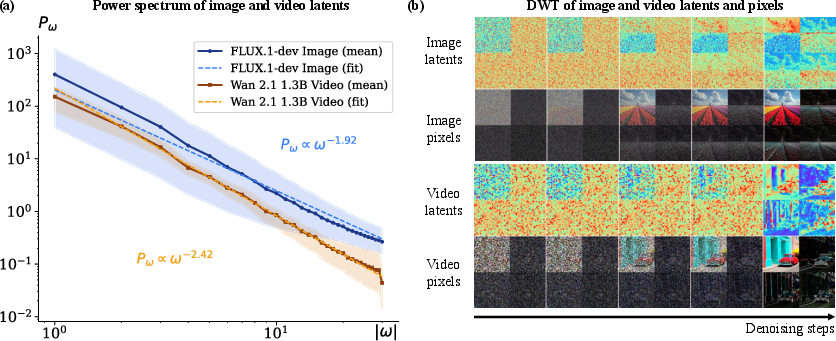
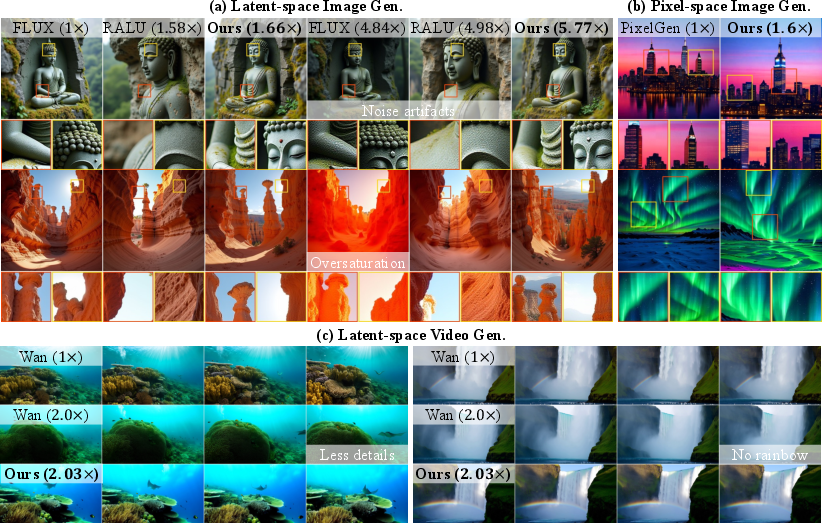
Abstract: Diffusion models have been shown to implicitly generate visual content autoregressively in the frequency domain, where low-frequency components are generated earlier in the denoising process while high-frequency details emerge only in later timesteps. This structure offers a natural opportunity for efficient generation, as high-resolution computation on noise-dominated frequencies is largely redundant. We propose Spectral Progressive Diffusion, a general framework that progressively grows resolution along the denoising trajectory of pretrained diffusion models. To this end, we develop a spectral noise expansion mechanism and derive an optimal resolution schedule from the model's power spectrum. Our framework supports training-free acceleration and a novel fine-tuning recipe that further improves efficiency and quality. We demonstrate significant speedups on state-of-the-art pretrained image and video generation models while preserving visual quality.

Paper Prompts
Sign up for free to create and run prompts on this paper using GPT-5.
Top Community Prompts
Explain it Like I'm 14
Spectral Progressive Diffusion: A simple explanation
Overview: What this paper is about
This paper is about making AI image and video generators faster without hurting quality. The authors noticed that these generators naturally create pictures “from coarse to fine”: big shapes and colors appear first, and small details like textures and edges show up later. They turn that idea into a new method called Spectral Progressive Diffusion, which starts at a lower resolution and only adds higher resolutions when the model is actually ready to fill in finer details. This saves a lot of computing time.
The key questions the paper asks
- Can we speed up image and video generation by matching the model’s coarse-to-fine behavior?
- Can we do this with models that already exist (without changing their architecture)?
- How do we decide the best moments to increase the resolution during generation?
- Can a tiny bit of extra fine-tuning make this even better?
How the method works, in everyday terms
First, a few simple ideas:
- Diffusion models: Think of making a picture by starting with TV static (pure noise) and slowly “cleaning” it to reveal the image. That cleaning happens step by step.
- Frequencies: Low frequencies are big, smooth parts of the picture (like sky vs. ground). High frequencies are tiny, sharp details (like hair strands or leaf veins). Natural images have much more “energy” in low frequencies than high ones, so big shapes stand out before tiny details.
- Spectral domain: This is just a way of looking at an image not as pixels, but as a mix of big patterns and small patterns. It’s like listening to music by separating bass and treble.
The core idea:
- The model already brings out big, low-frequency shapes early and only reveals small, high-frequency details later.
- So, instead of computing at full resolution from the start, the method begins at a smaller resolution (fewer “tokens” for the AI to process), and only increases the resolution when it’s time for finer details.
Two clever pieces make this work smoothly:
- Spectral noise expansion When it’s time to move up in resolution, the method:
- Keeps the already cleaned-up low-frequency content.
- Adds just the right amount of “randomness” (noise) in the new high-frequency slots so the model can naturally clean those next. This is like sketching a drawing on a small canvas, then moving to a bigger canvas and adding a light “placeholder fuzz” where fine details will go, so the next steps feel natural to the model.
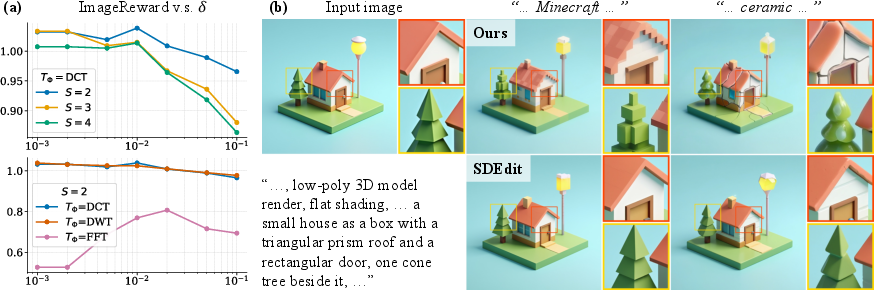
- An automatic schedule for when to upscale Instead of guessing when to switch resolutions, the method calculates it from the model’s “power spectrum” (how strong different detail sizes are in typical images). With one simple setting called delta (δ), which controls how picky you are about when details become meaningful, the method picks the best times to grow the resolution. In short: “Don’t bother with tiny details until they’re no longer drowned out by noise.”
Two ways to use it:
- Training-free: Plug this into existing models as-is. No retraining needed.
- Fine-tuning (optional): A short, light training step (like adding small adapters, called LoRA) to make the model even more comfortable with this progressive process. This further improves quality and efficiency.
What the researchers found and why it matters
Here are the main results, tested on state-of-the-art image and video generators:
- Big speedups with little to no quality loss:
- Up to about 7× faster for image generation.
- About 2.5× faster for video generation.
- Works across different kinds of models:
- Latent-space image models (which work in a compressed space).
- Pixel-space image models (which work directly with pixels).
- Latent-space video models.
- Better trade-offs than previous methods:
- Compared to other “progressive resolution” approaches, this method often runs faster while keeping visuals sharp and text prompts well matched.
- Simple and robust settings:
- One main knob (δ) controls how aggressively you speed up.
- It works with common “spectral transforms” like the DCT (a standard way to separate image frequencies).
- Optional fine-tuning helps even more:
- A small amount of fine-tuning closes any gap between how a model was trained and this new progressive way of sampling, boosting quality while keeping speed gains.
Why this is important:
- Faster, cheaper, and greener: Generating high-res images or long videos is expensive. Cutting compute means lower costs and energy use.
- Scales to harder tasks: Saving compute early lets you aim for bigger images, longer videos, or more variations within the same time.
- Backwards compatible: You don’t need to redesign or retrain giant models from scratch. You can speed up models that people already use.
The big takeaway
This paper turns a natural behavior of diffusion models—“big structures first, fine details later”—into a practical speedup tool. By starting small and only increasing resolution when the model is ready for fine details, Spectral Progressive Diffusion makes image and video generation much more efficient while keeping quality high. It’s a simple idea with a big impact: faster creativity, broader access, and better use of computing power.
Knowledge Gaps
Knowledge gaps, limitations, and open questions
Below is a concise list of what remains missing, uncertain, or unexplored in the paper, formulated to guide concrete future research.
- Assumptions behind the “optimal” schedule:
- Theoretical derivations assume per-frequency Gaussian data (), orthonormal transforms, and independence across frequencies; real data/latents violate these assumptions. Quantify how deviations impact the activation times and error bounds.
- Proposition 2 relies on a monotonic power-law spectrum. Assess cases (e.g., line art, CAD, text-heavy prompts) where deviates from power-law and whether the schedule remains near-optimal.
- The “Nyquist-limited” link between frequency and resolution ignores aliasing and filter responses of latent encoders/decoders. Provide a corrected formulation that accounts for the actual VAE/latent channel bandwidth and down/up-sampling filters.
- Schedule estimation and adaptivity:
- The procedure to estimate and derive is not specified (dataset choice, per-model/per-domain variability). Provide a robust, reproducible estimation protocol.
- A single, global δ is used across prompts and content. Investigate prompt- or content-adaptive thresholds (e.g., using online SNR estimates or model uncertainty) and whether adaptive schedules improve quality–speed trade-offs.
- Explore per-channel or per-head scheduling (different latent channels, attention heads, or semantic regions may require distinct activation times).
- Generality beyond flow matching and linear paths:
- The method and proofs target flow matching with straight noise-to-data paths; many deployed diffusion models use score-based SDEs, ε- or x̂0-parameterizations, and non-linear samplers. Derive analogous timestep alignment and noise-injection rules for those settings.
- Clarify interactions with classifier-free guidance (CFG) and guidance-distilled models: does mid-trajectory resolution growth alter CFG scaling or induce distribution shifts?
- Temporal dimension and video-specific issues:
- The approach grows spatial resolution only; temporal frequency scheduling is not addressed. Develop 3D (spatiotemporal) transforms and schedules that activate temporal frequencies coherently.
- Assess temporal consistency: does per-frame spectral expansion introduce flicker when high frequencies are injected independently across frames? Evaluate and propose temporally coherent noise expansion.
- Investigate applicability to long-duration videos, variable frame rates, and streaming generation where both spatial and temporal bandwidths evolve.
- Transform choices and artifacts:
- The paper defaults to DCT and briefly notes FFT oversmoothing; provide systematic analysis of transform-induced artifacts (ringing, blocking, boundary effects) in latents and pixels, and how they propagate through VAEs.
- Explore learned or data-adaptive bases (e.g., learned wavelets) that might better match latent statistics than fixed DCT/DWT.
- Examine tile- or patch-based transforms vs. global transforms, and their effect on block boundaries and attention positional encodings.
- Positional encodings and attention behavior:
- Changing resolution mid-sampling alters token counts and positional distributions. Characterize how absolute/relative/RoPE encodings behave across transitions and whether re-scaling/re-centering is needed to avoid attention drift.
- Measure effects on cross-attention to text (alignment) and propose adjustments (e.g., rescaling positional embeddings, re-initializing attention caches) to stabilize conditioning.
- Timestep alignment and sampler compatibility:
- The alignment formula is derived for a specific setting. Extend and validate it for diverse noise schedules, multi-branch samplers, and consistency/dPM-Solver-based ODE/SDE solvers.
- Provide error analyses quantifying how alignment and noise expansion deviate from the true probability flow and how errors accumulate over multiple transitions.
- Fine-tuning procedure:
- LoRA fine-tuning uses a short schedule (2k steps, rank 32) with a fixed δ/S; assess stability, overfitting, and generalization across diverse datasets and prompt distributions.
- Compare fine-tuning on latents vs. pixels more broadly and test whether task- or domain-specific fine-tuning (e.g., line art/text rendering) benefits from bespoke schedules or transforms.
- Study whether joint training of the autoencoder (or latent whitening) improves spectral separability and schedule optimality.
- Robustness and edge cases:
- Evaluate failure modes for high-frequency–dominated content (fine text, micro-patterns), highly compressible vs. non-natural images, and out-of-distribution prompts.
- Investigate very high resolutions (e.g., 4K/8K) and extremely long videos, where more stages may be beneficial but transition overhead and numerical errors can grow.
- Task extensions:
- Editing, inpainting, and controllable generation are only qualitatively touched upon; formalize mask-aware spectral expansion (e.g., inject frequencies only within masked regions) and compare against SDEdit/inpainting baselines.
- Explore multi-view/3D generation where frequency content has geometric constraints; propose schedules consistent with multi-view coherence.
- Systems and integration:
- Quantify the overhead of spectral transforms and data movement on different hardware; provide guidance on when transform costs negate speedups.
- Combine the approach with orthogonal accelerations (token merging, caching, sparse attention, distillation) and characterize compositional gains or conflicts.
- Report detailed memory savings and peak VRAM behavior across stages, not just FLOPs and wall-clock.
- Practical guidance and reproducibility:
- Provide explicit heuristics for choosing S, scales s1:S, and δ for models without multi-resolution training, and for domains with different spectral profiles.
- Release tools to estimate and derive per model/domain, along with per-prompt adaptive scheduling baselines to facilitate adoption.
Practical Applications
Immediate Applications
The following applications can be deployed now, leveraging training-free inference or light LoRA fine-tuning as described in the paper.
- Faster image and video generation in production pipelines (industry: media, advertising, gaming, e-commerce, social platforms)
- What: Replace the default sampler in DiT-based systems with a Spectral Progressive Diffusion (SPD) sampler to cut wall-clock time (up to ~7× for images, ~2.5× for videos in reported tests) and reduce TFLOPs at high resolutions.
- Tools/products/workflows:
- “Spectral Progressive Sampler” module for Diffusers/ComfyUI/Automatic1111.
- Backend service enhancement for content platforms to boost throughput and lower cost per render.
- Assumptions/dependencies:
- Pretrained diffusion/flow-matching models exhibit spectral autoregression (typical for natural images/videos).
- Access to sampler code path and latents to apply DCT/FFT/DWT transforms.
- May require per-model calibration of the error tolerance δ to preserve fidelity.
- Interactive, progressive preview UIs with early stopping (industry + daily life: creative tools, design, marketing)
- What: Show coarse, low-frequency previews early in the denoising trajectory and progressively add detail, letting users stop when “good enough.”
- Tools/products/workflows:
- UI sliders for “number of resolution stages S” and δ.
- Live prompt-tuning session where users iterate on composition first, then texture.
- Assumptions/dependencies:
- Frontends capable of streaming intermediate outputs.
- Slightly modified sampling loop to expose intermediate scales.
- VRAM/memory relief for high-resolution generation on consumer GPUs (industry + daily life)
- What: Run early denoising steps at reduced token counts and only expand when needed, enabling 1024×1024 or higher generations on smaller VRAM.
- Tools/products/workflows:
- “Low-VRAM mode” in off-the-shelf UIs that toggles SPD.
- Assumptions/dependencies:
- Token count dominates memory footprint in attention layers (true for DiTs).
- Faster storyboarding and previsualization for video (industry: film, animation, advertising, game studios)
- What: Generate lower-frequency, temporally stable drafts quickly, then refine high-frequency detail selectively.
- Tools/products/workflows:
- Two-stage pipelines: quick draft (S=2) for review, followed by refined pass for final frames.
- Assumptions/dependencies:
- Latent video backbones similar to WAN 2.1 or CogVideoX-like architectures.
- Synthetic dataset generation at scale with lower compute (industry + academia: CV/NLP multimodal research, robotics simulation textures)
- What: Reduce cost/time to produce high-resolution synthetic training data.
- Tools/products/workflows:
- Data synthesis farms adopting SPD to produce more samples per GPU hour.
- Assumptions/dependencies:
- Model quality remains sufficient for target tasks; δ adjusted for domain fidelity.
- Frequency-targeted editing and texture refinement (industry + daily life: photo/video editing)
- What: Edit high-frequency style/texture without disrupting coarse content by injecting/altering high-frequency bands along the SPD trajectory.
- Tools/products/workflows:
- “Frequency-aware SDEdit” mode in editors to tune detail vs. structure.
- Assumptions/dependencies:
- Access to spectral transform of latents; content with typical natural-image spectral profiles.
- Cloud cost and energy usage reduction (industry + policy: sustainability initiatives)
- What: Lower TFLOPs per image/video and raise throughput, reducing operational cost and carbon footprint.
- Tools/products/workflows:
- Integrate SPD metrics into MLOps dashboards (TFLOPs saved per job).
- Assumptions/dependencies:
- Realized savings depend on load, GPU mix, and non-inference overheads; rebound effects may offset gains.
- Academic prototyping and analysis tools (academia)
- What: Use the paper’s power-spectrum–driven schedule estimation to study spectral autoregression and new curricula.
- Tools/products/workflows:
- “δ-schedule estimator” that derives optimal transition times from a dataset’s power spectrum.
- Assumptions/dependencies:
- Access to representative data or latents to estimate spectra.
- Deployment in edge/mobile apps for image generation (industry + daily life)
- What: Achieve acceptable high-res image generation latency on-device by minimizing early-stage compute.
- Tools/products/workflows:
- Mobile SDKs incorporating SPD with device-specific δ, S presets.
- Assumptions/dependencies:
- On-device model size and accelerators sufficient for remaining high-frequency steps.
- MLOps/GPU scheduling improvements (industry)
- What: Use SPD’s multi-stage schedule to dynamically allocate compute—light resources during early steps, heavier near final stages.
- Tools/products/workflows:
- Job schedulers that scale GPU instances across resolution stages.
- Assumptions/dependencies:
- Pipeline orchestration that can reallocate resources across a single sampling run.
Long-Term Applications
These applications may require additional research, scaling, or engineering before widespread adoption.
- Real-time or near-real-time high-resolution video synthesis for AR/VR and live tools (industry + daily life)
- What: Combine SPD with distillation/LCM, caching, and sparse attention to reach interactive rates at 720p+.
- Tools/products/workflows:
- “Progressive AR content generator” that renders coarse scenes first for low latency and fills in detail in subsequent frames.
- Assumptions/dependencies:
- Further speedups from complementary methods; optimized kernels for spectral transforms; stronger video backbones.
- Generative codecs and progressive streaming (industry: communications, media)
- What: Transmit/stream low-frequency content first for instant previews and progressively synthesize high-frequency details at the receiver.
- Tools/products/workflows:
- “Generative progressive codec” where the sender transmits latent low-frequency seeds + RNG states; receiver runs SPD to reconstruct details.
- Assumptions/dependencies:
- Robustness to transmission noise; alignment of sender/receiver RNG and transforms; safety and fidelity standards.
- Safety gating via staged detail revelation (industry + policy)
- What: Generate coarse content early, run safety filters, and only then unlock high-frequency refinement to reduce unsafe detail synthesis.
- Tools/products/workflows:
- Multi-stage safety checks integrated into SPD pipeline; adjustable δ thresholds for conservative early stages.
- Assumptions/dependencies:
- Safety classifiers effective on low-frequency content; UX designs that accommodate staged outputs.
- Domain-adapted spectral schedules (industry + academia: healthcare, scientific imaging, maps/CAD)
- What: Learn domain-specific power spectra and transforms (e.g., wavelets tailored to medical imagery) for better quality-speed tradeoffs.
- Tools/products/workflows:
- Auto-tuned δ and per-band activation times; custom DWT bases for structured domains.
- Assumptions/dependencies:
- Access to domain data; validation of fidelity and compliance in regulated sectors.
- Training-time integration: spectral curricula and architectures (academia + industry)
- What: Train models that natively align denoising dynamics with spectral activation, improving both quality and efficiency.
- Tools/products/workflows:
- New DiT variants with frequency-aware modules; loss functions that encourage sharper spectral autoregression.
- Assumptions/dependencies:
- Large-scale training; benchmarks to measure spectral alignment and generalization.
- Cross-modal extensions (industry + academia: audio, speech, multimodal)
- What: Apply progressive band growth to audio diffusion (low-to-high frequency bands) and multimodal pipelines (e.g., joint audio-video).
- Tools/products/workflows:
- “Bandwise audio sampler” and multimodal SPD samplers.
- Assumptions/dependencies:
- Verified spectral autoregression in target modalities; task-specific transforms.
- Distributed and elastic inference with stage-aware orchestration (industry: cloud/edge)
- What: Schedule early SPD stages on cost-efficient nodes and high-res stages on performance nodes; preempt and resume between stages.
- Tools/products/workflows:
- Stage-aware orchestrators that migrate workloads at transition times t_i*.
- Assumptions/dependencies:
- Low overhead migration; checkpointing and RNG/state consistency across nodes.
- Progressive data synthesis and curation workflows (academia + industry)
- What: Generate low-frequency drafts for quick dataset triage or filtering before full high-frequency synthesis to reduce wasted compute.
- Tools/products/workflows:
- “Two-pass synthesis” pipelines with automated early rejection based on coarse previews.
- Assumptions/dependencies:
- Reliable proxies for data usefulness at coarse scales.
- Sustainability standards and metrics for generative AI (policy + industry)
- What: Establish best practices and reporting that include spectral-progressive inference as a recommended efficiency measure.
- Tools/products/workflows:
- TFLOPs-per-output and CO2-per-output metrics integrating SPD gains.
- Assumptions/dependencies:
- Broad industry adoption; standardized measurement frameworks.
- Fine-grained, frequency-aware editing suites (industry + daily life)
- What: Professional tools offering separate controls for structure (low frequency) and style/texture (high frequency) in both images and video.
- Tools/products/workflows:
- Layered editing interfaces that map user operations to SPD stage manipulations and spectral bands.
- Assumptions/dependencies:
- Mature UX patterns; consistent behavior across diverse content types.
Notes on Feasibility and Transferability
- Best results are expected for natural-image/video content with power-law spectral decay; line art, text-heavy diagrams, or high-frequency–dominant domains may require different δ or transforms.
- The approach is orthogonal to and combinable with other accelerations (distillation/LCM, caching, token pruning, sparse attention); integration may compound gains but needs careful validation.
- LoRA fine-tuning bridges training–inference gaps and improves quality; it requires access to data and training permissions for the target model.
- Implementation requires modifying the sampling loop to include spectral transforms and timestep alignment; no architecture changes are needed for pretrained models.
Glossary
- Bayes-optimal velocity predictor: The ideal predictor that minimizes expected error in the flow-matching objective, representing the best possible velocity estimate given noisy inputs. "A network with sufficient capacity that is trained on enough data converges to the Bayes-optimal velocity predictor ~\citep{liu2022rectified, lipman2023flow}."
- denoising trajectory: The sequence of timesteps along which a diffusion or flow model progressively transforms noise into data. "We propose Spectral Progressive Diffusion, a general framework that progressively grows resolution along the denoising trajectory of pretrained diffusion models."
- Diffusion models: Generative models that learn to reverse a noising process to produce data from random noise. "Diffusion models have been shown to implicitly generate visual content autoregressively in the frequency domain, where low-frequency components are generated earlier in the denoising process while high-frequency details emerge only in later timesteps."
- Diffusion Transformer (DiT): A transformer-based architecture tailored for diffusion/flow generative models, operating on sequences of tokens. "Most state-of-the-art diffusion and flow matching models adopt the Diffusion Transformer (DiT) architecture \citep{dit}, which processes tokens through a sequence of self-attention and Multilayer Perceptron (MLP)-based operations."
- Discrete Cosine Transform (DCT): A real-valued transform that decomposes signals into cosine basis functions, often used for compact spectral representations. "By default, we choose as the Discrete Cosine Transform (DCT)~\citep{ahmed1974dct} with discrete cosine basis ."
- Discrete Wavelet Transform (DWT): A multi-scale transform that decomposes signals into localized wavelet basis functions across scales and positions. "Alternative spectral transforms (such as Discrete Wavelet Transform (DWT) and Fourier Transform (FFT)) are compared and evaluated in Sec.~\ref{sec:exp:ablations}."
- Flow Matching: A training paradigm that learns a velocity field to deterministically transport noise to data along straight-line paths. "Flow Matching \cite{liu2022rectified,lipman2023flow} reformulates the diffusion process as a continuous-time optimal transport problem and learns a velocity field that deterministically transforms noisy samples to data samples along straight paths."
- Fourier Transform (FFT): A transform mapping signals into complex sinusoidal frequency components; widely used for spectral analysis. "Alternative spectral transforms (such as Discrete Wavelet Transform (DWT) and Fourier Transform (FFT)) are compared and evaluated in Sec.~\ref{sec:exp:ablations}."
- frequency domain: The representation of a signal in terms of its frequency components rather than spatial or temporal coordinates. "Diffusion models have been shown to implicitly generate visual content autoregressively in the frequency domain,"
- latent space: A compact, learned representation space (e.g., from an autoencoder) in which generative models operate. "We demonstrate the flexibility of our framework across three visual generation modalities: latent-space image generation~\cite{black2024flux, zimage}, pixel-space image generation~\cite{pixelgen}, and latent-space video generation~\cite{wan2025}."
- LoRA: A parameter-efficient fine-tuning method that injects low-rank updates into pretrained weight matrices. "All models are fine-tuned with LoRA~\citep{hu2021lora} using rank 32 for 2000 iterations in both latent-space and pixel-space image generation experiments."
- Multilayer Perceptron (MLP): A feed-forward neural network module used within transformer blocks for token-wise non-linear processing. "Most state-of-the-art diffusion and flow matching models adopt the Diffusion Transformer (DiT) architecture \citep{dit}, which processes tokens through a sequence of self-attention and Multilayer Perceptron (MLP)-based operations."
- noise schedule: The time-dependent scheme controlling the magnitude or structure of noise across timesteps in diffusion/flow processes. "We define progressive resolution scales , ... that are matched to the noise schedules of pretrained models."
- Nyquist--Shannon sampling theorem: A fundamental result establishing the maximum frequency that can be represented without aliasing for a given sampling rate. "The maximum representable frequency of the full-resolution spatial grid is given by the Nyquist--Shannon sampling theorem~\citep{nyquist1928certain,shannon1949communication}."
- optimal resolution schedule: A plan for when to increase spatial resolution during sampling to maximize efficiency while controlling error. "we develop a spectral noise expansion mechanism and derive an optimal resolution schedule from the model's power spectrum."
- optimal transport: A mathematical framework for moving one distribution to another with minimal cost, used here to interpret flow matching. "Flow Matching \cite{liu2022rectified,lipman2023flow} reformulates the diffusion process as a continuous-time optimal transport problem..."
- power-law decay: A distribution where magnitude decreases proportionally to a power of frequency; common in natural-image spectra. "When represents natural images, is known to exhibit a power-law decay,"
- power spectrum: The distribution of signal energy across frequencies, often used to analyze image or latent statistics. "we develop a spectral noise expansion mechanism and derive an optimal resolution schedule from the model's power spectrum."
- probability-flow ODE: The ordinary differential equation whose solution tracks the deterministic flow of samples from noise to data under the learned velocity field. "During inference, data samples are generated through sampling from the prior and solving the probability-flow Ordinary Differential Equation (ODE) $\dot{\mathbf{x}_t = \mathbf{v}_\theta(\mathbf{x}_t, t)$."
- self-attention: A mechanism in transformers that computes interactions between all token pairs to capture dependencies. "Most state-of-the-art diffusion and flow matching models adopt the Diffusion Transformer (DiT) architecture \citep{dit}, which processes tokens through a sequence of self-attention and Multilayer Perceptron (MLP)-based operations."
- spectral autoregression: The empirical behavior where low-frequency components are generated earlier and high-frequency details later during denoising. "We propose a progressive-resolution generation framework guided by the spectral autoregression of diffusion models, that applies directly to pretrained models and improves efficiency."
- spectral basis: An orthonormal set of functions (e.g., Fourier, DCT, wavelets) used to represent signals in the frequency domain. "let be a spectral basis indexed by frequency "
- spectral noise expansion: The proposed mechanism that increases resolution by inserting appropriately scaled high-frequency noise while preserving existing low-frequency content. "we introduce a spectral noise expansion mechanism"
- spectral transformation: A mapping between spatial and spectral representations (e.g., DCT, FFT, DWT) used to manipulate frequency components. "we progressively increase image resolution by injecting higher-frequency components along the denoising trajectory using a spectral transformation."
- Spectral-domain flow matching: The formulation of the flow matching process in the frequency domain, analyzing per-frequency behavior. "Spectral-domain flow matching."
- timestep alignment: The rescaling and re-indexing step that adjusts the effective timestep after resolution expansion to match the changed noise level. "At each scheduled transition, our spectral noise expansion mechanism (right) injects high-frequency noise at the correct level while preserving the partially-denoised low-frequency content." and "using spectral noise expansion and timestep alignment (see Fig.~\ref{fig:method})."
- token: A spatial patch or feature vector unit processed by transformers; computational cost grows with the number of tokens. "the underlying cost of self-attention in Diffusion Transformers (DiTs)~\citep{dit} scales quadratically with the number of generated tokens."
- token-efficient representations: Model or data encodings that reduce the number of tokens needed, improving computational efficiency. "A shift toward token-efficient representations offers a flexible and broadly compatible path for further scaling image and video generation."
- velocity field: The vector field predicted by flow matching that specifies how to move points in data space over time from noise to data. "Flow Matching \cite{liu2022rectified,lipman2023flow} reformulates the diffusion process as a continuous-time optimal transport problem and learns a velocity field that deterministically transforms noisy samples to data samples along straight paths."
Collections
Sign up for free to add this paper to one or more collections.

