BAGEN: Are LLM Agents Budget-Aware?
Abstract: While agents are increasingly spending more resources, today agent cost is mostly measured only after execution. A Budget-Aware Agent (BAGEN) should treat budget as an active control signal, rather than a passive cost metric. We first systematically define budget estimation as internal budgets (from agent computation) and external budgets (from agent actions). We then formalize budget-awareness as progressive interval estimation: at each step of a plan, an agent should predict an upper and lower bound on remaining budget, and alert when completion is unlikely. Scoring with a rollout-replay protocol, we find consistent failure patterns on four environments and five frontier agents: (1) strong agents do not necessarily have strong budget-awareness, with correlation r=0.35. (2) frontier models are consistently over-optimistic, continue spending on tasks that are unlikely to succeed, instead of alerting the user early. (3) budget-aware signal is actionable and trainable. Early stop saves 28-64% tokens on failed trajectories, and SFT+RL strengthens early stop and alert behavior. (4) precise interval calibration remains challenging, with interval coverage capping at 47% after SFT+RL. Project page: https://ragen-ai.github.io/bagen/

Paper Prompts
Sign up for free to create and run prompts on this paper using GPT-5.
Top Community Prompts
Explain it Like I'm 14
Easy Explanation of “BAGEN: Are LLM Agents Budget-Aware?”
What this paper is about (the big idea)
The paper asks a simple question: when an AI “agent” is working on a task, does it know how much it will cost to finish? Cost here can mean the AI’s own computing “tokens” (like word pieces it uses to think and talk), or real-world resources like money, time, or storage space. The authors call this skill budget awareness.
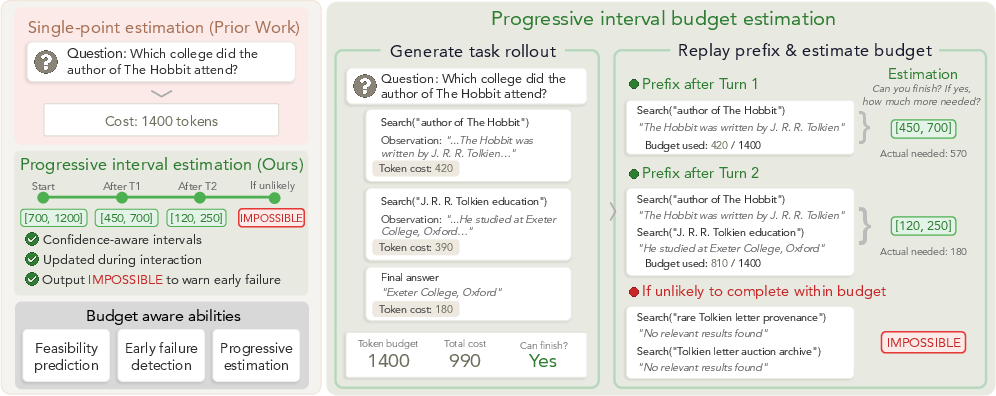
They propose a new way to test this: at each step of a task, the AI should estimate how much more “budget” it needs, give a reasonable range (not just a single guess), and say if finishing is no longer possible. They then test several advanced AI models across different tasks to see how well they do.
What questions the paper asks
In simple terms, the researchers wanted to know:
- Can AIs tell, while they’re working, how much more they’ll spend to finish a task?
- Are AIs honest with themselves, or are they too optimistic?
- Do better problem-solving AIs also make better budget estimates?
- Can we train AIs to do better at this?
- If an AI can predict failure early, can that save resources?
How they tested it (methods, in everyday language)
Think of managing a road trip:
- You have a gas budget (money), a time budget (hours), and space in the trunk (storage). At every stop, a smart navigator should update you: “We’ll need between X and Y more dollars and hours to finish,” or “We won’t make it—let’s turn back.”
The paper turns that idea into a test called progressive interval estimation:
- Progressive: The AI updates its estimate at every step as it learns more.
- Interval: The AI gives a range (lower and upper bound), not just one number, to show uncertainty.
- Impossible option: If it thinks the task won’t finish within the budget, it should say so clearly.
To fairly measure this, they use a rollout–replay protocol:
- Let the AI do the whole task once with no limits. Record everything: each step, how many tokens it used, and the final result.
- Rewind to each step and ask the same AI: “Given what you know up to now, how much more budget do you need? Or is this impossible?” This separates “doing the task” from “judging the budget.”
They check two kinds of budgets:
- Internal budget: the AI’s own token use (its thinking and talking).
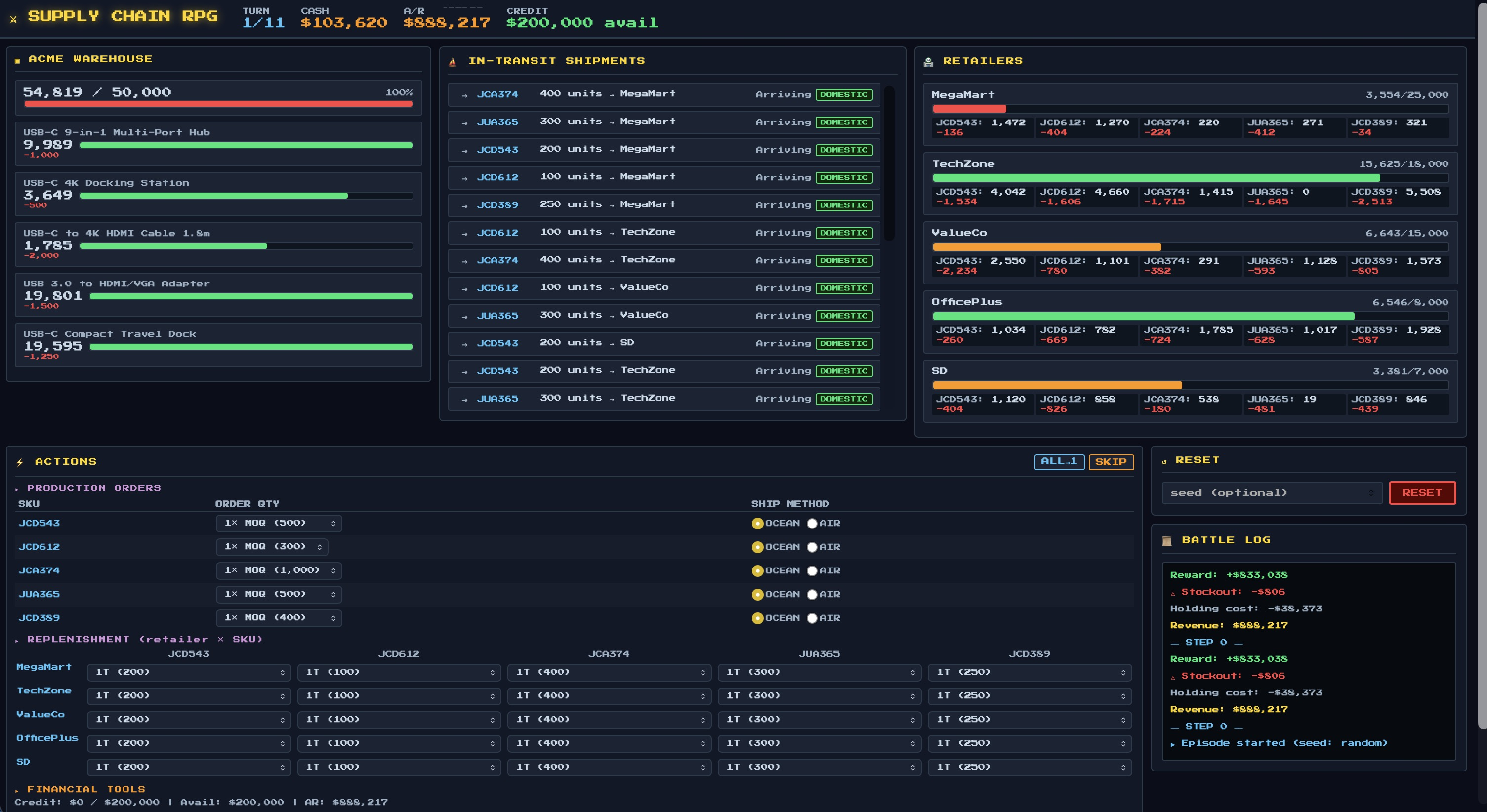
- External budgets: real-world costs like money, time, and warehouse storage.
They test across four settings:
- Sokoban (a puzzle game): measures planning and tokens used.
- Search-R1 (multi-step web search): measures tokens used to find and connect facts.
- SWE-bench (fixing software bugs): measures tokens/turns used while coding.
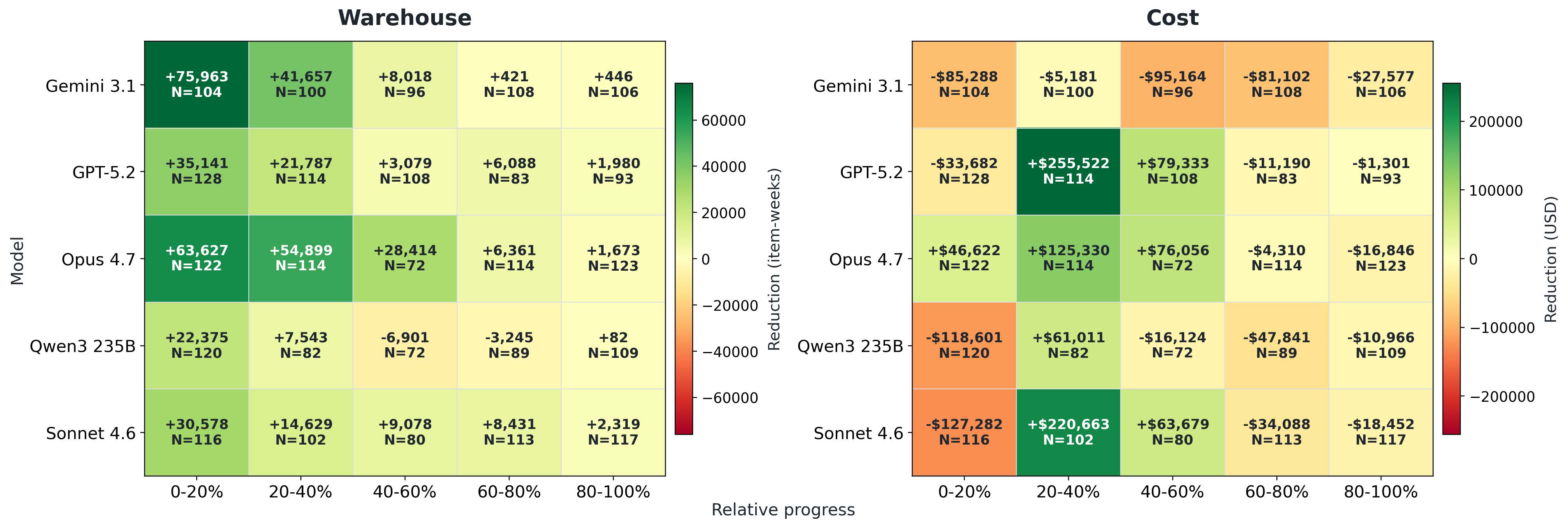
- A warehouse simulation (based on real business data): money spent, weeks used, and storage occupancy.
They evaluate three sub-skills:
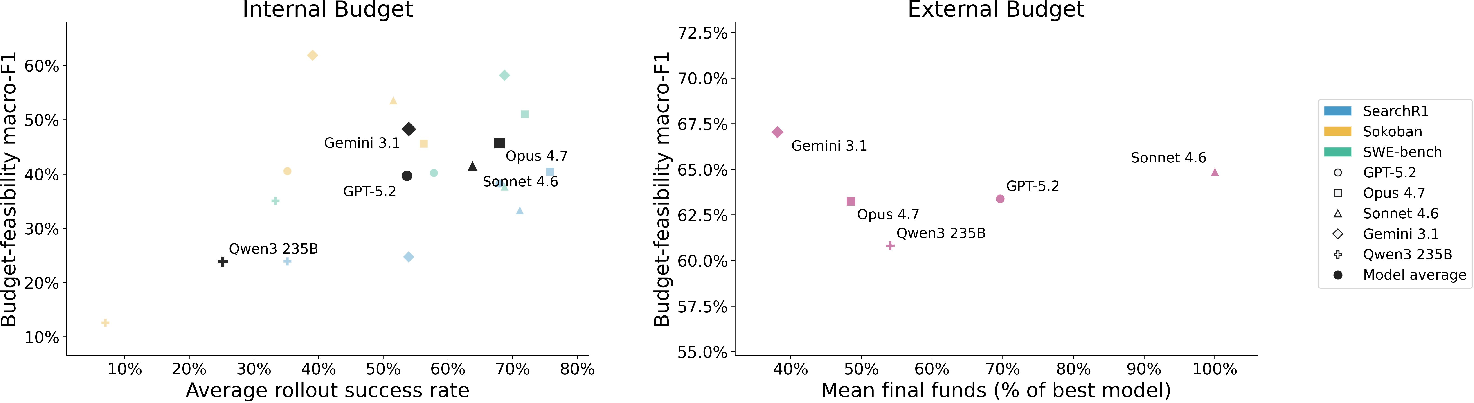
- Feasibility prediction: Can the AI tell if finishing within budget is possible?
- Early failure detection: When the task will fail, does the AI realize it early enough to save resources?
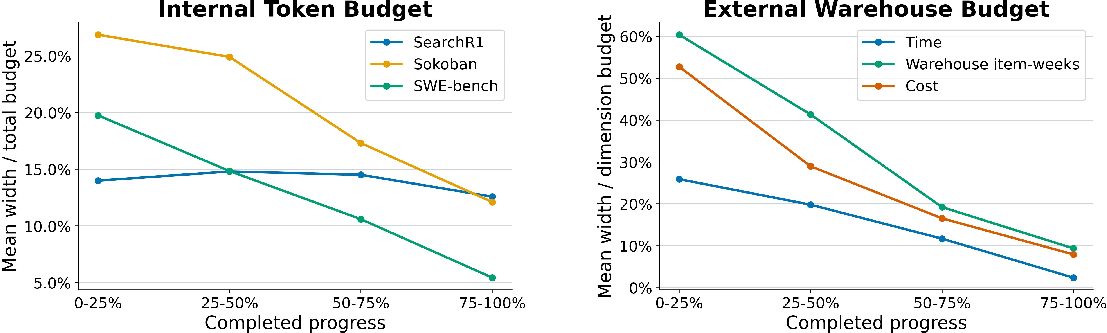
- Interval calibration: When success is possible, does the AI give a range that actually covers the true remaining cost, and is that range not ridiculously wide?
They also try training a smaller model to improve budget awareness using:
- SFT (Supervised Fine-Tuning): teaching by examples.
- RL (Reinforcement Learning): practicing with a reward signal to improve.
What they found (main results and why they matter)
Here are the key takeaways, explained plainly:
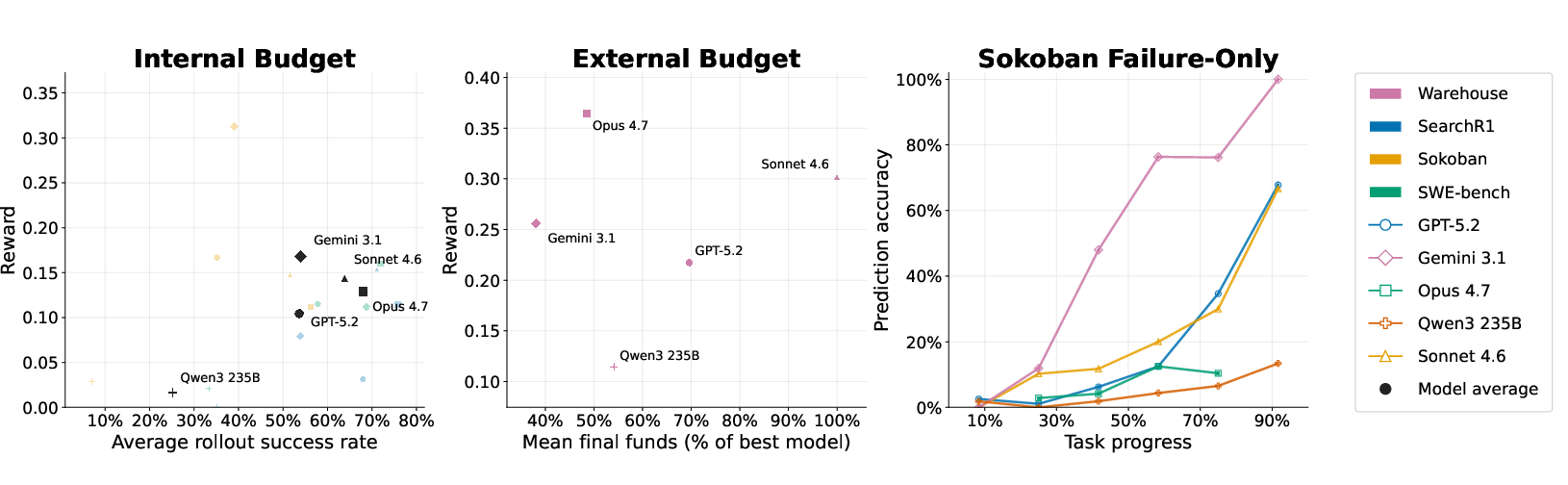
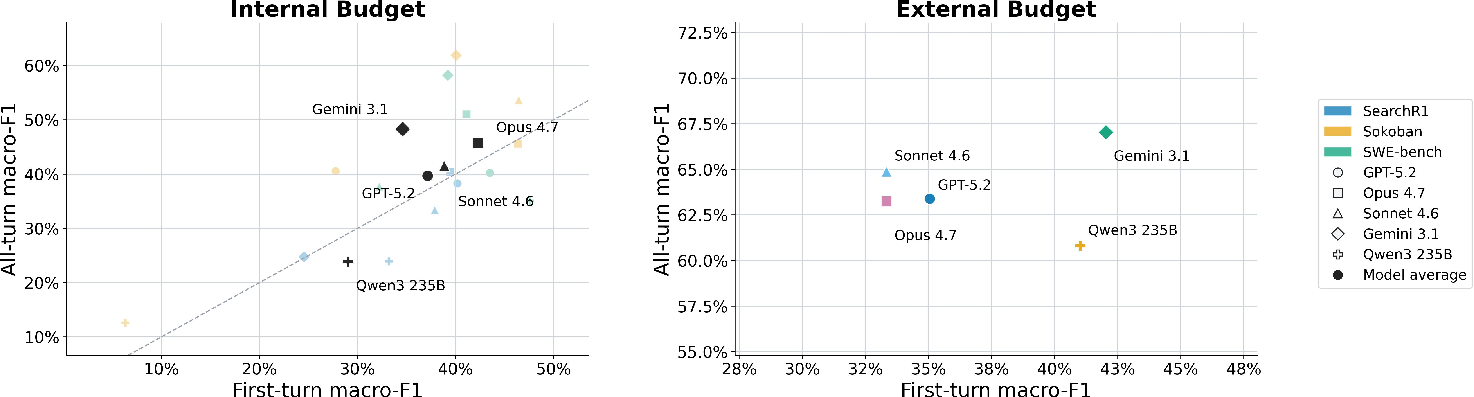
- Better problem-solvers aren’t automatically better budget estimators.
- Some models that solve tasks very well still give poor budget ranges. The correlation between being good at tasks and being good at budget awareness is weak. Budget awareness is its own skill.
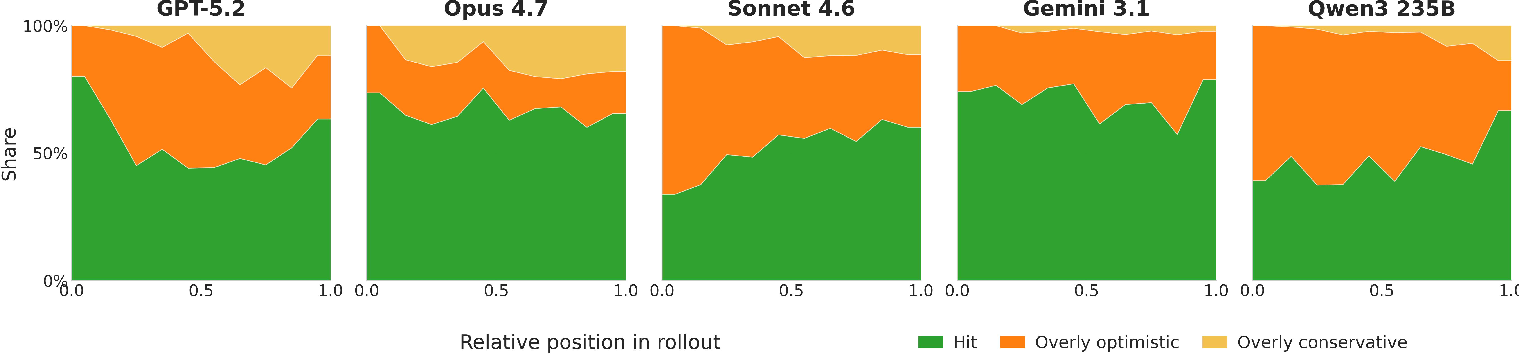
- AIs are consistently too optimistic.
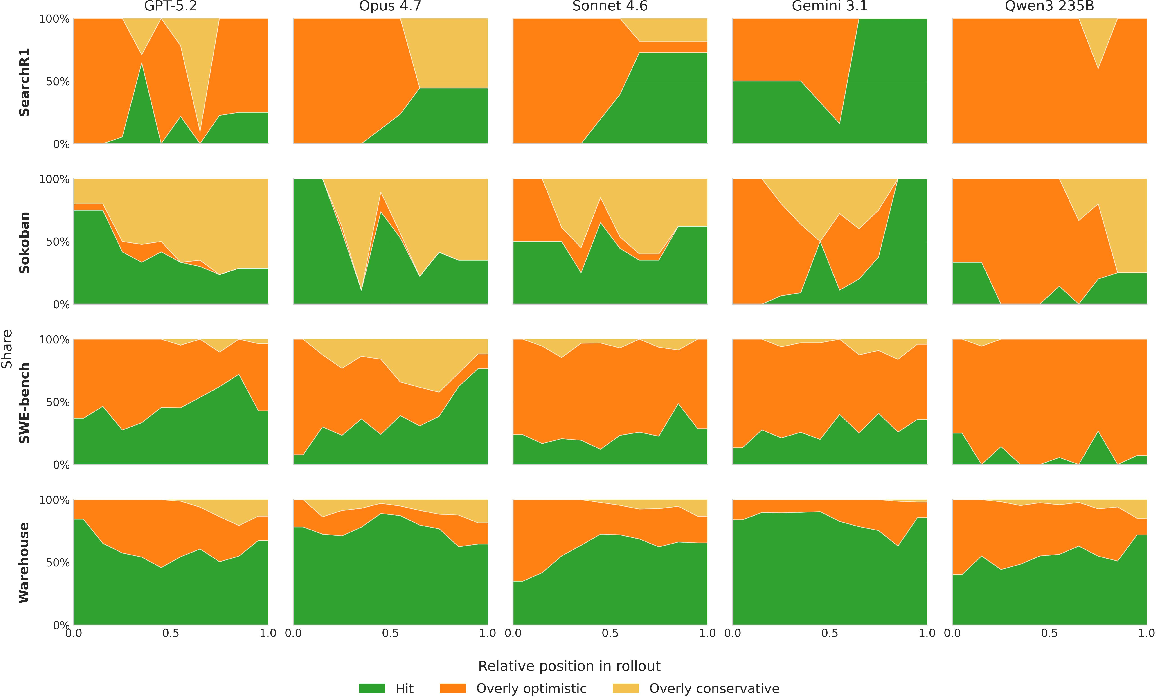
- They often underestimate how much budget is left. This happens across all tasks and models. Strangely, weaker models are often more optimistic, not less.
- AIs notice failure, but too late.
- Even when a task is doomed, AIs keep saying it’s feasible until very late in the process, after most of the budget is already spent. That makes it hard to save resources.
- The budget-awareness signal is useful right now.
- If you stop the task whenever the AI finally says “impossible,” you can save about 28% to 64% of the tokens on runs that were going to fail anyway—while only slightly hurting overall success (by about 1.6 to 4.2 percentage points). That’s a strong, practical win.
- Training helps, but only so far—and it’s fragile.
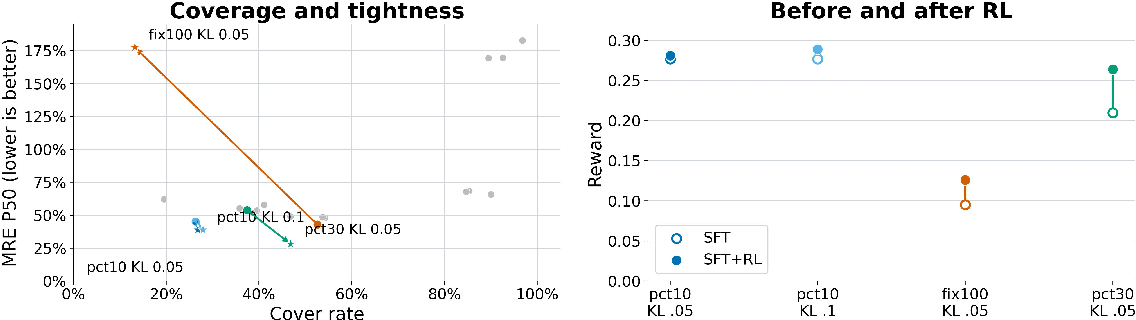
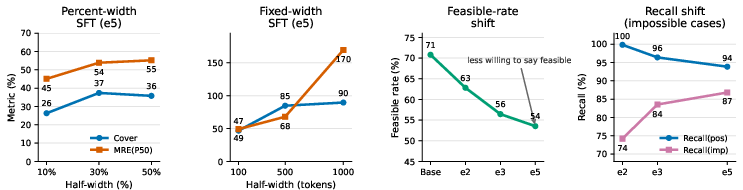
- With SFT, the AI quickly gets good at the yes/no part (feasibility). With SFT plus RL, the ranges (intervals) get better, but still aren’t great. Even after training, at best only about 47% of the predicted ranges actually cover the true remaining cost. Also, starting RL without the SFT step can make things collapse (the model may spam “impossible” or output invalid answers).
- Single guesses aren’t good enough.
- Asking for one number at the start fails in two ways: AIs are too optimistic, and their early estimates don’t match what they would say later. Asking for a range at every step works better.
Why this matters: If AIs are going to help with long tasks—like coding, research, or running parts of a business—they need to know when to continue, when to ask for more budget, and when to stop. Without that, they waste time, money, tokens, and user trust.
What this means for the future (implications and impact)
- Treat budget as a control signal, not just a receipt.
- Instead of counting cost after the task is over, use the AI’s live estimates to control what happens next: keep going, stop early, or request more resources.
- Build “budget awareness” into agents as a core skill.
- Developers should teach AIs to regularly update budget needs with ranges and to honestly declare “impossible” earlier. This is similar to a project manager giving realistic timelines and raising flags when plans won’t work.
- Use simple policies now for real savings.
- Even a basic rule—“stop when the AI says impossible”—already saves a lot of compute on failing attempts.
- Improve calibration and intervals.
- The hardest part is getting precise, well-calibrated ranges. That’s the main open challenge: reducing over-optimism, making intervals cover the truth more often, and keeping them tight.
- Expand beyond one type of budget.
- Real tasks juggle several constraints at once (money, time, storage). Future agents should reason about trade-offs across multiple budgets, not just one.
In short: The paper shows that knowing “how much more” is a different and essential skill for AI agents. AIs today tend to be over-optimistic and late to admit failure, but their self-estimates are already useful for saving resources. With better training and design, budget-aware agents could become much more reliable and efficient in the real world.
Knowledge Gaps
Knowledge gaps, limitations, and open questions
Below is a concise, actionable list of what remains missing, uncertain, or unexplored in the paper.
- Online (in-loop) budget estimation remains untested: how to interleave estimation with execution when estimation itself consumes tokens, and whether net savings persist after counting this overhead.
- Ground-truth definition is path-dependent: estimates are scored against the realized remaining cost of a single unconstrained rollout by the same agent, not the minimal remaining cost; counterfactual “best-achievable” remaining budget from a prefix is not identified.
- Closed-loop use beyond early stopping is unaddressed: how to integrate budget predictions into replanning, tool selection, search breadth/depth, or budget reallocation/request policies, and measure end-to-end utility gains.
- Early failure detection is too late; methods for earlier alarms are open: training objectives, features, or curricula that explicitly penalize late “impossible” predictions and optimize time-to-alarm vs false-abort trade-offs.
- Interval calibration remains weak (coverage ≤ 47% after SFT+RL); methods for sequential calibration (e.g., online or adaptive conformal prediction) tailored to evolving trajectories are not explored.
- Reasons for persistent optimism are not pinned down: how prompt framing, decoding temperature, scale, chain-of-thought verbosity, or instruction style modulate underestimation bias, and which interventions reduce it.
- Training fragility and algorithmic choices are underexplored: RL collapses without SFT; alternatives (e.g., policy constraints, KL regularization, reward shaping, curriculum, preference/DPO-style losses, quantile or evidential regression) are not evaluated.
- Generalization is limited: cross-task transfer retains only 17–36% reward; multi-task training, meta-learning, or adapters for budget awareness across domains and modalities are open.
- External budgets are tested in a single environment; broader coverage is missing: other real-world multi-dimensional budgets (latency, API quotas, energy, money) and domains (web agents, robotics, operations, planning with deadlines).
- Fungibility and trade-offs across budget dimensions are not modeled: methods to estimate and optimize interchangeable resource use (e.g., money vs time) and to produce joint intervals with controlled joint coverage remain open.
- Multi-dimensional interval scoring is simplistic: how to score and calibrate joint intervals (and dependence) across budget dimensions with proper multivariate scoring rules is not addressed.
- Statistical uncertainty is underreported: no confidence intervals, significance tests, or variance decomposition (across seeds/tasks) for key metrics; small sample sizes (e.g., 64 SWE-bench rollouts) may limit reliability.
- Robustness to input noise is unknown: sensitivity to incorrect or delayed cumulative-usage summaries, tool errors, stochastic environments, and adversarial prefixes is not measured.
- Estimation cadence is fixed (every turn); the trade-off of estimation frequency vs accuracy vs overhead is not studied, nor are adaptive querying policies.
- Internal budget is proxied by tokens only; alignment with real compute (latency, memory, energy) and tokenization variability across models is not validated.
- Consistent token accounting is unclear: whether counts include inputs, tool I/O, and system messages uniformly across agents and tasks; standardized measurement protocols are needed.
- Warehouse realism and reproducibility: details on data release, environment stochasticity, and external validity to real operations are limited.
- Human-in-the-loop design is absent: how to present intervals and “impossible” alerts, calibrate user trust, and support user overrides or budget renegotiation.
- Portfolio-level and multi-agent budgeting is unexplored: allocating limited budgets across concurrent tasks/agents, with competition, priorities, and fairness constraints.
- Policy-level safety analysis of early stopping is missing: when false aborts are acceptable, how to set risk thresholds, and how to mitigate harm in high-stakes domains.
- Temporal coherence constraints are not enforced: estimates can fluctuate arbitrarily across turns; methods for monotone or smoothed updates consistent with observed progress are not evaluated.
- Alternative uncertainty representations are not tried: predictive distributions, quantiles, abstention, or risk measures (e.g., CVaR) instead of (or alongside) intervals.
- Feasibility appears format-sensitive; why and how formats matter is unclear: the role of prompt schemas, rationales, confidence annotations, and self-critique in improving feasibility and calibration needs systematic study.
- Actor–estimator co-design is open: whether dedicated estimator heads, shared encoders, or tool-augmented monitors outperform prompting the same model; how co-training affects both performance and budget awareness.
- Distribution shift and planning adaptivity: estimates are made assuming the future mirrors the logged rollout; how predictions hold when plans adapt in response to estimates (feedback-induced shift) is unknown.
- Evaluation under real budget caps is missing: agents were unconstrained during rollout; whether the same conclusions hold when hard caps force truncations and strategic behavior changes remains untested.
- Proper scoring rules for intervals are limited: the “coverage × tightness” reward can be gamed by width choices; evaluating with strictly proper interval scores (e.g., Winkler, CRPS for quantiles) is an open direction.
- Scaling laws for budget awareness are unknown: how capability scales with model size, SFT data volume, and RL steps, and whether data-efficient strategies exist.
- Causal and interpretability analyses are absent: what internal signals (e.g., uncertainty tokens, self-reflection cues) predict accurate estimation, and whether targeted interventions can steer optimism and timing.
Practical Applications
Practical Applications of BAGEN: Budget-Aware Agents
The paper proposes progressive interval estimation for “budget awareness” in agents and shows it is actionable even with current models. Below are concrete, real-world use cases grouped by immediacy, tied to sectors, and annotated with dependencies/assumptions.
Immediate Applications
These can be piloted or deployed now using the paper’s rollout-replay insights and the demonstrated early-stop policy that saved 28–64% of tokens on failed runs with only a 1.6–4.2 pp success-rate tradeoff.
- Software engineering agents: token/cost-aware auto-repair and code assistants (Sector: software)
- What: Add a “Budget Estimator + Early-Stop Controller” to SWE-style code agents to predict remaining token budget and flag/abort hopeless trajectories.
- Tools/workflows:
- A “budget-sentinel” module in agent frameworks (e.g., LangChain/AutoGen) that calls a budget-estimation prompt every N turns and triggers early stop on “impossible.”
- UI “budget slider” showing predicted range of remaining tokens with a feasibility label.
- Assumptions/dependencies:
- Stable access to per-turn token accounting; willingness to trade small success losses for large cost savings.
- Optimism bias and late recognition are known failure modes; thresholds must be tuned to control false aborts.
- Enterprise search/RAG agents: API/tool-call throttling (Sector: software/enterprise IT)
- What: Apply interval-based estimates for remaining query/crawl costs and abort or route to a human if an answer appears infeasible under budget.
- Tools/workflows: Query-budget controller in RAG pipelines; dashboard showing interval hit rate and Fail-F1 by query class.
- Assumptions/dependencies:
- Access to tool-call cost telemetry; acceptance of periodic self-assessment calls.
- Supply-chain operations: feasibility-aware inventory/procurement planning (Sector: logistics/retail)
- What: Use progressive intervals over cost, time, and warehouse occupancy to gate risky procurement scenarios and raise early alerts when revenue targets are infeasible.
- Tools/workflows: Integrate a “Warehouse Budget Estimator” microservice in ERP/OMS that reports multi-dimensional budget intervals at each planning cycle.
- Assumptions/dependencies:
- Mapped external budgets (USD, weeks, capacity) per decision; calibrated alert thresholds; business appetite for early warnings that may be conservative.
- Customer support and sales chatbots: talk-time/cost-aware escalation (Sector: CX/sales)
- What: Predict remaining conversation cost/time and escalate to a human if resolution is unlikely within SLA budgets.
- Tools/workflows: Call-center orchestration that uses Fail-F1 signals to trigger handoff; training playbooks to limit false escalations.
- Assumptions/dependencies:
- Telemetry on per-turn time/cost; human fallback capacity; acceptable minor drop in automated resolution in exchange for cost predictability.
- Cloud cost containment for agentic workflows (Sector: cloud/IT finance)
- What: Introduce “Budget SLAs” where agents expose feasibility and intervals to FinOps dashboards and stop on predicted overruns.
- Tools/workflows: Cost dashboards tracking interval hit rate and saved-token share; policy hooks for automatic termination on sustained “impossible” predictions.
- Assumptions/dependencies:
- Accurate token-to-dollar metering; organization buy-in to enforce stop policies.
- Research & evaluation: standardized budget-awareness benchmarking (Sector: academia/industry R&D)
- What: Adopt the rollout-replay protocol and metrics (feasibility F1, Fail-F1, interval hit rate/reward) in agent eval suites.
- Tools/workflows: Open-source harness to log unconstrained rollouts and replay prefixes for estimation; model-vs-extrapolation comparisons.
- Assumptions/dependencies:
- Access to raw trajectories and per-turn costs; controlled environments to reduce drift between rollout and replay.
- Human-in-the-loop workflows: early alerting in long tasks (Sector: productivity/PM)
- What: Personal or team assistants estimate remaining time tokens for multi-step tasks and notify users early if on-time completion is unlikely.
- Tools/workflows: Calendar/task apps with “time-interval” badges and “request more time” or “trim scope” suggestions.
- Assumptions/dependencies:
- Users accept interval uncertainty and occasional over-conservatism; periodic self-estimation overhead is budgeted.
- Data labeling and content ops: budget-aware task triage (Sector: data ops/marketing)
- What: Abort or reroute labeling or content-generation jobs when predicted cost to completion exceeds allocated budget.
- Tools/workflows: Pipeline gate that monitors feasibility predictions; human adjudication queue for “impossible” cases.
- Assumptions/dependencies:
- Reliable quality checks; acceptance of conservative stops to avoid waste.
- Compliance/audit dashboards for agentic spend (Sector: governance/risk/compliance)
- What: Track budget-awareness metrics for agents that spend money or allocate capacity; flag over-optimism and late failure recognition.
- Tools/workflows: GRC dashboards with longitudinal interval coverage and false-abort/false-continue rates.
- Assumptions/dependencies:
- Log retention; agreement on audit thresholds and corrective actions.
- Education/tutoring agents: session planning under time budgets (Sector: education)
- What: Estimate ranges for covering lesson objectives within session time and advise scope adjustments when infeasible.
- Tools/workflows: LMS plug-ins that show coverage intervals and suggest reordering content.
- Assumptions/dependencies:
- Session telemetry; acceptance of conservative pacing to avoid rushed endings.
- Safety guardrails for tool-using agents (Sector: cross-sector)
- What: Use “impossible” predictions to prevent agents from over-spending API calls in brittle toolchains (e.g., web scraping, data extraction).
- Tools/workflows: Policy rule: halt tool use after N turns if feasibility remains low or intervals consistently miss on the optimistic side.
- Assumptions/dependencies:
- Tool cost observability; override paths for critical tasks.
Long-Term Applications
These require further research on interval calibration (coverage capped ~47% post SFT+RL), online estimation (not studied here), or deeper integration across planning and control.
- Online progressive estimation coupled to execution (Sector: software/robotics/logistics)
- What: Interleave estimation with actions to adapt plans in real time (e.g., dynamic replanning or resource reallocation).
- Potential products: “Budget-Aware Planner” that co-optimizes actions against live feasibility signals.
- Assumptions/dependencies:
- Methods to budget the meta-estimation overhead; stability of online prompts; mitigation of optimism bias.
- Portfolio-level budget allocation across many tasks/agents (Sector: enterprise IT/operations)
- What: Allocate a global budget across concurrent agent tasks based on predicted intervals and failure risk.
- Potential products: “Agent Budget Orchestrator” for queueing, prioritization, and rebalancing.
- Assumptions/dependencies:
- Accurate cross-task comparability; mechanisms to trade false abort costs vs. savings at portfolio scale.
- Multi-dimensional budget optimizers for operations (Sector: logistics/healthcare/energy)
- What: Extend Warehouse-style estimation to coupled constraints (money–time–capacity) with fungibility and trade-offs.
- Potential products: ERP/APS modules that reason over budget trade-offs and propose “ask for budget” or “reduce scope.”
- Assumptions/dependencies:
- Joint modeling of interacting budgets; human governance for trade-off decisions; robust interval calibration.
- Budget-aware safety in robotics and autonomy (Sector: robotics/mobility)
- What: Predict remaining energy/time to complete missions and trigger safe abort/return-to-base when infeasible.
- Potential products: “Mission Controller” with budget intervals and fail-safes.
- Assumptions/dependencies:
- Reliable sensing for external budgets (battery, distance); online estimation integration and conservative thresholds.
- Healthcare operations planning (Sector: healthcare)
- What: Budget-aware triage/scheduling for clinics or hospitals, estimating time/bed/resource feasibility and alerting on overloads.
- Potential products: Scheduling assistants with interval forecasts and escalation policies.
- Assumptions/dependencies:
- High-stakes calibration and regulatory compliance; human-in-the-loop triage; domain-specific validation.
- Risk-aware finance and trading assistants (Sector: finance)
- What: Treat capital-at-risk and time-to-exit as budgets; halt or hedge when achieving target return is infeasible under constraints.
- Potential products: “Risk Budget Sentinel” for algorithmic or advisory workflows.
- Assumptions/dependencies:
- Strict compliance and auditing; robust calibration under stochastic markets; human oversight.
- Energy and grid operations (Sector: energy)
- What: Budget intervals for remaining reserve margins, time-to-restore, or maintenance windows, enabling early load-shedding decisions.
- Potential products: Control-room advisors with feasibility-aware alerts.
- Assumptions/dependencies:
- Real-time telemetry; failsafe thresholds; rigorous testing for safety-critical use.
- Education program design and curriculum planning (Sector: education)
- What: Longer-horizon planning with learning-time budgets and confidence intervals; dynamically re-scope curricula.
- Potential products: Curriculum planners with progressive feasibility tracking.
- Assumptions/dependencies:
- Domain adaptation and better interval calibration; acceptance of rescoping policies.
- Policy and procurement standards for agentic systems (Sector: public policy/compliance)
- What: Require budget-awareness telemetry (feasibility, Fail-F1, interval hit rate) and early-stop safeguards for AI systems spending money or committing inventory/time.
- Potential products: “Budget-Awareness Compliance Profiles” for vendors; audit frameworks.
- Assumptions/dependencies:
- Consensus metrics and reporting formats; governance for acceptable false-abort costs.
- Training pipelines with budget-awareness objectives (Sector: AI model development)
- What: SFT+RL curricula optimizing interval reward and early-failure detection, with stabilization methods and cross-task generalization.
- Potential products: “Budget-Aware Heads” in agent models; conformal/sequential calibration methods adapted to evolving trajectories.
- Assumptions/dependencies:
- High-quality rollout-replay datasets; reward shaping to avoid mode collapse; transfer learning across tasks.
- Meta-estimation services across models (Sector: AI infrastructure)
- What: A service that ingests logs from diverse agents and provides standardized budget-awareness predictions and alerts.
- Potential products: “Budget Estimation as a Service” with SDKs and APIs.
- Assumptions/dependencies:
- Vendor-agnostic log access; privacy/security controls; alignment of units across internal/external budgets.
- Human–AI contract UX (Sector: product design)
- What: Interfaces that let users set budget caps and see live feasibility intervals; agents can proactively request additional budget with justification.
- Potential products: “Budget Negotiation” dialogs with explainable drivers for infeasibility.
- Assumptions/dependencies:
- Clear mappings from prediction intervals to user-understandable narratives; guardrails against gaming.
Notes on feasibility and deployment risks across applications:
- Calibration remains the bottleneck for intervals (coverage ~47% post SFT+RL in Sokoban), while binary feasibility is trainable with SFT. Conservative operating points and explicit thresholds are recommended.
- Models exhibit optimistic bias and late failure recognition; policies should combine interval width, midpoint bias monitoring, and hysteresis (e.g., require repeated “impossible” before abort).
- The paper’s evaluation uses rollout-replay to avoid contaminating costs with estimation overhead; online deployment must account for (and limit) the token/time cost of self-estimation.
- External-budget use cases depend on accurate, per-turn telemetry and clear definitions of success/feasibility under constraints.
- RL training was fragile without SFT warm-start; production training should include format supervision, reward shaping, and QA to prevent degenerate strategies.
These applications leverage the paper’s core findings: budget awareness is decoupled from task performance, the signal is already actionable via early stopping, and estimator behavior can be improved with SFT then RL—enabling immediate cost savings and setting a path for deeper, long-term integration into planning and governance.
Glossary
- actor: The component that executes actions or completes tasks, contrasted with an estimator that predicts costs or outcomes. "The best actor is not the best estimator."
- agentic tasks: Long-horizon, multi-step tasks where an agent autonomously decides and acts. "most evaluation protocols collect a single-point prediction at task start, which mismatches long-horizon agentic tasks where feasibility evolves turn by turn"
- budget awareness: An agent’s ability to estimate remaining resource needs and feasibility mid-execution. "We call this capability budget awareness and formalize an ability for Budget-Aware Agents (BAGEN) as progressive interval estimation:"
- Budget-Aware Agent (BAGEN): An agent that treats budget as a control signal and performs progressive interval estimation during execution. "We call this capability budget awareness and formalize an ability for Budget-Aware Agents (BAGEN) as progressive interval estimation:"
- budget modalities: The categories of resources an agent uses, here split into internal and external budgets. "We first introduce two budget modalities, then describe the progressive interval estimation protocol"
- calibration problem: A deficiency in aligning predicted probabilities or labels with actual outcomes, here affecting binary feasibility judgments. "Binary feasibility is a calibration problem; interval estimation is a reasoning problem"
- challenge-conditioned feasibility probes: Evaluation prompts that set up scenarios to test whether tasks are feasible under specified constraints. "we evaluate budget awareness via challenge-conditioned feasibility probes"
- coupled resource constraints: Interdependent limits across multiple resource dimensions that must be reasoned about jointly. "External budget forces the agent to reason about coupled resource constraints"
- deterministic extrapolation baseline: A simple, non-learned method that linearly projects remaining cost from observed usage. "we compare each agent midpoint with a deterministic extrapolation baseline"
- early failure detection: The ability to recognize infeasibility early enough to prevent wasted resources. "we decompose estimation into three sub-capabilities: feasibility prediction, early failure detection, and interval calibration"
- early-stop policy: A control rule that terminates execution when the agent predicts infeasibility. "and deploy their predictions through a simple early-stop policy"
- external budget: The environment-facing resources an agent consumes (e.g., money, time, capacity). "External budget is the cost the agent commits in the environment."
- Fail-F1: An F1 score focused on correctly identifying impossible (infeasible) cases. "Fail- measures detection of impossible cases."
- feasibility prediction: Deciding whether a task can still succeed given remaining budget. "we decompose estimation into three sub-capabilities: feasibility prediction, early failure detection, and interval calibration"
- horizon: The time span or number of turns over which the agent operates. "over a 24-week horizon (12 turns)"
- internal budget: The model’s own computational resources consumed during reasoning (e.g., tokens). "Internal budget is the compute generated by the model's own reasoning."
- interval calibration: Aligning predicted cost intervals with true remaining costs so they cover the truth at appropriate rates. "we decompose estimation into three sub-capabilities: feasibility prediction, early failure detection, and interval calibration"
- interval coverage: The fraction of times the true value falls within the predicted interval. "precise interval calibration remains challenging, with interval coverage capping at 47% after SFT+RL."
- interval hit rate: The rate at which predicted intervals include the realized remaining cost on successful trajectories. "For diagnostics, we also report interval hit rate (the fraction of success-case samples covered)"
- late recognition: Detecting failure only after most of the budget has been spent. "Hypothesis 4 (late recognition)."
- macro-F1: The average of per-class F1 scores (feasible vs. impossible), giving equal weight to each class. "On Sokoban, Gemini's feasibility macro- improves by points"
- midpoint relative error: The relative error of the interval’s midpoint compared to the true remaining cost. "and midpoint relative error, $|\frac{\hat{R}_k^{\text{lo} + \hat{R}_k^{\text{hi}{2} - R_k| / R_k$, at the 50th and 90th percentiles."
- multi-dimensional cost vector: A representation of external budget usage across several resource dimensions. "It is generally multi-dimensional: let $\mathbf{c}_t^{\text{ex} \in \mathbb{R}^D$ denote the -dimensional cost vector at turn~"
- multi-hop information retrieval: A search task requiring reasoning across multiple steps or sources. "Search-R1~\citep{jin2025searchr1}: multi-hop information retrieval, capped at tokens."
- per-dimension constraints: Resource limits that apply separately to each dimension of a multi-dimensional budget. "subject to per-dimension constraints for ."
- prefix replay: Re-feeding a partial trajectory to the model to elicit updated estimates mid-execution. "Prefix replay and estimation."
- progressive interval estimation: Step-by-step prediction of a remaining-budget interval or infeasibility as execution proceeds. "We then formalize budget-awareness as progressive interval estimation: at each step of a plan, an agent should predict an upper and lower bound on remaining budget, and alert when completion is unlikely."
- reasoning trace: The internal chain-of-thought or tokens generated during an agent’s deliberation. " is the agent's reasoning trace"
- reinforcement learning (RL): A learning paradigm optimizing behavior via reward signals; here used to improve estimators. "We train Qwen-7B on Sokoban budget estimation using supervised fine-tuning (SFT) followed by reinforcement learning (RL)."
- rollout: A complete sequence of interactions (trajectory) produced by the agent during task execution. "We record an unconstrained rollout, then re-query the same agent on every prefix"
- rollout generation: The phase where a full, unconstrained trajectory is logged for later evaluation. "Rollout generation. The agent executes the task without any budget constraint."
- rollout-replay protocol: An evaluation method that re-queries the agent on prefixes of a recorded rollout to assess estimates. "Scoring with a rollout-replay protocol, we find consistent failure patterns"
- Sokoban: A planning benchmark where agents push boxes to targets on a grid. "Sokoban~\citep{junghanns1998sokoban}: a planning task where agents push boxes to targets on a grid"
- supervised fine-tuning (SFT): Training with labeled examples to align model outputs with desired formats or behaviors. "We train Qwen-7B on Sokoban budget estimation using supervised fine-tuning (SFT) followed by reinforcement learning (RL)."
- supply-chain environment: A simulated setting with financial, temporal, and capacity constraints modeling inventory decisions. "a supply-chain environment curated from real enterprise data"
- SWE-bench: A coding/issue-resolution benchmark for software engineering tasks. "SWE-bench~\citep{jimenez2024swebench}: agents resolve GitHub issues, capped at $160$ turns."
- systematic optimism: A consistent tendency to underestimate remaining cost or overestimate feasibility. "The first failure is systematic optimism."
- tightness: A measure penalizing overly wide intervals, favoring sharper predictions. "Tightness penalizes wide intervals: a perfect prediction scores~1"
- token budget: The limit on the number of tokens an agent can consume during reasoning and interaction. "Failure is recognized late: across environments, models often label failed trajectories as impossible only after much of the token budget has already been spent."
- trajectory: The ordered sequence of observations, thoughts, and actions during agent execution. "Consider an agent executing a multi-turn trajectory "
- unconstrained rollout: A run without budget limits, used to log ground-truth usage and outcomes. "We record an unconstrained rollout, then re-query the same agent on every prefix"
- Warehouse (environment): A multi-budget, real-data-based environment with cost, time, and capacity dimensions. "We develop Warehouse (Appendix~\ref{sec:warehouse-environment-details}), a supply-chain environment curated from real enterprise data"
- warehouse occupancy (item-weeks): A capacity budget measuring inventory usage over time. "with three coupled budget dimensions: cumulative cost (USD), time (weeks), and warehouse occupancy (item-weeks)."
- warm-start: Initializing RL from an SFT-trained model to stabilize and improve training. "RL without an SFT warm-start collapses entirely"
- width adequacy: How appropriate the predicted interval width is relative to uncertainty, affecting coverage and sharpness. "Interval hit rate correlates strongly with midpoint bias () and width adequacy ()"
Collections
Sign up for free to add this paper to one or more collections.