Training Ecosystems: A Computational Approach to Uncovering Learning Behavior in Unconventional Contexts
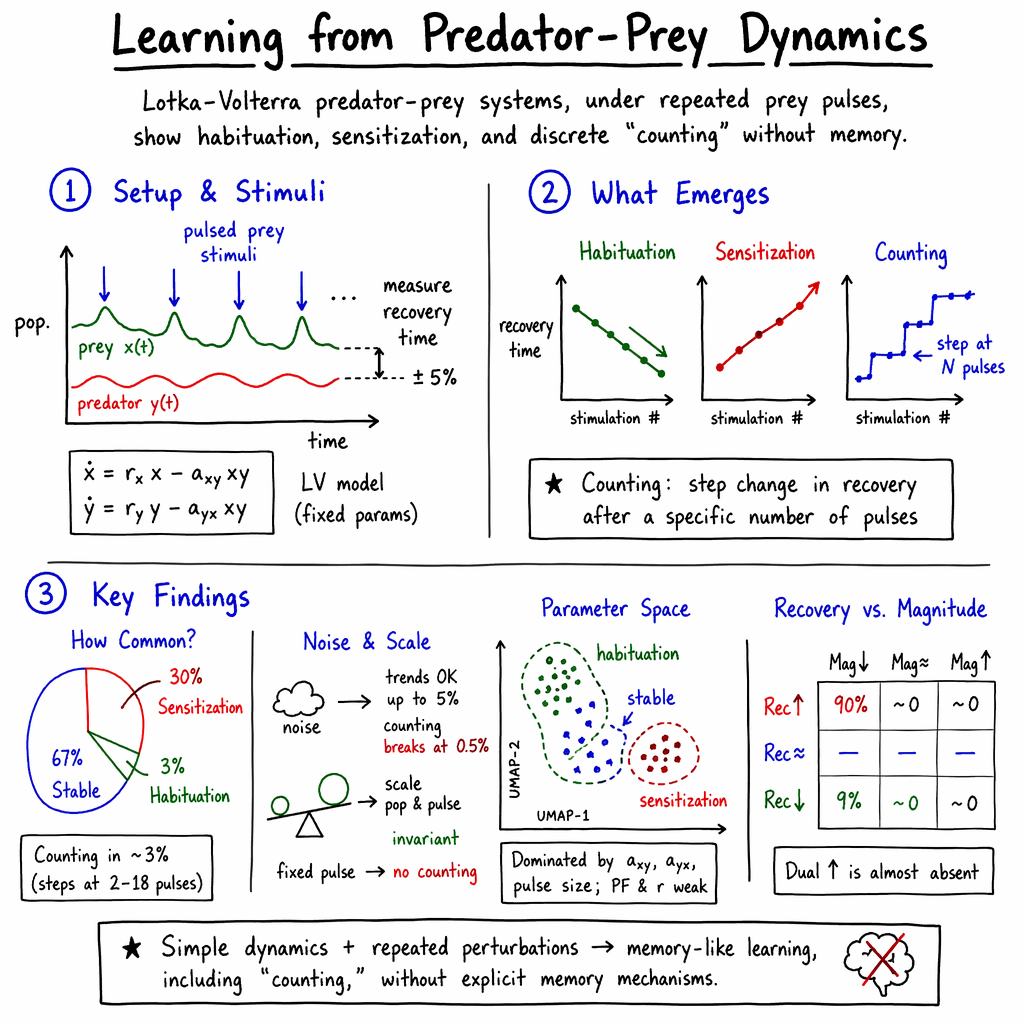
Abstract: Recent progress in diverse intelligence has shown simple learning capacities below the organism level - single cells and even molecular networks. However, there are still many knowledge gaps around learning capacity above the organism level, and about memory implemented purely by dynamical interactions without explicit memory media. We demonstrate that minimal ecological dynamics (in silico) are sufficient for several kinds of learning, assayed as changes in both, magnitude of response, and of recovery time. Systematic exploration of over 220,000 parameter combinations in a simulated classic predator-prey model revealed that, when perturbed by stimuli, recovery time exhibits habituation, sensitization, and a form of discrete number learning in a scale-invariant manner. Robustness analysis revealed that habituation and sensitization persist under stochastic perturbations, while discrete number learning is disrupted even at low noise levels. Dimensionality reduction revealed that the incidence of learning capacity is primarily determined by ecological interaction strengths. Clear, unique clustering patterns in parameter space allow high prediction accuracy for novel parameter combinations that enable learning. Response magnitude revealed a striking asymmetry: 90.6% of parameter combinations exhibited recovery time sensitization paired with habituation of response magnitude, while the opposite pattern was extremely rare. These findings highlight a set of phenomena at the intersection of ecology, basal cognition, and mathematics with many implications for a wide range of systems describable by similar kinds of equations. These properties provide numerous efforts in biology and engineering with a substrate that has considerable, pre-patterned, propensity for learning, which ultimately arises from mathematics, not depending on the details of physics or biology.
Paper Prompts
Sign up for free to create and run prompts on this paper using GPT-5.
Top Community Prompts
Explain it Like I'm 14
Overview
This paper asks a surprising question: can something as simple as a two-species ecosystem “learn,” even without a brain? Using computer simulations of a classic predator–prey model, the authors show that the system can adapt to repeated disturbances in ways that look like well-known forms of learning, such as getting used to a stimulus (habituation), becoming more reactive (sensitization), and even “counting” how many times something happens before changing its behavior.
Key questions
The authors set out to find, in simple, everyday terms:
- Can a basic ecosystem model change how it reacts after being disturbed many times, the way living beings do during learning?
- Which settings of the system (like how strongly species affect each other) make learning-like behavior more or less likely?
- Are these learning-like effects robust to randomness (noise), and do they depend on the absolute size of the populations or just on proportions?
- Can we predict where in the “settings space” learning will happen, and what kind?
How they studied it
Think of an ecosystem “toy world” with two characters: prey and predators. Their populations grow and shrink according to simple rules that describe:
- how fast each species would grow on its own,
- how much they limit each other (predators limiting prey and vice versa).
The team “poked” this system over and over by temporarily adding extra prey at regular times—like tapping an aquarium and watching how long it takes the fish to calm down. They measured:
- response size: how much the prey level shifted,
- recovery time: how long it took the prey to get back to near its original level (within 5%).
They repeated this many times and watched whether recovery time went down (habituation), went up (sensitization), stayed the same, or suddenly jumped to a new level only after a specific number of “taps” (which they call number learning).
To be thorough, they:
- tried about 220,000 different combinations of settings (how big each “poke” was, how often they poked, growth rates, and interaction strengths),
- added randomness to see what breaks or survives,
- scaled population sizes up and down to test if behavior depends on absolute numbers or on proportions,
- used a “map-making” tool (UMAP) to turn many settings into a two-dimensional picture that shows clusters of similar behaviors, which helps predict what new settings will do.
Jargon-to-everyday analogies:
- Model equations: rules of a board game that determine how pieces move.
- Parameter sweep: trying lots of knob settings on a machine to see what happens.
- UMAP: shrinking a complex map down so neighborhoods with similar houses end up near each other.
What they found and why it matters
Here are the main takeaways, organized to make them easy to scan:
- Learning-like patterns are common, but not uniform
- About 30% of settings showed sensitization (recovery times kept getting longer).
- About 3% showed habituation (recovery times kept getting shorter).
- About 67% stayed stable (no strong trend).
- This means even a very simple ecological system can adapt in different ways, depending on its settings.
- The system can “count” repeated events
- In about 3% of settings, the recovery time shifted suddenly to a new stable level, but only after a specific number of pokes (for example, after the 4th, 7th, 10th, or even 15th poke).
- Most systems that counted did so once; a few did it twice or more.
- Earlier transitions (like 1→2) were more common; later ones were rarer. But there was a notable bump in learnability around 4–7, suggesting some numbers are “easier” for this system.
- Robustness and fragility
- Habituation and sensitization survived even when the researchers added quite a bit of noise (randomness), so these trends are sturdy.
- The “counting” effect broke down with even tiny noise—meaning it needs very precise dynamics to work.
- Scale invariance (proportions matter more than absolute size)
- If you scale up the whole ecosystem (say 10× more animals) and also scale the poke by the same percentage, the system behaves the same way and even “learns” the same number. It’s like doubling a recipe: same cake, just bigger.
- But if you keep the poke fixed and only scale the population, the larger systems may barely notice it.
- Stimulus strength matters in complex ways
- For habituation, nothing happened below a threshold. Above it, habituation got stronger, but not smoothly—there were sharp, surprising jumps, like stepping across a hidden line.
- No “meta-memory” for counting across changes
- If you make the system count to 3 with one poke size and then switch to a new poke size that usually makes it count to 10, it still counts to 10. The earlier experience doesn’t shift the later counting.
- Which knobs matter most
- The strength of interactions between species and the size of the poke were the main factors that decided whether the system habituated, sensitized, or stayed stable.
- How often the pokes happened and the basic growth rates mattered much less.
- Predictable clusters, but rugged borders
- When they plotted all those settings on a 2D “map,” clear clusters appeared for different behaviors.
- The boundaries between “learning” and “not learning” regions stayed mixed and intricate even when zooming in many times—like a coastline that keeps revealing new coves the closer you look. This means the transition zones are complex, not clean lines.
- Despite that, the map could still predict the behavior of most new, untested settings very well.
- An interesting asymmetry in how response size and recovery time pair up
- Often, recovery got slower (sensitization) while the size of the response shrank (habituation of magnitude). The reverse pairing was rare. This hints that “how much” and “how fast you calm down” can adapt in different directions at the same time.
Why this matters
This study suggests that learning isn’t only a brain thing. Even a super-simple, brainless system—just two populations following basic rules—can show familiar learning patterns and even a form of counting. That means:
- Learning-like behavior can emerge from the mathematics of interactions, not just from special memory hardware like neurons.
- Many systems in nature and engineering that are governed by similar kinds of equations might already have a built-in tendency to adapt and recognize patterns.
- Engineers could potentially harness these properties to design materials or devices that adapt or “learn” without needing complex controllers.
The big picture
The key message is powerful and simple: when things interact over time, adaptation and memory-like behavior can appear naturally—even in places we don’t expect. That opens doors for rethinking how we detect, use, and design learning in biology, ecology, and technology, from managing ecosystems to building smarter, simpler machines.
Knowledge Gaps
Unresolved knowledge gaps, limitations, and open questions
- Model realism: The equations used are logistic competition with mutual inhibition (both species have intrinsic logistic growth), not a canonical predator–prey consumer–resource model (e.g., prey logistic growth, predator growth fueled by prey via a functional response). It remains unknown whether the reported learning phenomena persist in models with more realistic trophic coupling (e.g., Lotka–Volterra consumption terms, Holling type I–III responses, predator mortality dependent on prey, ratio dependence).
- Carrying-capacity design: Carrying capacities are defined from initial conditions (Kx = x0 + axy·y0, Ky = y0 + ayx·x0) to “begin near equilibrium”. This nonstandard, history-dependent choice could bias recovery dynamics and scale invariance; tests with conventional, fixed K values are missing.
- Stimulus implementation details: The pulse protocol lacks precise mathematical specification (e.g., additive term, duration, on/off waveform, removal procedure). Clarifying whether pulses are instantaneous injections, finite-time forcings, or piecewise constant inputs is necessary to assess reproducibility and artifacts.
- Stimulus scope: Only prey receives pulses. The effects of perturbing the predator, both species simultaneously, or applying negative pulses (removals) remain unexplored; symmetry/asymmetry of learning with respect to which species is stimulated is unknown.
- Pulse scheduling: All pulses are periodic and identical. The impact of variable inter-pulse intervals, jittered schedules, burst/massed vs spaced training, randomized pulse strengths, and mixed-sequence protocols on habituation, sensitization, and counting is untested.
- Recovery metric design: Recovery time is defined as return to within 5% of pre-pulse baseline, measured only on the prey. Sensitivity to threshold choices (e.g., 1%, 10%), alternative metrics (e.g., joint prey–predator recovery, energy/distance-to-attractor, phase-based return), and scenarios without a true fixed baseline (e.g., oscillatory regimes) is not assessed.
- Classification thresholds: Habituation/sensitization are defined by linear regression slopes with ad hoc cutoffs (±0.01 for recovery, ±0.005 for magnitude). No analysis of threshold sensitivity, error rates, or alternative trend estimators (robust regression, Kendall–Theil slopes) is provided.
- Change-point detection robustness: “Number learning” relies on a custom 3% step threshold and stability windows. The false positive/negative rates versus noise, solver settings, and alternative change-point algorithms (Bayesian CPD, PELT, BOCPD) have not been quantified or compared using ground-truth synthetic data.
- Noise robustness generality: Noise tests were limited to Gaussian noise injected into prey only, on three parameter sets, and at a few amplitudes. It is unresolved how results generalize across the parameter space, to other noise types (colored, multiplicative, demographic), noise on predator, parameter drift, or observation noise.
- Numerical artifacts: All simulations use fixed-step RK4 (Δt=0.1) with a single step size; there is no convergence analysis or solver cross-check. Whether discrete step transitions (“counting”) persist under smaller time steps, adaptive solvers, and event-driven pulse implementations is unknown.
- Simulation horizon: Simulations run for a fixed 800 time units with PF up to 700, yet counting is reported up to 18 pulses. The relation between PF, total duration, and the number of pulses realized is not clarified; longer horizons may reveal additional or different transitions (e.g., counts >18).
- Initial conditions: Most analyses fix x0=25, y0=5 (apart from scale tests). The dependence of learning phenomena on broader initial states (including different ratios, far-from-equilibrium states, or basins-of-attraction boundaries) is uncharacterized.
- Mechanistic explanation: The mathematical mechanism producing habituation, sensitization, and discrete count transitions is not derived. An analytical treatment (e.g., Poincaré map of pulse-to-state, bifurcation analysis, invariant manifolds) to predict when and why step-changes occur is missing.
- Anomalous 4–7 count peak: The excess frequency of transitions at 4→5, 5→6, 6→7 is reported but not explained. It is unknown whether this arises from resonances with PF, intrinsic timescales, phase relationships, or detection artifacts; systematic PF/phase sweeps and analytic theory are needed.
- Scale invariance boundaries: Scale invariance is demonstrated for a few cases with proportional stimulus scaling. Whether this invariance holds across the full parameter space, under different K definitions, for predator perturbations, and with proportional noise is untested.
- Non-monotonic stimulus–count mapping: The highly non-monotonic mapping from pulse size to learned number is shown for one parameter set. The global structure of this mapping across parameter space, its dependence on PF and interaction coefficients, and its reproducibility under noise remain unknown.
- Meta-memory and history dependence: Meta-memory was probed in a single example with one PS switch. A systematic exploration of sequence effects (e.g., ABA, ABC protocols, escalating/de-escalating pulse sizes, mixed pulse types) is needed to determine whether learning depends purely on current input or exhibits deeper history dependence.
- Predator response and joint metrics: Analyses focus on prey recovery and magnitude. Whether predators exhibit analogous learning signatures, and how joint prey–predator metrics behave (e.g., synchronized vs desynchronized recovery), is not addressed.
- Extinction and regime shifts: The parameter ranges and pulse sizes include extreme values (e.g., >100% of population), yet the incidence of extinctions, boundary hits, or transitions to other attractors (e.g., limit cycles, bistability) and their relation to learning remain unreported.
- Parameter coverage: The grid explores specific ranges for six variables with single-run evaluations. Coverage of broader or ecologically calibrated ranges, non-uniform sampling, and replicated runs to capture near-boundary variability are absent.
- Generalization to other dynamical classes: Claims of substrate-independent learning are not tested on other systems (e.g., classical LV predator–prey with consumption, SIR epidemiology, gene networks, reaction–diffusion, agent-based ecosystems). Cross-model persistence of phenomena is an open question.
- UMAP interpretation limits: Correlating raw parameters with UMAP dimensions (which are non-linear and not globally interpretable) is tenuous; feature importance should be confirmed with supervised models (e.g., random forests, SHAP) and ablation studies.
- Clustering sensitivity: DBSCAN eps/min_samples choices and convex-hull buffering strongly affect cluster boundaries and prediction; sensitivity analyses and comparison with alternative clustering/classification methods are missing.
- “Fractal-like” boundary claim: The inference of fractal boundaries is based on visual persistence of mixing in a UMAP projection. Rigorous tests in the original parameter space (e.g., box-counting dimension, scaling laws, Lyapunov analysis of parameter-to-outcome maps) are needed to substantiate this claim and rule out embedding artifacts.
- Asymmetry between recovery-time sensitization and magnitude habituation: The reported 90.6% asymmetry lacks a mechanistic account. Analytical conditions and parameter dependencies producing this coupling and the rare opposite pattern are not established.
- Temporal parameter effects: Despite low correlations in UMAP, a targeted analysis of pulse frequency relative to intrinsic recovery times (e.g., resonance, refractory periods, entrainment) is lacking; irregular schedules and phase alignment could materially alter outcomes.
- Threshold dependence of findings: Many key results (habituation/sensitization prevalence, counting incidence) may hinge on chosen percentage thresholds and stability windows; robustness to these hyperparameters is not quantified.
- Ecological plausibility and empirical tests: The translation of “learning” as defined here to measurable ecological phenomena (e.g., recovery after enrichment or removal events in microcosms/mesocosms) is not demonstrated; experimental validation and identification of candidate systems are open tasks.
- Broader stimuli and inputs: Only positive, additive pulses were studied. The effects of inhibitory pulses, multiplicative shocks (e.g., mortality events), environmental drivers, or parameter perturbations (e.g., temporary changes in rx, ry) on learning patterns remain unexplored.
- Reproducibility and availability: Details on code, random seeds, and full datasets (to replicate detection thresholds, UMAP embeddings, and cluster boundaries) are not provided; open repositories and reproducibility checks would strengthen confidence.
- Limits on counting depth: Analyses stop at 18 pulses; it is unknown how far counting can extend with longer runs, how count capacity scales with parameters, and whether there are principled limits or saturation effects.
- Theoretical criteria for learning-capable regimes: Necessary and sufficient conditions (in terms of interaction coefficients, growth rates, pulse amplitude/frequency) for each learning type are not derived; a phase diagram with analytic boundaries would guide design and validation in other systems.
Practical Applications
Below is an overview of practical applications stemming from the paper’s findings about learning-like behavior (habituation, sensitization, and discrete number learning) in simple dynamical systems governed by Lotka–Volterra-type interactions. Items are grouped by deployment horizon and reference relevant sectors, potential tools/workflows, and key assumptions/dependencies.
Immediate Applications
- Ecological intervention planning and monitoring (environment, conservation, policy)
- Use recovery-time trends (habituation vs sensitization) under repeated, small, periodic interventions (e.g., stocking, culling, invasive-species suppression, nutrient pulses) to evaluate ecosystem resilience and tune policy.
- Apply proportional interventions (scaled to population size) to leverage demonstrated scale invariance; avoid fixed-size pulses that can mislead outcomes across different stock sizes.
- Tools/workflows: decision-support dashboards that track recovery-time slopes across intervention cycles; pulse-testing protocols for wildlife agencies; parameter-estimation routines to infer interaction strengths (proxy for axy, ayx).
- Assumptions/dependencies: ecosystem dynamics reasonably approximated by competition/predator-prey forms; ability to measure baselines and apply repeatable “pulses”; parameters relatively stationary on the intervention timescale; real ecosystems are noisy—favor trend-based metrics over counting.
- Chaos engineering and SRE resilience audits (software, cloud/DevOps)
- Introduce standardized, repeated fault injections/load spikes and track system recovery time trends; sensitization indicates degrading resilience, habituation indicates improving or robust recovery.
- Use scale invariance by normalizing perturbations to system size (e.g., percentage of baseline traffic or capacity) rather than fixed absolute loads.
- Tools/workflows: add “recovery-time learning slope” to observability dashboards; runbooks specifying pulse magnitude/frequency; UMAP/cluster-based regime tagging for services.
- Assumptions/dependencies: system recovery dynamics are stable over the audit period; sufficient instrumentation for precise baseline and recovery detection; trend detection thresholds tuned to operational noise levels.
- Process control diagnostics via pulse-testing (manufacturing, chemical reactors)
- Apply controlled periodic inputs to reactors or bioprocesses to classify regimes via recovery-time habituation/sensitization; adjust coupling/interaction parameters (e.g., inhibitor/activator concentrations) to move into desired adaptive regimes.
- Tools/workflows: “learning-in-dynamics” assay modules integrated into SCADA/DCS; parameter sweeps with UMAP visualization to map safe/efficient operating regimes.
- Assumptions/dependencies: process dynamics approximately low-dimensional and well captured by coupled growth/competition terms; capacity to inject and measure small pulses safely; counting-based effects are unlikely in noisy plants—prioritize trend-based analysis.
- Market microstructure stress tests (finance, fintech)
- Use repeated micro-shocks (small, controlled order imbalances or simulated interventions) to quantify recovery-time trends in spreads/liquidity/latency; if sensitization emerges, scale back intervention size or frequency; scale interventions to market depth.
- Tools/workflows: intraday “recovery-time slope” monitors; regime maps linking interaction-strength proxies (e.g., market impact coefficients) to expected adaptation patterns.
- Assumptions/dependencies: market segment treated as quasi-stationary over the test horizon; strong stochasticity means avoid reliance on discrete counting; compliance and ethical constraints on live market perturbations.
- Demand response and grid resilience probing (energy, utilities)
- Run small, periodic demand-response signals scaled to system size to monitor grid or microgrid recovery-time trends; sensitization suggests fragility or poorly tuned controllers.
- Tools/workflows: operator dashboards tracking recovery-time slopes; pulse-testing protocols integrated with EMS/DERMS.
- Assumptions/dependencies: safe windows for controlled pulses; observability of baselines and recovery; accounting for exogenous noise and weather.
- Supply-chain stress probing (operations, logistics)
- Apply small, scheduled demand perturbations (or simulations) to monitor inventory/service-level recovery-time trends; use proportional perturbations relative to volume to maintain scale invariance.
- Tools/workflows: resilience KPIs capturing recovery-time slopes; digital twins with periodic pulse training and UMAP-based parameter mapping.
- Assumptions/dependencies: sufficient data resolution; structural similarity to competition dynamics; stochasticity reduces utility of counting—use trend metrics.
- Model-agnostic “learning detection” toolkit for dynamical systems (academia, software tools)
- Package the paper’s pipeline—pulse protocol, recovery-time/magnitude measurement, trend classification, step-detection, UMAP clustering—into a reusable library for ODE/PDE simulators.
- Tools/workflows: open-source Python module (SciPy, scikit-learn, UMAP) + reproducible notebooks; APIs for plugging into existing simulators (e.g., MATLAB, Julia, Modelica).
- Assumptions/dependencies: access to system equations or black-box simulators; repeatable stimulation and measurable baseline/recovery; threshold tuning for each domain’s noise.
- Teaching and training modules for systems thinking (education)
- Use interactive labs to demonstrate that “learning” can arise in simple, non-neural systems and to train students to detect habituation/sensitization/step transitions.
- Tools/workflows: classroom notebooks, web demos, parameter-space explorers with UMAP visualizations.
- Assumptions/dependencies: simplified, controlled simulation environments.
- Early-warning indicators from magnitude–time asymmetry (cross-sector)
- Monitor the paper’s observed asymmetry: frequent pairing of recovery-time sensitization with magnitude habituation. Divergence in these two metrics can flag hidden regime shifts before failures.
- Tools/workflows: dual-metric dashboards; alarms when coupling pattern deviates from historical norm.
- Assumptions/dependencies: ability to measure both equilibrium magnitude shifts and recovery-time dynamics reliably.
Long-Term Applications
- Proportional-intervention regulations and standards (policy, environment, fisheries)
- Codify “scale-with-size” rules for ecological interventions (catch limits, restocking, culling) to avoid unintended regime shifts, based on demonstrated scale invariance and sensitivity to interaction strengths.
- Tools/workflows: regulatory guidelines linking measured interaction coefficients to safe intervention envelopes; adaptive management protocols that track recovery-time slopes.
- Assumptions/dependencies: routine field estimation of interaction strengths (axy, ayx); governance acceptance; model validity across diverse ecosystems.
- Ecological or chemical “counters” and unconventional computing (materials, microfluidics, robotics)
- Engineer low-noise reactors or synthetic ecosystems that exploit discrete number learning to count event pulses or act as simple state machines under tightly controlled conditions.
- Tools/products: microfluidic devices with precise actuation and sensing; embedded controllers that exploit step-like transitions for event detection.
- Assumptions/dependencies: extremely low noise (the paper shows counting breaks at ~0.5% noise); stable parameters; robust fabrication and isolation—likely lab-scale first.
- Swarm/collective robotics leveraging dynamical adaptation (robotics)
- Design controllers where group-level coupling yields robust habituation (fastening recovery to disturbances) without explicit memory, inspired by ecological interaction strengths dominating adaptation regimes.
- Tools/workflows: controller synthesis frameworks that tune “interaction coefficients” among agents; pulse-based field tests to validate recovery-time trends.
- Assumptions/dependencies: mapping robot interaction rules to effective competition coefficients; managing environmental noise; safety constraints.
- Clinical scheduling and exposure therapy design (healthcare)
- Explore whether repeated, proportional “pulse” interventions (e.g., graded exposure in pain/PTSD, physiotherapy dosing) induce habituation rather than sensitization in recovery-time-like metrics (e.g., symptom recovery times).
- Tools/workflows: N-of-1 trials tracking recovery-time slopes; adaptive dosing schedules based on trend detection.
- Assumptions/dependencies: ethical safeguards; human systems are complex and noisy—translation from ecological dynamics is nontrivial; rigorous clinical validation needed.
- Adaptive controllers with regime maps and robust design (software, industrial control, energy)
- Use UMAP/DBSCAN-derived regime maps and interaction-strength estimates to select operating points that preferentially yield habituation. Incorporate robust margins given the fractal-like, rugged boundaries.
- Tools/workflows: online parameter inference + regime classification; robust optimization that avoids narrow “knife-edge” regions.
- Assumptions/dependencies: stable identification of interaction-strength proxies; computational resources for online embedding/classification; safeguards for boundary uncertainty.
- Market and macro policy design under repeated interventions (finance, central banking)
- Develop frameworks that plan the magnitude and frequency of interventions (e.g., liquidity injections) proportionally to system “size” and interaction-strength proxies to avoid sensitization of recovery.
- Tools/workflows: policy simulations using pulse protocols; recovery-time monitoring as a policy KPI.
- Assumptions/dependencies: micro-to-macro mapping validity; high noise and regime shifts in real markets; governance acceptance.
- Smart-city and traffic-control pulse protocols (mobility, infrastructure)
- Test pulse-based control (e.g., signal timing or metering “pulses”) scaled to traffic volume to induce habituation-like rapid recovery from disturbances.
- Tools/workflows: digital twins with pulse training; regime mapping for corridor management.
- Assumptions/dependencies: safety, public acceptance; translating interaction strengths to traffic coupling parameters.
- Materials and soft-matter training by cyclic loading (materials)
- Apply periodic, scaled mechanical/thermal pulses to “train” materials for faster recovery from perturbations (habituation-like), or to avoid sensitization that increases relaxation times.
- Tools/workflows: cyclic loading protocols; recovery-time analytics; parameter sweeps to locate beneficial regimes.
- Assumptions/dependencies: correspondence of material microdynamics to low-dimensional competition-like models; experimental control over noise and defects.
- AI/ML benchmarking for non-neural learning-in-dynamics (academia, AI safety)
- Extend the behaviorist protocol—training by pulses and classifying recovery-time responses—to benchmark learning-like properties in diverse simulators (biological, physical, economic), including model components in AI pipelines.
- Tools/workflows: cross-domain benchmarks; libraries that attach pulse-trainers to black-box models; risk detection when systems show sensitization under repeated perturbations.
- Assumptions/dependencies: clear definition of baselines and recovery; careful thresholding to avoid false positives in noisy settings.
Notes on cross-cutting feasibility:
- Counting is fragile: it requires low noise and stable parameters; in most real-world settings, prioritize habituation/sensitization trends for actionable insights.
- Interaction strengths matter most: the paper’s dimensionality reduction indicates axy/ayx and pulse magnitude dominate regime outcomes—field programs should focus on estimating and controlling these.
- Boundaries are rugged: parameter-regime boundaries appear fractal-like; avoid policies that rely on fine-tuned points—prefer robust buffers and probabilistic classification.
- Scale interventions: many benefits depend on scaling pulse size to system size; fixed-size interventions can mischaracterize or undermine adaptive responses.
Glossary
- Basal cognition: Study of primitive or foundational cognitive capacities in simple biological or physical systems. Example: "These findings highlight a set of phenomena at the intersection of ecology, basal cognition, and mathematics"
- Behaviorist approach: Method focusing on observable inputs and outputs (stimuli and responses) rather than internal mechanisms. Example: "using a behaviorist approach which focuses on functional outcomes not restricted to specific mechanisms or embodiments"
- Carrying capacities: Maximum sustainable population sizes in an environment given resource limits. Example: "Rather than fixing carrying capacities independently, we defined them self-consistently from the initial conditions and interaction strengths as:"
- Contingency matrix: A table summarizing counts of outcomes across categorical variables, used to analyze associations. Example: "we constructed a 2×2 contingency matrix categorizing each combination by its recovery time response"
- Convex hull: The smallest convex set containing a set of points, often used to bound clusters. Example: "fell within the convex hull boundaries (10% buffer)"
- curve_fit: A SciPy function for non-linear least squares curve fitting to data. Example: "model fitting was performed using scipy.optimize.curve_fit in Python [50]"
- DBSCAN (Density-Based Spatial Clustering of Applications with Noise): A clustering algorithm that groups points by density and identifies noise. Example: "identified using DBSCAN (Density-Based Spatial Clus- tering of Applications with Noise) [53] from scikit-learn"
- Dimensionality reduction: Techniques that project high-dimensional data into fewer dimensions while preserving structure. Example: "Dimensionality reduction revealed that the incidence of learning ca- pacity is primarily determined by ecological interaction strengths"
- Discrete number learning: A phenomenon where the system changes state only after a specific count of identical stimuli. Example: "recovery time exhibits habituation, sensitization, and a form of discrete number learning in a scale-invariant manner"
- Diverse Intelligence: A research field exploring intelligence, learning, and memory across unconventional substrates and scales. Example: "the field of Diverse Intelligence seeks fundamental insight into what features are necessary and sufficient for memory"
- Equilibrium stability: Analysis of whether a system returns to equilibrium after perturbations. Example: "While traditionally used to study equilibrium stability and coexistence"
- Euclidean distance: The standard straight-line distance metric used in many algorithms. Example: "using Euclidean distance as the metric"
- Exponential decay model: A model where quantities decrease at rates proportional to their current value. Example: "We fitted an exponential decay model of the form y = ae-bx + c"
- Fractal-like: Exhibiting self-similar, complex structure at multiple scales. Example: "the boundary between learning and non-learning parameter regimes has fractal- like fine structure that does not simplify upon closer inspection"
- Gaussian noise: Random variation following a normal (Gaussian) distribution. Example: "we introduced Gaussian noise into the prey population dynamics"
- Grid search: Systematic exploration of parameter combinations over a predefined grid. Example: "In total, this grid search yielded approximately 220,000 unique parameter combinations"
- Habituation: Decrease in responsiveness after repeated exposure to a stimulus. Example: "Classic adap- tation patterns like habituation (decreased responsiveness) and sensitization (increased responsiveness) are well-doc- umented"
- Intrinsic growth rates: Species’ growth rates in isolation, absent interspecific interactions. Example: "rx and ry denote the intrinsic growth rates of the prey and predator populations, respectively"
- Interspecific competition coefficients: Parameters quantifying how much one species inhibits the growth of another. Example: "The parameters axy and dyx represent interspecific competition coefficients, capturing the inhibitory effect of one species on the growth of the other"
- Lotka-Volterra: A classic set of equations modeling interacting species (e.g., predator-prey). Example: "We studied adaptive responses in a periodically perturbed predator-prey system using a two-species Lotka- Volterra competition model"
- Meta-memory: Memory about memory; here, whether prior counting experience affects future counting behavior. Example: "the counting behavior in this system does not retain meta-memory across pulse size changes"
- Noise robustness: The persistence of a phenomenon despite stochastic fluctuations. Example: "Noise robustness of learning phenomena under stochastic perturbations"
- Number learning: Learning that depends on the count of stimuli rather than their timing or magnitude. Example: "we identified number learning when re- covery times exhibited discrete, step-like transitions"
- Ordinary differential equations: Equations involving functions and their derivatives with respect to a single variable. Example: "The system of ordinary differential equations was integrated numerically"
- Parameter sweep: Systematic exploration of model behavior across ranges of parameter values. Example: "we performed a comprehensive pa- rameter sweep over six independent variables"
- Pearson correlation: A measure of linear association between two variables. Example: "Analysis of parameter contributions using Pearson correlation with UMAP dimensions"
- Predator-prey model: A dynamical model of interacting species where one preys on the other. Example: "We subjected a two-species Lotka-Volterra predator-prey model to periodic pulse perturbations"
- Proto-cognitive: Displaying primitive forms of cognitive-like processing without a nervous system. Example: "ecological models can exhibit interesting proto-cognitive and computational properties"
- Psychophysics: The study of relationships between physical stimuli and perceptual responses. Example: "As per standard psychophysics and behavioral training protocols"
- Pulse perturbations: Brief, discrete external inputs applied to a system to probe responses. Example: "pulse perturbations applied at regular intervals"
- Recovery time: Time required for a system to return to baseline after a perturbation. Example: "recovery time was defined as the elapsed time required for the prey population to return to within 5% of its pre-perturbation baseline"
- Runge-Kutta method: A family of numerical methods for solving differential equations; fourth-order is common. Example: "using a fourth-order Runge-Kutta method with a fixed time step"
- Scale invariance: Behavior that remains unchanged when system and inputs are scaled proportionally. Example: "recovery time exhibits habituation, sensitization, and a form of discrete number learning in a scale-invariant manner"
- Sensitization: Increase in responsiveness after repeated exposure to a stimulus. Example: "habituation (decreased responsiveness) and sensitization (increased responsiveness) are well-doc- umented"
- StandardScaler: A preprocessing tool that standardizes features to zero mean and unit variance. Example: "all parameters were standardized to zero mean and unit variance using StandardScaler from scikit-learn [52]"
- Stochastic perturbations: Random disturbances affecting system dynamics. Example: "habituation and sensitization persist under stochastic perturbations"
- Transformational process: Learning within an individual or fixed system over its lifetime (vs. evolutionary change). Example: "we wanted to focus on learning at the level of a population as an individual in one lifetime (a transformational process)"
- UMAP (Uniform Manifold Approximation and Projection): A nonlinear dimensionality reduction technique for embedding high-dimensional data. Example: "We applied Uniform Manifold Approximation and Projection (UMAP) [51] using the umap-learn Python package"
- UMAP embedding: The low-dimensional representation produced by UMAP. Example: "UMAP embedding of the six-dimensional parameter space"
- Variational process: Change via selection across generations (evolutionary timescales) rather than within a lifetime. Example: "not learning at the level of an ever-changing population through evolutionary timescales (a variational process)"
Collections
Sign up for free to add this paper to one or more collections.

