- The paper introduces a novel autoregressive diffusion transformer that uses explicit subject state tokens for precise multi-agent action binding.
- It employs attention masking and 3D RoPE spatial bias to maintain consistent subject-action mappings in visually complex environments.
- Experimental results demonstrate significant improvements in movement accuracy, identity preservation, and scalability compared to baseline models.
Multi-Subject Action Binding in Generative Video World Models: An Analysis of ActionParty
Motivation and Problem Statement
The proliferation of video diffusion models has facilitated generative “world models” capable of simulating action-conditioned visual environments from raw pixels. However, current approaches primarily address single-agent scenarios with egocentric views and exhibit critical limitations in multi-agent environments, specifically in action binding: the accurate association of discrete action signals to the correct visual entities (subjects) in a shared scene. Conventional diffusion-based text-to-video and image-to-video systems fail catastrophically in this setting, tending to misassign or merge action-entity mappings, especially when prompted with multi-subject, multi-step instructions. This fundamental binding problem undermines control fidelity for practical applications such as interactive multi-agent games, robotics, and autonomous systems.
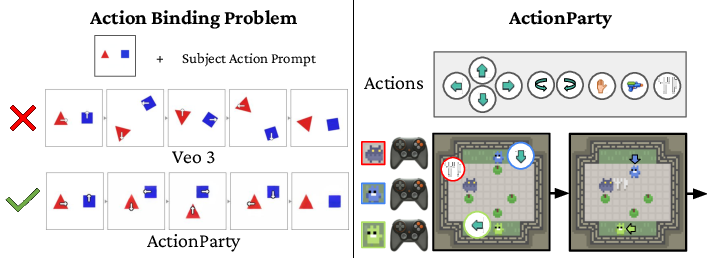
Figure 1: Left shows a canonical failure mode of existing text-to-video models on multi-subject, sequential action binding; Right demonstrates ActionParty's capacity for precise subject-specific action control.
ActionParty: Model and Pipeline Innovations
ActionParty introduces a novel autoregressive video diffusion transformer (DiT) architecture for multi-subject action-conditioned video generation. The central contribution is the introduction of explicit subject state tokens—persistent latent variables denoting the per-timestep spatial state (e.g., 2D position and orientation) for each actor in the environment. These tokens are processed jointly with standard video latents, enabling persistent subject identities across time and disentangled individual subject dynamics.
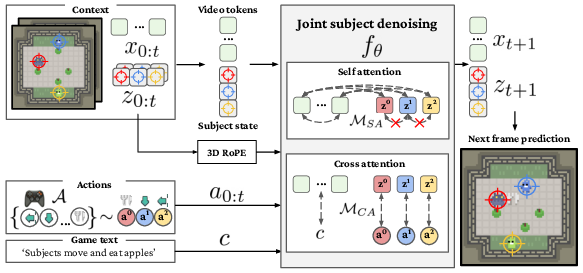
Figure 2: The ActionParty pipeline, with joint modeling and denoising of video tokens and subject state tokens through a diffusion transformer architecture; subject-action associations are enforced through attention masking and spatial biasing.
The architecture is anchored around two critical mechanisms:
- Attention Masking for Action Binding: Cross-attention layers are masked such that each subject token exclusively attends to its associated action embedding, ensuring unambiguous action-subject correspondence at every generation step.
- 3D RoPE-based Spatial Biasing: Self-attention layers employ 3D Rotary Position Embeddings (RoPE) to bias subject tokens towards the spatial locations occupied by the corresponding subjects in the previous frame, operationalizing persistent and spatially-localized subject identity without appearance-based cues.
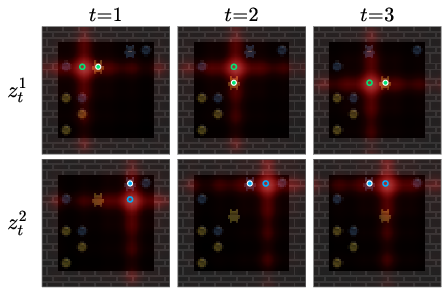
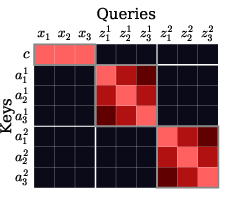
Figure 3: Visualization of subject-video RoPE bias in self-attention, promoting strong spatial alignment between subject tokens and their visual footprint across video frames.
This framework instantiates an update-and-render paradigm analogous to discrete-time game engines: explicit state updates are executed using the action-subject binding, followed by visual rendering modulated by subject and scene context. Careful design of masking matrices prevents information leakage between subjects and blocks inappropriate action mixing even in cluttered or visually ambiguous settings.
Experimental Results and Empirical Analysis
Evaluation is centered on the Melting Pot benchmark, a suite of 46 diverse multi-agent, two-dimensional games designed to stress-test multi-subject simulation capabilities. ActionParty is compared against several tailored baselines, including powerful zero-shot text-conditioned video models (using large-scale DiTs) and text-action controlled autoregressive DiTs, none of which employ explicit subject state modeling.
Key empirical findings include:
- ActionParty achieves a movement accuracy (MA) of 0.779, a more than 4.9x improvement over the strongest text-conditioned baseline (MA=0.158). This underscores that explicit subject-state modeling and attention-masked action routing are necessary for reliable per-subject control.
- Identity preservation (SP=0.903) and detection rate (DR=0.886) are significantly higher than baseline approaches, indicating robust maintenance of subject trajectories and visual integrity throughout extended rollouts.
- Visual quality metrics (LPIPS, PSNR, FVD) also improve, but the primary innovation is correct subject-action binding under ambiguous and crowded conditions, as standard fidelity metrics alone do not measure this phenomenon.
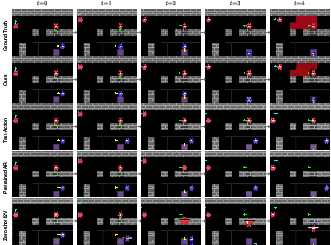
Figure 4: Comparative qualitative evaluation highlights ActionParty as the only model that maintains ground-truth-aligned subject positions and orientations across time when subjected to complex control sequences.
- ActionParty is stable under long autoregressive rollouts, displaying negligible degradation of action binding performance up to the tested horizon, while baseline models rapidly collapse.
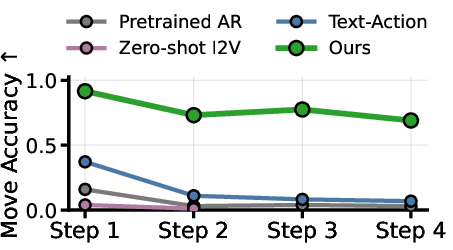
Figure 5: Movement accuracy (MA) over multiple autoregressive steps, demonstrating ActionParty's temporal stability versus strong baseline decay.
- Scalability: ActionParty is the first model to support simultaneous, consistent action control of up to seven agents in a unified scene and model, generalizing across forty-six distinct environments with a unified action embedding.
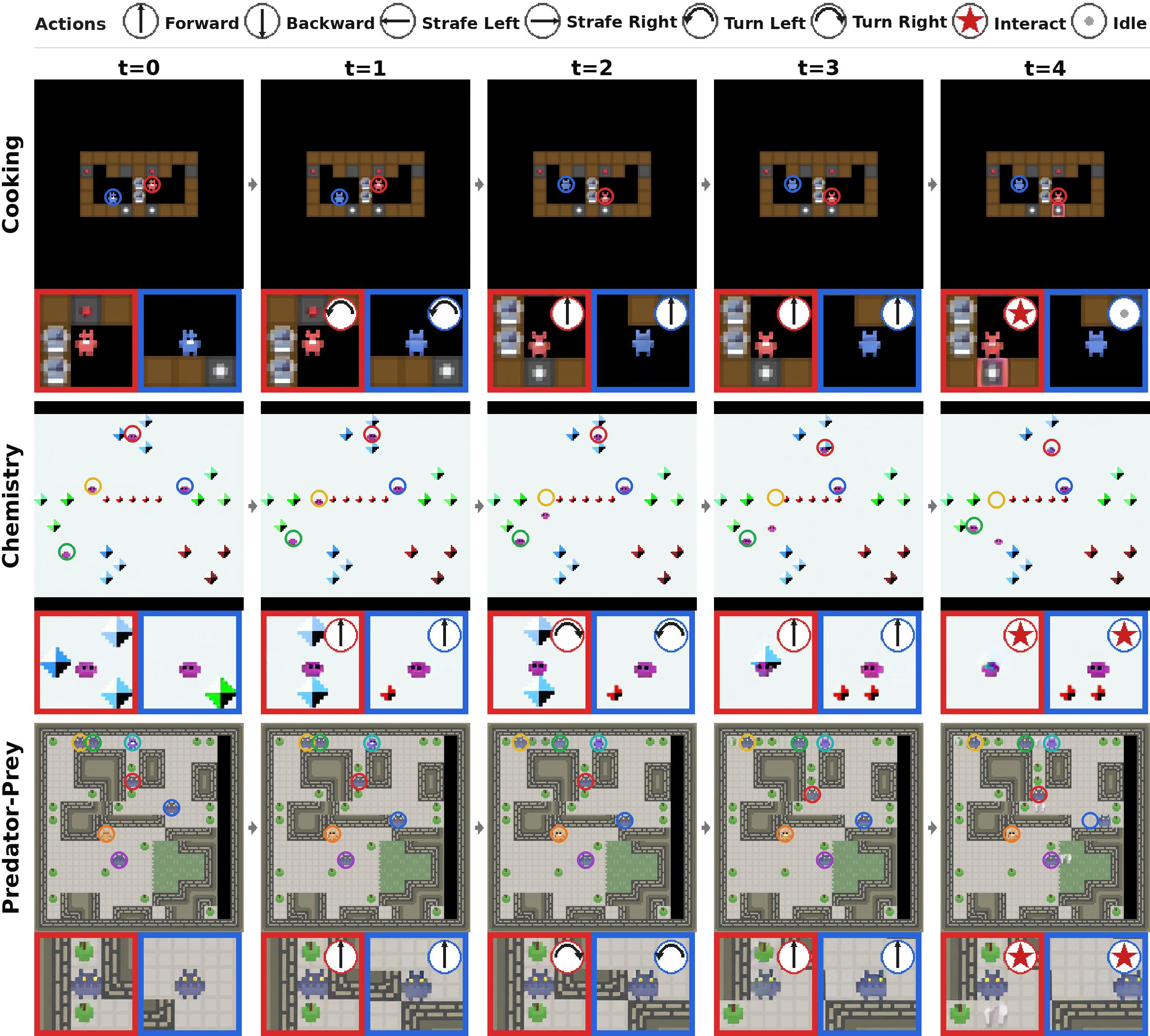
Figure 6: Visualization of ActionParty's ability to simultaneously control up to seven diverse, visually ambiguous agents with correct action disambiguation and robust coordinate tracking.
Ablation and Mechanism Analysis
Comprehensive ablation studies confirm the necessity of both the cross-attention masking and RoPE spatial bias for stable action-subject binding. Disabling these mechanisms leads to severe subject state mixing, failure of action binding (MA as low as 0.032–0.052), and subject identity loss. Modifications that allow subject tokens to share information or relax attention masks result in catastrophic degradation, validating the architectural intervention.
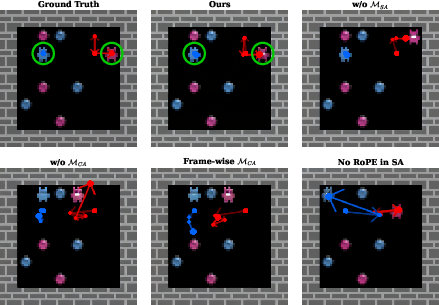
Figure 7: Qualitative impact of component ablation; removing key mechanisms leads to collapse of coordinated subject control and identity preservation.
Theoretical and Practical Implications
ActionParty resolves a long-standing issue in vision-based world models: the “binding problem” for multi-entity action-conditioned video simulation. By decoupling subject state from pixel-space appearance and enforcing explicit action-subject connections through action-specific attention masking and learnable spatial bias, the model is able to control visually indistinguishable entities with high reliability. This enables tractable multi-agent simulation in visually ambiguous environments—relevant for synthetic data generation, robotics, and closed-loop training in reinforcement learning contexts. ActionParty’s mechanisms are compatible with scalable, pre-trained DiTs and incur minimal computational overhead, suggesting broad applicability.
From a theoretical perspective, ActionParty bridges insights from attribute binding in multi-modal and compositional generative modeling with explicit architectural mechanisms for binding discrete control signals to visuo-spatial entities. The model’s methodology could be extended to spatially-entangled and partially-observable 3D scenarios, and its binding approach provides a template for developing more general-purpose, multi-entity world models.
Conclusion
ActionParty presents a technically rigorous solution to multi-subject action binding in generative video games, introducing jointly denoised subject state tokens, attention masking, and spatial RoPE biasing to deliver reliable, scalable control over multiple entities. The approach sets a performance standard on Melting Pot and exposes new directions for robust, controllable, and generalizable video world modeling with structured latent state representations. These results motivate further investigation into scalable, explicit binding architectures for action-conditioned simulation in more complex and realistic settings, including partial observability and high-entity diversity.
Reference: "ActionParty: Multi-Subject Action Binding in Generative Video Games" (2604.02330)