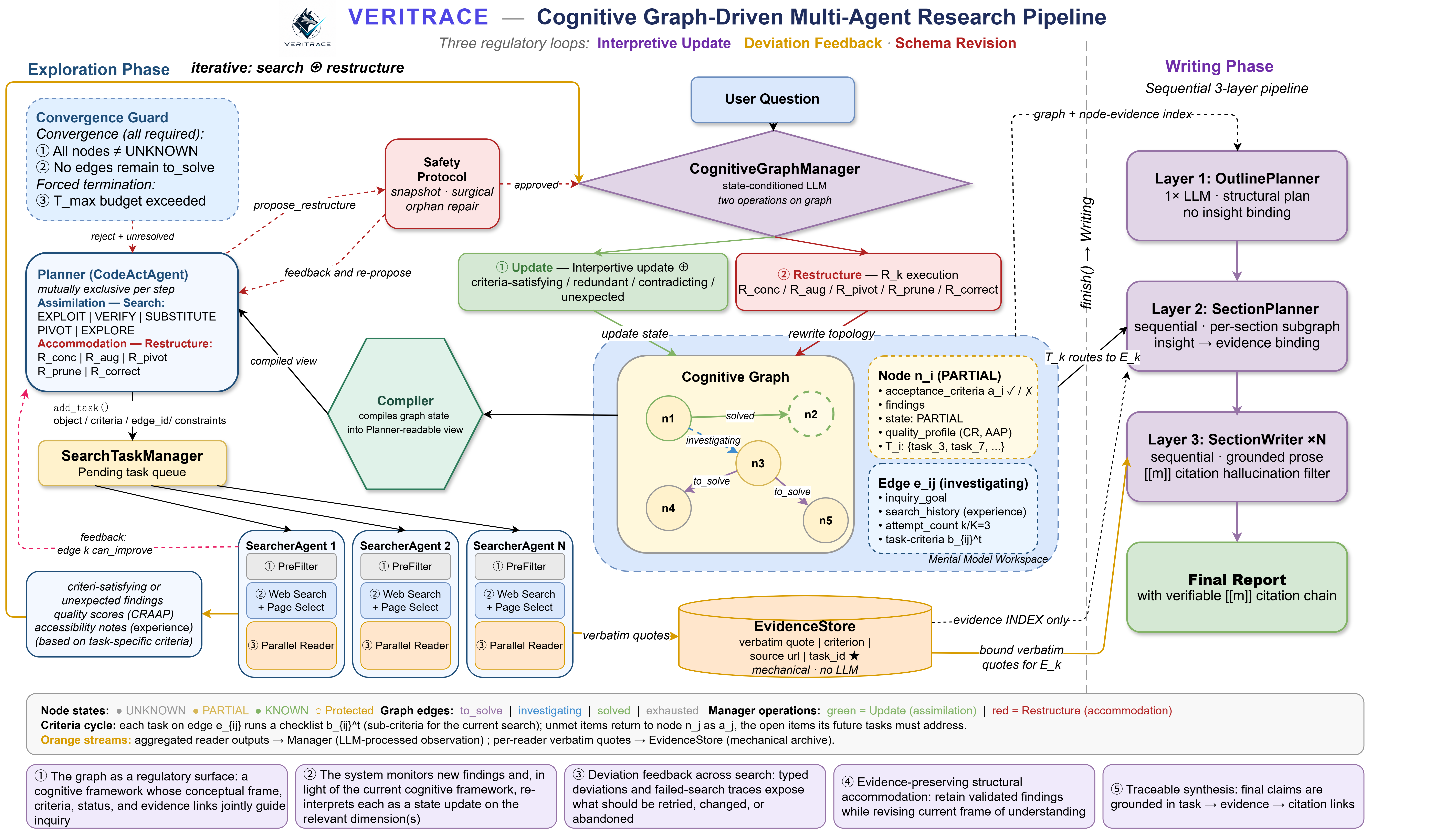
- The paper introduces explicit regulatory loops—interpretive update, deviation feedback, and schema revision—to manage evolving mental models in deep research agents.
- It employs a cognitive graph to coordinate research tasks, ensuring traceability and robust evidence synthesis throughout the research process.
- Empirical evaluation shows performance gains over baseline agents on benchmarks like DRB and DeepConsult, underscoring the framework’s verifiability and reliability.
Explicit Mental Model Regulation in Deep Research Agents: An Analysis of VeriTrace
VeriTrace is introduced within the context of deep research tasks, where LLM-based agents confront extensive, interdependent evidence and uncertainty, particularly in domains like scientific literature synthesis and open-ended exploratory research. Prior agentic frameworks (WebWeaver, OmniThink, FS-Researcher) have externalized intermediate memory and knowledge artefacts but largely rely on LLMs' implicit reasoning for their evolution. This often results in uncontrolled propagation of error, contamination with noisy data, and reliance on model scale to compensate for absent explicit regulation, particularly when the structure of reasoning and update lacks formal mechanisms.
The authors argue for a principled separation of the intermediate representation as an explicit mental model, continuously realigned with task reality via feedback loops. This mental model is neither short-term nor long-term memory but an evolving, structured state reflecting concepts, evidence, and uncertainties over the research trajectory.
Regulatory Loops: Interpretive Update, Deviation Feedback, and Schema Revision
The paper identifies and formalizes three regulatory mechanisms critical for maintaining consistency between the agent’s evolving mental model and external reality:
- Interpretive Update: Each incoming finding is interpreted against the current conceptual frame, not merely accumulated. The system classifies new information as confirming, contradicting, gap-filling, or unexpected. Without this, the agent’s memory becomes polluted and loses actionable focus.
- Deviation Feedback: The planner issues explicit expectations for each search, then measures the outcome via structured deviation signals (content relevance, source credibility, accessibility, and unexpectedness). This decomposes error into strategic and framing failures, supporting targeted corrective strategies over undifferentiated retrials.
- Schema Revision: When deviation feedback or contradictions aggregate, the agent restructures its conceptual frame, reallocates inquiry directions, and retains evidence subject to structural invariants (e.g., immutability of acquired evidence, protection of user-anchored dimensions).
This framework draws on cognitive science as a design vocabulary (metacognition, predictive processing, assimilation/accommodation) without claiming cognitive equivalence, enabling task-aware and verifiable regulation.
Cognitive Graph Implementation
VeriTrace realizes these regulatory loops within a cognitive graph (Figure 1):
Assimilation operates via prior-guided interpretation: findings are routed by attribution, critiqued against accumulated evidence, and classified structurally. Deviation feedback produces typed signals used in a five-region strategy router (exploit, verify, substitute, pivot, explore). Schema revision executes structural operators subject to evidence preservation and user-dimension protection invariants.
Writing Pipeline and Citation Traceability
Upon termination, the three-layer writing pipeline leverages the cognitive graph and evidence store:
- Outline planner generates report sections mapped to graph nodes with evidence availability constraints.
- Section planners sequentially bind insights to evidence collected in the graph, enforcing cross-section deduplication and citation traceability.
- Section writers render narrative with explicit [[m]] markers linked to verbatim evidence.
This design safeguards verifiability through information boundaries and post-generation filtering, making reasoning steps and claims auditable.
Empirical Evaluation and Ablation
On DeepResearch Bench (DRB) and DeepConsult benchmarks, VeriTrace demonstrates consistent improvements. Under matched Qwen3.5-27B backbones, VeriTrace outperforms WebWeaver and FS-Researcher by 4.22 pp on DRB Insight and 1.49 pp Overall; DeepConsult transfers yield a 5.9 pp win rate advantage. Config-DeepSeek achieves the strongest reproducible open-source DRB score (Overall 55.77, Insight 59.56).
Ablation studies show each loop is indispensable: removal of deviation feedback inflates search volume and reduces success, removal of interpretive update disables informative restructuring and degrades performance, and flattening topology impacts fault tolerance. The cognitive graph’s explicit control mechanisms demonstrate that regulatory maturity is orthogonal to backbone scale and prerequisite for consistent, interpretable mental-model evolution.
Theoretical and Practical Implications
The work solidifies the necessity of explicit regulation for deep research systems, separating model scale and architectural headroom. Regulatory loops operationalize self-regulation mechanisms directly and are reflected in empirical improvements in insight consistency under pervasive uncertainty. Structured cognitive graphs enable verifiable, traceable synthesis that is audit-friendly and robust to framing errors.
Practically, VeriTrace’s mechanisms have immediate applications in scientific research automation, report generation, and high-stakes domains (medicine, law, finance), provided human verification is adopted. Theoretical implications include drawing lines between implicit and explicit metacognitive control in agent design, providing a formal vocabulary for evaluating regulatory maturity as agent capabilities expand to longer horizons and more complex environments.
Future developments could include formalizing restructuring triggers, integrating cross-task transfer in cognitive graphs, expanding loop regulation to larger or multi-agent systems, and validating across broader open-environment tasks.
Conclusion
VeriTrace establishes a cognitive-graph framework regulated by interpretive update, deviation feedback, and schema revision. By formalizing explicit loops for dynamic mental-model evolution, it achieves verifiable, high-quality synthesis and performance gains beyond backbone scale. The authors argue that regulatory loop maturity is central to deep agent evaluation and diagnosis, and forms a foundation for scalable, auditable agentic reasoning in open-ended research.