Thermodynamics of classifiers
Abstract: The Landauer principle bridges the energetic cost and information processing, showing that irreversible computation inevitably demands energy dissipation. As energy demands from computation continue to rise, approximate computing has attracted considerable attention. Approximate computing is based on the idea that energy consumption can be reduced by sacrificing computational accuracy. This raises a fundamental question about the relationship between error and thermodynamic cost in information processing. In this study, we derive the error-cost trade-off in the binary classifier by considering classification based on Markov processes. We obtain the lower bounds on the Bayes error in terms of thermodynamic costs such as entropy production and dynamical activity. Our results show that when entropy production or dynamical activity vanishes, the Bayes error reaches $1/2$, equivalent to random guessing, while greater thermodynamic costs enable lower error. This establishes a fundamental trade-off between error and cost in information processing by thermodynamic systems. Because the Bayes error provides the lowest achievable error among all possible classifiers, the classification error cannot fall below the obtained bounds given the entropy production or dynamical activity. We also discuss the quantum generalization and show that the Bayes error of the quantum classifier is bounded from below by the variance of the Hamiltonian.
Paper Prompts
Sign up for free to create and run prompts on this paper using GPT-5.
Top Community Prompts
Explain it Like I'm 14
What is this paper about?
This paper explores a simple but powerful idea: if you want a machine to make good decisions, you have to spend energy—and there’s a limit to how good those decisions can be for a given energy budget. The authors study this for binary classifiers, which are machines that decide between two options (like “yes/no” or “cat/dog”). They connect the best possible error rate of such classifiers to physical quantities from thermodynamics, showing a fundamental trade-off between accuracy and energy use. They also extend the idea to quantum systems.
What questions does it ask?
In everyday terms, the paper asks:
- If a computer (or any physical system that processes information) has only so much energy to use, how accurate can its decisions be?
- How does the “cost” of running the system—measured by thermodynamic quantities like heat produced or how busy the system is—limit the smallest possible classification error?
- Do similar limits show up in quantum systems?
How did the researchers study this?
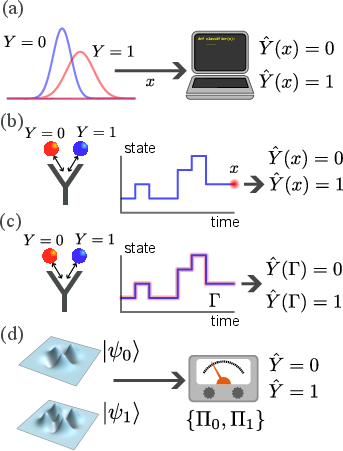
To answer these questions, the authors look at classifiers built from physical processes and relate their decision-making ability to thermodynamic “costs.”
- Markov processes (classical systems):
- Think of a Markov process like a board game where the token hops between squares. Each hop has some chance of happening, and future moves depend only on where the token is now (not how it got there).
- The classifier’s job is to observe the system’s state (either the final square or the whole path of squares it visited) and guess which of two “worlds” it came from (world 0 or world 1), where each world has slightly different rules for hopping.
- Key thermodynamic costs:
- Entropy production: This is a measure of how much “thermodynamic irreversibility” or wasted energy (like heat) the process generates. More irreversibility usually means more energy spent.
- Dynamical activity: This is a measure of how busy the system is—roughly, how many jumps it makes over time. Even if those jumps are reversible, a lot of jumping means the system is “working hard.”
- Bayes error:
- This is the smallest possible error any classifier can achieve, even the smartest one. It’s the “best-case” error for a given task. If the Bayes error is 1/2, that’s as bad as random guessing; if it’s 0, perfect classification is possible.
- Trajectories vs. final state:
- The authors study two ways a classifier might work: by looking only at the final state (where the token ends up), or by looking at the entire trajectory (the whole path taken). Using the full trajectory can carry more information, but still faces energy–error limits.
- Quantum version:
- In the quantum setting, the system is a quantum state evolving under a Hamiltonian (its “energy operator”). The classifier performs a measurement to tell which of two quantum evolutions the state followed. Here, the limit on how well you can tell the two apart is connected to the variance of the energy (how spread out the energy values are). This links to the “quantum speed limit,” which says how fast a quantum state can change.
What did they find?
Here are the main takeaways:
- There is a fundamental error–cost trade-off:
- If entropy production (energy dissipation) or dynamical activity (how much the system moves) is zero, the best possible error rate is 1/2—no better than a coin flip.
- Allowing more thermodynamic cost lets the best possible error go below 1/2. In other words, spending more energy (or letting the system be more active) can enable more accurate decisions.
- Universal lower bounds:
- The authors derive formulas that give lower bounds on the Bayes error in terms of either:
- The total entropy production from the two possible processes, or
- The total dynamical activity from the two possible processes.
- These bounds are “universal” in the sense that no classifier, no matter how cleverly designed, can beat them if the thermodynamic costs are fixed.
- Final state and trajectory settings:
- The bounds apply both when the classifier sees only the final state and when it sees the whole trajectory, with slightly different forms. For trajectory-based classification, the bound depends on how active the system is right at the start (time 0), showing early-time dynamics can strongly affect limits on accuracy.
- Quantum systems:
- In the quantum case, the best possible error (the Helstrom bound) is itself bounded from below by a quantity involving the energy variance of the two Hamiltonians. If the initial state is an energy eigenstate (zero variance), the bound again becomes 1/2—random guessing—because the state doesn’t change in a way that helps you tell the two cases apart.
- Beyond previous limits:
- Earlier thermodynamic “uncertainty relations” showed that making certain physical currents precise costs entropy. Here, the authors go further: they bound the actual classification error—the difference between the predicted and true labels—which is a more direct measure of useful information processing.
Why does it matter?
- Energy-aware computing:
- As computers and AI systems use more energy, designers look for “approximate computing” strategies that save power at the cost of some errors. This paper gives a physics-based limit on how low the error can go for a given energy budget. It provides a yardstick for what’s possible, no matter the hardware or algorithm details.
- Biological sensing:
- Cells make decisions (like detecting specific molecules) with noisy, energy-limited biochemical networks. The results suggest a fundamental limit: if the cell spends less energy or runs less active processes, its decisions can’t be very accurate.
- Quantum technologies:
- For quantum sensors and quantum machine learning, the bounds connect distinguishability to energy variance and speed limits, helping set expectations for performance vs. resource use.
- Big picture:
- The paper strengthens the idea that information processing is a physical process. Better performance requires paying a physical price—in heat, activity, or energy fluctuations. It turns a vague “no free lunch” principle into concrete, quantitative limits that designers and scientists can use.
Knowledge Gaps
Below is a consolidated list of specific knowledge gaps, limitations, and open questions that remain after this work. These items are intended to guide concrete follow-up research.
- Tightness and achievability
- No characterization of when the bounds in Eqs. (result1), (result2), and (result_da1) are tight; identify dynamics (rates, initializations, observation schemes) that saturate the bounds or quantify their looseness.
- Lack of constructive protocols that achieve the lowest possible Bayes error for a given thermodynamic budget; formulate and solve the optimization over rates and observation rules that minimize error at fixed entropy production or activity.
- Range-restricted bounds
- The main bounds for state-based classification require small-angle conditions (e.g., 0 ≤ (1/(2√2))∫_0τ √(Σ⊕(t))/t dt ≤ π/2 and 0 ≤ (1/2)∫_0τ √(𝒜⊕(t))/t dt ≤ π/2), becoming trivial outside these ranges; derive bounds that remain informative for larger costs/times.
- Analyze the asymptotic behavior (large τ or large cost) beyond the current trigonometric-regime constraints; identify nontrivial global bounds or tight exponential-rate characterizations.
- Cost aggregation across classes
- Bounds depend on the sum of costs across the two classes (Σ⊕, 𝒜⊕); explore alternative constraints such as per-class budgets, max-cost constraints, or weighted sums, and derive corresponding error bounds.
- Determine optimal allocation of thermodynamic resources across classes for fixed total budget to minimize the Bayes error.
- Initial conditions and priors
- State-based results assume identical initial states across classes; quantify how differences in initial distributions affect the bounds and whether they can tighten error limits.
- The main statements are presented for uniform priors; provide explicit, closed-form bounds for non-uniform priors in the main text and analyze how prior skew changes the error–cost trade-off (including worst-case priors).
- Observation model limitations
- Perfect, noise-free access to the final state or full trajectory is assumed; extend to partial observation, measurement noise, coarse-graining, or hidden Markov (HMM) observation channels and derive robust bounds.
- Trajectory-based bound Eq. (result_da1) requires observables that vanish for no-jump paths; assess how restrictive this is for practical classifiers and derive bounds for general trajectory statistics that need not vanish on no-jump trajectories.
- For state-based classification, demonstrate explicitly how one recovers Eq. (result_da1) (the Appendix proof is truncated); provide the complete derivation and any conditions required.
- Model scope and generality
- Time homogeneity is assumed; extend to time-inhomogeneous Markov generators W(t) and quantify the effect of protocol design on the error–cost frontier.
- Clarify and rigorously specify the domain of validity for the temporal Fisher bounds I(t) ≤ Σ(t)/(2t2) and I(t) ≤ 𝒜(t)/t2 used in the proofs (noting the comment about Langevin vs. jump processes); provide versions valid for continuous-time Markov jump processes or supply alternative inequalities that hold generally.
- Local detailed balance is invoked for entropy production; characterize how the bounds change (or whether they still hold) when local detailed balance does not apply (e.g., effective or coarse-grained models).
- Extend the framework from finite-state jump processes to diffusive (continuous-state) processes and hybrid dynamics, with explicit bounds in terms of pathwise thermodynamic quantities.
- Beyond binary classification
- Generalize the error–cost trade-off to multi-class classification (K > 2), derive bounds in terms of suitable multiway divergences/overlaps, and compare scaling with class number K.
- Investigate regression or structured prediction settings where the loss is not 0–1; develop thermodynamic bounds for more general loss functions and ROC/PR operating points (e.g., Neyman–Pearson trade-offs under cost constraints).
- Trajectory-based bounds
- Eq. (result_da1) depends only on the initial dynamical activity 𝔞⊕(0), potentially missing informative later-time dynamics; derive tighter bounds that incorporate time-dependent activity 𝔞(t) or integrated activity.
- Characterize which classes of trajectory statistics N∘(Γ) (beyond count observables) come closest to the fundamental bound; identify sufficient statistics for optimal discrimination under thermodynamic constraints.
- Quantum setting
- The quantum bound considers closed systems with pure initial states and time-independent Hamiltonians; extend to open quantum dynamics (Lindblad evolution), mixed states, time-dependent Hamiltonians, and control protocols.
- Analyze tightness relative to the Helstrom bound: quantify the gap induced by variance-based quantum speed limits and explore alternatives using quantum Fisher information or geometric distances (e.g., Bures angle, Wigner–Yanase skew information).
- Consider the role of prior probabilities and unequal costs in quantum hypothesis testing (Bayesian and minimax formulations) under energy or dissipation constraints.
- Explore multi-copy and entangling measurement strategies under energy budgets; characterize how the error–cost scaling improves with the number of copies and whether collective measurements can approach the bound.
- Practical and experimental relevance
- Map entropy production and dynamical activity to experimentally accessible and energetically relevant quantities in specific platforms (e.g., biochemical receptors, molecular motors, nanoscale electronic devices); design experiments to test the predicted trade-offs.
- Connect the thermodynamic metrics to actual power and energy budgets in approximate computing hardware; quantify how these bounds constrain accuracy–energy trade-offs in neuromorphic or in-memory computing systems.
- Design and control questions
- Formulate and solve inverse problems: given a target error, compute the minimal entropy production or activity and the corresponding optimal dynamics/measurement policy.
- Develop numerical methods to evaluate the derived bounds and to synthesize rate matrices or Hamiltonians that approach them under constraints (e.g., bounded rates, finite state-space, physical constraints on couplings).
- Relation to existing theory
- Provide a unified comparison with alternative information–thermodynamics bounds (Pinsker/Chernoff-type inequalities, fluctuation theorems for hypothesis testing) to identify which conditions favor each bound and when one dominates the others.
- Clarify the precise connection between these error bounds and Landauer heat bounds for irreversible operations in realistic computing scenarios (beyond formal entropy production).
- Completeness and clarity of derivations
- The Appendix text for the trajectory-to-state reduction of Eq. (result_da1) is incomplete; provide the full proof and any technical lemmas (including conditions for equality).
- Systematically list all assumptions used at each step (e.g., independence of processes, identical initial states, local detailed balance, boundedness of rates) and indicate which results survive when assumptions are relaxed.
Practical Applications
Overview
The paper establishes fundamental lower bounds on the Bayes error of binary classifiers implemented by physical processes. For continuous-time Markov classifiers, the error is bounded below by thermodynamic costs—entropy production Σ and dynamical activity 𝒜—and, for trajectory-based decisions, by the initial activity. In quantum classification, the Bayes error is bounded below by the combined energy variance of the class-dependent Hamiltonians and the evolution time. These error–cost trade-offs provide practical principles for designing, operating, and governing energy-constrained classifiers across physical, digital, and quantum platforms.
Below are actionable applications derived from these findings, grouped by deployment horizon. Each item names sectors, sketches potential tools/products/workflows, and notes assumptions/dependencies that affect feasibility.
Immediate Applications
These can be piloted with today’s hardware, measurement capabilities, and software stacks, often using calibrated proxies for Σ and 𝒜.
- Energy-aware classifier design and runtime control (Semiconductors, Edge/IoT, Mobile, Cloud)
- What: Use the bounds to compute the minimum cost (Σ or 𝒜) needed to achieve a target error, and to refuse configurations (e.g., undervolting, aggressive pruning) that cannot meet the accuracy.
- Tools/workflows: Runtime controller that inverts the bound to compute a required activity/energy budget; DVFS governors; power/thermal sensors and performance counters as proxies for 𝒜; guardrails in firmware to maintain feasible regimes.
- Assumptions/dependencies: Classifier or pipeline stage can be approximated by a Markov process; availability of calibrated mappings from measured power/switching activity to Σ/𝒜; for Σ-based bounds, applicability ranges where the sine-bound is nontrivial.
- Approximate computing guardrails and autotuning (Semiconductors, Software)
- What: Tune quantization level, clock/voltage, and approximate arithmetic while guaranteeing a floor on achievable error from the thermodynamic side.
- Tools/workflows: Autotuners that explore energy–accuracy trade-offs and use the bound as a feasibility filter; compile-time profiles of switching activity.
- Assumptions/dependencies: Accurate activity estimates per operator/microarchitecture; binary decision points in the pipeline (extend to one-vs-rest for multi-class as an interim workaround).
- Workload admission and power scheduling (Cloud/Datacenters, Energy)
- What: Schedule inference jobs by allocating sufficient energy/time to meet declared accuracy SLAs; deny or defer under-provisioned jobs whose required Σ/𝒜 exceeds current budgets.
- Tools/workflows: Cluster schedulers with “accuracy-per-joule” constraints; dashboards reporting observed gaps to the bound.
- Assumptions/dependencies: Operators accept “accuracy under cap” SLAs; measurement overhead is low; mapping Joules → Σ is calibrated for target workloads.
- Early stopping and anytime inference for HMM-like models (Software, Speech, Finance)
- What: Use the integral-of-√𝒜 bound to determine the minimal horizon needed to achieve a desired error for Markov/HMM decoders; stop earlier when additional time cannot improve accuracy without extra activity.
- Tools/workflows: HMM libraries exposing instantaneous/accumulated activity estimates during decoding; controllers that monitor bound progress.
- Assumptions/dependencies: Access to model parameters and per-step transition intensities; the activity-based bound is applicable and within its effective range.
- Biosensor and diagnostic assay design (Healthcare, Biotech)
- What: Set minimum ATP/energy budgets to achieve target false positive/negative rates in ligand discrimination pathways, aligning with kinetic proofreading trade-offs.
- Tools/workflows: Wet-lab calculators using dynamical activity at t=0 and integrated activity to size enzyme concentrations and fuel turnover; microfluidic experiments verifying the predicted error floors.
- Assumptions/dependencies: Measurable reaction jump rates (activity); pathways approximated by Markov networks with local detailed balance; binary decision (presence/absence, A vs B).
- Sensor and pipeline health diagnostics (Robotics, Industrial IoT)
- What: If measured activity is near zero, no classifier can outperform random guessing; trigger safe modes or reinitialization when bound indicates infeasibility.
- Tools/workflows: On-device monitors of switching/jump rates; watchdogs that compare observed accuracy to the theoretical minimum to detect anomalies.
- Assumptions/dependencies: Reliable proxies for activity; causality between low activity and degraded inference (not just low load).
- Energy-accuracy benchmarking suites (Academia, Industry)
- What: Benchmarks that report empirical performance relative to the thermodynamic lower bounds, enabling “gap-to-bound” comparisons across models/hardware.
- Tools/workflows: Open-source harnesses that collect power/activity traces during classification, compute bounds, and summarize feasibility gaps.
- Assumptions/dependencies: Standardized measurement methodology; consistent workloads and input distributions.
- Training-time regularization for energy budgets (Software/ML)
- What: Add loss terms that penalize violating energy/activity budgets for a desired error target, encouraging architectures and decision thresholds compatible with feasible Σ/𝒜.
- Tools/workflows: Surrogate Σ/𝒜 estimators from FLOPs/sparsity/bitwidth; differentiable proxies embedded in training objectives.
- Assumptions/dependencies: Surrogates correlate sufficiently with physical costs; primarily useful for models whose inference dynamics can be coarse-grained as Markovian.
- Quantum experiment planning for state discrimination (Quantum sensing/communications)
- What: Use the variance-based bound to choose minimum evolution times or Hamiltonian engineering (variance allocation) to meet discrimination error targets.
- Tools/workflows: Lab planners that compute τ √(Var[H(0)]+Var[H(1)]) and verify operation within the proven range; selection of initial states to maximize useful variance.
- Assumptions/dependencies: Approximately closed system over the evolution; ability to compute or estimate energy variances from device/tomography; binary discrimination tasks.
- Power-labeling and procurement checklists (Policy, Standards)
- What: Require “accuracy at power cap” disclosures grounded in physics-based lower bounds; add feasibility checks to procurement to avoid overpromises.
- Tools/workflows: Reporting templates that include measured activity/energy and bound-derived minimum error; third-party audits for sampling workloads.
- Assumptions/dependencies: Agreement on standardized measurement and bound evaluation; scope limited to binary or binarized decision components.
- Edge-device user modes (Daily life, Consumer electronics)
- What: Battery-saver modes that adjust model fidelity while guaranteeing the minimum error cannot be improved without raising power—transparent user trade-offs.
- Tools/workflows: UI slider backed by a controller mapping user-selected power budgets to predicted error floors; on-device estimation of activity.
- Assumptions/dependencies: Lightweight estimators; acceptable UX when accuracy degrades predictably under caps.
- Safety monitors for autonomy (Robotics, Automotive)
- What: If power dips reduce feasible accuracy below mission thresholds (per bound), trigger conservative behaviors or task shedding.
- Tools/workflows: Real-time bound evaluation tied to failover policies; certification artifacts showing safety envelopes.
- Assumptions/dependencies: Calibrated mappings; conservative margins to account for model mismatch.
Long-Term Applications
These require further theoretical generalization, tighter model–hardware mappings, or advances in measurement and fabrication.
- Thermodynamically co-designed ML accelerators (Semiconductors)
- What: Architectures and ISAs that expose/optimize proxies for Σ and 𝒜 at the instruction or layer level, allowing bound-aware scheduling and compilation.
- Tools/products: “Accuracy-per-joule” optimized accelerators; instruction-level activity counters; compiler passes that allocate energy budgets per decision stage.
- Dependencies: Robust, validated mappings from microarchitectural events to thermodynamic quantities; hardware–software co-design.
- Physical stochastic and neuromorphic classifiers that approach the bounds (Hardware)
- What: Analog/probabilistic devices implementing Markov decision dynamics with controlled activity/entropy production to closely saturate the bounds.
- Tools/products: Stochastic MTJ, memristor, photonic, or spintronic primitives designed for tunable activity; cryogenic or room-temperature implementations.
- Dependencies: Manufacturing repeatability; noise engineering; energy-efficient readout.
- Biochemical computing and synthetic receptors with energy–accuracy co-optimization (Healthcare, Biotech)
- What: Pathway designs that allocate ATP budgets across proofreading/cascades to meet diagnostic error targets with minimum fuel.
- Tools/workflows: In-silico pathway optimizers using the activity-based bound; high-throughput screening to validate energy–accuracy envelopes.
- Dependencies: System identification of in vivo activity; robustness to cellular variability.
- Multi-class and structured-output generalizations (Academia, Software)
- What: Extend the bounds beyond binary to K-class and sequence labeling; integrate with CRFs/HMMs/LDS and deep hybrid models.
- Tools/workflows: New theory; reference implementations; benchmarks spanning text, vision, and time series.
- Dependencies: Mathematical generalization; efficient estimators for class-wise cost aggregation.
- Open-quantum-system bounds and dissipative quantum classifiers (Quantum technologies)
- What: Extend from closed-system variance bounds to Lindblad dynamics; design dissipative classifiers and sensors under energy/time constraints.
- Tools/products: Quantum devices with engineered baths that balance speed, energy variance, and discrimination error.
- Dependencies: Accurate noise models; controllable dissipation channels.
- Compiler-level energy–error contracts (Software toolchains)
- What: Static/dynamic analyses that annotate code regions with required energy/activity to achieve target error, enabling build-time enforcement.
- Tools/workflows: IR passes estimating 𝒜 proxies; contract verifiers linking to power models.
- Dependencies: Stable proxy metrics; cooperation from hardware runtimes.
- Carbon-aware AI SLAs and regulation (Policy, Energy)
- What: SLAs and regulations that tie CO2 budgets to minimum achievable accuracy, avoiding greenwashing by setting physics-consistent expectations.
- Tools/workflows: Compliance frameworks using bound-based feasibility checks; certified test suites.
- Dependencies: Consensus standards; verifiable measurement protocols.
- Federated/distributed inference under power caps (Networks, Edge/IoT)
- What: Coordinated allocation of energy budgets across nodes so that the end-to-end decision remains feasible per the combined activity bound.
- Tools/workflows: Distributed schedulers optimizing activity sums; edge-cloud cooperative inference plans.
- Dependencies: Node-level telemetry; models of activity composability.
- Verification and certification programs (“Thermodynamics of AI” labels)
- What: Third-party certification that claimed accuracy at given power is consistent with lower bounds across representative tasks.
- Tools/workflows: Auditing organizations; conformance testbeds; public labels.
- Dependencies: Sector-specific task suites; legal frameworks.
- Algorithms and hardware that saturate bounds in practice (Academia, Industry)
- What: Constructive schemes and devices that achieve errors close to the proven minima for given energy/activity, informing optimal designs.
- Tools/workflows: Co-optimization of architecture, algorithm, and operating point; learning curricula with energy constraints.
- Dependencies: Joint advances in modeling and fabrication.
- Educational and outreach kits (Education)
- What: Hands-on labs showing Landauer’s principle and the classifier error–cost trade-off with Markov devices or quantum simulators.
- Tools/workflows: Low-cost hardware, microfluidic kits, or quantum SDK modules that visualize bounds.
- Dependencies: Funding; curriculum integration.
- Digital twins for energy–error co-design (Software, EDA)
- What: Simulation environments that couple thermodynamic models with ML workloads to explore design spaces before tape-out or deployment.
- Tools/workflows: EDA add-ons modeling Σ/𝒜; scenario explorers for target SLAs.
- Dependencies: Validated models; scalable simulation.
- Security and resilience analytics (Security, Safety)
- What: Detect energy- or fault-injection attacks that force low-activity regimes, predicting unavoidable accuracy collapse via the bound.
- Tools/workflows: Monitors that flag infeasible operating points; defensive reconfiguration.
- Dependencies: Threat models; low false positive rates.
Common Assumptions and Dependencies Across Applications
- Physical model match: Classifier components must admit a Markov-process (or quantum) abstraction; non-Markovian effects and complex pipelines may need coarse-grained approximations.
- Measurability: Entropy production Σ is hard to measure directly in digital hardware; practical deployments rely on proxies (power, temperature, switching activity) that require careful calibration.
- Scope: Results are for binary classification; multi-class uses one-vs-rest or awaits theoretical extensions.
- Validity ranges: Some bounds are tight/nontrivial only within specific ranges (e.g., the sine-bound regime); outside, the inequality becomes trivial.
- Priors: Results are stated for uniform priors but can be generalized; deployments must account for class imbalance.
- Overheads: Measurement and control should not erase energy gains or violate real-time constraints.
By turning these thermodynamic limits into design constraints, runtime policies, and reporting standards, stakeholders can engineer classifiers that are both energy-efficient and scientifically honest about their achievable accuracy.
Glossary
- Arrow-of-time inference: A binary decision problem to infer whether a trajectory was generated by forward or time-reversed dynamics. "Classification has been discussed in stochastic thermodynamics, especially in arrow-of-time inference"
- Bhattacharyya coefficient: A measure of overlap between two probability distributions, often used to bound classification error. "Let \mathrm{Bhat}(\mathfrak{p},\mathfrak{q}) be the Bhattacharyya coefficient:"
- Counting observable: A trajectory-dependent quantity that counts the number of specified jumps (with weights) in a Markov process. "The counting observable is expressed as"
- Current observable: A special antisymmetric counting observable that captures net flow (current) between states. "the counting observable becomes the current observable denoted by ."
- Detailed fluctuation theorem: A relation connecting the probabilities of forward and reversed trajectories to entropy production. "Using the detailed fluctuation theorem, the posterior distribution given the trajectory is given by"
- Dynamical activity: The expected rate or count of jump events in a Markov process, quantifying how “busy” the dynamics are. "where is the dynamical activity:"
- Entropy production: The total entropy generated by a system and its environment during nonequilibrium processes. "time-integrated entropy production is given by"
- Helstrom bound: The minimum achievable error probability for distinguishing between quantum states via any measurement. "Equation~\eqref{eq:Helmstrom_Bayes_error} is known as the Helstrom bound"
- Kinetic proofreading: An energy-consuming mechanism in biochemical systems that increases discrimination accuracy between similar inputs. "proposed a kinetic proofreading model"
- Kolmogorov complexity: The length of the shortest description (program) producing a given object, used to formalize complexity. "extended the Landauer principle to incorporate Kolmogorov complexity."
- Landauer principle: A thermodynamic limit stating that erasing one bit of information dissipates at least of heat. "The Landauer principle bridges the energetic cost and information processing,"
- Local detailed balance: A condition linking transition-rate ratios to thermodynamic forces, ensuring consistency with microscopic reversibility. "Assuming the local detailed balance condition,"
- Mandelstam–Tamm quantum speed limit: A bound relating the minimum time for quantum state evolution to the energy variance. "In the Mandelstam-Tamm quantum speed limit"
- Master equation: A differential equation describing the time evolution of state probabilities in a Markov process. "follows the master equation:"
- Pinsker inequality: An inequality relating total variation distance to Kullback–Leibler divergence; used here to bound Bayes error via entropy production. "Using the Pinsker inequality, the following relation holds:"
- Positive operator-valued measure (POVM): The most general form of quantum measurement, represented by positive operators summing to identity. "we perform a positive operator-valued measure (POVM) measurement on "
- Schrödinger equation: The fundamental equation governing unitary evolution of closed quantum systems. "The dynamics obeys the Schr\"odinger equation:"
- Stochastic thermodynamics: A theoretical framework studying thermodynamic behavior of small systems subject to fluctuations. "Recent advances in stochastic thermodynamics"
- Swap operator: An operator that exchanges two subsystems; useful in multi-copy measurements and overlap estimation. "This is reminiscent of the swap operator considered in the multi-copy measurement"
- Temporal Fisher information: A measure of how rapidly a probability distribution changes in time; bounds the speed of evolution. "where is the temporal Fisher information defined by"
- Thermodynamic currents: Integrated flow-like quantities (e.g., particle, heat, entropy flows) in nonequilibrium systems. "the precision of thermodynamic currents"
- Thermodynamic uncertainty relation: Bounds stating that the precision of currents is limited by entropy production or dynamical activity. "the thermodynamic uncertainty relation"
- Time-integrated dynamical activity: The cumulative dynamical activity over a time interval, representing the total expected number of jumps. "The time-integrated dynamical activity is defined by"
- Total variation distance: A statistical distance measuring the maximum difference between two probability distributions. "be the total variation distance for general distributions"
- Unitary propagator: The time-evolution operator for closed quantum systems, preserving norms and inner products. "the unitary propagator factorizes as"
Collections
Sign up for free to add this paper to one or more collections.