Published 30 Apr 2026 in quant-ph and cond-mat.stat-mech | (2604.27858v1)
Abstract: The third law of thermodynamics forbids cooling a physical system to absolute zero in a finite number of operational steps. Although this unattainability principle has been quantified for specific state-to-state transitions, a universal, dynamics-independent bound for implementing a state-agnostic reset map remains elusive. In this work, we unveil the fundamental limits of physical map implementation by deriving a trade-off relation based on geometric complexity. By analyzing continuous paths of maps on a geometric manifold, we prove that the geometric complexity of any classical stochastic map or quantum channel is bounded from below by its execution error. As a consequence, we show that achieving zero error in a state-reset operation requires a divergent geometric complexity -- a unified measure that naturally incorporates disparate physical resources, including infinite time, energetic cost, or control bandwidth. This unattainability principle holds universally across both classical and quantum regimes, establishing a strict geometric limit on the physical realization of reset operations in thermodynamic control and quantum computation.
The paper introduces a geometric complexity measure that quantifies the minimal transformation cost for state-reset operations.
It employs a Riemannian metric framework to derive a universal trade-off between reset error and operational complexity across classical and quantum systems.
The results extend the third-law unattainability concept by setting strict lower bounds on resources needed for near-perfect state control.
Geometric Complexity and the Universal Limits of Thermodynamic Control
Introduction
The paper "Geometric complexity in thermodynamics" (2604.27858) presents a comprehensive geometric theory of the fundamental limits governing reset operations in both classical and quantum systems. The work establishes a universal, dynamics-independent lower bound linking the operational complexity required to implement state-agnostic reset maps—central to thermodynamic control and quantum computation—with the attained accuracy. By leveraging a Riemannian geometric framework, the authors rigorously formalize a new unattainability principle, subsuming the third law of thermodynamics under the broader paradigm of geometric complexity.
Background and Motivation
The Nernst unattainability statement of the third law strictly prohibits the preparation of a pure (zero-entropy) state in finite operations. Operationally, this constraint translates into an irreducible lower bound on the error of protocols tasked with state initialization, cooling, or logical erasure—tasks central to classical and quantum computation. Traditionally, bounds on performance metrics such as execution time, energetic expense, or control bandwidth have been derived for specific protocols and particular system dynamics, rendering them insufficient for a truly universal prescription. Furthermore, state-agnostic reset maps—those which reset an arbitrary distribution, not merely specific initial states—are of especial relevance, as they epitomize practical requirements in computation and error correction.
Geometric Complexity: Formalism and Properties
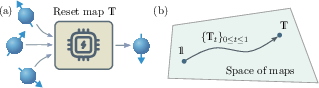
The authors introduce "geometric complexity" as the minimum geodesic distance, with respect to a physically motivated Riemannian metric, between the identity map and a target stochastic or quantum channel on the manifold of all physical maps. This framework achieves unification by abstracting away the particulars of dynamical realization, enabling results that directly connect operational cost with achievable error thresholds.
The chosen Riemannian metric is constructed as a log-barrier Hessian metric, with three essential properties:
Physical penalization: Assigns large cost to transformations that suppress probability from target subspaces.
Protocol scaling: Provides a lower bound linear in the number of physical (e.g., Markovian) protocols required.
Divergent resources: Correctly diverges as resource requirements (e.g., time, energetic/kinetic cost, control strength) become infinite in the pursuit of zero error.
The geometric complexity C(T) of a classical stochastic map T between d-dimensional distributions is defined as
C(T)={Tt}min∫01dtgTt(T˙t,T˙t),
minimized over all continuous paths connecting the identity to T, where g is the tailored metric.
Figure 1: Geometric framework for reset maps. (a) A unified state-agnostic reset map T removes probability from a target subspace; (b) geometric complexity is the minimal geodesic length between the identity and T on the manifold of physical maps.
Complexity–Error Trade-off and the Geometric Unattainability Principle
A central result is a universal, model-independent trade-off linking the geometric complexity C(T) of any classical or quantum reset map with the error ϵ(T) of the reset operation:
T0
(in both classical and quantum cases, with T1 the total probability remaining in the undesired subspace after reset).
Strong claim: Achieving zero error (T2) necessitates diverging geometric complexity (T3), regardless of the specific physical realization. Thus, disparate explicit resources—time, energy, bath size, transition rates—are encapsulated in a single operational measure.
The result is shown to be universal, holding across Markovian and non-Markovian classical dynamics, as well as for all quantum CPTP channels, via an analogous construction using the quantum Choi matrix formalism and a natural quantum generalization of the metric.
Operational and Thermodynamic Consequences
The geometric complexity can be explicitly bounded from below and above, even in high-dimensional settings, using closed-form expressions involving the row-sum vector or Choi-reduced state. The work relates geometric complexity strictly to the number of required protocols—showing that the minimum number of sequential Markovian steps, each limited by a maximum transition rate, is linear in T4. Further, the minimal required complexity is always no less than the entropy decrease between initial and final states, subsuming previous entropy-based unattainability statements.
The framework rigorously demonstrates that operations such as logical erasure, ground-state cooling, and general state-resetting, all obey a single, general unattainability constraint dictated by geometric complexity. This result encompasses and generalizes classical forms of the third law, establishing a strictly more powerful, resource-agnostic limitation.
Quantum Extension
By employing the Choi-Jamiołkowski isomorphism, the authors define the quantum geometric complexity of a CPTP map T5 in terms of the minimal geodesic connecting the identity channel to T6, with a metric on positive operators reducing to the classical form in the commutative limit. All trade-off relations, including the universal lower bound T7, carry over.
This extension guarantees that error-correcting operations, quantum cooling protocols, and initialization in quantum computers cannot reach perfect fidelity in finite complexity, regardless of environmental or control constraints, echoing and sharpening what is allowed within the theory of open quantum systems.
Practical and Theoretical Implications
Practically, this framework prescribes how physical map implementation in thermodynamic control and quantum information is inherently limited: engineering zero-error reset is prohibited, as it would require infinite complexity in physical resources, irrespective of the chosen realization. Theoretically, the work prompts a re-examination of complexity as the fundamental resource controlling state transformation, placing gate complexity, computational complexity, energetic dissipation, and thermodynamic entropy reduction on equal footing in a geometric hierarchy.
The geometric paradigm also interacts with resource-theoretic notions of purity and opens new lines for analyzing optimality in thermodynamic protocols (both classical and quantum), as well as for developing new lower bounds on algorithmic and operational tasks in physical and computational systems.
Conclusion
This work fundamentally generalizes the unattainability paradigm of the third law of thermodynamics by framing it as a complexity-theoretic limitation on physical map implementation, with a strict, universal trade-off between the geometric complexity of a state-reset map and its execution fidelity (2604.27858). By formalizing complexity as a geodesic on the manifold of physical transformations—subsuming disparate conventional resources under a single, rigorous operational metric—the authors establish a new, universal boundary for thermodynamic and computational control. This geometric perspective is expected to prompt further cross-disciplinary developments, enriching both the theoretical landscape and practical applications in quantum information, nonequilibrium thermodynamics, and complexity theory.
“Emergent Mind helps me see which AI papers have caught fire online.”
Philip
Creator, AI Explained on YouTube
Sign up for free to explore the frontiers of research
Discover trending papers, chat with arXiv, and track the latest research shaping the future of science and technology.Discover trending papers, chat with arXiv, and more.