- The paper presents a novel efficiency bound, η*, derived from internal state-Hamiltonian correlations that generalizes Carnot's theorem.
- It utilizes Lindblad dynamics and covariance measures of observables to rigorously quantify maximal heat currents in both classical and quantum engines.
- A quantum dot engine case study demonstrates that precise energy control can saturate the theoretical bound, even under finite-time operations and noise.
Overview and Motivation
The paper "An Information-Theoretic Bound on Thermodynamic Efficiency and the Generalized Carnot's Theorem" (2604.10762) presents a rigorous derivation of a fundamental upper bound on the efficiency of thermal engines—both classical and quantum—rooted in the statistical correlations between the internal state of the engine and its Hamiltonian. Unlike the classical Carnot bound, which is solely a function of environmental temperatures and only saturates under reversible, quasi-static conditions, the information-theoretic bound is determined by physically controllable parameters within the engine and applies to arbitrary numbers of thermal baths and finite-time operation regimes. The main contribution is the establishment of a sharper, saturable efficiency bound, η∗, which generalizes Carnot's theorem and is demonstrably relevant in irreversibly driven and technologically realistic cycles.
The efficiency of generic heat-to-work conversion cycles is formulated from first principles in the context of open quantum systems via Lindblad dynamics. The rate of heat transfer is identified with the covariance between the time derivative of the log-density operator and the Hamiltonian. The maximal heat current, I(t), is bounded analytically using the correlation matrix of three observables: dtdlogρ, logρ, and H. This procedure yields:
η≤η∗=1−∫+I(t)dt∫−I(t)dt
where I(t) depends on the instantaneous state ρ(t) and Hamiltonian H(t), with the integrals spanning intervals of heat release and absorption.
This bound is tight, in that it can be saturated if the underlying engine state forms a Gibbs distribution for each instantaneous Hamiltonian. The framework is independent of equilibrium conditions, thus encompassing non-equilibrium irreversible cycles.
Generalized Carnot’s Theorem for Multiple Baths
The formulation establishes a generalized Carnot's theorem. For systems cycling between arbitrary numbers of thermal baths, the tightest attainable bound becomes:
η≤ηR∗=1−T+T−
where I(t)0 are the entropy-weighted mean temperatures of the baths during heat release and absorption. This result not only generalizes Carnot’s efficiency but also provides clear guidance for optimization of realistic engine cycles beyond the idealized two-bath scenario.
Case Study: Quantum Dot Engine and Bound Saturation
To demonstrate the efficacy and saturability of the information-theoretic bound, the paper analyzes a single-level quantum dot engine, externally driven and coupled to two fermionic baths at prescribed temperatures and chemical potentials. The detailed model utilizes Markovian master equations to capture population dynamics during both thermal and adiabatic strokes. The cycle includes:
- Finite-time thermal contacts with baths,
- Adiabatic energy level shifts,
- External gate-controlled driving of the dot’s energy level, subject to stochastic fluctuations.
The analysis confirms that when the energy levels are perfectly controlled, the engine saturates the bound I(t)1. When extrinsic noise is introduced in the energy control, the real efficiency I(t)2 decreases quadraticly with noise strength, but is always upper-bounded by I(t)3. These findings are supported numerically.
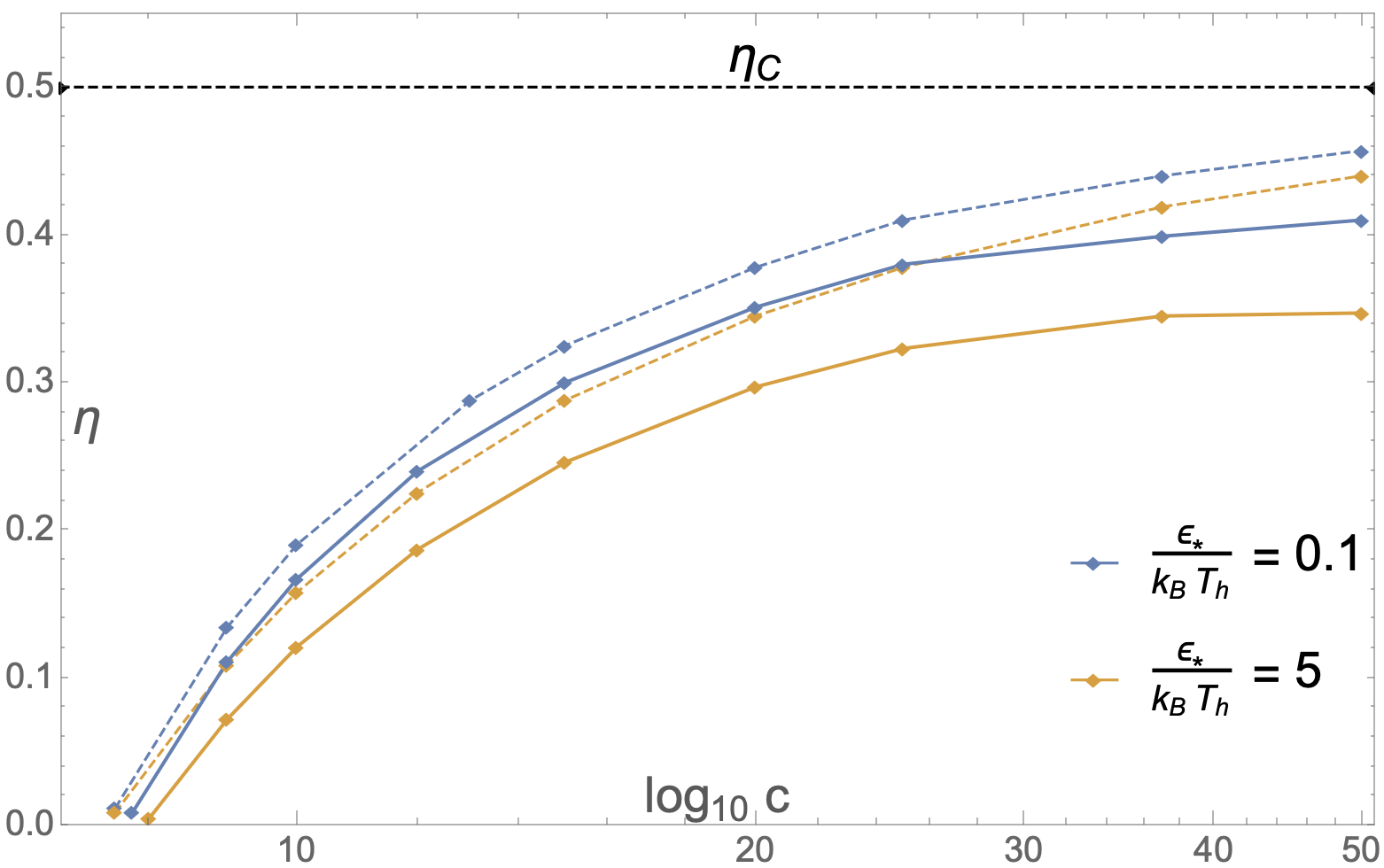
Figure 1: Efficiency I(t)4 and bound I(t)5 versus system-bath coupling strength I(t)6, showing monotonic approach to Carnot limit and the informativeness of I(t)7 compared to I(t)8.
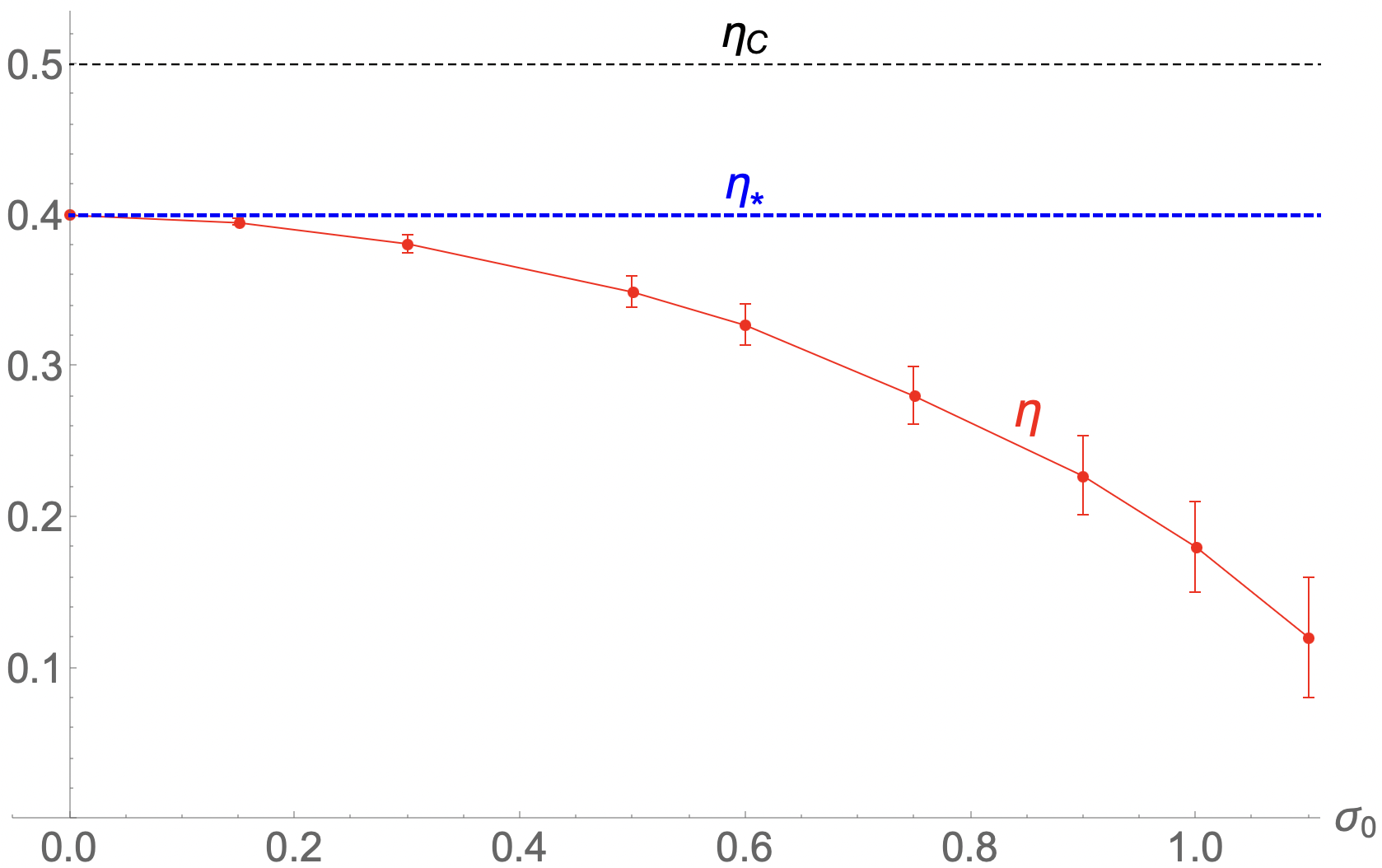
Figure 2: Dependence of efficiency I(t)9 and bound dtdlogρ0 on noise strength dtdlogρ1, with dtdlogρ2 saturating the bound in the absence of noise and degrading quadratically as noise increases.
Implications and Future Prospects
The practical implication is that maximal efficiency can be achieved by engineering the system's Hamiltonian and control protocol, even when operating irreversibly and with multiple temperature reservoirs. The bound's formulation brings efficiency optimization into the purview of information theory, linking engine performance with correlation structures and protocols underlying quantum or classical dynamics.
The theoretical implications extend towards:
- Broadening the study of work extraction in chemical motors, squeezed reservoirs, and scenarios where Carnot’s bound is not directly applicable.
- Suggesting a fundamental relationship between information-theoretic measures, control complexity, and thermodynamic output.
Areas for continued investigation include:
- Quantitative mappings between efficiency and experimental cost—especially in the quantum regime, where circuit complexity may emerge as a natural cost metric.
- Saturable bound analyses for engines exploiting quantum coherence or non-standard resources (e.g., squeezed baths) and finite-size environments.
Conclusion
The paper establishes an information-theoretic upper bound on engine efficiency, tighter and more physically informative than Carnot's classical limit, relevant for realistic engines operating with arbitrary numbers of baths and under non-equilibrium conditions. It elucidates the critical role of internal state-Hamiltonian correlations in dictating maximal performance and provides a blueprint for experimental optimization in quantum thermodynamics and beyond.

