- The paper's main contribution is demonstrating a moving pseudo-critical line in the many-body spectrum under cosmic expansion.
- It employs exact diagonalization and tensor network methods to capture avoided level crossings and redshifted kinetic behaviors in QED2.
- The work identifies quantifiable entropy production and operationally accessible irreversibility fronts via LOCC protocols.
Introduction and Motivation
This work provides a rigorous analysis of the nonperturbative quantum information dynamics of the (1+1)-dimensional Schwinger model (QED2) evolving in a cosmological de Sitter background (2604.02777). The essential novelty lies in demonstrating how cosmic expansion orchestrates a dynamical competition between redshifting kinetic terms and an electric-energy scale that grows proportionally with the scale factor, giving rise to a pseudo-critical line in the many-body spectrum, and a corresponding irreversibility front in operational diagnostics.
The Schwinger model is chosen due to its nontrivial interaction structure—confinement, pair production, and an exact local Gauss law—while remaining tractable via exact diagonalization and tensor networks. Unlike previous studies that focused on particle creation or entanglement in expanding backgrounds, this analysis targets many-body spectral transformations and their operational thermodynamic signatures under cosmological expansion.
Hamiltonian Construction and Dynamical Scaling
The (1+1)-dimensional FLRW metric is specialized to a de Sitter background, and the canonical Hamiltonian for lattice QED2 is constructed in cosmic time. The key scaling relations for each Hamiltonian sector under cosmic expansion are as follows:
- Kinetic term (hopping): Redshifts as J(t)∝1/a(t).
- Electric term: Scales as g2a(t), amplifying the energy cost of electric fields with expansion.
- Total Hamiltonian structure:
H(τ,m)=J(τ)K+mM+hFLRW(τ)Q+λ(τ)W+const.
Eliminating gauge degrees of freedom via Gauss’s law, the Jordan–Wigner transformation yields a qubit Hamiltonian rendering the problem suitable for both exact diagonalization and MPS techniques.
The late-time regime is characterized by suppressed kinetic energy and a dominant electric term, leading to traversals of a shifting set of avoided level crossings in `configuration space.' The resulting pseudo-critical line in the (τ,m) plane is not a static critical point, but rather a moving region of minimal gap dictated by the evolving interplay of competing energy scales.
Spectral Flow and Dynamical Manifestations
Exact diagonalization for small system sizes exposes an instantaneous gap landscape, with a narrow-gap pseudo-critical line (τ) shifting along the mass direction as the universe expands.
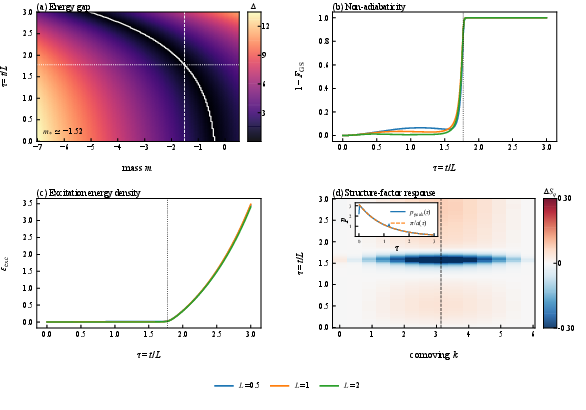
Figure 1: Instantaneous gap landscape (1+1)0, moving pseudo-critical line (1+1)1, onset of non-adiabaticity (1+1)2, growth of excitation energy density (1+1)3, and redshift of structure factor response.
Crossing the pseudo-critical line results in a breakdown of adiabatic following, manifested as a rapid drop in ground-state fidelity and a sharp rise in excitation energy. These features, including the cosmological redshift of structure-factor peaks, are quantitatively consistent with a Landau-Zener picture, where the suppressed gap and enhanced detuning rate lead to increasingly non-adiabatic dynamics as expansion continues. The point of breakdown is controlled by both system parameters and the expansion rate ((1+1)4).
Thermodynamic Limit and Continuum Extrapolation
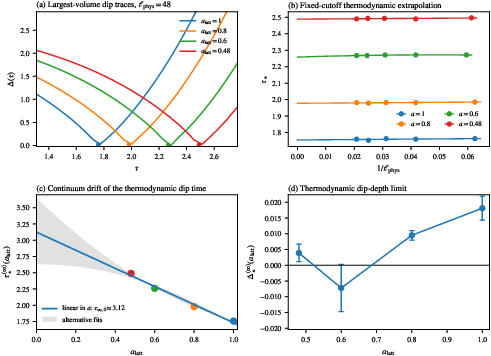
To ascertain the persistence of the moving gap valley beyond fixed-volume artifacts, MPS calculations are performed at increasing physical box size and decreasing lattice spacing for fixed (1+1)5. Two disentangled limits are taken:
The moving avoided crossing thus represents a robust dynamical feature, not an idiosyncracy of small or coarse system sizes.
Entropy Production and Irreversibility Front
Turning to initial Gibbs-state protocols, the evolution under expansion is reframed as a nonequilibrium process. The quantum relative entropy to the instantaneous Gibbs state, 22, quantifies entropy production and is shown to develop a sharp front precisely tracking the pseudo-critical line.
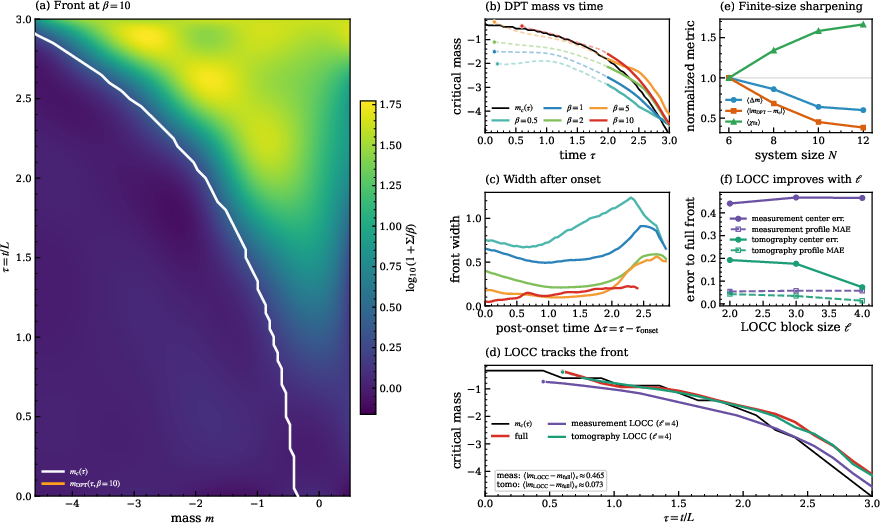
Figure 3: Smoothed entropy-production landscape, tracking of the irreversibility front with the pseudo-critical line, temperature and size dependence of front width and displacement, and LOCC-accessible witness diagnostic.
The width of this irreversibility front is governed by the competition between the instantaneous avoided-crossing gap and thermal broadening, scaling as: 23
Larger system size and lower temperature both sharpen the front, indicating an emergent dynamical criticality in the nonequilibrium thermodynamics. Finite-size scaling trends show monotonic sharpening toward a putative transition in the thermodynamic limit.
LOCC Accessibility and Operational Thermodynamics
A central claim is the operational accessibility of the irreversibility front. By computing LOCC-accessible classical and reduced-state relative entropy witnesses, it is demonstrated that even locally accessible observables on end blocks encode signatures of the irreversible front. Tomography-based protocols significantly outperform direct local measurement and both approach the global front as block size increases. This imbues the entropy production front with concrete detectability in quantum simulation platforms.
Implications and Outlook
This study establishes de Sitter QED24 as a controlled setting for exploring the interplay of cosmological expansion, gauge dynamics, spectral flows, and quantum thermodynamics. The operational irreversibility front and its LOCC accessibility point toward practical diagnostic schemes for upcoming quantum simulators of gauge theories in curved backgrounds and, by extension, reinforce the utility of entropic quantities in the study of non-equilibrium field theories.
Several future research directions are natural outgrowths:
- Quantum simulation and experimental verification: The protocol is directly relevant for digital quantum simulation (e.g., trapped ion or cold atom platforms) of dynamical gauge fields in time-dependent backgrounds.
- Extension to non-Abelian theories: The architecture offers a template for exploring dynamical criticality and thermodynamic irreversibility in systems with richer gauge structures.
- Tensor network and mixed-state simulation: Increasing system size and incorporating mixed-state tensor networks may further probe the thermodynamic sharpness of the transition.
- Alternative backgrounds and interactions: Analysis can be ported to AdS backgrounds or theories with additional interaction channels (Gross–Neveu, Thirring models).
Conclusion
This work demonstrates that the quantum information dynamics of Schwinger model in a de Sitter background are governed by a moving pseudo-critical line arising from the expanding-universe Hamiltonian, resulting in operationally meaningful thresholds for adiabaticity loss and entropy production. The pseudo-critical structure persists in the thermodynamic and continuum limits, while the tracking irreversibility front is accessible through locally measurable quantum information metrics. These results substantiate the use of expanding QED25 as a testbed for fundamental questions in quantum thermodynamics and quantum field theory in curved spacetime, and provide concrete diagnostics for experimental realization in quantum simulation platforms.