- The paper shows that force geometry, by analyzing the alignment between external and entropic forces, offers a new framework for understanding irreversible dissipation.
- It presents a force-level decomposition of entropy production, detailing contributions from force variances and cross-correlations measured via the Pearson coefficient.
- The study connects theory to experiment using harmonic trap examples and geometric design charts, providing actionable insights for controlled nonequilibrium processes.
Force Geometry as a Structural Determinant of Irreversibility
Motivation and Problem Statement
Traditional stochastic thermodynamics predominantly quantifies irreversibility via scalar observables such as entropy production rates and probability currents, offering limited insight into the structural organization of dissipative processes at the force level. Recent spatially resolved experiments on driven biological systems [DiTerlizzi 2024] demonstrate pronounced spatial heterogeneity in entropy production, correlated with anti-aligned dissipation and positional fluctuations. This empirical observation exposes inadequacies in scalar formulations, motivating the need for a geometric perspective on thermodynamic forces. The present paper introduces force geometry—specifically the relative alignment between deterministic driving and entropic (information-theoretic) forces—as a unifying principle for the organization of nonequilibrium thermodynamics.
Force-Level Decomposition and Entropy Production
The paper formalizes entropy production in overdamped stochastic dynamics as a quadratic function of the net thermodynamic force, decomposed into external (Fext) and information-theoretic (Finfo) components. The entropy production rate is expressed as
S˙i(t)=kBT2D⟨(Fext+Finfo)2⟩
where Fext=−∇U encodes deterministic driving (e.g., optical trapping) and Finfo=−kBT∇lnρ represents the entropic gradient from spatial probability inhomogeneity. Expanding yields three distinct contributions: the variance of Fext, the variance of Finfo, and the force-force cross-correlation term, which exclusively encodes geometric alignment. This decomposition is functionally richer than scalar current-based descriptions, revealing that even with matched force variances, spatial configuration and mutual orientation crucially determine dissipation.
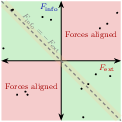
Figure 1: Force correlation diagram depicting instantaneous joint fluctuations of Fext and Finfo; green quadrants show anti-alignment, red quadrants show alignment, and dashed diagonal indicates force cancellation.
Geometric Stall, Reversibility, and Correlation Hierarchy
Perfect anti-alignment—where Finfo=−Fext everywhere—defines a reversible regime with vanishing entropy production and transport. In practical nonequilibrium operation, a global anti-alignment (Pearson force-correlation coefficient Finfo0) leads to zero mean transport but typically nonzero entropy production due to local imbalances. The paper introduces "geometric waste" as entropy production arising from departures either in alignment (Finfo1 deviating from Finfo2) or magnitude matching. This hierarchy clarifies the energetic distance between stall regimes (zero mean transport, finite dissipation) and true reversibility.
Instantaneous Force-Correlation as a Geometric Measure
The key quantity organizing force geometry is the instantaneous Pearson correlation coefficient Finfo3 between Finfo4 and Finfo5, capturing their spatial and temporal alignment. Finfo6 is readily accessible in experiments and provides a direct metric for proximity to stall. The authors derive an instantaneous geometric lower bound on entropy production, saturated when Finfo7, encoding a physically interpretable regime distinct from scalar bounds like thermodynamic uncertainty relations.
Paradigmatic Example: Harmonic Trap Dynamics
The moving harmonic trap is analytically tractable and bridges theory with experimental microrheology. The system's state is characterized by lag Finfo8 (mean position minus trap center) and variance Finfo9, yielding explicit force expressions:
S˙i(t)=kBT2D⟨(Fext+Finfo)2⟩0
The correlation coefficient is found to depend solely on the dimensionless ratio S˙i(t)=kBT2D⟨(Fext+Finfo)2⟩1, not on individual fluctuation or lag scales:
S˙i(t)=kBT2D⟨(Fext+Finfo)2⟩2
Regions with S˙i(t)=kBT2D⟨(Fext+Finfo)2⟩3 operate near perfect anti-alignment and minimal entropy production, while S˙i(t)=kBT2D⟨(Fext+Finfo)2⟩4 produces strong dissipation. This geometric dependency explains the fluctuation-dissipation anticorrelation observed in experiments.
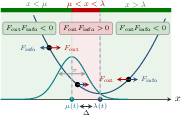
Figure 2: Schematic of force configurations in a harmonic trap, illustrating anti-aligned and aligned regimes and dependency on S˙i(t)=kBT2D⟨(Fext+Finfo)2⟩5.
Geometric Interpretation of Experimental Observations
The theoretical framework maps directly onto spatially resolved experimental observations. It clarifies that energetically efficient flickering in red blood cell membranes is not due to anomalously low noise, but to spatial regimes with strong force anti-alignment buffering dissipation.
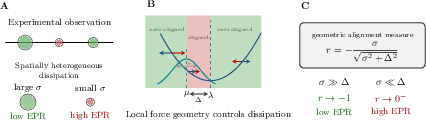
Figure 3: Conceptual mapping between spatial heterogeneity in experimentally inferred entropy production and force geometry.
Geometric Control Charts and Operational Trade-offs
The authors construct geometric design charts for constant dragging and sinusoidal driving (the two main experimental protocols) in the S˙i(t)=kBT2D⟨(Fext+Finfo)2⟩6 and S˙i(t)=kBT2D⟨(Fext+Finfo)2⟩7 parameter spaces. The charts showcase contours of constant force-correlation S˙i(t)=kBT2D⟨(Fext+Finfo)2⟩8, with energetic cost (e.g., injected power) orthogonal to geometric alignment, enabling systematic navigation of nonequilibrium trade-offs. These charts locate actual experimental operating points—e.g., the dragged red cell system resides in a regime with S˙i(t)=kBT2D⟨(Fext+Finfo)2⟩9, demonstrating strong force anti-alignment at finite power input.
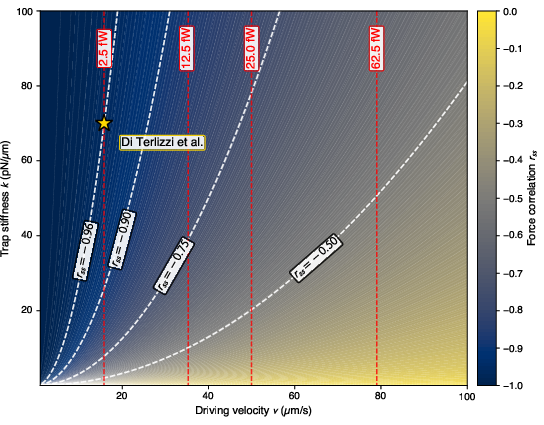
Figure 4: Heat map of steady-state force-correlation Fext=−∇U0 under constant dragging, showing iso-correlation and iso-power curves and placement of the experimental operating point.
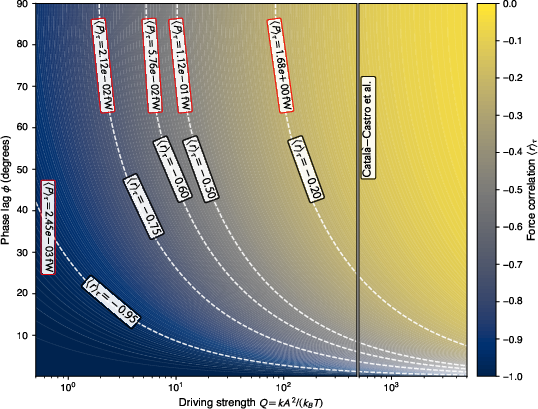
Figure 5: Heat map of time-averaged force-correlation Fext=−∇U1 for sinusoidal driving, organized by driving strength Fext=−∇U2 and phase lag Fext=−∇U3.
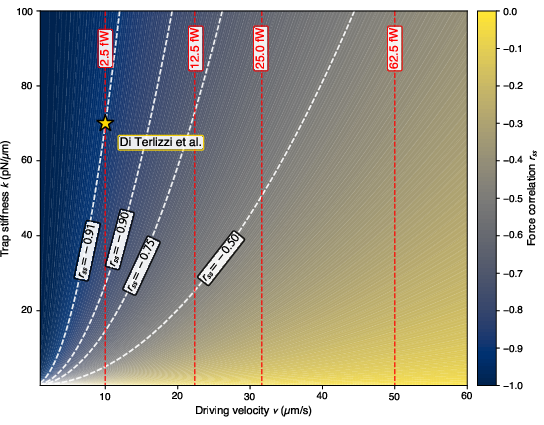
Figure 6: Geometric design chart matching experimental dissipation, with contours of Fext=−∇U4 and experimental operating point under empirical friction coefficient.
Comparison to Scalar Thermodynamic Bounds
Force geometry complements, but does not duplicate, existing scalar thermodynamic bounds such as TURs or Fisher-information speed limits. At stall, TURs become trivial, yet force geometry clarifies persistent entropy production due to fluctuation. The vectorial decomposition thus enriches the theoretical landscape, organizing dissipative structure beyond efficient or precise current generation.
Extension to Underdamped Dynamics and Multidimensionality
For underdamped regimes, momentum provides additional freedom: perfect spatial anti-alignment does not necessarily suppress transport, allowing "coasting" states where strong anti-alignment coincides with directed motion. This indicates momentum as a thermodynamic buffer, further decoupling force geometry from entropy production. The framework extends directly to higher dimensions via inner products, suggesting broad applicability for optimal control and nonequilibrium regulation across complex driven systems.
Conclusion
The paper establishes force geometry, via the alignment of external and entropic forces, as a principal structural determinant of irreversibility in nonequilibrium stochastic systems (2603.29416). The force-correlation metric Fext=−∇U5 provides experimentally accessible diagnostics for mapping operating regimes, tuning dissipation, and interpreting spatial heterogeneity. Geometric control charts enable protocol design beyond traditional scalar bounds, offering a pathway to systematic regulation of energetic cost in driven biological and soft matter systems. The perspective invites further exploration in underdamped dynamics, multidimensional systems, and active matter, where force organization and transport can be decoupled for optimizing stochastic machine performance.