- The paper presents a novel integration of 1/f colored noise into DDPMs that mitigates spectral mismatch for more efficient generative modeling.
- It introduces a kernel-based noise module, derived using Matérn covariance, to match power-law spectra characteristic of natural data.
- Empirical results on CIFAR-10 demonstrate a 3.33× speedup and improved FID scores, confirming both theoretical and practical benefits.
Flicker-DDPM: Spectrally Matched Diffusion via $1/f$ Colored Noise Injection
Motivation and Spectral Matching
The central premise of Flicker-DDPM is addressing spectral mismatch in standard denoising diffusion probabilistic models (DDPM). While conventional DDPMs rely on white Gaussian noise for data corruption—which generates a flat power spectrum—real-world structured data modalities (such as natural images, protein maps, audio, and astrophysical time series) follow power-law spectral statistics, typically P(k)∝k−α with α∼2–$3$. This mismatch imposes a dual burden on the neural network: it must simultaneously reconstruct the spectral hierarchy and generate detailed content, producing heavily frequency-dependent relaxation dynamics and inefficiency. Flicker noise ($1/f$), characteristic of self-organized criticality (SOC), offers a physically principled noise model aligned with natural data statistics; thus, the paper proposes integrating $1/f$-type colored noise in diffusion, enabling efficient, spectrally aware generative modeling.
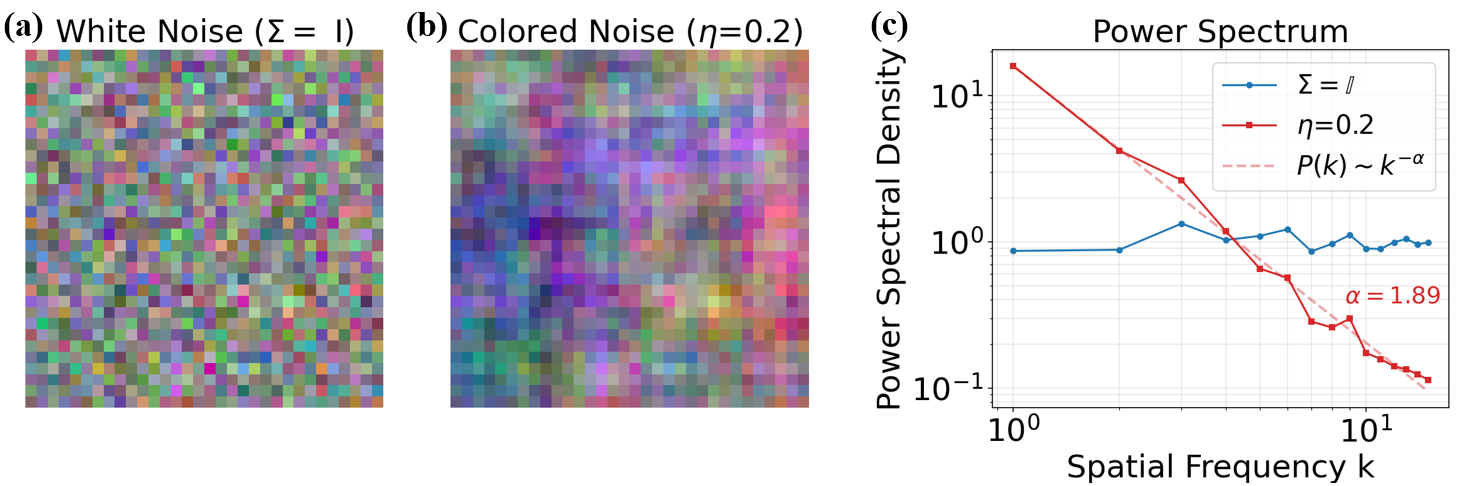
Figure 1: Comparison of white and colored noise samples on a 32×32 lattice, highlighting the spatial correlation and power-law spectrum of colored noise.
Colored Noise Construction & Theory
The authors formalize the spectral matching in DDPM with a kernel-based colored noise module. The spatial correlation kernel is parameterized as C(d)=(d+1)−η, where d is the Manhattan distance and η controls the spectral exponent. Using the Wiener–Khinchin theorem, power-law spatial correlations yield power-law spectra, and Matérn covariance theory provides the analytic mapping between P(k)∝k−α0 and the dataset-specific P(k)∝k−α1: P(k)∝k−α2 for two-dimensional data. Critically, this parameter is not a hyperparameter but is derived via regression from the measured spectral statistics of the target dataset, enabling universal adaptation to modalities with diverse spectral properties.
Integration Within DDPM
Colored noise is injected in both the forward SDE and reverse denoising processes without modification to the neural architecture. The noise generation uses either Cholesky-based transformation or FFT diagonalization for scalability. The forward process becomes P(k)∝k−α3, where P(k)∝k−α4 is the Cholesky or FFT factor and P(k)∝k−α5 is standard white noise. The reverse process similarly employs colored noise at each denoising step, and loss computation is properly whitened for spectral balance. This integration is compatible with all DDPM acceleration schemes, requires negligible computational overhead per step, and is robust to architectural choice, making it a true drop-in replacement.
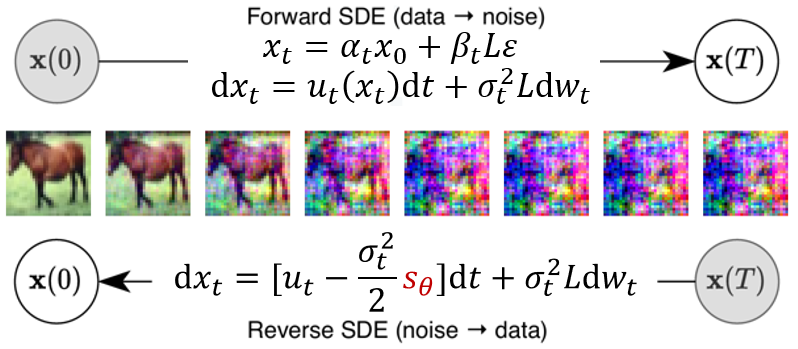
Figure 2: Schematic illustration of Flicker-DDPM's forward and reverse SDE trajectories under colored noise injection; the architecture remains unchanged.
On CIFAR-10, Flicker-DDPM achieves generation quality (FID) matching or surpassing baseline white-noise DDPM with significantly fewer sampling steps. At P(k)∝k−α6 steps, Flicker-DDPM yields FID~12.2, outperforming the baseline's FID~13.0 even at P(k)∝k−α7 steps, i.e., a P(k)∝k−α8 speedup with improved output quality. This speedup is explained by the fact that spectrally matched noise eliminates the need for sequential spectral reshaping and mode desynchronization. Flicker-DDPM's FID remains virtually invariant as P(k)∝k−α9 is reduced, a claim substantiated by experiments; in contrast, baseline DDPM suffers sharp degradation with fewer steps.
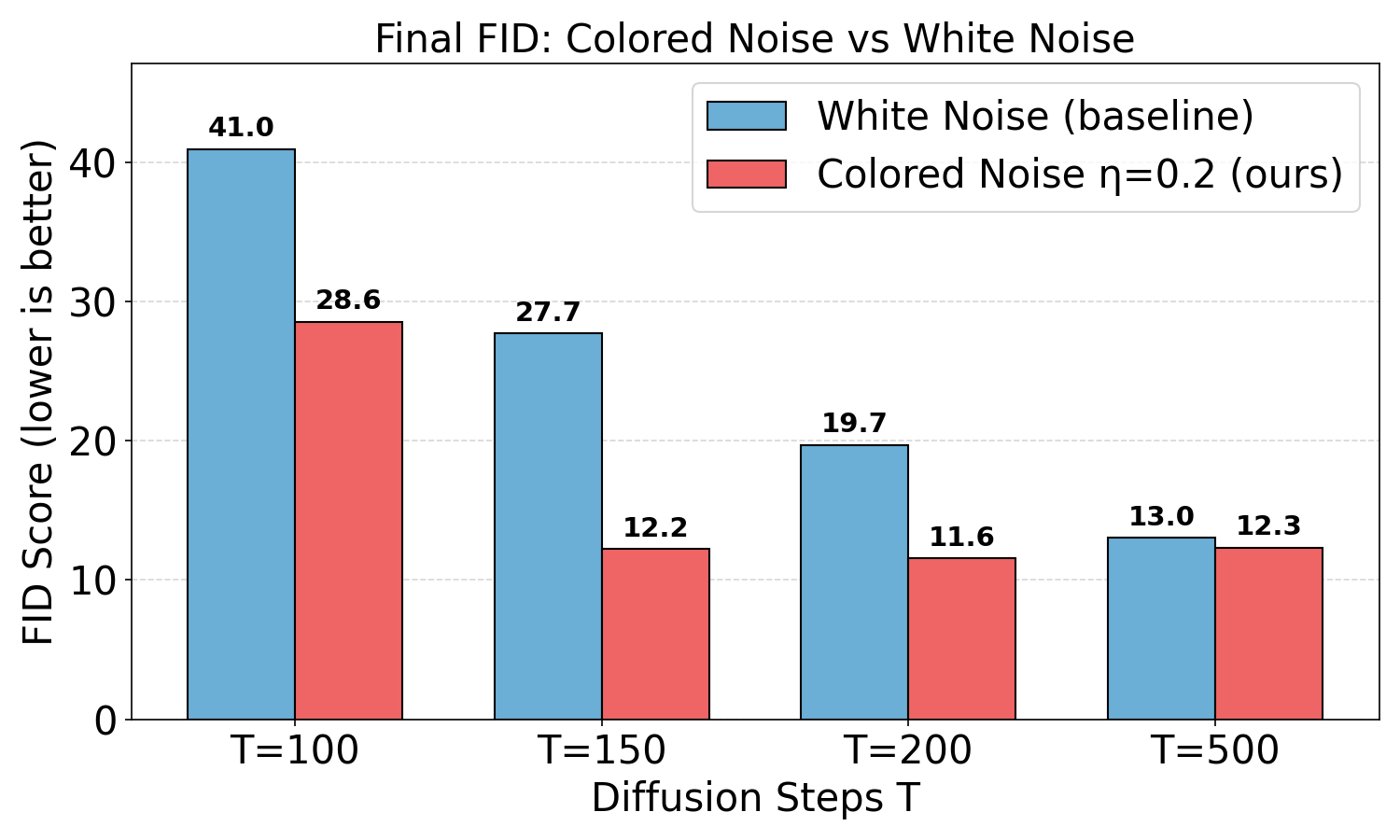
Figure 3: FID as a function of diffusion steps α∼20, demonstrating Flicker-DDPM's quality improvement and sampling speedup.
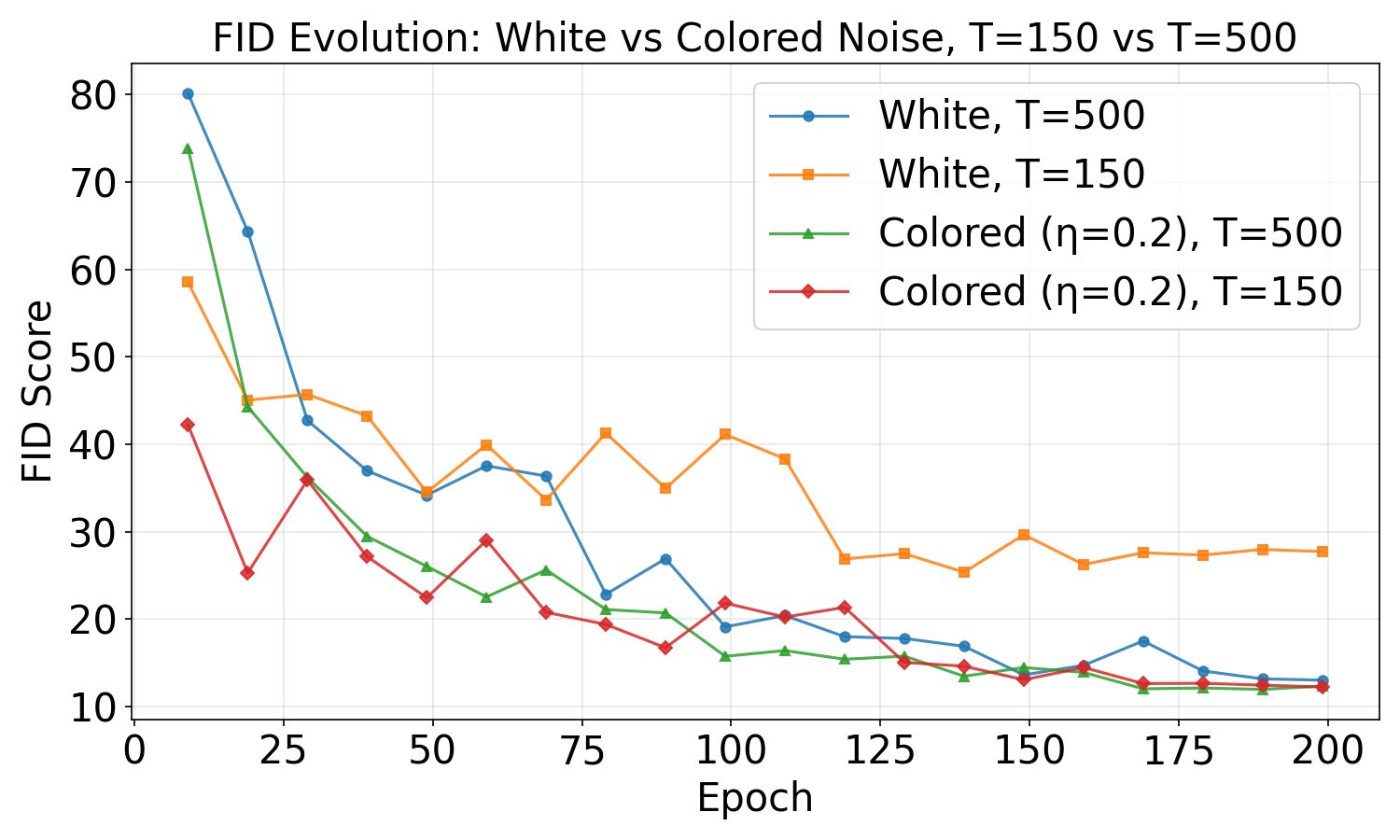
Figure 4: FID training convergence: Flicker-DDPM converges faster and achieves a lower asymptote with fewer steps.
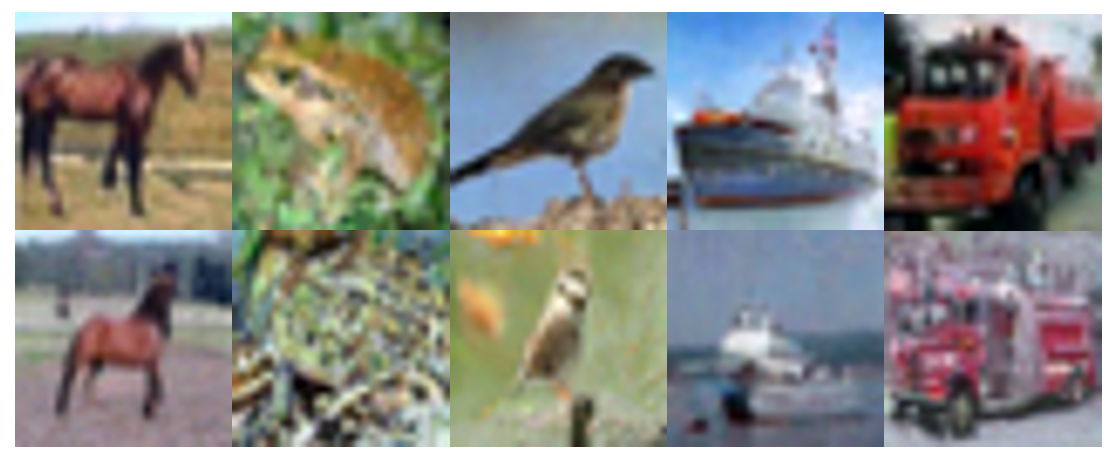
Figure 5: Generated samples at α∼21: Flicker-DDPM produces sharper, artifact-free images compared to white-noise DDPM.
Frequency-Domain Linearization and Theoretical Prospects
The paper develops a frequency-domain linear theory as the mechanism underpinning the acceleration. In the spatial Fourier basis, the score function's Jacobian becomes nearly diagonal for translationally invariant data, permitting a per-frequency mode linearization. Colored noise achieves initial spectral matching (α∼22 for all α∼23), meaning the reverse process allocates all steps to content generation instead of spectral correction. Quantitative analysis confirms that colored noise induces uniform linearization across all frequency modes: regression α∼24 scores exceed 0.95 for nearly all α∼25 in Flicker-DDPM, while baseline DDPM exhibits catastrophic nonlinearity in low-frequency modes until late stages. The theoretical derivations, validated experimentally, show that mode desynchronization is eliminated, and the entire frequency hierarchy evolves concurrently.
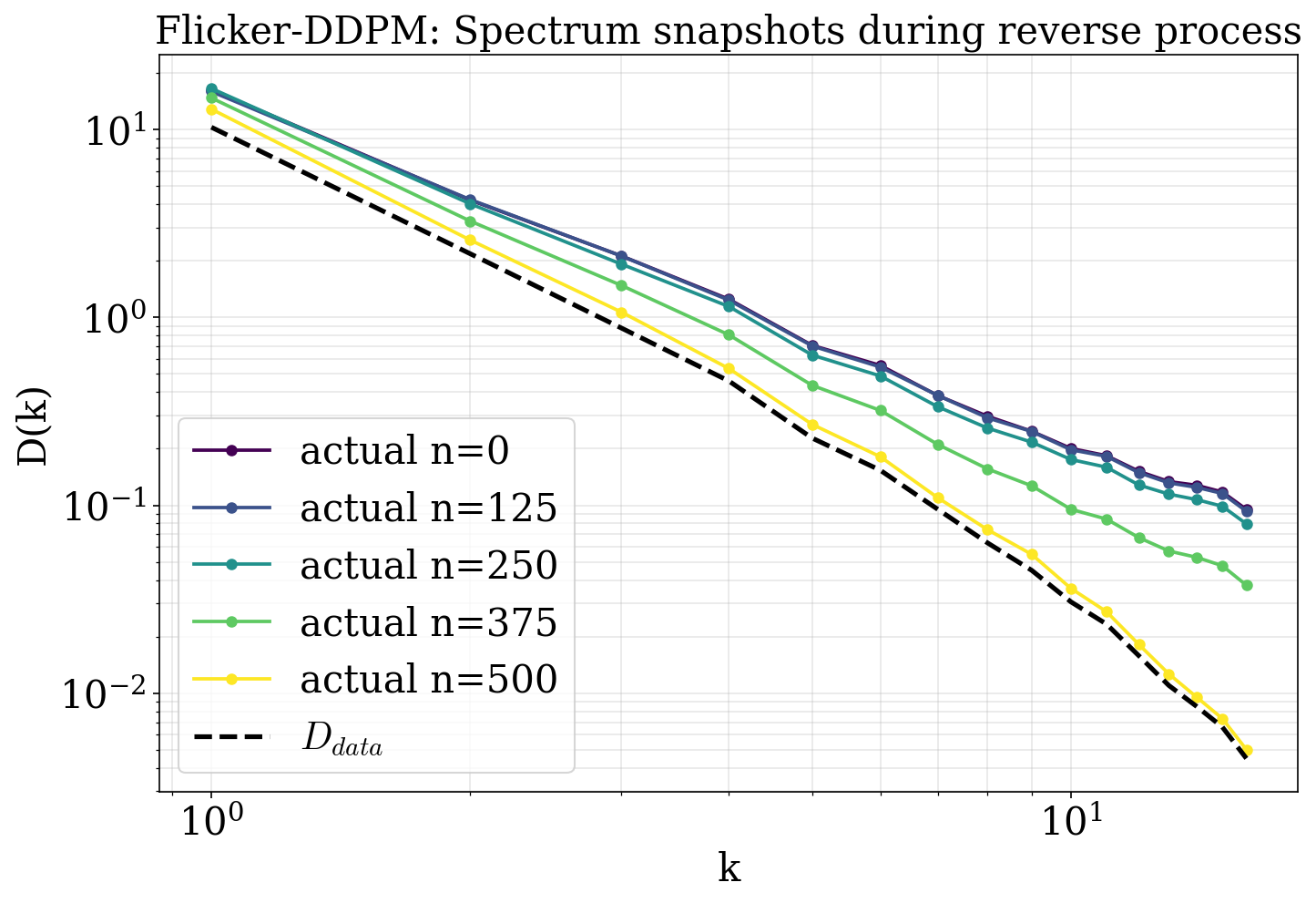
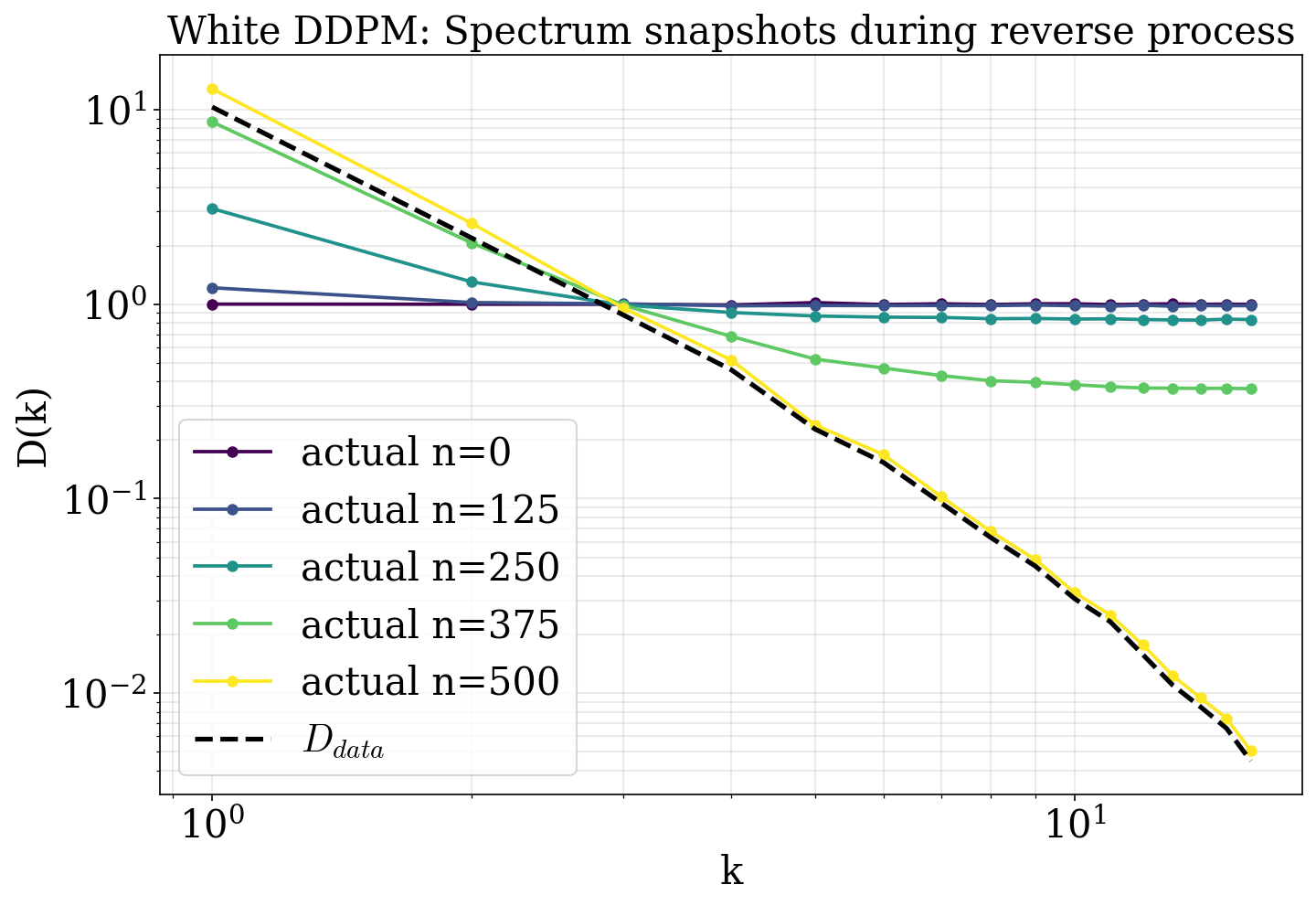
Figure 6: Evolution of radial power spectra during reverse diffusion, showing synchronized spectral convergence in Flicker-DDPM and sequential reshaping in baseline.
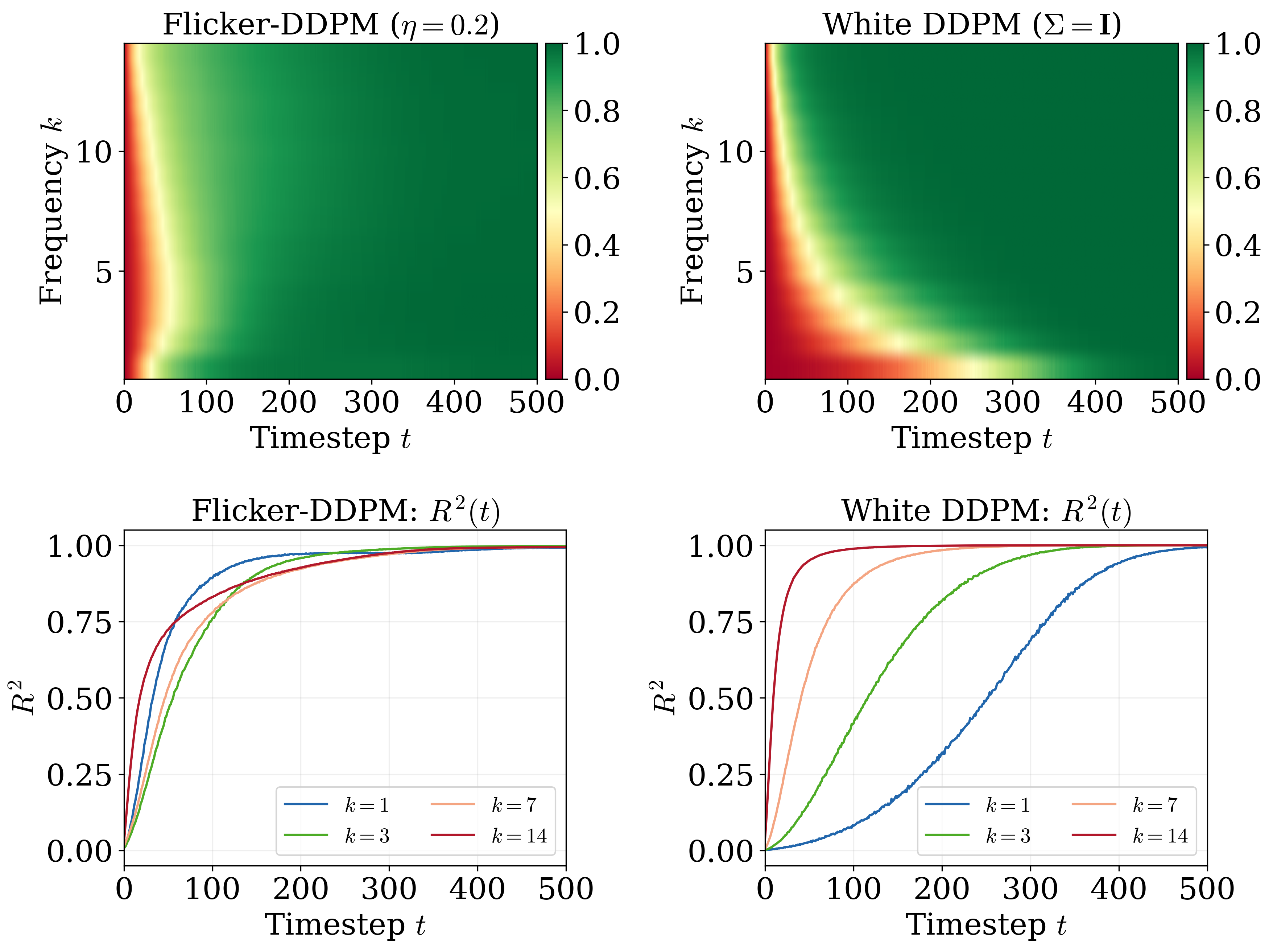
Figure 7: Linearization quality heatmaps: Flicker-DDPM achieves uniform α∼26 linearity across all modes; baseline exhibits severe low-frequency nonlinearity.
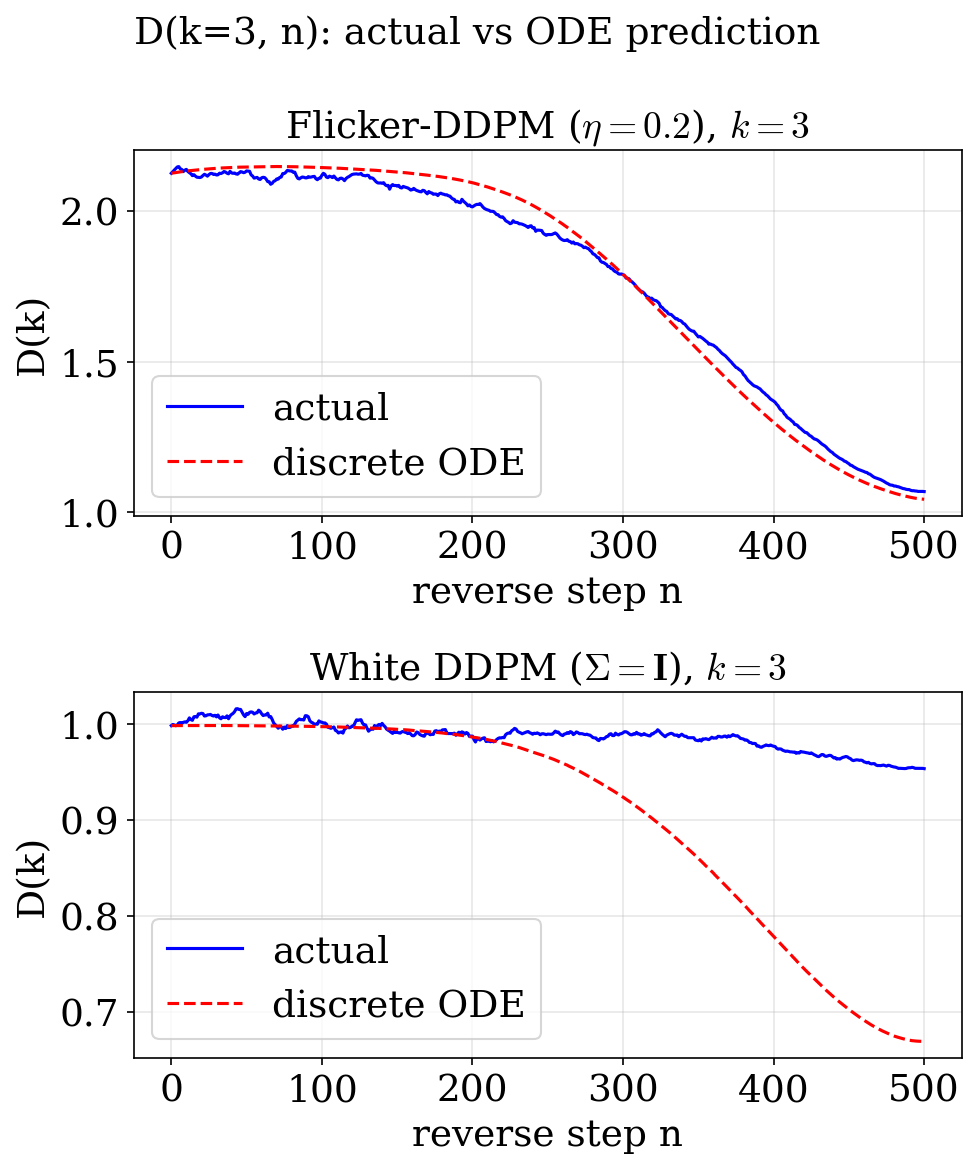
Figure 8: Evolution of power spectral density α∼27; Flicker-DDPM matches ODE predictions, confirming linear regime.
Practical and Theoretical Implications
By analytically matching noise statistics to data spectra, Flicker-DDPM provides a universal prescription for diffusion modeling of power-law datasets. The approach is extensible to other spatial dimensions and correlation structures, with domain-specific spectral-matching formulas. The method is orthogonal and complementary to noise schedule design, spectral regularization, and other frequency-aware optimization techniques, and can be combined for further acceleration or quality gains. The principal limitation is the underweighting of high-frequency components; augmenting with blue-noise or hybrid spectral kernels could further enhance texture realism. The universal approach applies to modalities such as protein structure, molecular graphs, audio, and astrophysical sequences, contingent on proper spectrum measurement.
Conclusion
Flicker-DDPM constitutes a principled modification to diffusion generative modeling, enabling α∼28 colored noise injection based on self-organized criticality and empirical spectral statistics. The method achieves robust sampling acceleration (α∼29 for CIFAR-10), improved FID scores, and universal architectural compatibility. The frequency-domain linearization theory elucidates why spectral matching yields simultaneous quality and efficiency improvements. The practical implications are broad for generative modeling across multiple scientific and engineering domains, with future developments likely in hybrid spectral kernels and application to non-image data.