PopuLoRA: Co-Evolving LLM Populations for Reasoning Self-Play
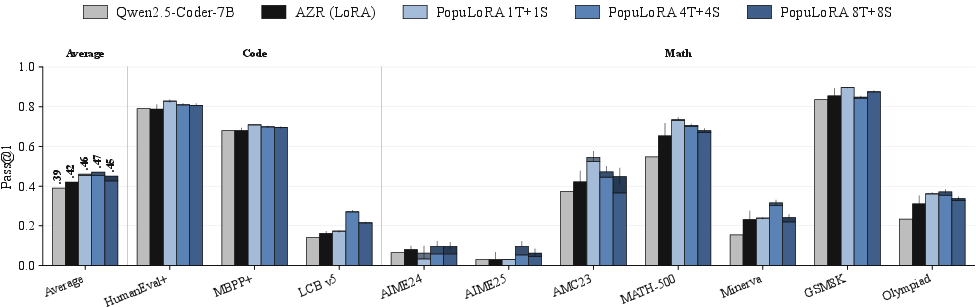
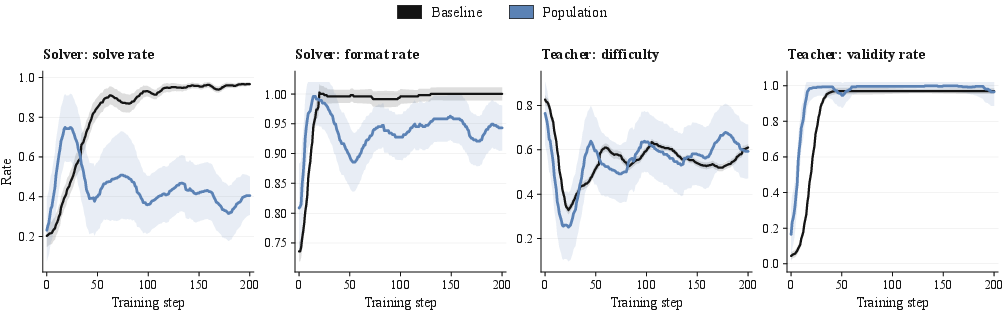
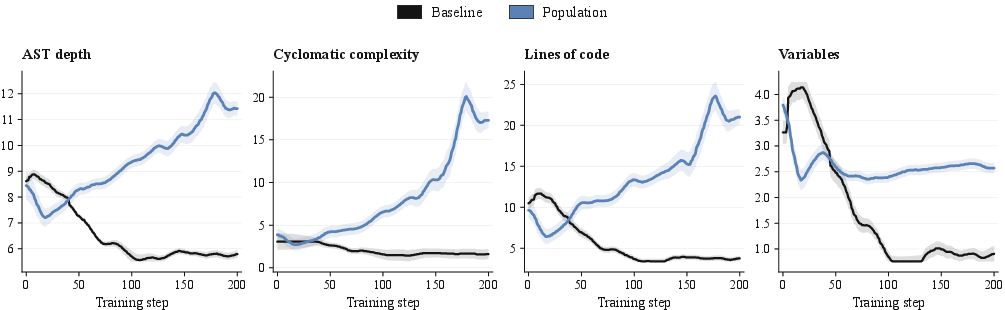
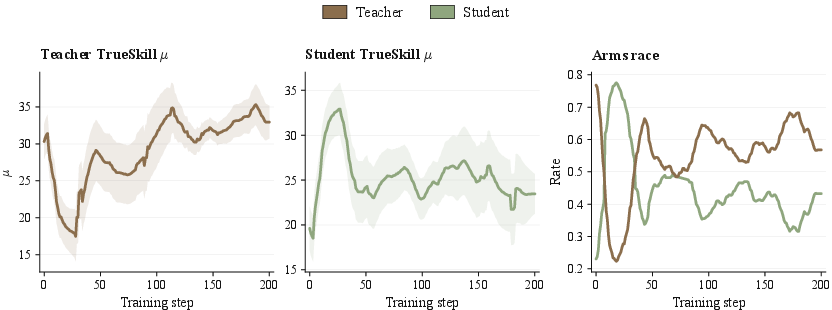
Abstract: We introduce PopuLoRA, a population-based asymmetric self-play framework for reinforcement learning with verifiable rewards (RLVR) post-training of LLMs. Teachers and students are specialised LoRA adapters on a shared frozen base: teachers propose problems, matched students solve them under a programmatic verifier, and cross-evaluation between sub-populations replaces the self-calibration that limits single-agent self-play. A family of LoRA weight-space evolution operators (mutations and crossovers that produce same-rank population members in seconds) serves as the replacement step of a population-based training loop at 7B scale. We instantiate PopuLoRA on top of Absolute Zero Reasoner and compare it against a per-adapter compute-matched single-agent baseline. Where the single agent self-calibrates to generating easy problems it can reliably solve, the population enters a co-evolutionary arms race: teachers produce increasingly complex problems, student solve rates oscillate, and problem-space coverage keeps expanding throughout training. Despite lower training-time reward, the population mean outperforms the baseline on three code benchmarks (HumanEval+, MBPP+, LiveCodeBench) and seven math benchmarks (AIME 24/25, AMC 23, MATH-500, Minerva, GSM8K, OlympiadBench), and even the weakest member of the population beats the baseline on aggregate.
Paper Prompts
Sign up for free to create and run prompts on this paper using GPT-5.
Top Community Prompts
Explain it Like I'm 14
What is this paper about?
This paper introduces PopuLoRA, a way to train LLMs to reason better without relying on human-made practice sets. Instead, the model learns from problems it generates itself, and a computer program (a “verifier”) checks whether answers are correct. The big idea is to use many cooperating and competing “teacher” and “student” models at once, not just a single model teaching itself.
What questions does it try to answer?
The authors focus on four simple questions:
- If one model writes its own practice problems and then solves them, why does it often get stuck making only easy problems?
- Can we prevent that by using a population (a group) of separate teachers and students who challenge each other?
- Can we do this efficiently by using small, plug‑in “adapters” (called LoRA) so we don’t need many full-sized models?
- Does this approach actually make models better at coding and math on well-known tests?
How does the method work?
Think of a school where many teachers and students learn together, and a strict robot judge grades the work.
Teachers and students as a population
- There are multiple teachers and multiple students. Teachers create coding problems; students try to solve them.
- A rating system (like those used in online games, called TrueSkill) matches teachers with students who are at a similar level. This keeps the problems challenging but not impossible.
The verifier (the strict robot judge)
- The verifier is a sandboxed Python runner. It executes the student’s code and checks:
- Is the answer correct?
- Is the code in the right format?
- Is the problem valid and non-cheaty (not broken or random)?
- Students get points for correct answers and lose points for wrong or badly formatted ones.
- Teachers get points when they produce valid problems that are hard for the matched student (the student fails sometimes), but teachers get nothing for impossible or invalid problems. This stops teachers from “cheating” with trick questions.
LoRA adapters: small add-ons instead of many big models
- Running many full models is expensive. So each teacher and student is a small LoRA adapter attached to one shared big model (the base).
- A LoRA adapter is like a clip‑on lens for a camera: it changes how the base model behaves without copying the whole model.
- This saves lots of memory and lets many teachers and students run together on the same machine.
Evolution to keep ideas fresh
- Every few steps, the weakest adapters are replaced by new ones created from the best adapters.
- The “evolution” step makes new adapters by:
- Mutating a parent adapter (small, smart nudges).
- Crossing over two parents (mixing their strengths).
- These operations are fast and don’t need retraining from scratch, so learning keeps moving.
The training loop in plain words
- Match a teacher with a student of similar level.
- The teacher writes several code problems.
- The student tries to solve them; the verifier grades the results.
- Both teacher and student update their behavior based on their scores.
- Periodically, replace the weakest adapters with new “children” made from the best ones.
Why this prevents “getting stuck”: If one person both writes and solves problems, they might drift into always making easy stuff they can solve. Here, because teachers and students are different and matched across a population, teachers are pushed to create harder problems, and students must keep improving to keep up. This back‑and‑forth creates an “arms race,” not a boring routine.
What did they find, and why is it important?
Here are the main takeaways, explained simply:
- Stronger results on coding tests:
- On benchmarks like HumanEval+, MBPP+, and LiveCodeBench, the population approach did better than a compute‑matched single model that teaches itself.
- The biggest gain showed up on LiveCodeBench (hard, real-world style problems), suggesting the method teaches more general coding skills.
- Surprising gains in math too:
- Even though training focused on code (and the verifier was a Python executor, not a math checker), the method also improved math performance (e.g., AIME, AMC, MATH-500) compared to the single-model baseline. That hints at better general reasoning, not just better coding.
- Healthier training dynamics:
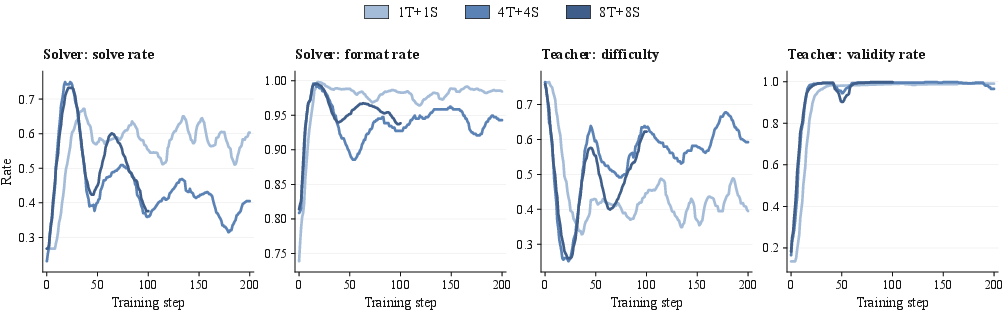
- In the single-model setup, solve rates quickly rose to near-perfect and then… stopped improving. This means the model settled into making easy, simple problems it always solves (a “mode collapse”).
- In the population setup, solve rates oscillated: as teachers made harder problems, students struggled, then improved, then teachers pushed difficulty again. This “arms race” is a sign of growing challenge and progress.
- Problems became more complex and more diverse:
- Over time, teacher-made programs got deeper, longer, and more intricate (measured by features like AST depth and cyclomatic complexity).
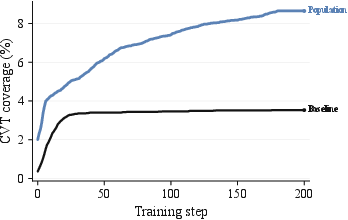
- The variety of problems also grew, instead of shrinking to a tiny set of easy ones.
- Efficient and practical:
- Because all teachers and students are lightweight LoRA adapters on one shared base model, the whole system runs on a single node with only a small increase in wall-clock time compared to training a single adapter.
What could this change in the future?
- Less reliance on human-made datasets: The system creates its own curriculum with a programmatic checker. That could speed up training and reduce manual data work.
- More general reasoning skills: Since the approach improved math even without direct math training, it may help models develop broader reasoning abilities.
- Scalable teamwork for models: Using populations and fast “evolution” could become a standard way to keep training challenging and prevent getting stuck on easy tasks.
Limitations and next steps
- The tests used one base model (Qwen2.5‑Coder‑7B) and one type of verifier (Python execution). It’s still unknown how well this works in other domains where automatic checking is weaker.
- All adapters used the same size (rank) in this study; mixing adapter sizes might help even more.
- Evolution doesn’t replace learning; it only reshuffles and nudges. The real skill growth still comes from the ongoing training after each replacement.
In one sentence
PopuLoRA shows that letting many small teacher and student models co‑evolve—while a strict program checks answers—creates a steady supply of challenging problems, avoids getting stuck on easy ones, and leads to stronger, more general reasoning skills in LLMs.
Knowledge Gaps
Knowledge gaps, limitations, and open questions
Below is a consolidated list of what remains missing, uncertain, or unexplored in the paper; each point is framed to be actionable for future work.
- Generality across bases and verifiers: results are shown only for a single 7B code base (Qwen2.5-Coder-7B) and a single strong verifier (sandboxed Python). It is unknown whether the co-evolutionary dynamics hold for larger/smaller bases, non-code models, or weaker/noisy verifiers (e.g., LLM-as-judge, partial checkers).
- Verifier exploitation and robustness: despite penalties for invalid/nondeterministic problems, it’s unclear how robust the system is to teachers generating adversarial-but-formally-valid tasks (e.g., pathological time/memory usage, flaky floating-point cases, heavy I/O). No stress tests of sandbox policies or resource limits are reported.
- Transfer beyond the AZR task family: teachers generate only AZR code_i/o/f triples; whether the population self-extends to richer task grammars (debugging, refactoring, multi-file programs, spec-to-code, tool use) remains untested.
- Out-of-domain mechanism: math gains arise without a math verifier, but the causal pathway (general reasoning vs. code-induced heuristics vs. spurious correlation with longer outputs) is not established. No counterfactual or ablation pinpoints which training signals drive math transfer.
- Stability and long-horizon behavior: training is capped at 200 updates (or 100 for 8T+8S). It remains unknown whether the arms race sustains, saturates, or destabilizes over much longer horizons, or whether complexity eventually collapses or cycles unpredictably.
- Population size/shape scaling laws: only 1T+1S, 4T+4S, and 8T+8S are explored; no systematic scaling curve (adapters vs. performance vs. wall-clock/compute) or mixed-size populations (e.g., few teachers, many students) is provided.
- Compute-fair baselines: comparisons are per-adapter compute-matched, but total FLOPs scale with adapter count. There is no equal-total-compute single/multi-agent baseline (e.g., one adapter trained longer or with more rollouts) to quantify pure population effects.
- Adapter selection at inference: evaluation uses population mean and a test-set-selected argmax (not deployable). No deployable selection/gating strategy (e.g., learned router, meta-controller, uncertainty-based chooser) or ensemble method is provided.
- Distillation/merging for deployment: how to compress the population into a single deployable model (via distillation, mixture-of-experts routing, or post-hoc merging) is not studied.
- Sensitivity to RL algorithmic choices: the study fixes critic-free GRPO-style updates with no KL penalty and a specific advantage normalization. The effect of alternative algorithms (value networks, KL control, off-policy data reuse, entropy regularization) is unknown.
- Reward shaping design: student rewards are coarse (+1, -0.5, -1), and teacher reward is 1 − solve-rate with a zero reward for impossible tasks. No exploration of alternative shapings (e.g., partial credit, time-to-solve, program complexity-weighted rewards) or their impact on curricula.
- Matchmaking and rating systems: PFSP over TrueSkill is chosen; the sensitivity to choice of rating system (Elo, Glicko, multi-dimensional ratings for non-transitivity), pairing temperature, and noise/uncertainty handling is not explored.
- Collusion and gaming risks: teachers and students co-adapt; safeguards against implicit collusion (teachers posing superficially hard but pattern-learnable tasks) are not analyzed, nor are anti-gaming diagnostics beyond validity checks.
- Diversity measurement and maintenance: while specialization and diversity are suggested by TrueSkill spread and coverage, explicit measures (representation-space diversity, behavior descriptors, disagreement metrics) and active diversity maintenance (e.g., novelty search, Pareto fronts) are absent.
- Coverage-quality trade-offs: complexity metrics (AST depth, cyclomatic complexity, LOC, variable count) can rise via obfuscation, not conceptual difficulty. No human or semantic difficulty audit ensures growth reflects harder reasoning rather than syntactic inflation.
- LoRA design space: all adapters share rank 32 and target only attention projections. The impact of heterogeneous ranks, placement into MLPs, rank-scheduling, or low-rank structure learning is untested.
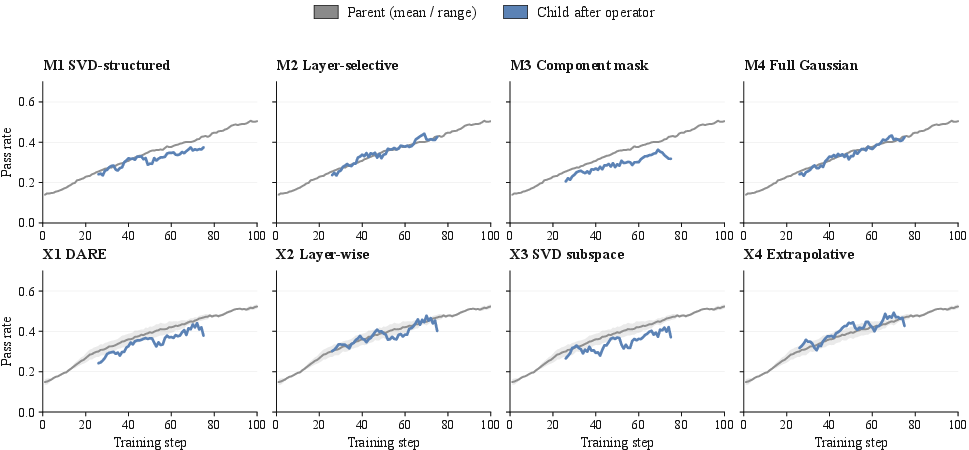
- Evolution operator palette and schedule: operators (M1–M4, X1–X4) and replacement schedule (k=10, γ=0.25) are fixed. There is no ablation on operator mixtures, application frequency, parent selection pressure, or adaptive schedules driven by population health metrics.
- Operator generality: retention is shown within-domain; transfer of these operators to other bases, higher ranks, or other modalities (vision, speech) remains open.
- Multi-student difficulty estimation: teacher difficulty is estimated against a single matched student. Whether multi-student aggregation (median/quantile failure rate) yields more robust difficulty signals is untested.
- Non-transitivity and niches: co-evolution often produces non-transitive competencies. There is no explicit analysis of non-transitivity (e.g., rock–paper–scissors structures) or mechanisms to preserve/expand niche skills.
- Safety and content risks: beyond sandboxing code, the system’s propensity to generate unsafe or harmful content, prompt injection, or jailbreak-like problems is not assessed; no red-teaming or alignment metrics are reported.
- Resource and energy profiling: wall-clock is reported, but detailed FLOPs/energy efficiency and memory-bandwidth profiles across population sizes and multi-node settings are missing.
- Multi-node and distributed training: the approach is demonstrated on a single node with vLLM multi-LoRA; scalability, bandwidth contention, and scheduling on multi-node clusters are not evaluated.
- Robustness to seeds and variance: no multi-seed runs are reported; sensitivity to initialization, population seeding, and stochasticity is unknown.
- Failure mode analysis: qualitative error analyses (e.g., systematic solver failures, teacher failure taxonomy) and remediation strategies (curriculum steering, verifier improvements) are not provided.
- Benchmark breadth and protocol: evaluations rely on greedy pass@1; effects under sampling, test-time compute (CoT, self-consistency), or tool use are not assessed. The robustness to benchmark contamination is assumed via LiveCodeBench but not probed for other sets.
- Inference cost vs. gains: population training yields longer responses (~1000 tokens). The throughput/latency impact at inference and cost–performance trade-offs are not quantified.
- Task generalization granularity: only code and math benchmarks are used. Transfer to reasoning-heavy but non-programmatic tasks (planning, theorem proving with formal verifiers, tabular reasoning) remains an open test.
- Theoretical underpinnings: there is no formal analysis of when asymmetric population self-play avoids self-calibration, conditions for sustained open-endedness, or convergence/oscillation guarantees under PFSP + TrueSkill dynamics.
Practical Applications
Immediate Applications
The following applications can be deployed with today’s tooling by leveraging PopuLoRA’s core innovations: population-based asymmetric self-play, RL with verifiable rewards (RLVR), LoRA adapter “swarms” over a shared base, and rapid LoRA evolution operators. Each item notes sectors, likely tools/workflows, and key dependencies.
- Software/DevOps — Adversarial unit/integration test generation in CI/CD
- Use case: A “teacher” adapter proposes edge-case tests (e.g., fuzzed inputs, unusual API sequences), and a “student” adapter attempts to satisfy them; failures feed back to harden code and tests.
- Tools/workflows: GitHub/GitLab CI step that spins a sandboxed executor; teachers produce tests, students propose patches; verify via pytest, static analyzers, and policy linters.
- Dependencies/assumptions: Strong sandboxing and deterministic test harnesses; reliable verifiers for code correctness; content-safety filters to avoid harmful payloads.
- Software/ML Engineering — In-house post-training of code LLMs without labeled datasets
- Use case: Replace hand-curated training sets with a self-generated curriculum using a Python executor (or custom verifiers) to improve internal code assistants.
- Tools/workflows: vLLM multi-LoRA serving; PopuLoRA-style PBT loop with TrueSkill/PFSP matchmaking; LoRA evolution (DARE/TIES-style crossovers, SVD mutations) for fast adapter replacement.
- Dependencies/assumptions: Adequate base model quality; robust verifiers tailored to target languages/frameworks; MLOps to track population metrics and prevent reward hacking.
- Security/LLM Safety — Automated red teaming and robustness evaluation
- Use case: Populations of “teacher” adapters generate adversarial prompts or test cases while “student” models attempt to maintain safe, correct behavior; identify jailbreaks or unsafe outputs.
- Tools/workflows: Rule-based/verifiable safety checkers (e.g., policy regexes, AST filters, sandbox execution with capability constraints); TrueSkill to prioritize difficult attack vectors.
- Dependencies/assumptions: Safety verifiers must be precise; careful sandboxing; governance for sensitive content; clear stop conditions for escalation.
- Education (Programming/Math) — Dynamic curriculum and exercise generation
- Use case: Teacher adapters generate exercises graded by programmatic verifiers (unit tests for code, math solvers/CAS for symbolic problems), adapting difficulty via cross-evaluation.
- Tools/workflows: LMS plugins that surface personalized problem sets; integrated verifiers (pytests, SymPy/CAS, SAT/SMT solvers) to grade automatically; logging of complexity metrics for pedagogy.
- Dependencies/assumptions: High-quality verifiers for domains; fairness and transparency policies for difficulty adaptation; educator oversight and guardrails.
- Enterprise Automation — Verified SQL/data pipeline synthesis
- Use case: Self-training agents for SQL query generation, schema migration scripts, and ETL code using dry-run verifiers (e.g., EXPLAIN plans, row-count checks, synthetic data tests).
- Tools/workflows: Teachers propose “data chores” or quality constraints; students implement; verification via database sandboxes and data contracts; adapters specialized to business schemas.
- Dependencies/assumptions: Safe access to representative (or synthetic) data; deterministic verification; privacy controls to avoid leakage.
- Product Engineering — “Adapter swarms” for personalized assistants
- Use case: Serve multiple specialized LoRA adapters (e.g., frontend, backend, data-eng, compliance) over a shared base and route requests via tags or router policies.
- Tools/workflows: vLLM S-LoRA for multi-adapter serving; offline/online adapter selection policies; periodic population refresh with PBT to preserve diversity.
- Dependencies/assumptions: Stable base model APIs and memory budgets; adapter arbitration logic; telemetry to avoid regressions.
- QA/Benchmarking (Academia/Industry) — Synthetic benchmark and coverage tooling
- Use case: Generate evaluation suites with controlled complexity (AST depth, cyclomatic complexity), and use CVT/MAP-Elites-style archives to track capability coverage over time.
- Tools/workflows: PopuLoRA training runs producing problem archives; coverage dashboards; reproducibility harnesses for seeding and deterministic verification.
- Dependencies/assumptions: Verifier fidelity; standardized complexity metrics; contamination controls for fair evaluations.
- Research/MLOps — Rapid LoRA evolution as a PBT replacement step
- Use case: Speed up exploration in adapter space by mutating/crossing over adapter weights in seconds, then resuming RLVR training on the children.
- Tools/workflows: Operator library (SVD-structured noise, component masking, DARE/TIES-style merges); retention tests baked into pipelines; automated “bottom-γ” replacement policy.
- Dependencies/assumptions: Operator retention validated per base model/task; guardrails against catastrophic forgetting; logging/versioning for auditability.
- Games/EdTech — Procedural puzzle/level generation with solvability guarantees
- Use case: Teachers propose puzzles or game levels; students solve; a simulator/verifier ensures solvability and measures difficulty; content adapts to player proficiency.
- Tools/workflows: Game-engine or puzzle-solver verifiers; TrueSkill to maintain a moving “sweet spot” of difficulty; replay buffers for content reuse.
- Dependencies/assumptions: Reliable simulation; content-safety and IP considerations for generated assets.
- Personal Productivity — Verified macro/script synthesis
- Use case: Generate spreadsheet/Python/R scripts with executable tests (e.g., golden outputs) proposed by teachers and solved by students, ensuring correctness before use.
- Tools/workflows: Local sandbox execution; template-based test generation; one-click “verify and apply” flows in productivity apps.
- Dependencies/assumptions: App-level sandboxing; guardrails for filesystem/network access; deterministic fixtures for reproducible tests.
Long-Term Applications
These opportunities require further research, scaling, and/or verifier development beyond the paper’s current Python-executor setting.
- Robotics/Autonomy — Co-evolution in simulators with verifiable objectives
- Use case: Teachers generate tasks/scenarios in physics simulators; students learn policies; verifiers check task success (e.g., waypoint completion, safety constraints).
- Tools/workflows: High-fidelity sim (MuJoCo, Isaac, Habitat); task-DSLs with formal acceptance tests; transfer via sim-to-real pipelines.
- Dependencies/assumptions: Sim fidelity and determinism; scalable reward verifiers; safety assurance for real-world deployment.
- General STEM Tutoring — Open-ended curricula with formal graders
- Use case: Extend beyond code/math to physics, chemistry, logic using formal solvers/checkers (SMT, theorem provers, CAS).
- Tools/workflows: Integrations with Lean/Coq/Isabelle, Z3; problem-generating teachers tuned to human learners; analytics on learning trajectories.
- Dependencies/assumptions: High-quality graders per domain; pedagogical oversight; bias/fairness management in personalized challenge generation.
- Foundation Model Training — Population RLVR at scale with adapter marketplaces
- Use case: Continual improvement via many specialized adapters co-evolving on shared bases; periodic merging into stronger models.
- Tools/workflows: Adapter registries/marketplaces; automated selection/merging (task arithmetic, sign-aligned merges); fleet-level TrueSkill/PFSP orchestration.
- Dependencies/assumptions: Strong governance for provenance and safety; compute for large-scale RLVR; compatibility standards for cross-org adapter composition.
- Enterprise Knowledge Work — Continuous self-improvement loops on verifiable workflows
- Use case: Auto-drafting policies, configs, and IaC with dry-run and policy-as-code verifiers (OPA, Terraform plan), enabling agents that improve with each iteration.
- Tools/workflows: Organizational rule engines; change-control gates integrating verification; rollout with canary checks and rollback.
- Dependencies/assumptions: Comprehensive verifiers for business rules; change management discipline; guardrails to prevent subtle policy regressions.
- Safety/Alignment — Co-evolved adversaries for hard-to-catch failures
- Use case: Populations of red-team teachers generate new jailbreaks/specification-gaming attempts; blue-team students learn robust refusal/interpretability behaviors, verified by rules and audits.
- Tools/workflows: Safety-spec DSLs with formal verifiers; adversarial curriculum archives; interpretability probes built into training.
- Dependencies/assumptions: High-precision safety verifiers to avoid false security; rigorous human-in-the-loop review; incident response for discovered vulnerabilities.
- Scientific Discovery/Simulation — Hypothesis and solver co-evolution
- Use case: Teachers propose experiments/sim configurations; students design solvers or analysis scripts; verifiers check simulated outcomes/constraints.
- Tools/workflows: Domain simulators (CFD, molecular dynamics, climate); experiment-spec DSLs; reproducibility ledgers.
- Dependencies/assumptions: Trustworthy, differentiable, and deterministic simulators; clear acceptance criteria for scientific validity.
- Public Sector/Policy — Verifier-centric AI services with audit trails
- Use case: Digital government assistants trained via rule-based verifiers (eligibility rules, application completeness), with population dynamics to improve coverage and fairness.
- Tools/workflows: Policy-as-code frameworks; audit logs of population interactions; fairness/impact assessments on generated curricula and decisions.
- Dependencies/assumptions: Legally accurate rule encoding; privacy-preserving sandboxes; oversight boards for self-improvement loops.
- Multimodal Agents — Verifier-checked tasks across modalities
- Use case: Extend RLVR to vision-language or speech tasks where verifiers can be programmatic (e.g., OCR consistency, diagram parsers, synthetic-to-real matching).
- Tools/workflows: Synthetic data generators with embedded ground truth; multimodal verifiers (e.g., differentiable renderers); adapter populations per modality.
- Dependencies/assumptions: Reliable multimodal verifiers; robust anti-spoofing to prevent reward exploitation.
- Open-Ended Content Platforms — Co-evolving creators and solvers
- Use case: Platforms that continuously generate and rate challenges (coding, logic, math), curating diverse, solvable, and appropriately difficult content for communities.
- Tools/workflows: Community feedback as an auxiliary signal; curation powered by TrueSkill-like rankings; safety/content moderation integrated into verification.
- Dependencies/assumptions: Scalable moderation; IP and ethical content policies; mechanisms to prevent homogenization or exploitative content.
- Regulatory/Standards — Governance for self-improving AI systems
- Use case: Standards for verifiers (accuracy, determinism), logging of population interactions, and red-team/blue-team co-evolution practices.
- Tools/workflows: Certification processes for verifiers; audit schemas for PBT events (operator used, lineage, retention metrics); conformance testing.
- Dependencies/assumptions: Consensus on minimum verifier quality; industry buy-in; mechanisms for cross-vendor transparency without IP leakage.
Cross-Cutting Assumptions and Dependencies
- Verifier quality is critical: RLVR effectiveness depends on accurate, deterministic, and non-exploitable programmatic checks; weak verifiers invite reward hacking.
- Domain transfer: Current results are for code reasoning with a Python executor; extensions need comparable verifiers (math CAS, theorem provers, simulators).
- Safety and sandboxing: Running model-generated code or tasks requires strong isolation, resource limits, and content safety.
- Compute and infrastructure: Multi-LoRA serving (e.g., vLLM S-LoRA) and population orchestration must be supported in production MLOps.
- Base model and adapters: Benefits depend on a competent base model and carefully tuned adapter ranks/hyperparameters; LoRA operator retention should be revalidated per domain.
- Governance: Self-improving loops require observability (logs, lineage), human oversight, and clear rollback strategies.
Glossary
- Arms race (co-evolutionary): A dynamic where opposing roles (teachers and students) continually escalate capabilities in response to each other’s improvements, preventing convergence to a trivial fixed point. "This phasic dynamic is the signature of a genuine co-evolutionary arms race rather than a self-calibrating fixed point."
- AZR (Absolute Zero Reasoner): A single-model self-play framework where one code LLM proposes and solves its own problems using only executable verification, without external datasets. "We evaluate PopuLoRA on the three code-reasoning task types AZR defines: code_i (infer-input), code_o (infer-output), and code_f (infer-function), all verified mechanically by the executor."
- Cayley rotation: A numerical transformation that rotates matrices while preserving orthogonality, used here to perturb LoRA subspaces in a structured way. "applies a first-order Cayley rotation to , preserving orthogonality while moving the child off the parent's subspace."
- Component masking: An evolutionary mutation that zeroes selected SVD components of a LoRA delta to reduce effective rank and force relearning of specific directions. "M3 (component masking) zeroes a random subset of the SVD components of , reducing effective rank and forcing the child to relearn masked directions."
- Cross-evaluation: Assessing agents against each other (e.g., teacher problems against matched students) to generate difficulty and fitness signals at the population level. "the difficulty signal comes from cross-evaluation across the population rather than from a fixed target solve-rate band."
- CVT archive: A coverage grid based on Centroidal Voronoi Tessellations used to track diversity across a feature space (e.g., program structure). "we tile the structural feature space with a CVT archive~\citep{vassiliades2018cvt} of 4\,096 cells"
- Cyclomatic complexity: A software metric quantifying the number of linearly independent paths in a program, used to measure problem difficulty. "AST depth, cyclomatic complexity, lines of code, and variable count"
- DARE: A weight-drop-and-rescale merge operator used to combine LoRA adapters in crossover. "X1 (DARE) applies the DARE drop-and-rescale recipe of~\citet{yu2024dare} to each parent's delta then sums them."
- Evolutionary model merging: Combining model (or adapter) parameters via evolutionary operators to create new children without retraining. "in the spirit of evolutionary model merging~\citep{akiba2024evolutionary})"
- Extrapolative crossover: A recombination that linearly combines parent adapters with coefficients that go beyond convex interpolation to explore outside the parent hull. "X4 (extrapolative) performs a task-arithmetic-style linear combination \citep{ilharco2023taskarithmetic} with a coefficient greater than one, extrapolating beyond the convex hull of the parents rather than interpolating between them."
- GRPO (Generalized Reinforce Policy Optimization): A critic-free policy optimization approach (related to PPO) used here with advantage normalization. "in the critic-free GRPO~\citep{shao2024deepseekmath} family descended from PPO~\citep{schulman2017ppo}"
- KL penalty: A regularization term that constrains a policy to remain close to a reference distribution; set to zero in this work. "without a KL penalty to a reference model ($\beta_{\text{KL}{=}0$)"
- Layer-selective Gaussian mutation: A mutation operator that adds Gaussian noise to a random subset of layer-module slots in a LoRA adapter. "M2 (layer-selective Gaussian) draws a random 33\,\% subset of the layer-module slots and adds Gaussian noise to only within that subset"
- Layer-wise crossover: A recombination that selects each layer-module slot independently from either parent, mixing adapters at the layer granularity. "X2 (layer-wise) selects each layer-module slot independently from either parent"
- LoRA adapter: A low-rank parameter-efficient module that modifies a frozen base model via learned A/B matrices attached to projections. "Every population member is a rank-32 LoRA adapter with scaling "
- LoRA weight-space evolution operators: Mutation and crossover procedures acting directly on LoRA A/B tensors to rapidly produce new same-rank children without retraining. "LoRA weight-space evolution operators (SVD-structured, layer-selective, and component-masking mutations together with DARE~\citep{yu2024dare}, TIES-inspired~\citep{yadav2023ties}, and task-arithmetic~\citep{ilharco2023taskarithmetic} crossovers...)"
- Lower-confidence bound (TrueSkill): A conservative performance estimate (mean minus uncertainty) used to rank and replace weaker population members. "the bottom fraction of each sub-population (ranked by TrueSkill lower-confidence bound) is replaced"
- Multi-LoRA scheduler (vLLM): A serving mechanism that routes batched requests to different LoRA adapters on a shared frozen base without swapping the base model. "the vLLM~\citep{kwon2023vllm} multi-LoRA scheduler~\citep{sheng2023slora} can dispatch each request to the correct adapter by tag inside a shared forward pass"
- On-policy updates: Learning from trajectories generated by the current policy, as opposed to off-policy or alternating-role schemes. "updates are joint and on-policy rather than alternating"
- pass@1: A code-generation accuracy metric indicating the fraction of problems solved by the model’s first (greedy) attempt. "report greedy pass@1"
- PBT (Population-Based Training): An approach that maintains and periodically mutates/replaces a population of models during training to explore multiple solutions. "A population-based training (PBT)~\citep{jaderberg2017population} replacement step recombines what the gradient path has already discovered."
- PEFT (Parameter-Efficient Fine-Tuning): Techniques that adapt large models by training small auxiliary modules and later merging them into the base. "At evaluation time we merge each final adapter into the frozen base with PEFT"
- PFSP (Prioritised Fictitious Self-Play): A matchmaking strategy that biases pairings toward informative, balanced matches using rating systems. "each teacher is paired with one student via prioritised fictitious self-play (PFSP)~\citep{vinyals2019alphastar} over TrueSkill~\citep{trueskill2007} ratings"
- Population-of-adapters regime: A training setup where many LoRA adapters co-exist on one frozen base, enabling efficient population methods. "making a population-of-adapters regime that is inaccessible to prior LoRA composition work"
- Programmatic verifier: An automated checker (e.g., executor or grader) that determines correctness without human labels, yielding scalar rewards. "using only a programmatic verifier as the external signal."
- REINFORCE++: A stabilized, critic-free policy-gradient method using per-prompt centering and global whitening for advantage normalization. "Advantages are estimated with REINFORCE++~\citep{hu2025reinforcepp,williams1992reinforce}-baseline (per-prompt centring followed by global whitening across the batch)"
- Rollout: A sampled trajectory from a policy used to compute rewards and gradients during RL training. "a verifier (a sandboxed Python executor plus a format checker) emits a scalar reward on every rollout"
- Sandboxed Python executor: A constrained runtime that safely executes generated code to verify correctness and prevent side effects. "We evaluate in the Absolute Zero code-reasoning setting, with a sandboxed Python executor as the verifier."
- SVD-structured mutation: A mutation that perturbs a LoRA delta via its singular value decomposition, adjusting spectrum and subspace orientations. "M1 (SVD-structured) takes the singular-value decomposition , perturbs the singular spectrum ..."
- SVD subspace crossover: A crossover that mixes top singular components from two parent adapters within a fixed rank budget. "X3 (SVD subspace) takes the top- singular components from one parent and fills the remaining components from the other"
- Task arithmetic: Linear combination of task-specific parameter deltas to compose or extrapolate behaviors across adapters. "task-arithmetic-style linear combination \citep{ilharco2023taskarithmetic}"
- TIES-style sign alignment: A merging heuristic that aligns parameter signs to preserve and combine sparse updates from different sources. "reminiscent of TIES-style sign alignment \citep{yadav2023ties}"
- TrueSkill: A Bayesian rating system that estimates agent skill and uncertainty, used for matchmaking and ranking. "TrueSkill~\citep{trueskill2007} ratings"
- vLLM: A high-throughput inference engine that supports serving many adapters efficiently via PagedAttention and scheduling. "the vLLM~\citep{kwon2023vllm} multi-LoRA scheduler~\citep{sheng2023slora} can dispatch each request to the correct adapter by tag"
Collections
Sign up for free to add this paper to one or more collections.

