- The paper introduces OpenAaaS, a hierarchical framework that securely orchestrates distributed materials informatics using master agents, a central hub, and local computational nodes.
- It validates the approach with case studies—AlphaAgent and HEA-Executor—demonstrating significant performance improvements and minimal data transfer for complex analytics.
- The framework enforces evidence validation, on-demand agent composition, and robust security protocols, enabling federated research without centralizing sensitive data.
Motivation and Problem Statement
OpenAaaS addresses the persistent organizational bottleneck in materials informatics: integrating high-performance models, massive data assets, and intelligent agents across institutional boundaries under strict data-sovereignty constraints. The current landscape consists of powerful LLM-based agents and mature centralized platforms (e.g., Materials Project, AFLOW, OQMD), but cross-organizational collaboration remains severely limited by the inability to compose and orchestrate resources without centralizing sensitive or proprietary information. The “code flows, data stays still” principle underlies OpenAaaS’s architectural response, aiming to enable secure, efficient, and fine-grained cooperation for AI-driven materials discovery across diverse actors.
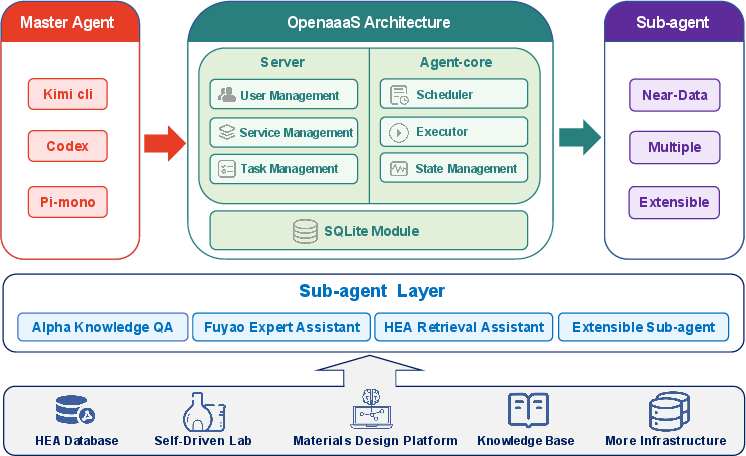
Figure 1: The OpenAaaS hierarchical architecture, showcasing master agents interfacing with a central hub that routes tasks to specialized, near-data sub-agents, securely exposing local resources without raw data migration.
Framework Architecture
OpenAaaS implements a rigorous three-tier, hierarchical network:
- Master Agent Layer: User-facing generalist LLM agents interface with the system, decomposing complex research inquiries into task specifications, orchestrating discovery, execution, and synthesis. Importantly, the master agents are fully decoupled from direct data access, operating strictly at the level of metadata, service descriptors, and returned structured results.
- Network Hub: The central server component coordinates service registration, distributed task routing, authentication, and transfer of lightweight artifacts. It has no access to raw data and leverages outbound, poll-based communication, facilitating deployment behind institutional firewalls.
- Network Node (Agent Core): Each node is a local computational nucleus running domain-specific executors in isolated Docker containers. Nodes expose composable services (e.g., analytics scripts, ML tools, instrument drivers) via self-describing contracts. Data remains confined to local storage; only essential outputs, typically in KB–MB scale, are transmitted over the network.
This design supports progressive capability discovery to alleviate context-window limitations in LLM orchestration, and is fully MCP-compatible, allowing integration with the fast-evolving Model Context Protocol ecosystem and both standard and custom agents.
Evidence-Grounded Literature Analysis: AlphaAgent Case Study
A principal validation of OpenAaaS is its instantiation with AlphaAgent, an executor for materials-science literature grounded reasoning. AlphaAgent formalizes a controlled, evidence-driven workflow, separating retrieval, iterative sufficiency checking, bounded query reformulation, and structured reporting. Validity enforcement is encoded at the task-contract level, with guarantees that all answers are traceable to contextualized and validated evidence.
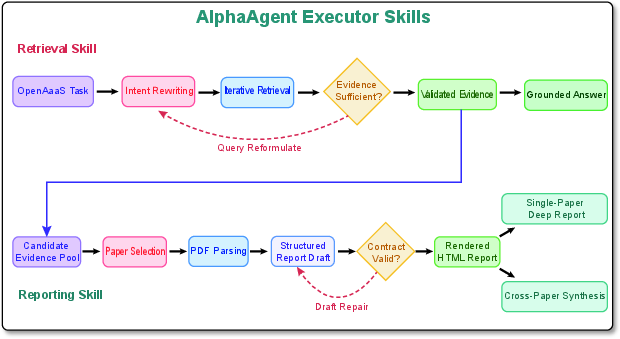
Figure 2: The evidence-grounded skill composition of the AlphaAgent executor, detailing retrieval, evidence sufficiency, and reporting skills, including feedback mechanisms for iterative refinement.
Evaluation against strong single-pass RAG and current closed-source model baselines demonstrates the efficacy of the approach. AlphaAgent achieves a mean score of 4.66 on deep analytical materials questions—a significant improvement over the best single-pass RAG baseline (2.67) and outperforming GPT-5.5 and Kimi-K2.6 on both analytical and general inquiry tasks. The executor’s methodological emphasis on validation, evidence chain traceability, and paper-level reasoning directly addresses domain-specific requirements (compositional specificity, mechanistic focus), which are inadequately served by previous single-shot retrieval-augmented generators or generic LLM agents.
Ultra-Large-Scale HEA Database Service: Near-Data Execution
A second case study operationalizes OpenAaaS on an ultra-large, 17.4 TB hexa-high-entropy alloy (HEA) descriptor database. The HEA-Executor enforces a set of protocol rules ensuring remote execution, minimal data return, strict database isolation, and multi-user concurrency with fully isolated task contexts.
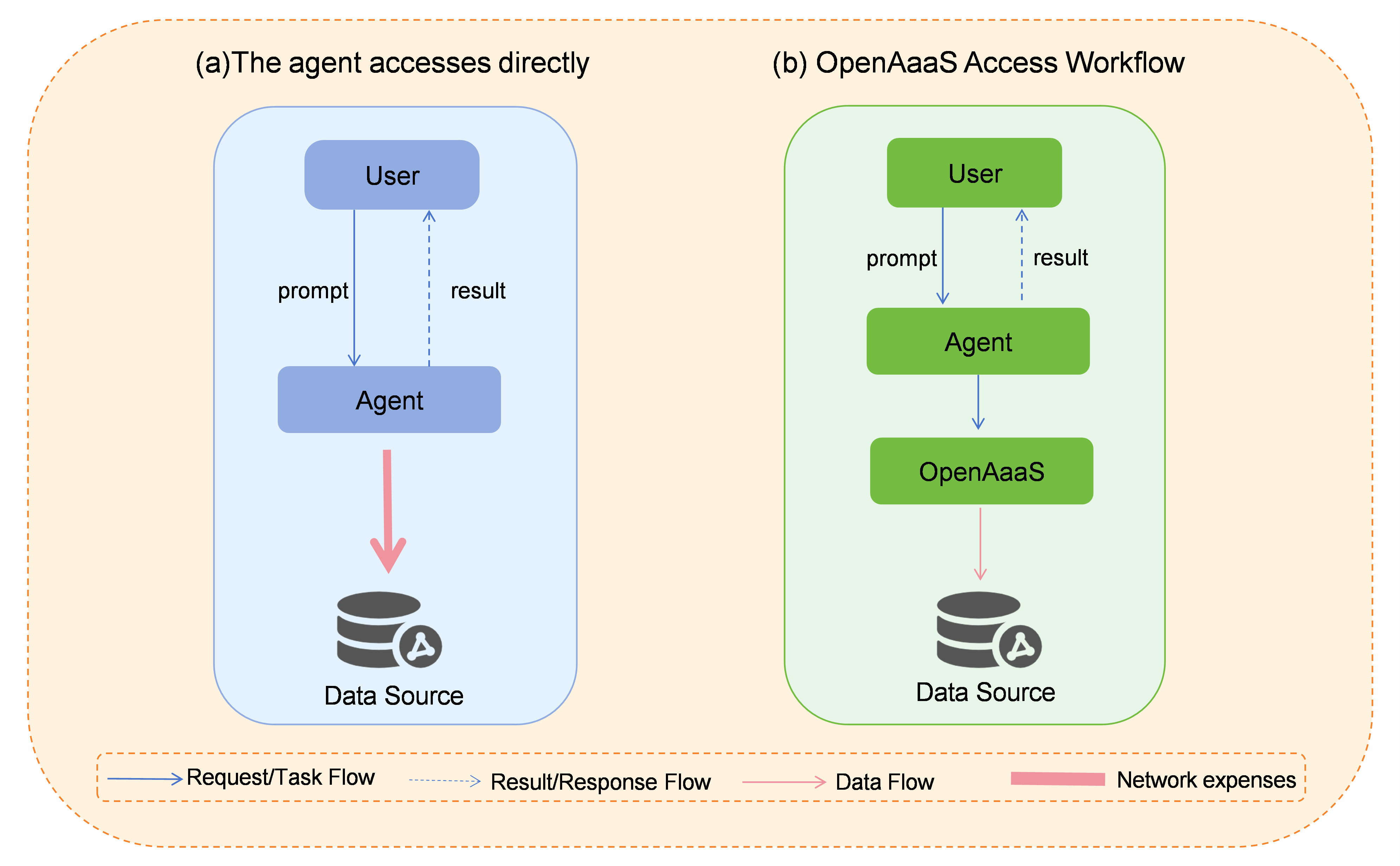
Figure 3: Comparison between direct-agent access, which requires prohibitive bandwidth for large datasets, and OpenAaaS-mediated retrieval, which executes tasks at the data node to avoid data migration.
The executor organizes a multi-agent pipeline for complex querying, ML-based property prediction, and report generation, specifically enforcing constraints like permutation invariance on compositional queries and restricting data exposure to strictly-necessary summary results.
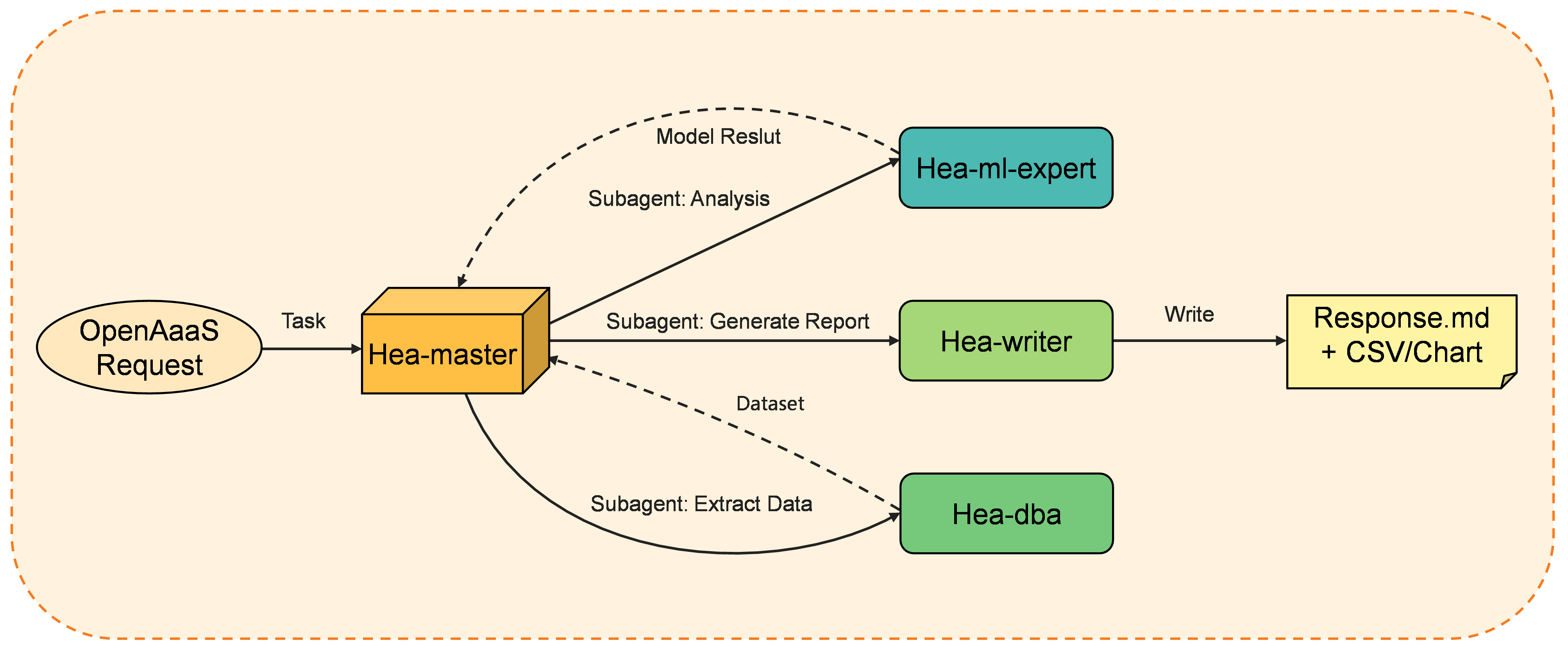
Figure 4: The internal structure of the HEA-Executor, showing coordination among data-access, ML, and writer sub-agents, with explicit state-passing and reproducibility controls.
A practical task—screening MoNbTaW-variant HEAs for optimized room-temperature ductility—demonstrates rapid, secure, and bandwidth-efficient discovery: only 2.3 MB of data transfer sufficed for exhaustive analysis over ~17 TB of candidate space, with the executor identifying design directions that yield a 10.7× improvement in ductile fraction over conventional approaches.
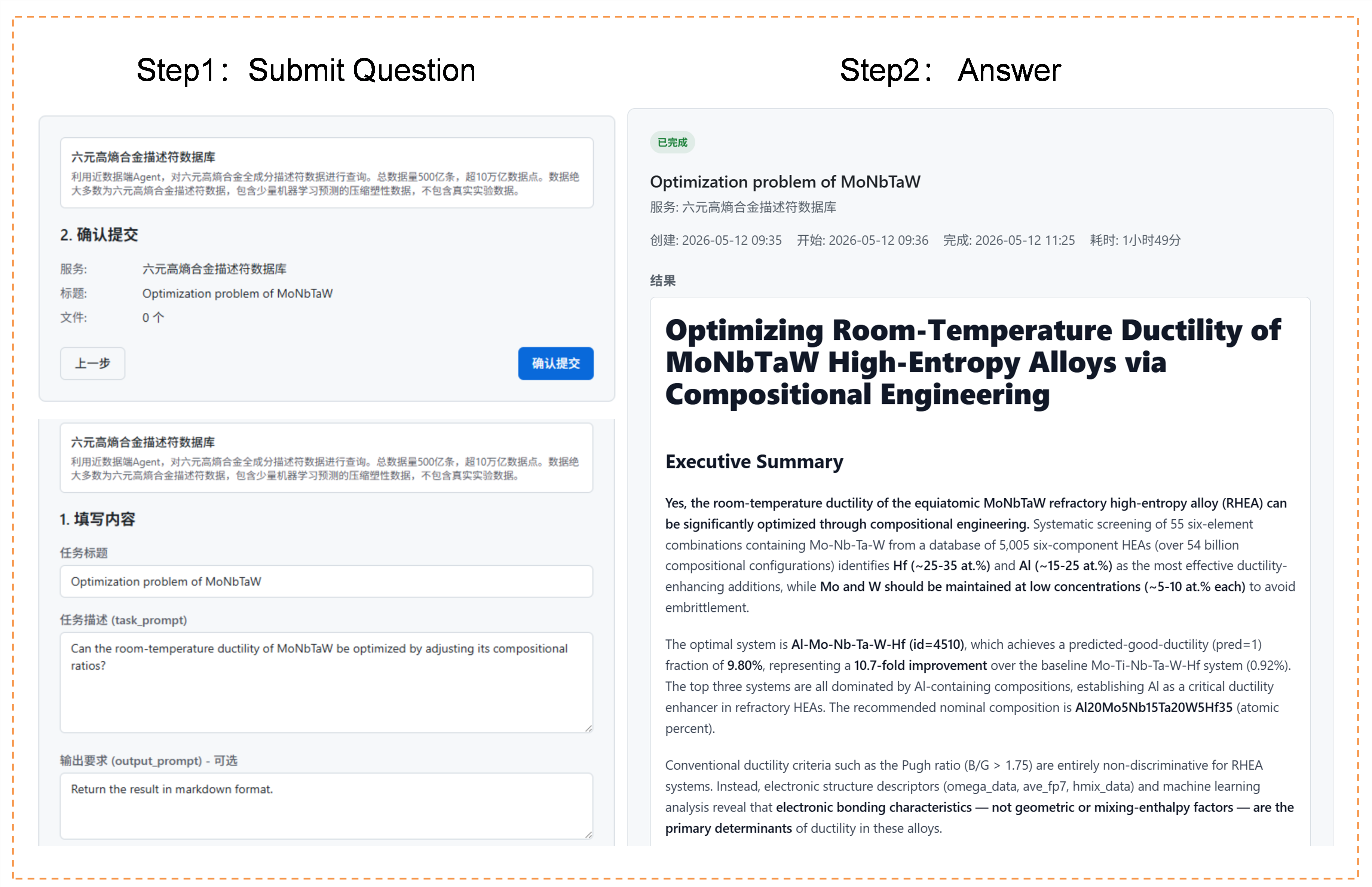
Figure 5: Task submission and returned results for HEA-Executor, demonstrating high-precision filtering and reporting with negligible data transmission requirements compared to database size.
Boundary of Contribution, Security Model, and Limitations
OpenAaaS is not a monolithic agent or learning system but a secure, orchestrating substrate for domain-specialized executors. Scientific reliability emerges from the explicit encoding of evidence discipline, protocol enforcement, and workflow controls inside each executor, rather than from the generic substrate itself. The framework’s defense-in-depth security posture (network encryption, authentication, container isolation, audit trails) is sufficient for deployment across heterogeneous trust boundaries but does not obviate the need for node-level operational security or address all inter-agent trust concerns (e.g., reputation management, result verification).
Current scaling is validated to tens of nodes; further research is required for open-world, permissionless discovery, as well as for building semantically-rich service registries and fully autonomous inter-agent collaboration.
Theoretical and Practical Implications
OpenAaaS introduces a generalizable substrate for “organized research”—persistent, federated multi-agent coordination for scientific discovery, with enforcement of data sovereignty as a first-class architectural constraint. Practically, OpenAaaS enables secure composition of heterogeneous analytics, design, and experimental capabilities, spanning both open and proprietary assets, without centralized trust. The model stands in contrast to the limitations of both centralized platforms (which mandate universal data sharing) and existing multi-agent systems (which typically assume a shared trust boundary).
Theoretically, OpenAaaS demonstrates the viability of fine-grained, service-level trust models for agentic science, highlighting the role of protocolized evidence, partial disclosure, and on-demand composition as foundations for scalable, trustable AI interventions in critical scientific domains.
Conclusion
OpenAaaS offers a robust, composable, and secure framework for distributed, agent-driven materials informatics. Its architectural emphasis on near-data execution, schema-agnostic onboarding, and separable evidence discipline enables complex, high-value research workflows spanning institutional boundaries. The strong empirical performance and practical scalability demonstrated in the AlphaAgent and HEA-Executor studies position OpenAaaS as a foundation for next-generation agentic science platforms, providing specific advances in data security, execution locality, and orchestrated collective intelligence. Future directions include formal verification for agent collectives, autonomous cross-scale design loops, and deeper integration of decentralized trust mechanisms, expanding the reach of agentic systems in both materials science and broader scientific domains.