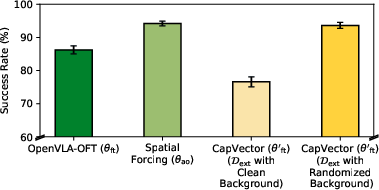
- The paper introduces CapVector, a method that captures auxiliary SFT capability gains as parameter-space vectors for efficient downstream adaptation.
- It employs an orthogonal regularization loss to preserve injected capabilities and prevent degradation during extended finetuning.
- Empirical results demonstrate faster convergence and robust OOD transfer across simulation and real-world robotic tasks.
CapVector: Parameter-Space Capability Transfer for Efficient Vision-Language-Action Model Adaptation
Introduction and Motivation
Vision-Language-Action (VLA) models underpin the current wave of generalist robotic agents via their ability to map multimodal inputs to actionable outputs. Despite extensive pretraining on large-scale robotic datasets, VLA models often require expensive supervised finetuning (SFT) or the introduction of computationally intensive auxiliary training objectives (e.g., spatial alignment, chain-of-thought reasoning) to achieve strong performance and rapid adaptation on complex downstream tasks. This work introduces CapVector, a method for distilling the capability gains of auxiliary-objective SFT into efficient, transferable parameter-space vectors, thereby bridging the functional gap between standard SFT and auxiliary-based approaches with minimal training and computational overhead (2605.10903).
Method: Capability Vectors in Parameter Space
The CapVector framework is based on the hypothesis that the general capability improvements and task-specific adaptation obtained during auxiliary-objective SFT can be linearly decoupled and encoded as parameter-space vectors. The core idea involves executing SFT on a small-scale capability extraction dataset with both standard and auxiliary objectives, yielding two model checkpoints (θft and θao, respectively). The difference in their parameters (γao=θao−θft) is attributed to the capability acquired by the auxiliary objective.
CapVector merges this capability vector with the original pretrained backbone to yield a new meta model (θmeta=θpt+αγao), where α is a hyperparameter controlling the degree of injection.
To retain newly injected capabilities during standard downstream finetuning, CapVector employs an orthogonal regularization loss to enforce that parameter updates for downstream tasks remain orthogonal to the injected capability direction, mitigating catastrophic forgetting with negligible overhead compared to SFT and auxiliary SFT.
Empirical Evaluation: Effectiveness, Generalization, and Versatility
CapVector is evaluated across challenging simulation (LIBERO, RoboTwin 2.0) and real-world robotic manipulation benchmarks using diverse backbones (OpenVLA-OFT, StarVLA, π0.5) and auxiliary strategies (Spatial Forcing, LaRA-VLA). Across all settings, CapVector demonstrates strong quantitative gains:
- ID Performance: On LIBERO-Long, CapVector achieves higher or comparable average success rates vs. full auxiliary SFT baselines at all training budgets, with performance boosts especially pronounced in the low-data regime.
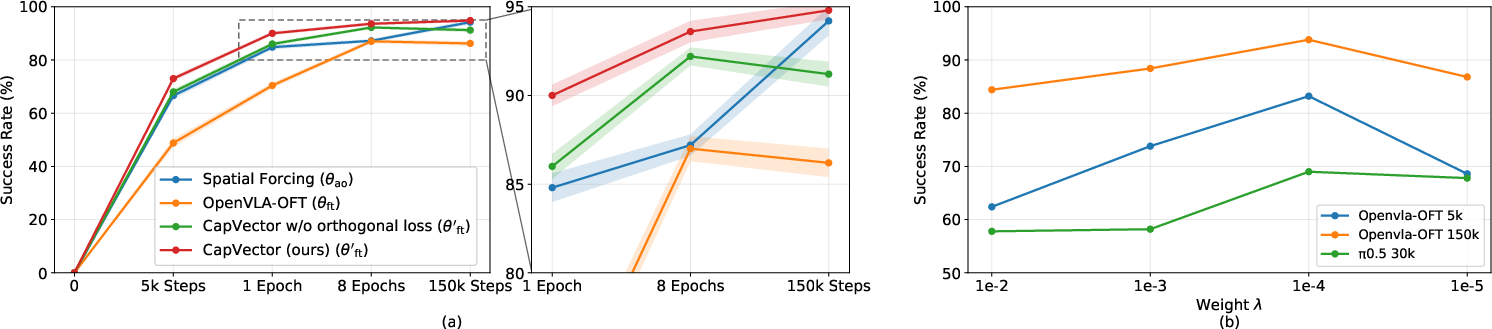
Figure 1: Success rates vs. training iterations on LIBERO-Long for Spatial Forcing (θao), OpenVLA-OFT (θft), and CapVector, demonstrating faster convergence and effective capability transfer with CapVector.
- Ablation: The addition of the orthogonal loss is essential to prevent degradation of injected capabilities under extended finetuning.
- OOD Transfer: Capability vectors trained on LIBERO transfer robustly to RoboTwin tasks—outperforming standard SFT by margins (6.7% → 31.8% success rate with OpenVLA-OFT).
Extensive analyses identify two critical factors shaping the quality of extracted capability vectors:
Sim-to-Real and Cross-Embodiment Robustness
The practical applicability of CapVector is validated on industrial tasks with the UR3 robot, ARX Lift 2, and AgileX Cobot platforms. Capability vectors distilled entirely in simulation are injected into real-robot finetuning, consistently improving manipulation success rates in both in-house and external validation scenarios.
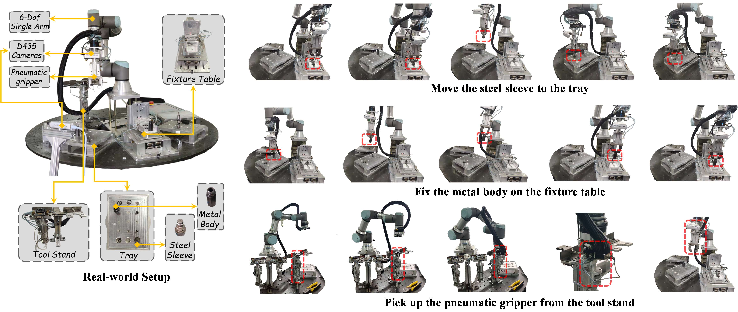
Figure 3: Real-world setup on industrial tasks on UR3 robot, depicting the testbed for sim-to-real evaluation.
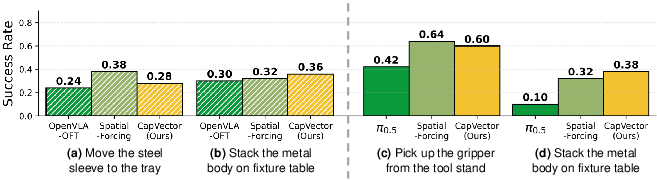
Figure 4: Real-world experiments on industrial tasks with UR3, demonstrating improved success rates for CapVector-injected models.

Figure 5: Cross-embodiment deployment of capability vectors on ARX Lift 2 and AgileX Cobot, showing robust out-of-the-box capability transfer.
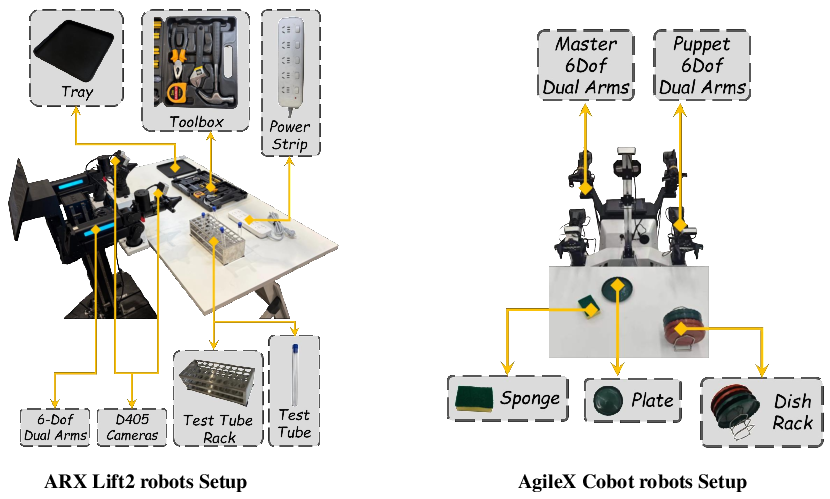
Figure 6: Real-world setup of cross-embodiment deployment tasks, highlighting adaptability to different robot platforms.
The results indicate that CapVector enables scalable sim-to-real transfer and broad embodiment generalization, as the injected capabilities are not overfitted to visual idiosyncrasies of the source environment.
Theoretical and Practical Implications
The main assertions of this work are as follows:
- Linear Decoupling: The paper claims that improvements in general capabilities and task-specific adaptation due to auxiliary SFT are approximately linearly separable in parameter space, allowing capability vectors to generalize across tasks and robot embodiments.
- Computational Efficiency: CapVector achieves the same or superior downstream task performance as auxiliary SFT methods, without repeated auxiliary forward passes and with only a lightweight orthogonal regularizer, yielding negligible additional FLOPs or memory cost.
- Versatility: The merging protocol is agnostic to the SFT strategy (full, LoRA) and the architecture (autoregressive, flow-matching).
- Capability Transfer: CapVector enables one-shot transfer of auxiliary-learned capabilities to new domains, facilitating efficient downstream SFT via a better pre-initialization.
Practically, CapVector offers a plug-and-play mechanism to enhance pretrained VLA models' capability without increasing runtime or training complexity, and provides a pathway for simulation-trained capability extraction to be universally injected into real-world deployment scenarios.
Future Directions
The work opens several research avenues:
- Extending to RL: The current mechanism is limited to supervised finetuning. Future work should generalize capability vector extraction in the reinforcement learning paradigm.
- Nonlinear Merging: While linear decoupling is empirically effective, understanding the limits and possible nonlinear extensions could yield further gains in complex, highly entangled objective settings.
- Automated Capability Extraction: Instantaneous, automated detection and extraction of optimal capability vectors from large task clusters can support more scalable and robust foundation model preinitialization.
Conclusion
CapVector introduces a parameter-space arithmetic mechanism for capability transfer in VLA models, enabling SFT to inherit the training efficiency and generalization property of auxiliary-objective SFT without incurring their computational overhead. This method demonstrates broad utility across architectures, task distributions, and physical robot platforms, providing a tractable and efficient solution for generalist robotic foundation model post-processing and rapid downstream adaptation.