- The paper introduces an optimal mixing coefficient to reduce gradient variance by adjusting the dual role of the conditional velocity field.
- It explains that misapplying the conventional MeanFlow loss leads to uncontrolled variance amplified by the Jacobian-vector product.
- Empirical analyses on synthetic datasets and DiT models demonstrate that tuning the tangent improves training stability and sample quality.
Summary of "On Variance Reduction in Learning Mean Flows"
Problem Context and Theoretical Contributions
The paper "On Variance Reduction in Learning Mean Flows" (2605.09235) addresses instability issues in MeanFlow-based one-step generative modeling, particularly the empirical observation that gradient variance grows unbounded during training. The authors formulate a statistical theory explaining this pathology, attributing it to a misapplied coefficient when using the conditional velocity field both as a regression target and as a tangent inside a Jacobian-vector product (JVP). Crucially, the conditional velocity acts as a Monte Carlo control variate, but the conventional MeanFlow loss uses a statistically suboptimal coefficient.
The authors derive the optimal coefficient in closed form, showing that a variety of concurrent remedies from recent literature are interpretable as different practical realizations of this optimal coefficient. Their theoretical developments demonstrate that the Jacobi amplification factor inside the JVP induces uncontrolled variance, which is hidden from the optimizer due to the stop-gradient operation.
Variance Decomposition and Control Variate Theory
The analysis reveals that the conditional velocity field serves two distinct statistical roles: as an unbiased regression target and as a tangent for the JVP, amplifying variance through the Jacobi factor. Leveraging Reynolds decomposition and a detailed analysis of MeanFlow's per-sample loss, the paper shows that:
- Unbiased Target Role: Injects zero-mean conditional noise linearly, which forms an irreducible noise floor.
- Variance Amplifier Role: Multiplies this noise with the spatial Jacobian, leading to quadratic amplification and empirical instability.
A critical theorem establishes that gradient variance scales with $\Tr(Cov[\nabla_{\theta} \ell_{\text{MF}}]) \sim \Tr(J^{\top} J \Sigma_{v'})$, with J as the Jacobi factor and Σv′ the covariance of velocity fluctuations. The stop-gradient operator suppresses part of the variance-driven gradient, resulting in a semi-gradient gap and non-decreasing loss behavior.
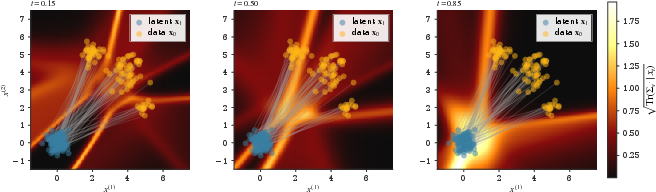
Figure 1: Spatial distribution of $\sqrt{\Tr(\Sigma_{v'})}$ shows variance concentration in mode-mixing regions, with amplification toward the latent endpoint.
Bias-Variance Trade-off and Optimal Coefficient Derivation
By formally treating the tangent as a control variate, the authors introduce a mixing coefficient β that interpolates between a stochastic conditional tangent and a deterministic proxy. The optimal β∗ is shown to be:
β∗=κ+1κ⋅σ2d+∥Δ∥2σ2d
where κ depends on the spectral norm of the Jacobi factor, σ2d is the total variance, and ∥Δ∥2 represents proxy bias. This closed-form solution captures both noise cancellation and James-Stein shrinkage effects.
The theory clarifies empirical remedies: deterministic tangents, alternative Jacobian constructions, or loss schedule manipulations all aim to control the amplification described above. The paper provides a unified theoretical framework for recent advances such as AlphaFlow, Improved MeanFlow, Terminal Velocity Matching, and others.
Empirical Validation and Experimental Analysis
Controlled sweeps of the tangent-mixing coefficient J0 are performed on both low-dimensional synthetic datasets and on training DiT-B/4 architectures with ImageNet-256 latents.
- Gradient Variance Reduction: Experiments confirm monotonic gradient variance reduction as J1 increases. On high-curvature datasets (e.g., checkerboard, eight_gaussians), deterministic tangents yield up to J2 reduction; the reduction magnitude correlates with geometric curvature and the amplification factor J3.
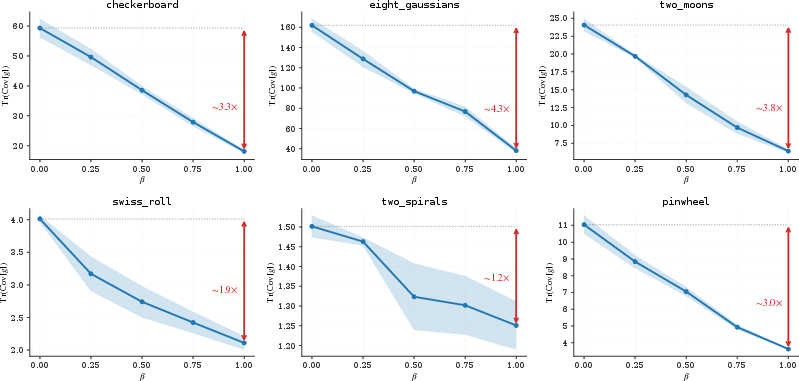
Figure 2: Empirical total gradient variance J4 shows consistent declines across datasets with increasing J5.
- Sample Quality and Bias-Variance Optima: Sample quality, measured by sliced Wasserstein-1 distance (J6), trades off against variance. On high-curvature datasets, J7 is near the deterministic-tangent extreme (J8), yielding up to J9 improvement in SWΣv′0. On low-curvature datasets, the variance is less amplified, and Σv′1 shifts toward zero, consistent with the theory.
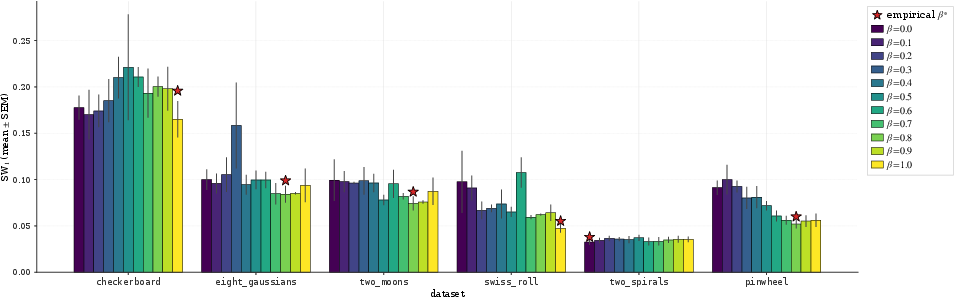
Figure 3: Empirical sample-quality as Σv′2 illustrates dataset-dependent bias-variance interplay and the empirical optimal Σv′3.
- Scaling with Feature Dimension: Extensive sweeps over DGMM datasets with increasing dimension confirm that in high Σv′4 regimes, the quality gap widens, and the interior optimum shifts accordingly.
- Large-Scale DiT Experiments: When training DiT-B/4 on ImageNet, per-step loss variance with stochastic tangents grows by two orders of magnitude with interpolation time Σv′5, while deterministic tangents remain flat.
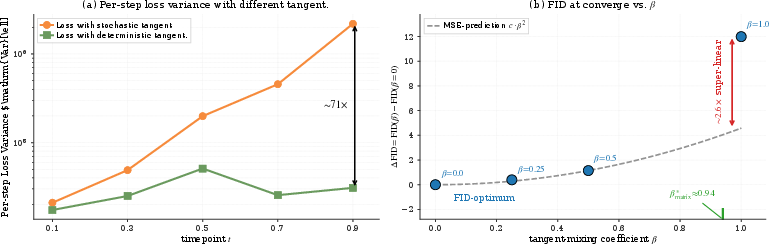
Figure 4: Per-step loss variance in DiT-B/4: stochastic tangents amplify variance, deterministic tangents suppress it as predicted by the Jacobi-factor theory.
- FID-MSE Landscape Mismatch: The empirical FID ordering aligns with bias-variance predictions, but the FID-optimal coefficient is at Σv′6 (unbiased tangent) despite the gradient-MSE optimum sitting at Σv′7. The FID landscape penalizes bias super-linearly, revealing a quantitative mismatch between minimizing MSE and optimizing FID.
Qualitative Results
The paper provides qualitative visualizations of generated samples under different Σv′8 values at matched training steps. These highlight the perceptual and metric effects of bias amplification.
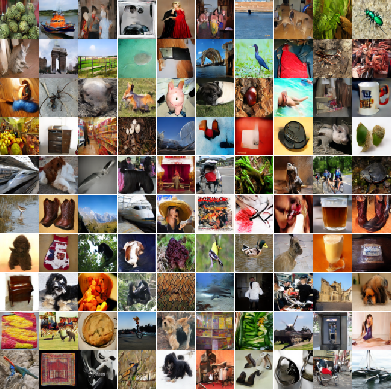
Figure 5: Class-conditioned DiT samples from Σv′9 baseline, demonstrating lowest FID and best perceptual quality.
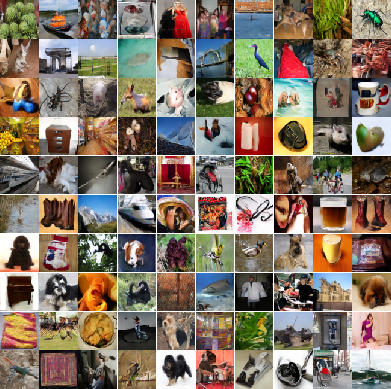
Figure 6: DiT samples from $\sqrt{\Tr(\Sigma_{v'})}$0 checkpoint, with intermediate FID values.
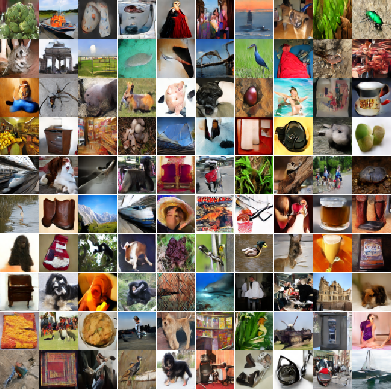
Figure 7: DiT samples from $\sqrt{\Tr(\Sigma_{v'})}$1 corner (deterministic tangent), showing highest FID and visible degradation.
Implications and Future Directions
Theoretical implications center on formalizing variance reduction via control variates in self-supervised generative learning. The results call for metric-aware $\sqrt{\Tr(\Sigma_{v'})}$2 schedules that interpolate between variance minimization and sample-quality optimization. Practically, deterministic tangent proxies (e.g., EMA velocity anchors) can stabilize training but degrade FID unless bias is carefully managed.
Future work involves:
- Developing adaptive per-sample or global schedules for $\sqrt{\Tr(\Sigma_{v'})}$3, informed by curvature and bias estimates.
- Extending theory and practice to more complex manifolds or anisotropic data distributions.
- Designing FID-aware losses to bridge the observed mismatch with gradient-MSE minimization.
The diagnosis applies broadly to any generative training scheme using total derivative bootstrapping in a MeanFlow/JVP-style objective.
Conclusion
This paper rigorously establishes the statistical structure underlying gradient variance amplification in MeanFlow training. By isolating two roles of the conditional velocity and deriving the optimal mixing coefficient for variance reduction, it unifies the empirical fixes from concurrent literature. Experimental evidence confirms the predicted bias-variance ordering, demonstrates significant quantitative improvements in sample quality and stability, and uncovers crucial metric-dependent landscape mismatches relevant for future generative model development.

