- The paper introduces EnvSimBench, a formal benchmark to evaluate LLM-based environment simulation by framing the task as a fully observable MDP.
- It defines 'EnvSim Ability' and employs stratification along action outcomes, state-change complexity, and argument cardinality for precise diagnostics.
- Empirical results reveal a universal state-change cliff and demonstrate how specialized fine-tuning enhances simulation fidelity and cost-efficiency.
Introduction and Context
Recent shifts toward the use of LLMs for simulating interactive environments have exposed a critical bottleneck in the training and evaluation of autonomous agents. The scalability and flexibility of LLM-simulated environments promise reduced costs and higher diversity compared to manually crafted alternatives. However, the underlying assumption—that LLMs can consistently and accurately simulate environment state transitions and feedback—remains unexamined and empirically fragile. "EnvSimBench" (2605.07247) establishes a formal foundation for diagnosing, benchmarking, and improving the fidelity of LLM-based environment simulators, introducing new metrics and methodologies, and delivering actionable insights for agent training paradigms.
The paper provides a rigorous operationalization of Environment Simulation Ability (EnvSim Ability)—defined as a model's capacity to produce precise environment state transitions and observable feedback given an explicit specification of the current state, the intended action, and its implementation logic. The prevailing approach utilizes LLMs in a partially observable Markov decision process (POMDP) setting—forcing models to infer the latent environment state from action-observation histories, which systematically leads to cumulative state drift, hallucination, and logical inconsistencies.
In contrast, EnvSimBench reframes simulation as a fully observable Markov decision process (MDP), supplying the explicit environment state and transition schema to the model at every step. This decoupling of state estimation from state transition prediction constrains the model's task to programmatic logic execution and state update, making each action independently verifiable and abolishing compounded errors.
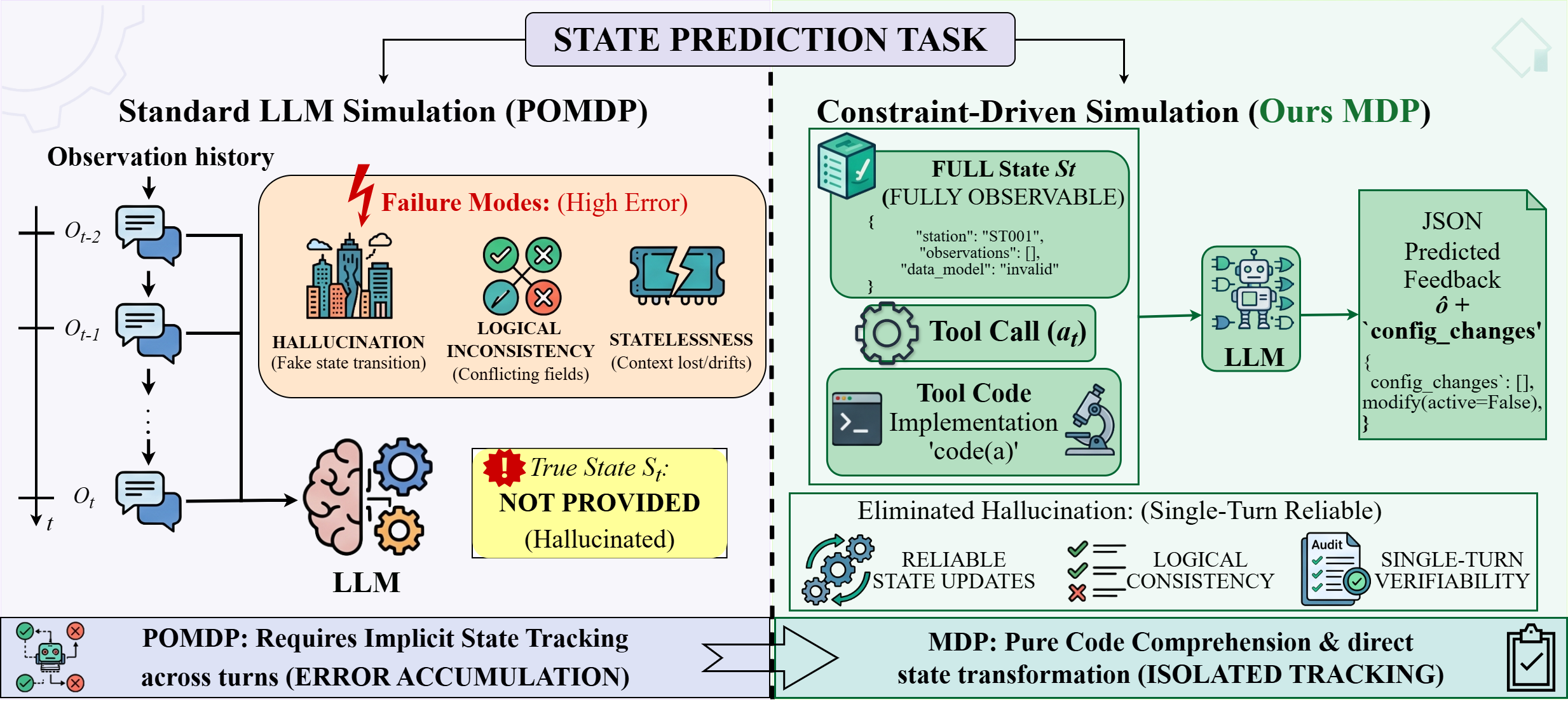
Figure 2: The transition from a POMDP to an MDP paradigm in LLM simulation eliminates state drift and makes each step independently verifiable.
EnvSimBench: Construction and Stratification
EnvSimBench is a meticulously constructed benchmark comprising 400 samples spanning 167 distinct tool-interactive environments. Benchmark generation is powered by a pipeline collecting multi-turn execution traces in EnvScaler environments, preprocessing them into atomic, single-turn samples, each providing all necessary state, action, and code for deterministic evaluation. Crucially, ground-truth labels are generated exclusively by a Python executor, not by LLMs.
The benchmark introduces fine-grained stratification along three orthogonal axes:
- Action Outcome: Partitioning actions by success or failure.
- State-Change Complexity (∣Δ∣): Categorizing samples by the number of simultaneous state changes (No-Change, Simple, Medium, Difficult).
- Argument Cardinality: Further dissecting cases by number of action arguments.
This stratification allows the isolation and diagnosis of state transition failures, rather than suppressing them into aggregate scores.
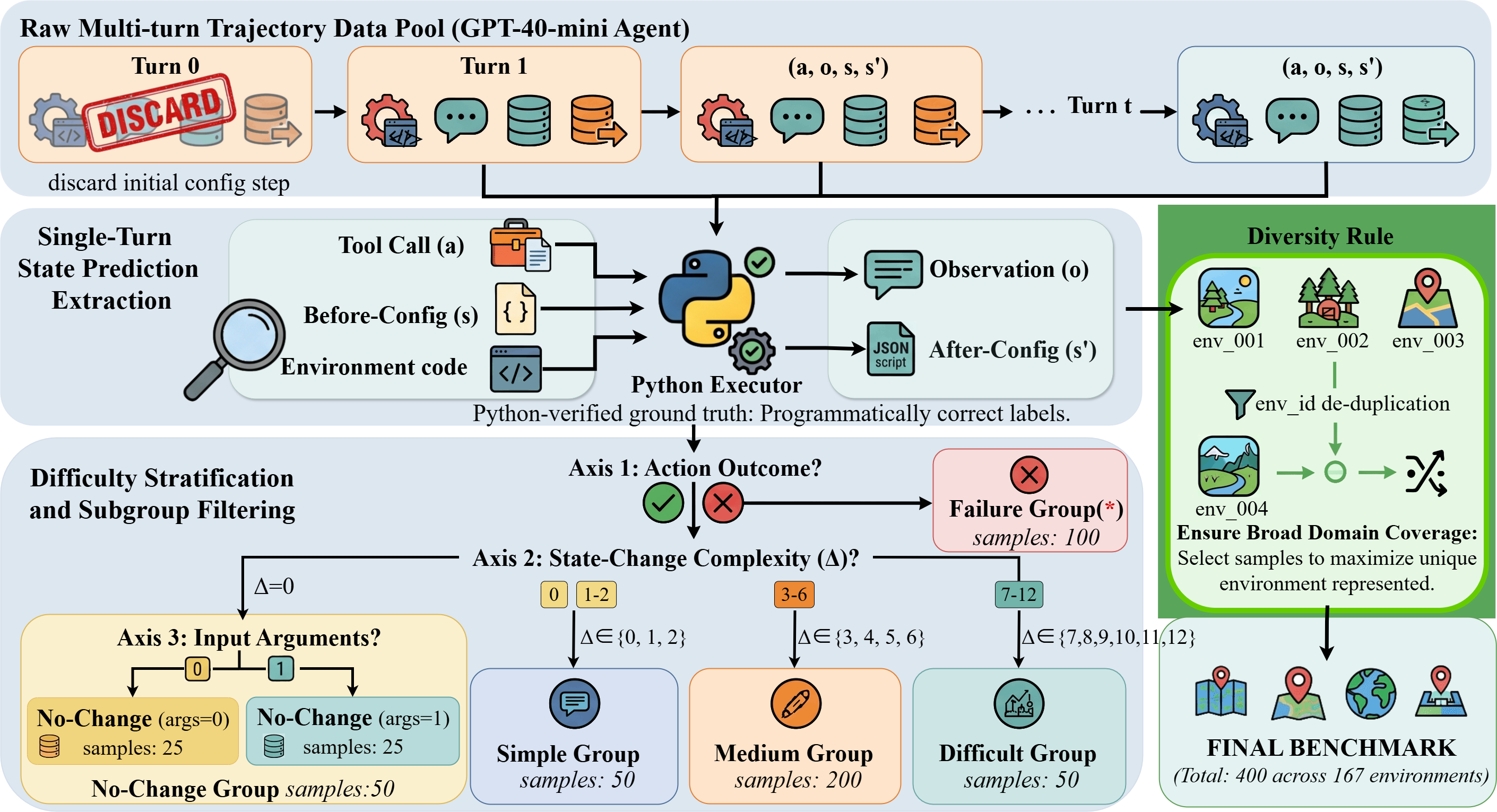
Figure 1: Benchmark construction pipeline: multi-turn trajectories are stratified by outcome, complexity, and argument count, then diversified for maximal environment coverage.
Evaluation of LLMs: State-Change Cliff and Architectural Failure Modes
Systematic evaluation of seven competitive LLMs (e.g., DeepSeek-V3.2, Qwen3.5-397B-A17B, GPT-5.4, Gemini-3.1-Pro-Preview) reveals a universal and sharp state-change cliff: all models achieve near-perfect state prediction when no mutations are needed but their performance in config match (CM) collapses catastrophically as ∣Δ∣ increases. At ∣Δ∣≥3, all frontier models rapidly approach zero accuracy, indicating a qualitative barrier not attributable to model scale or generic reasoning ability.
Quantitative analyses distinguish between two orthogonal failure modes:
- Format Mismatch: Output structurally correct transitions but incorrect feedback formatting, irrelevant to true simulation fidelity.
- State-Tracking Failures: Appear as high feedback match (FM) but low config match (CM), signifying cases where LLMs produce plausible agent-facing strings yet silently corrupt the underlying state. These failures are invisible to downstream agents and dangerously undermine agent training.
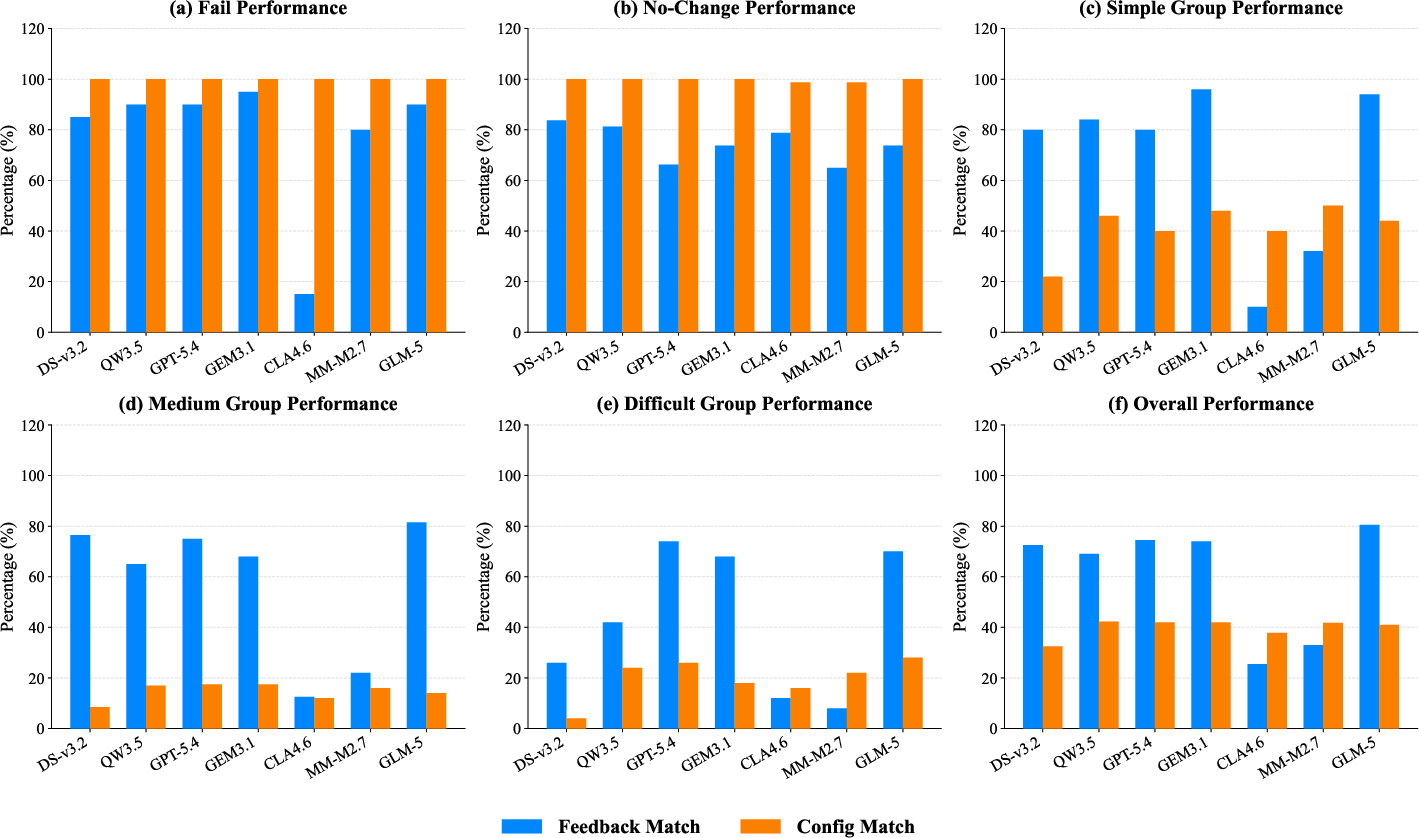
Figure 5: FM remains relatively high with increasing ∣Δ∣, but CM collapses dramatically—a hallmark of the "state-change cliff".
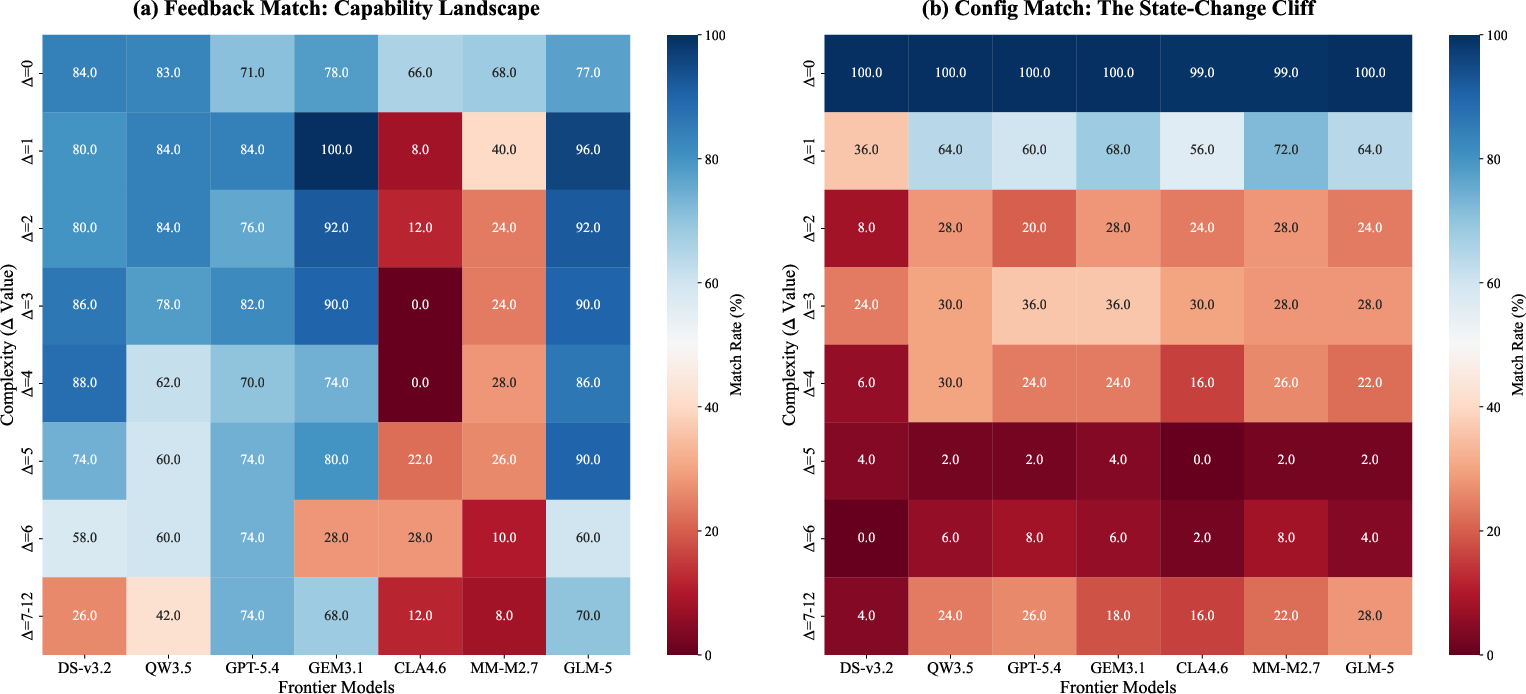
Figure 3: Heatmaps of FM (left) and CM (right) by model and Δ, highlighting the universal cliff and format-dependent failure columns.
Specialized Training and Cost-Efficiency
Attempts to mitigate these limitations through full-parameter supervised fine-tuning (SFT) of a Qwen3-4B-Base model demonstrate that:
- Model specialization is critical; scaling alone does not close the fidelity gap.
- Balanced curricula (mirroring empirical state-change distributions) substantially boost generalization across difficulty strata and yield CM scores (45.3%) surpassing all evaluated frontier models.
- The state-change cliff persists, suggesting a fundamentally hard generalization barrier for LLMs in multi-field state tracking.
Critically, substituting the specialized 4B model into the downstream environment synthesis pipeline increases the yield of passing environments by 6.8% and reduces cost by over 90%, confirming the practical value of targeted model design.
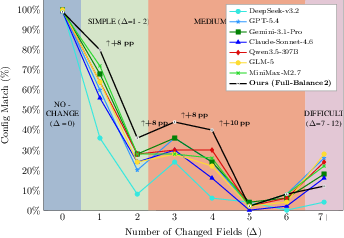
Figure 4: Config Match across Δ shows the specialized fine-tuned model outperforms all frontier LLMs at moderate state-change complexity.
Failure Analysis and Implications
EnvSimBench exposes core issues in LLM-based simulation:
- Hallucination and Logical Inconsistency: Models hallucinate constraints or invent side effects not present in the tool logic, especially in poorly-represented (high ∣Δ∣) or ambiguous cases.
- State Drift Elimination: Framing the problem as single-step MDP eliminates cumulative state drift but cannot resolve fundamental program synthesis limitations.
- Data Composition vs Volume: Training data composition, not mere quantity, drives generalization. Over-weighting complex examples or supporting reasoning traces alone do not overcome the cliff.
The strong empirical decoupling between reasoning proficiency and state simulation ability challenges fundamental assumptions about LLM agent training and calls for the integration of explicit execution modules or hybrid neural-symbolic architectures.
Future Directions
Several open research directions follow:
- Semantic Metrics: Moving beyond exact match toward semantic and functional equivalence for feedback and state predictions, enabling the diagnosis of subtle logical errors.
- Structured State and Transition Reasoning: Augmenting LLMs with code-execution modules or hybrid approaches to handle compositional multi-field updates and nontrivial side effects.
- Automated Data Augmentation: Systematic enrichment of high-complexity, high-diversity state transitions in training corpora to better expose models to the hard cases underpinning the state-change cliff.
- Robust Agent Evaluation: Integrating environment simulation benchmarks into standard agent evaluation pipelines, with joint tracking of both observed and latent agent-environment divergence.
Conclusion
"EnvSimBench" (2605.07247) operationalizes a precise standard for evaluating and improving LLM-based environment simulation, exposing the core limitations of current models and providing both a rigorous diagnostic framework and a practical optimization path. By formalizing the environment simulation task as a fully observable and independently verifiable MDP, and by demonstrating the empirical universality of the state-change cliff, this work establishes foundational baselines for future research in reliable, scalable environment simulation—a prerequisite for trustworthy agent training at scale.

