- The paper introduces AuxPath-FM, which generalizes flow matching by incorporating auxiliary variables from arbitrary distributions to guide generative trajectories.
- It employs deterministic time-dependent coefficients and label-guided auxiliary variables to seamlessly enable trajectory-level conditional generation and efficient classifier-free guidance.
- Empirical results on datasets like MNIST and CIFAR-10 demonstrate enhanced classification accuracy, improved mode separation, and reduced inference costs.
Flow Matching with Arbitrary Auxiliary Paths: An Authoritative Analysis
Introduction
The paper "Flow Matching with Arbitrary Auxiliary Paths" (2605.06364) introduces AuxPath-FM, a generative modeling framework that generalizes flow matching via the incorporation of auxiliary random variables drawn from arbitrary distributions into the interpolation paths connecting base and data distributions. This approach extends the capacity for trajectory-level control and guidance in continuous-time generative models, enabling diverse probability path designs and principled integration of semantic information directly into the generative process.
Framework Overview and Theoretical Foundation
AuxPath-FM parameterizes generative trajectories as Xt=a(t)X1+b(t)X0+c(t)η, where X0 and X1 are endpoint samples, a, b, c are deterministic time-dependent coefficients, and η is an auxiliary variable sampled from an arbitrary distribution. The theoretical analysis demonstrates that the resulting probability paths, including those with structured or discrete priors, preserve fundamental requirements: boundary conditions, the continuity equation, and marginal flow matching objectives. Notably, it is proven that the conditional flow matching objective under these paths yields optimality equivalent to standard marginal flow matching loss, enabling tractable and unbiased training via Monte Carlo estimates.
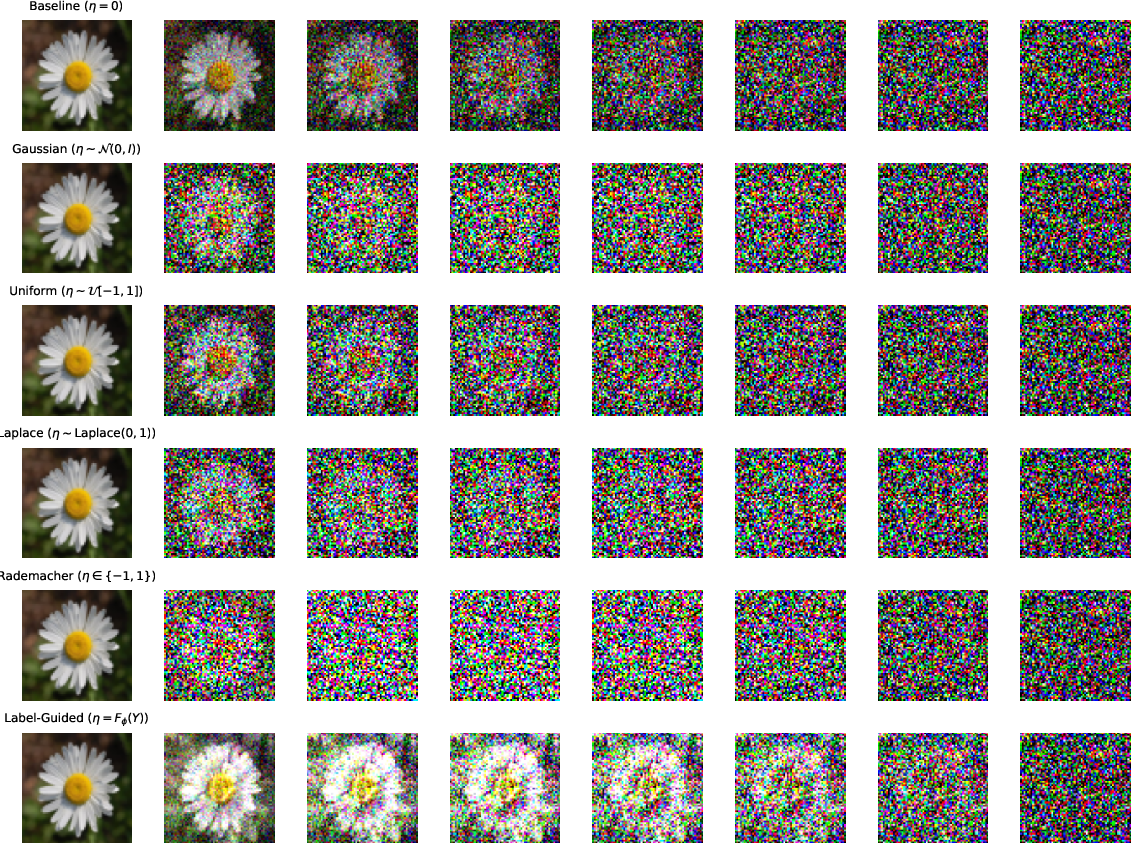
Figure 1: Generative trajectories of AuxPath-FM with diverse auxiliary distributions. Different choices for η (Gaussian, Uniform, Laplace, Rademacher, Label-guided) induce distinct geometric behaviors in interpolation paths between X0 and X1.
Auxiliary Variable Design and Geometric Properties
AuxPath-FM's flexibility allows X00 to be instantiated from Gaussian, Uniform, Laplace, Rademacher, or even label-guided distributions. Empirical demonstrations reveal that distinct structural biases arise from choosing discrete or heavy-tailed auxiliary priors, affecting the geometry and controllability of generative trajectories. This broadens the operational regime of flow matching models, unifying continuous and discrete data types and enabling compositional or deterministic auxiliary variable configurations.
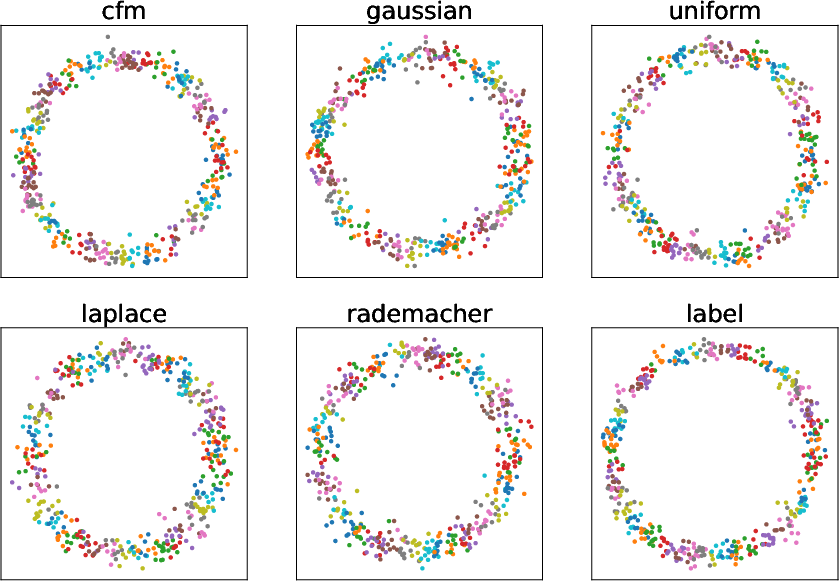
Figure 2: Generated trajectories on the ring-64 dataset using different auxiliary distributions for X01, illustrating the effect of auxiliary choice on trajectory separation and mode accuracy.
Conditional Generation and Semantic Guidance
A significant contribution is the embedding of semantic conditioning into the probability path itself via label-guided auxiliary variables: X02, where X03 is a neural prototype encoder trained to approximate class centroids. Unlike prior approaches that restrict conditioning to network-level modulation, this setup ensures global trajectory bias toward semantic regions throughout the generative flow. Experiments confirm that label-guided auxiliary variables yield heightened conditional accuracy and reduced error in multi-modal settings such as ring-64, MNIST, and CIFAR-10.
Further, AuxPath-FM enables classifier-free guidance (CFG) at the trajectory level, decoupling guidance from backbone velocity field evaluations and admitting linear auxiliary interpolation as X04. This cuts inference costs in half compared to conventional CFG, as guidance is implemented via lightweight semantic modules rather than expensive backbone passes.
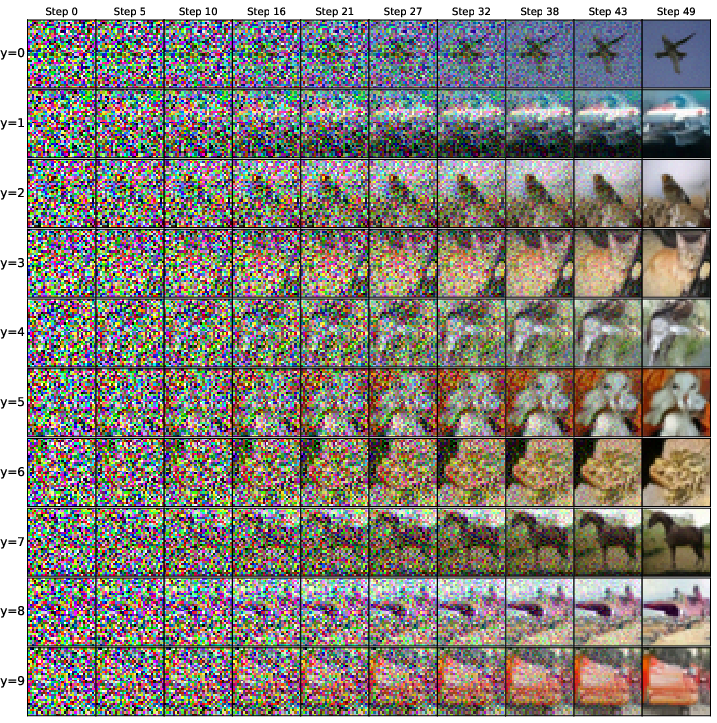
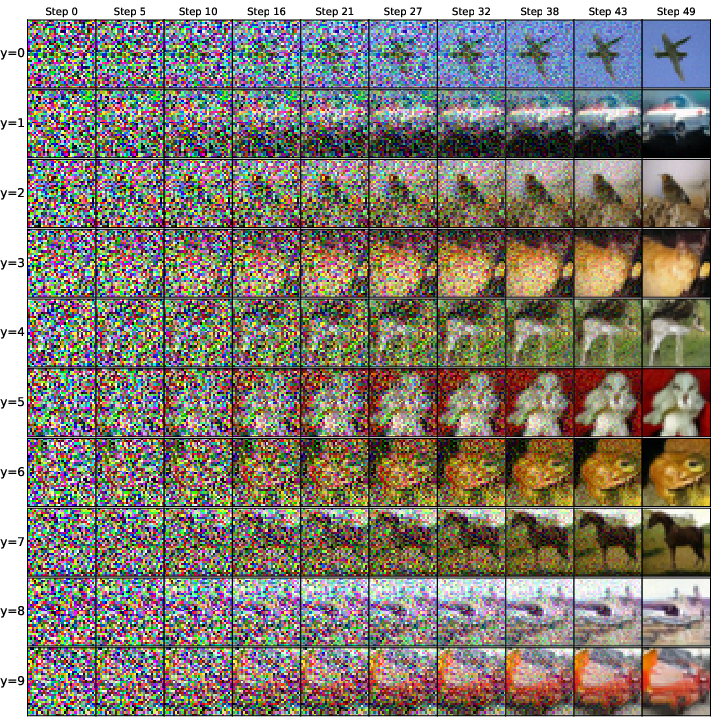
Figure 3: Generation trajectories of AuxPath-FM with trajectory-level CFG on CIFAR-10. Increasing guidance scale enhances semantic alignment of generated samples while maintaining path continuity, achieved in single-pass backbone evaluation.
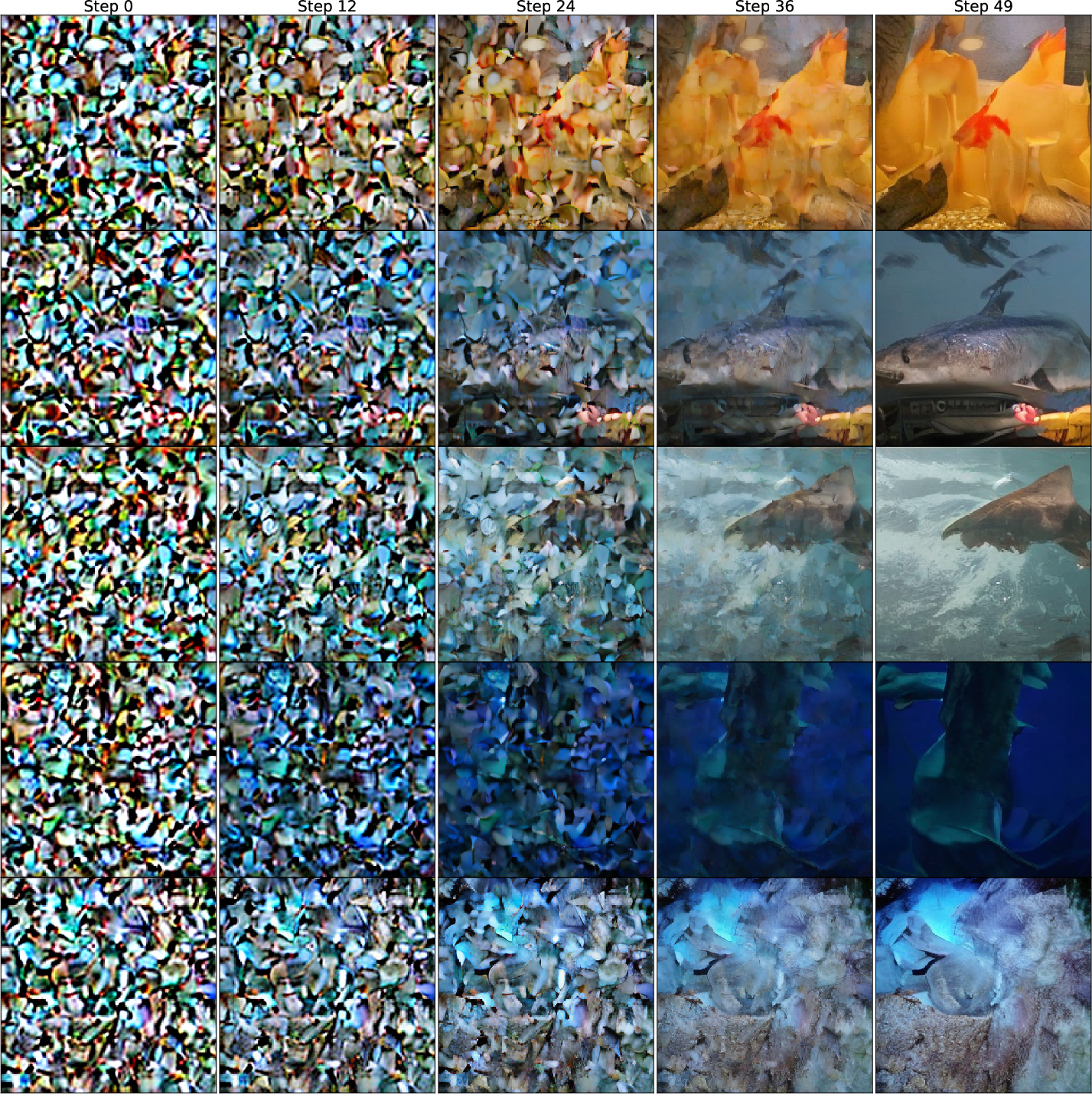
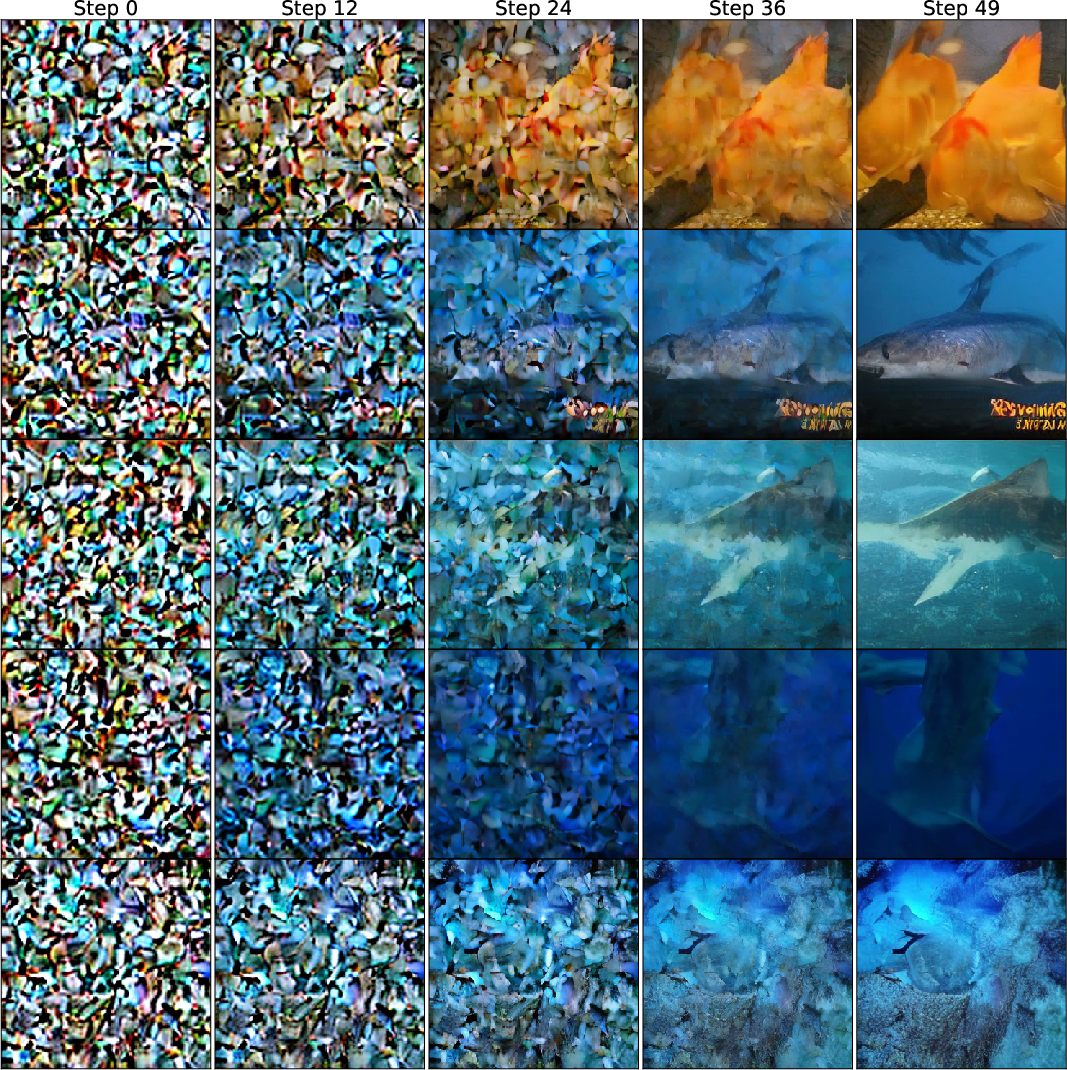
Figure 4: Trajectory-level CFG on ImageNet-1k with AuxPath-FM. Higher guidance scale steers samples closer to target classes, preserving smooth transitions throughout the probability path.
Numerical Results and Empirical Validation
AuxPath-FM exhibits robust performance across standard benchmarks. On MNIST and CIFAR-10:
- Classification accuracy (Acc) increases to 98.1% with numeric auxiliary guidance and 97.1% with learned semantic prototypes, outperforming baseline CFM.
- Frechet Inception Distance (FID) and spatial FID (sFID) remain competitive or are improved by integrating auxiliary paths.
- Auxiliary design: All tested auxiliary distributions sustain stable generation, with label-guided X05 achieving superior mode separation and semantic alignment.
- Trajectory-level CFG: Increasing guidance scale X06 yields higher semantic accuracy and Inception Score (IS) while retaining generative fidelity. This guidance is realized in a single backbone evaluation, demonstrating practical efficiency gains.
- Fine-tuning: AuxPath-FM enables conversion of pre-trained unconditional flow models to conditional generators via lightweight auxiliary modules, with no architectural changes.
Practical and Theoretical Implications
The principal practical implication is the clear decoupling of conditional guidance from core velocity field computations, allowing for efficient inference and scalable conditional generation in large-scale settings (e.g., ImageNet-1k). The framework's compatibility with pre-trained models facilitates rapid retrofitting for conditional tasks. Theoretically, AuxPath-FM provides a unified perspective that subsumes Gaussian stochastic interpolants, Schrödinger Bridge models, and discrete flows as special cases. Its capacity for arbitrary auxiliary distributions extends generative modeling beyond Euclidean Gaussianity, accommodating structured signals and complex geometries, with adaptive manifold behavior confirmed in related studies [kumar2026manifold].
AuxPath-FM's ability to encode semantic prototypes and enable trajectory-level CFG may inspire future architectures for domain adaptation, controllable generation, and compositional data modeling. The modularity of auxiliary components suggests potential extensions into multi-modal, hierarchical, and reinforcement-guided flows, as well as applications in discrete and geometric generative tasks.
Conclusion
AuxPath-FM generalizes flow matching by integrating arbitrary auxiliary distributions into probability paths, maintaining theoretical guarantees and enhancing empirical controllability, precision, and efficiency. Semantic-guided auxiliary variables allow for principled label-conditioning and trajectory-level guidance, reducing computational cost and improving generation quality. The framework’s flexibility and compatibility with standard objectives position it as a compelling foundation for structured, conditional, and efficient generative modeling across diverse modalities and tasks.