Generative Modeling by Value-Driven Transport
Abstract: We propose a new framework for generative modeling based on a discrete-time stochastic control formulation of measure transport. Adapting classic results from control theory, we formulate our problem as a linear program whose dual variables correspond to the \emph{optimal value function} of the control problem, which directly encodes the optimal control policy. Exploiting this LP formulation, we develop an efficient simulation-free primal-dual algorithm for computing approximately optimal value functions and the associated \emph{value-driven transport} (VDT) policies which approximate the true optimal policy. We show that well-trained VDT policies enjoy numerous favorable properties in comparison with other state-of-the-art methods based on flows, diffusions, or Schrödinger bridges: they lead to straight transport paths which can be simulated quickly and robustly, and can be enhanced in all the same ways as diffusion and flow-based models (e.g., conditional generation, classifier-free guidance, unpaired data-to-data translation are all easy to incorporate). We evaluate our methodology in a range of experiments, with results that indicate strong performance and good potential for scalability.




Paper Prompts
Sign up for free to create and run prompts on this paper using GPT-5.
Top Community Prompts
Explain it Like I'm 14
Overview
This paper introduces a new way for computers to “make” data—like images—by learning how to move points from one shape to another. Think of it as starting with a bunch of dots in one pattern (the “source,” like random noise) and carefully moving them so they end up in a new pattern (the “target,” like a real image). The authors call their method Value-Driven Transport (VDT). It uses ideas from planning and control (how to decide good moves step by step) to create fast, stable, and flexible generators.
What questions does the paper ask?
In simple terms, the paper asks:
- How can we turn samples from one distribution (like noise) into samples from another distribution (like real images) in a way that’s efficient, accurate, and easy to control?
- Can we design a method that moves points along simple, straight paths so generation is fast?
- Can we use a single “brain” (a neural network) that tells us the best direction to move at every step?
- Can this method work both forward (noise → image) and backward (image → noise), and also handle tasks like conditional generation (e.g., “make a 7”) or translation between different kinds of data?
How does the method work? (with plain-language explanations)
Imagine you have a pile of sand shaped like a hill (the source) and you want to reshape it into a castle (the target). You want to move the sand using the least effort. This is called “optimal transport.”
VDT turns this idea into a step-by-step moving plan:
- Step-by-step moves: Instead of moving all the sand in one go, you move it in small steps over a fixed number of rounds.
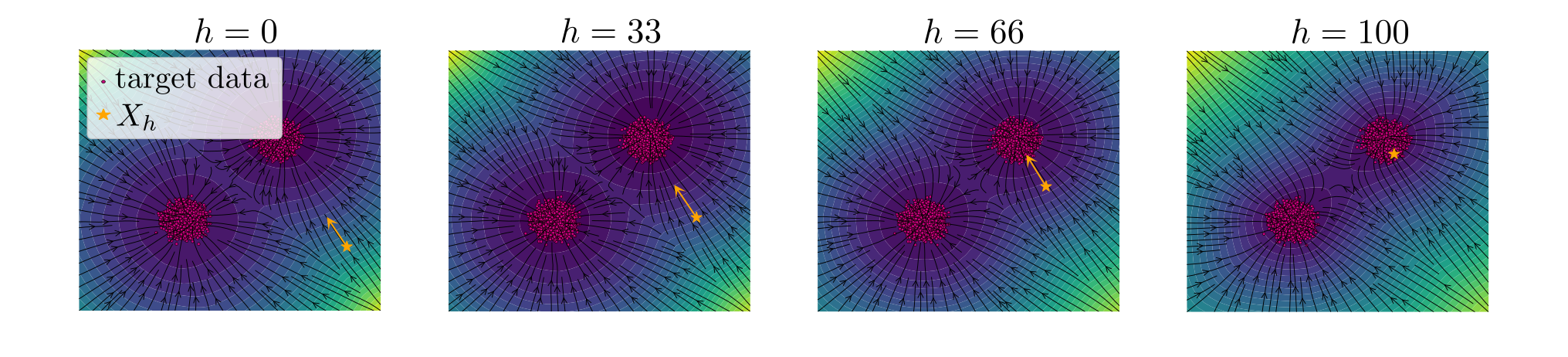
- A value function as a “map”: The method learns a special function—think of it as a landscape, where each point has a “score” for how good it is to be there next. The slope of this landscape (the gradient) tells you which way to move to get closer to the target with minimal effort.
- Value-Driven Transport (VDT): In each step, the method moves every point a short distance downhill on this landscape. That downhill direction is the “best move” the method has learned.
- A “primal–dual” training loop:
- Primal side (the mover): Represent lots of points (particles) and nudge them to better match the rules and goals (start looks like the source, end looks like the target, and movement cost is small).
- Dual side (the judge): Train the value function—the judge that scores and guides moves—so it rewards correct transport and penalizes wrong endings.
- They update each other: The mover tries to minimize transport cost; the judge adjusts to make sure final points really match the target. This back-and-forth teaches the landscape how to guide points well.
Helpful analogies for the technical bits:
- “Optimal transport” = moving mass with the least effort.
- “Linear program” = a structured way of planning under simple rules (like “start here,” “finish there”) to minimize cost.
- “Dual variables/value function” = a smart “judge” that assigns scores so the best plan is also the cheapest.
- “Gradient” = the direction of steepest downhill on the landscape; it’s the direction to move next.
- “Particles” = tiny pebbles that stand in for many data points so the method can learn from examples.
A neat property: When the method is ideal, the points move in straight lines from source to target. This means once you’ve learned the landscape, you can often generate in far fewer steps than you used during training.
What did they find, and why is it important?
The main findings:
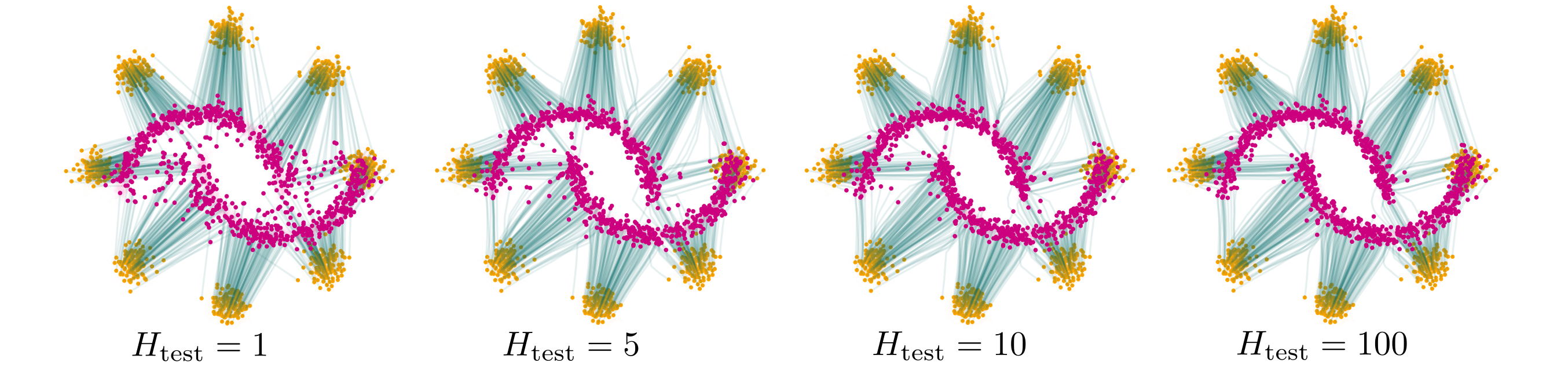
- Straight, fast paths: The method learns to move points along nearly straight lines, which lets it generate samples in fewer steps at test time—often much fewer than used in training—saving time without losing much quality.
- Strong performance in tests:
- On simple 2D datasets (like moons or multiple Gaussians), VDT matched or approached the performance of popular methods while keeping paths smooth and short (low “path energy”).
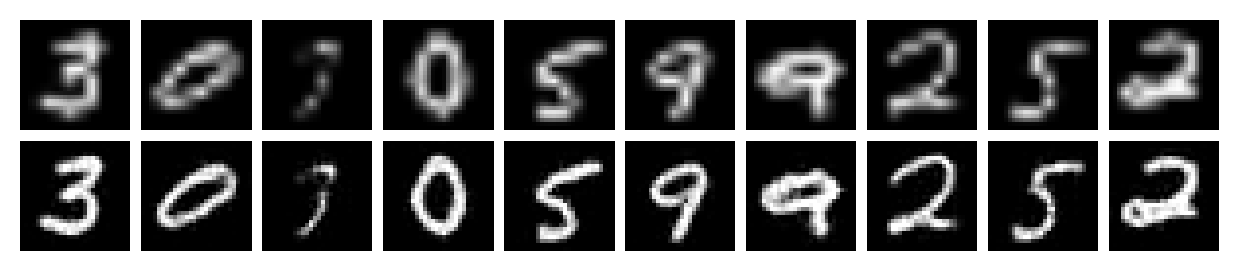
- On MNIST tasks (handwritten digits), VDT worked for:
- Paired translation: deblurring images back to clean digits.
- Unpaired translation: turning letters (from another dataset) into digits without explicit pairings, learning the relation from data alone.
- Conditional generation: making a specific digit, and even improving sharpness with “classifier-free guidance,” a trick borrowed from diffusion models.
- Flexible and symmetric: Because the method is built on moving distributions, it naturally works both ways (source → target and target → source) and easily fits in labels or other information for conditional tasks.
- Simple architecture: Training uses one neural network (the value function) and doesn’t need complex simulations. This helps keep things robust and easier to scale.
Why this matters:
- Fewer steps = faster generation, which is valuable in practice.
- A clean, control-based view provides a new toolkit for generative modeling, different from diffusion or flow models, but compatible with many of their tricks.
What could this mean going forward?
The paper shows that generative modeling can be done by learning a “landscape” (value function) that naturally guides data from source to target along cheap, straight routes. This opens up several possibilities:
- Speed: Few-step generation could make future models much faster.
- Control: Because it comes from control theory, it may be easier to add constraints, goals, or custom guidance.
- Versatility: The same setup supports conditional generation, forward/backward transport, and even unpaired translation.
- New bridges: The approach connects fields—optimal transport, control, reinforcement learning, and deep learning—suggesting more cross-pollination and new methods.
The authors also note current limits: the training recipe is new and might need more engineering to tackle the largest, most complex datasets. But the promising results and simple structure suggest strong potential as the method and tools mature.
Knowledge Gaps
Knowledge gaps, limitations, and open questions
Below is a consolidated list of concrete gaps and open questions that remain unresolved and could guide future research:
- Convergence theory: No guarantees that the proposed stochastic primal–dual procedure converges to the optimal dual value function when the dual is parametrized by a neural network and the primal is approximated by particle updates; conditions for convergence, rates, and failure modes remain unknown.
- Duality gap quantification: Absent bounds on the duality gap induced by (i) finite minibatches, (ii) a finite number of primal particle updates K, and (iii) inexact primal minimization; need a priori and a posteriori error estimates.
- Sample complexity: No analysis of the number of samples/minibatches required to learn an ε-optimal value function, nor how this scales with data dimension, horizon H, and network capacity.
- Effect of approximate value functions: Lacking theory relating approximation error in V to deviation of the induced VDT policy from feasibility (i.e., target marginal matching) and to the Wasserstein-2 error of generated samples.
- Few-step generation accuracy: While few-step generation is empirically promising, there are no bounds quantifying the degradation in sample quality when using a test-time horizon different from the training horizon (time-scale invariance under approximation error).
- Discretization bias: Unclear how discretization (finite H) interacts with value-function approximation and primal inexactness; need analysis of error vs. H and conditions under which the method approximates the continuous-time OT solution.
- Feasibility of terminal constraint: The method treats Law(X_{H+1})=ν via dual penalization, but provides no diagnostics or guarantees for constraint satisfaction; techniques to measure, enforce, or project onto the constraint are missing.
- Scalability and complexity: No complexity analysis (time/memory) for training and inference as a function of H, batch size b, data dimension d, and network size; it is unclear how to scale to high-resolution images or large datasets.
- Minibatch OT coupling: The algorithm relies on computing a coupling within each minibatch for particle initialization; the computational cost, the effect of entropic regularization, and the impact of batch-local (vs. global) couplings on bias and stability are not studied.
- Initialization sensitivity: There is no ablation on particle initialization (e.g., naive vs. OT-based) in higher dimensions; robustness when OT initialization is noisy, expensive, or unavailable remains unexplored.
- Architectural choices: Limited exploration of architectures tailored to images (e.g., U-Nets, multi-scale CNNs) or high-dimensional data; how architecture, normalization, and positional/time embeddings affect smoothness and gradient quality of V is unknown.
- Regularity and structure of V: Theoretical OT suggests convex/semiconvex potentials under certain conditions, yet the method imposes no structural constraints on V; the role of convexity/Lipschitz/monotonicity regularization in stability and accuracy is not investigated.
- Manifold mismatch: Straight-line transport in pixel space may leave the data manifold; strategies to learn or impose non-Euclidean metrics, manifold-aware costs, or learned Riemannian structures (and their effect on path realism) are unaddressed.
- Cost function generality: The framework is developed for the squared Euclidean cost; extensions to other costs (e.g., perceptual metrics, learned costs, regularized OT) and the required algorithmic changes are not explored.
- Deterministic policy limitations: The method uses deterministic maps; it is unclear how to incorporate stochasticity to model multi-modal conditionals (e.g., many-to-one or one-to-many mappings) when a Monge map may not exist or be desirable.
- Domain constraints: Images live in bounded domains ([0,1]d); the algorithm does not discuss enforcing domain constraints during updates (e.g., clipping, barrier methods) and the effect on feasibility and stability.
- Reverse and bidirectional transport: Although symmetry is claimed, there is no quantitative evaluation of reverse-generation quality or analysis of asymmetries introduced by approximation errors.
- Conditional generation and guidance: Classifier-free guidance is demonstrated qualitatively; missing is a systematic study of guidance scales, diversity–fidelity trade-offs, calibration, and comparison to diffusion-based CFG.
- Robustness and generalization: No experiments on out-of-distribution source samples, label noise, or domain shifts; robustness of VDT under dataset shifts and adversarial perturbations is unknown.
- Tuning and optimization dynamics: The method introduces several hyperparameters (H, K, η, dual step size γ) but lacks principled schedules or adaptive strategies (e.g., extragradient, optimistic methods, variance reduction); sensitivity analyses and stability diagnostics are absent.
- Large-scale benchmarks: Evaluation is limited to 2D datasets and MNIST; performance on standard benchmarks (e.g., CIFAR-10, ImageNet) with quantitative metrics (FID, IS, recall/precision) and wall-clock comparisons to flows/diffusions are missing.
- Memory footprint: Particle representations across H steps may be memory intensive; memory-saving strategies (e.g., reversible updates, truncated horizons, checkpointing) are not discussed.
- Occupancy measure alternatives: The particle-based primal minimization is heuristic; alternatives (e.g., parametric primal models, normalizing flows for occupancy measures) and their trade-offs are unexplored.
- Multi-domain and many-to-many translation: It is unclear how to extend a single value function to multiple target domains or to simultaneously handle many-to-many mappings.
- Discrete/structured data: The method assumes differentiability in x; how to adapt VDT to discrete data (graphs, text tokens) or hybrid spaces is not addressed.
- Evaluation along paths: Path energy is reported, but perceptual quality and realism along intermediate states (i.e., whether trajectories stay on the data manifold) are not assessed.
- Identifiability and coupling dependence: The learned mapping may depend on minibatch couplings; how sensitive generation quality is to coupling choice and whether learned couplings become globally coherent is unknown.
- Theoretical uniqueness and stability: Uniqueness of the learned V up to constants is stated only “on the transported support”; the implications for training instabilities, saddle points, and mode collapse are not analyzed.
- Horizon choice: The choice of H and its interaction with network capacity and data complexity is not systematically studied; best practices for selecting H and leveraging time-scale invariance are missing.
- Safety and constraints: Incorporating semantic constraints (e.g., class preservation, fairness, content/style disentanglement) or hard constraints (e.g., sparsity, support constraints) in the LP or VDT policy is an open design question.
Practical Applications
Immediate Applications
Below are concrete applications that can be deployed now based on the paper’s findings, with sectors, likely tools/workflows, and key assumptions noted.
- Bold: On-device photo deblurring and enhancement (few-step inference)
- What: Use a trained value function to remove blur/upsample images in a handful of steps, enabling real-time or near-real-time enhancement on edge devices.
- Sectors: Software/consumer electronics; creative tools.
- Tools/workflows: Train VDT with paired data (blurred→clean); normalize time index to allow fewer test-time steps; integrate gradient-based updates into mobile inference (e.g., PyTorch Mobile, Core ML).
- Assumptions/dependencies: Suitable source–target datasets; squared-Euclidean cost is a good proxy for perceptual quality or is augmented with perceptual losses; model size/compute fits device.
- Bold: Unpaired image-to-image translation (style, sketch/photo, day/night)
- What: Translate between visual domains without explicit pairings, leveraging symmetric source–target formulation and VDT’s value-driven policy.
- Sectors: Creative software, AR/VR, e-commerce (catalog style harmonization).
- Tools/workflows: Unpaired minibatches (optionally with minibatch OT/Sinkhorn for particle initialization), few-step inference for interactivity; optional label embeddings for conditioning.
- Assumptions/dependencies: Overlap/compatibility of data supports; control of mode collapse/hallucination via guidance or regularization; adequate unlabeled corpora.
- Bold: Conditional generation with classifier-free guidance (CFG)
- What: Class- or text-conditional generation using CFG adapted to VDT to trade off fidelity vs diversity, similar to diffusion models.
- Sectors: Marketing/design (ad creatives, product variations), educational content.
- Tools/workflows: Concatenate labels/embeddings to value function inputs; tune guidance scale; export a lightweight value-function model for serving.
- Assumptions/dependencies: Labeled data or reliable text embeddings; guidance tuned to avoid overfitting and reduce bias.
- Bold: Domain adaptation and data augmentation via transport
- What: Map a labeled source dataset into the target domain to train downstream models that generalize under distribution shift.
- Sectors: Software/ML platforms; computer vision in manufacturing/retail.
- Tools/workflows: Train VDT on unlabeled source–target pools; transport labeled source samples into target style; retrain target-domain models on translated data.
- Assumptions/dependencies: Sufficient support overlap; target style does not distort task-relevant semantics; monitoring with target validation data.
- Bold: Reverse translation for dataset normalization and anonymization
- What: Use the bidirectional nature of VDT to harmonize datasets across sites/scanners or to map into a public “canonical” style for safer sharing.
- Sectors: Academia; public sector/open data.
- Tools/workflows: Train symmetric VDT; apply inverse mapping for harmonization; assess privacy leakage empirically.
- Assumptions/dependencies: Mapping preserves salient information; privacy evaluation (VDT alone is not DP); governance for data sharing.
- Bold: Low-latency generative backends on small/medium tasks
- What: Replace or complement diffusion/flow inference with few-step VDT when latency is critical (e.g., prototyping, interactive tools, embedded UIs).
- Sectors: Software/UX; edge AI.
- Tools/workflows: Normalize time input (h/H) to enable variable step counts; integrate value-function gradients into existing pipelines.
- Assumptions/dependencies: Target domain sizes similar to demonstrated scales (2D/MNIST-like) for immediate use; quality–latency tradeoff acceptable.
- Bold: Teaching and research kits for OT–control duality
- What: Use VDT to teach optimal transport, linear programming duality, and control-theoretic views of generative modeling with reproducible labs.
- Sectors: Education; academia.
- Tools/workflows: Notebooks demonstrating 2D transports, conditional generation, few-step scaling; comparisons to diffusions/flows.
- Assumptions/dependencies: None beyond standard ML tooling.
- Bold: Baseline solver for small constrained MDPs via LP primal–dual
- What: Apply the simulation-free primal–dual LP algorithm as a strong baseline in research on constrained MDPs where dynamics are known.
- Sectors: Academia (RL/control).
- Tools/workflows: Reuse value-function parameterization; occupancy-measure particle updates; evaluate against classical DP/LP solvers.
- Assumptions/dependencies: Known dynamics; moderate state/action dimensionality; function approximation suffices.
Long-Term Applications
The following opportunities are plausible but require further research, scaling, or validation before deployment.
- Bold: Few-step, high-resolution generative media (images/audio/video) as a diffusion alternative
- What: Scale VDT to large models for high-fidelity content with 1–10 inference steps, enabling on-device generative cameras and creative suites.
- Sectors: Creative software; mobile devices; gaming.
- Tools/products: VDT backbones integrated into creation tools; plug-ins for existing “diffusers”-style frameworks; model compression for edge.
- Assumptions/dependencies: Scaling laws, robust training at high dimension, efficient minibatch coupling at scale, content-safety tooling.
- Bold: Medical imaging translation and enhancement without paired data
- What: Cross-modality translation (e.g., MRI↔CT, PET attenuation maps), deblurring/denoising with VDT’s symmetric transport and guidance.
- Sectors: Healthcare/medical imaging.
- Tools/products: PACS-integrated inference; uncertainty-aware outputs; QA dashboards; regulatory documentation.
- Assumptions/dependencies: Rigorous clinical validation, bias/safety assessment, regulatory approvals, physical-consistency constraints, dataset diversity.
- Bold: Robotics sim-to-real perception and domain randomization
- What: Transport simulated sensor distributions to real-world observations (and back) to close the reality gap for perception and training.
- Sectors: Robotics; autonomous systems.
- Tools/products: VDT-based perception preprocessor; reversible sim↔real translators; integration with control stacks.
- Assumptions/dependencies: Real-time constraints, safety validation, robustness to out-of-support states, joint optimization with policies.
- Bold: Financial scenario transport and stress testing
- What: Map historical distributions to stressed/forward-looking distributions to generate realistic scenarios for risk analysis.
- Sectors: Finance.
- Tools/products: VDT scenario engines with governance hooks; explainability dashboards (value-function diagnostics).
- Assumptions/dependencies: Model risk management, explainability, heavy-tail handling, regulatory compliance; possibly non-Euclidean costs.
- Bold: Distribution-shift adaptation for time-series forecasting
- What: Transport feature/residual distributions across regimes (e.g., demand spikes, weather shifts) to stabilize forecasting models.
- Sectors: Energy, mobility/logistics, retail.
- Tools/products: VDT modules in MLOps pipelines; shift detectors triggering real-time transport.
- Assumptions/dependencies: Extension of VDT to sequential/causal settings; safeguards against label leakage; regime-change detection.
- Bold: Satellite/remote-sensing enhancement and cross-sensor translation
- What: Super-resolution/deblurring and SAR↔optical translation to aid monitoring, agriculture, and disaster response.
- Sectors: Energy, agriculture, climate/disaster response, public policy.
- Tools/products: VDT-enhanced imagery pipelines; field analytics integration.
- Assumptions/dependencies: Large-scale training on geospatial data; physics-aware costs/constraints; evaluation beyond pixel metrics.
- Bold: Privacy-preserving synthetic data release with explicit constraints
- What: Combine VDT with differential privacy or constraint penalties to transport to sanitized targets for safe data sharing across agencies.
- Sectors: Public sector; healthcare; finance.
- Tools/products: “Transport-and-sanitize” pipelines; auditing tools for privacy/fairness.
- Assumptions/dependencies: DP mechanism integration into the LP/primal–dual updates, formal guarantees, fairness checks, legal compliance.
- Bold: Unified generative–control stack for constrained objectives
- What: Leverage the LP/value-function perspective to solve control tasks with distributional targets (e.g., safety funnels, terminal distributions).
- Sectors: Autonomy; operations research.
- Tools/products: VDT-inspired planners handling distributional constraints; hybrid planning–generation systems.
- Assumptions/dependencies: Algorithmic advances for unknown dynamics, partial observability, and scalability.
- Bold: Multimodal and cross-lingual embedding alignment by transport
- What: Transport embeddings across modalities/languages to reduce alignment costs in large multimodal models.
- Sectors: AI platforms; localization.
- Tools/products: VDT alignment modules; plug-ins for retrieval/translation systems.
- Assumptions/dependencies: High-dimensional manifolds and non-Euclidean/geodesic costs; robust evaluation.
- Bold: Carbon-aware generative AI
- What: Use few-step VDT inference to reduce energy and latency at scale, enabling greener generative services.
- Sectors: Cloud providers; sustainability policy.
- Tools/products: Energy-aware schedulers favoring VDT paths; cost–quality optimizers.
- Assumptions/dependencies: Demonstrated parity with diffusion quality at scale; standardized energy tracking.
Cross-cutting dependencies and assumptions (affecting most applications):
- Source and target distributions must have sufficient support overlap; extreme mismatches degrade transport.
- The squared Euclidean cost is assumed; certain domains may require perceptual/physics-aware metrics or non-Euclidean geometry.
- Training relies on differentiable value functions and minibatch couplings; practical OT approximations (e.g., Sinkhorn) introduce bias but speed up training.
- Current empirical evidence is at small scale (2D, MNIST); large-scale deployment requires engineering for stability, scalability, and evaluation (robustness, fairness, safety).
Glossary
- Bellman optimality equations: A set of recursive equations that characterize the optimal value function in dynamic programming and optimal control. "satisfies a system of equations analogous to the \emph{Bellman optimality equations} from the theory of (unconstrained) optimal control and dynamic programming."
- Benamou–Brenier formulation: A continuous-time formulation of optimal transport that casts it as a control problem minimizing kinetic energy of a velocity field driving mass between distributions. "Another equivalent formulation due to \citet{benamou2000computational} poses the OT problem as a problem of stochastic control."
- Classifier-free guidance: A technique for conditional generative models that blends conditional and unconditional signals to steer generation, often improving fidelity at the cost of diversity. "allows us to incorporate classifier-free guidance (CFG), originally proposed for improving conditional generation quality of diffusion models."
- Constrained Markov decision process (MDP): An MDP with constraints (e.g., on terminal distributions or costs) in addition to a reward objective. "equivalent to finding optimal policies in a constrained Markov decision process (MDP, \citep{Puterman1994,Ber07:DPbookVol1})"
- Control drift: A time-dependent vector field that deterministically drives state evolution in a controlled dynamical system. "steered by a time-dependent control drift according to the continuous-time dynamics ."
- Coupling (of measures): A joint distribution over a product space whose marginals are the specified distributions. "where the domain of optimization is the set of all couplings of : ."
- Dirac measure: A probability measure concentrated at a single point, assigning mass one to that point. "where is the Dirac measure centered at $z\inR^{2d}$."
- Dual function: The function obtained by minimizing the Lagrangian over primal variables, which the dual optimization maximizes. "the optimal dual variables $V^$ maximize the associated dual function defined as $G(V) = \inf_{\mu\inS^{H+1} ~ L(\mu,V)$."
- Dual variables: Lagrange multipliers introduced to enforce constraints in an optimization problem. "by introducing a set of dual variables $V:R^{d}\raR$ to enforce the constraints"
- Greedy policy: A policy that chooses the next state/action that minimizes the immediate cost plus the next-step value according to a value function. "a policy is greedy with respect to a value function if it maps state to that satisfies"
- Kantorovich problem: The linear-programming relaxation of Monge’s optimal transport problem, optimizing over couplings. "The distance can equivalently be shown to be the value of the Kantorovich problem"
- Lagrangian: A function combining an objective and constraints weighted by dual variables, enabling saddle-point formulations. "The Lagrangian function associated with~\eqref{eq:primal-lp} is defined by introducing a set of dual variables"
- Linear program (LP): An optimization problem with a linear objective and linear constraints. "we formulate our optimal control problem as the following linear program:"
- Marginalization operator: An operator that maps a joint distribution to one of its marginals. "which respectively induce the marginalization operators and acting on joint distributions."
- Monge problem: The formulation of optimal transport seeking a deterministic map pushing the source distribution to the target with minimum cost. "aim to solve the so-called Monge problem"
- Occupancy measure: A measure over successive state pairs (or state–action pairs) capturing how often they occur under a policy. "A key concept of our framework is that of occupancy measures."
- Optimal transport (OT): The problem of moving one probability distribution to another while minimizing a given transport cost. "We consider the problem of optimal transport (OT) over with the squared Euclidean distance"
- Potential function: A scalar function whose gradient yields the optimal control/velocity field in continuous-time OT. "for some scalar \emph{potential function} $:[0,1]\timesR^d R$."
- Primal-dual algorithm: An iterative method that updates both primal and dual variables to solve constrained optimization or saddle-point problems. "we develop an efficient simulation-free primal-dual algorithm for computing approximately optimal value functions"
- Pushforward (measure): The image of a distribution under a measurable map, i.e., the distribution of f(X) when X has a given law. "we use to denote the pushforward of under "
- Radon probability measure: A probability measure defined on Borel sets that is inner regular and finite on compact sets. "We denote the set of (Radon) probability measures on by ."
- Saddle-point: A point that minimizes the Lagrangian in the primal variables and maximizes it in the dual variables. "or, equivalently, to find a saddle-point of its Lagrangian."
- Schrödinger bridges: Entropy-regularized transport problems connecting given marginals via stochastic dynamics, often seen as stochastic OT. "in comparison with other state-of-the-art methods based on flows, diffusions, or Schr\"odinger bridges"
- Stochastic differential equations (SDEs): Differential equations driven by stochastic processes (e.g., Brownian motion), modeling continuous-time randomness. "Instead of using concepts from continuous-time mathematics (SDEs and their time reversals) and denoising (score functions and their estimation)"
- Stochastic interpolant: A stochastic process constructed to interpolate between two distributions, used here to initialize particles between source and target. "initialized as samples of a stochastic interpolant between the source and target distributions"
- Support (of a measure): The smallest closed set of full measure; points where the measure is nonzero. "by assuming that ."
- Value function: The expected cost-to-go from a given state and time index under an optimal (or specified) policy. "refer to the set of dual variables as the value function and $V^$ as the \emph{optimal value function}."
- Value-driven transport (VDT) policy: A transport policy that updates states by moving along the gradient of a value function. "value-driven transport (VDT) policies which approximate the true optimal policy."
- Wasserstein-2 distance: A metric on probability measures defined by the minimum quadratic transport cost between them. "the value of the minimum is called the squared Wasserstein-2 distance between ."
- Wasserstein gradient descent: Optimization of functionals over probability measures by descending along gradients in the Wasserstein (optimal transport) geometry. "which are then updated using Wasserstein gradient descent."
Collections
Sign up for free to add this paper to one or more collections.