- The paper presents a compositional category-theoretic framework that rigorously maps biological stimulus-response hierarchies to engineered systems.
- It introduces key functors (𝓕, 𝓔) and categories (Dyn, Nat, Art, Spec) that ensure global behavioral fidelity across multi-scale designs.
- Experimental validation on pinecone hygromorphism demonstrates precise actuator performance and consistency from model prediction to fabrication.
A Category-Theoretic and Compositional Framework Bridging Biological Hierarchy to Engineered Stimulus-Response Systems
Introduction and Motivation
This work introduces a mathematically rigorous, category-theoretic framework to translate stimulus-response mechanisms from biological hierarchies to engineering systems. The authors address a fundamental challenge: while biological materials often function via compositional, multiscale mechanisms, conventional biomimetic engineering typically relies on heuristic or analogy-driven strategies that fail to guarantee global behavioral fidelity when complexity grows. The proposed approach formalizes this translation using compositional category theory, enabling the construction of engineered systems that are hierarchically, dynamically, and structurally isomorphic to their biological counterparts—with correctness and behavioral preservation verifiable by construction.
The technical backbone of the work is the introduction of the category Dyn (stimulus-response dynamical systems), with Nat and Art as full subcategories representing natural (biological) and artificial (engineered) systems, respectively. Objects of Dyn encapsulate a triplet: state space X, stimulus/environment space E, and a governing evolution law Nat0, such that system dynamics are given by Nat1. Morphisms (assemblies, reductions) are smooth maps between these objects that satisfy a strong simulation condition—ensuring that coarse-grained state and stimulus evolution are consistent with their fine-grained originals.
The category-theoretic apparatus built atop Nat2 includes:
- Implementation functor Nat3: A structure-preserving translation mapping a biophysical hierarchy in Nat4 to its engineered analog in Nat5, retaining compositional logic but substituting material and process parameters.
- Specification space Nat6 and projection Nat7: Nat8 encodes the machine-agnostic fabrication specification—capturing the many-to-one mapping from process parameters to functional targets. The projection Nat9 defines the set of all process schedules that yield the same engineered behavioral target.
- Compilation functor Art0: Translates verified, machine-agnostic specifications into executable machine code (e.g., G-code for FFF).
This architecture not only enforces strict compositionality across assembly but enables systematic, verifiable design-space exploration.
Biological Case Study: The Pinecone Hygromorphic Hierarchy
The authors instantiate the framework on the pinecone's humidity-driven actuation mechanism, a canonical multiscale biological system for stimulus-response—modeling it across a nested fiber, lamina, tissue, element, and organ hierarchy in Art1.
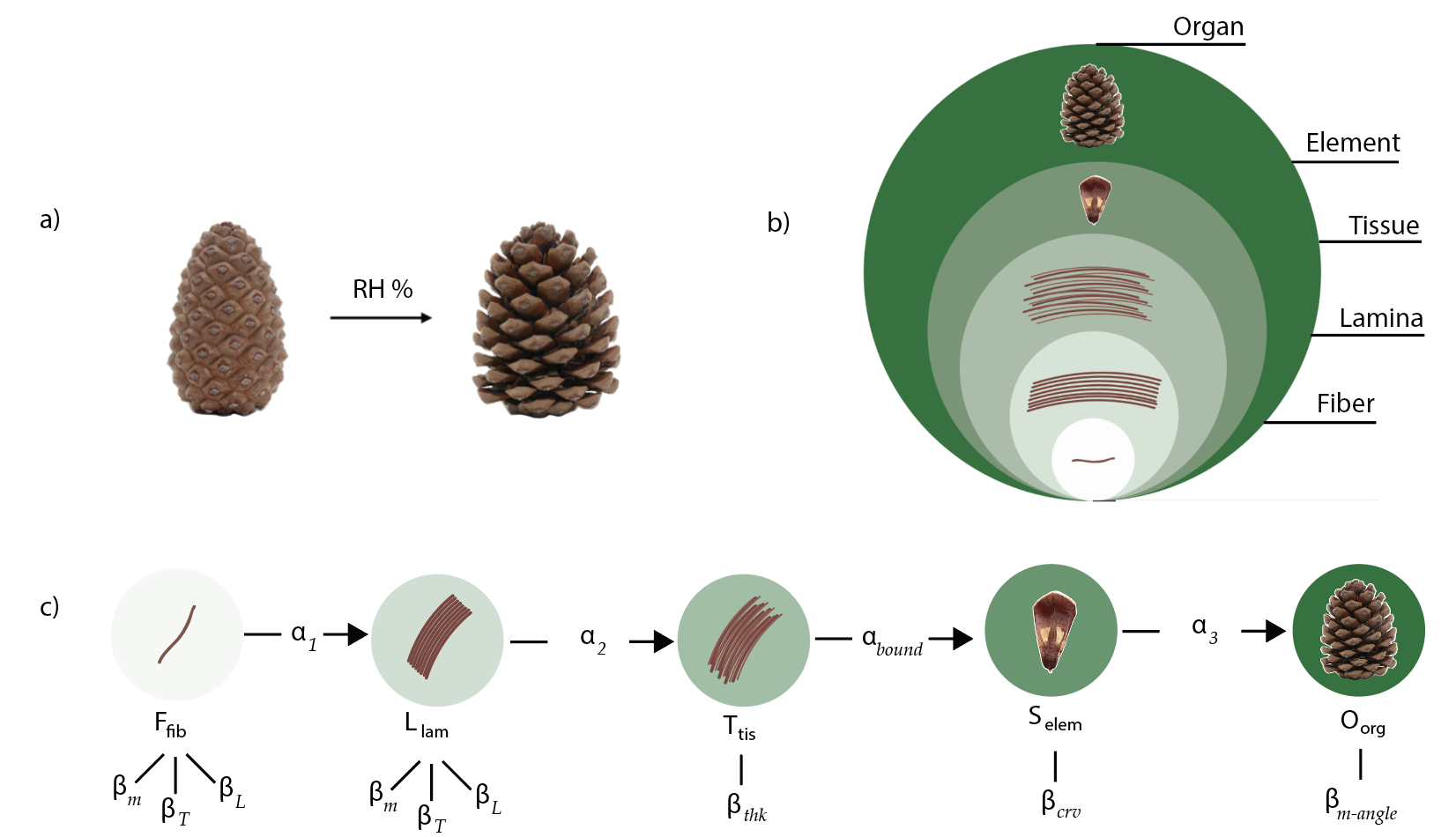
Figure 1: The pinecone hierarchy in Nat, with dynamic actuation, hierarchical organization across scales, and a formalization as a chain of objects linked by assembly and reduction morphisms.
Key technical contributions for each scale include:
- Fiber scale: Moisture-driven anisotropic swelling modeled via relaxation dynamics for fiber bundles.
- Lamina scale: Assembly morphism averaging fiber states; inherited principal strain response.
- Tissue scale: Multi-lamina composites with differential strain (governed by orientation angles) serving as the source for through-thickness mismatches.
- Element scale: Application of classical beam theory (Timoshenko) to translate strain mismatch into curvature.
- Organ scale: Aggregation of elements into macroscale deformation and actuation (e.g., pinecone opening angle).
Reductions (observable extractions) and assembly morphisms (compositions) ensure the simulation condition and compositional closure at every interface.
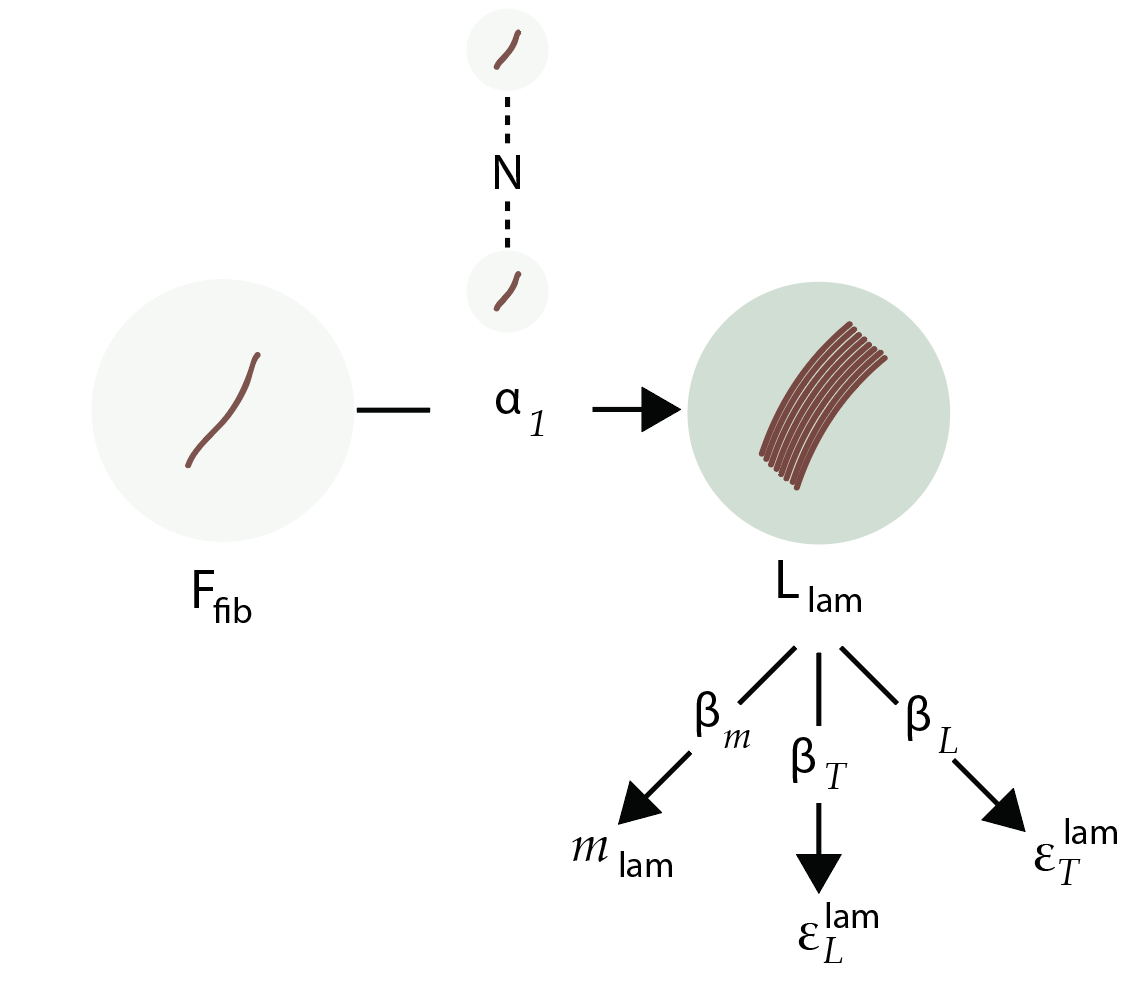
Figure 3: Fiber-to-lamina assembly via averaging morphism Art2 over Art3 fibers, extracting effective lamina observables.
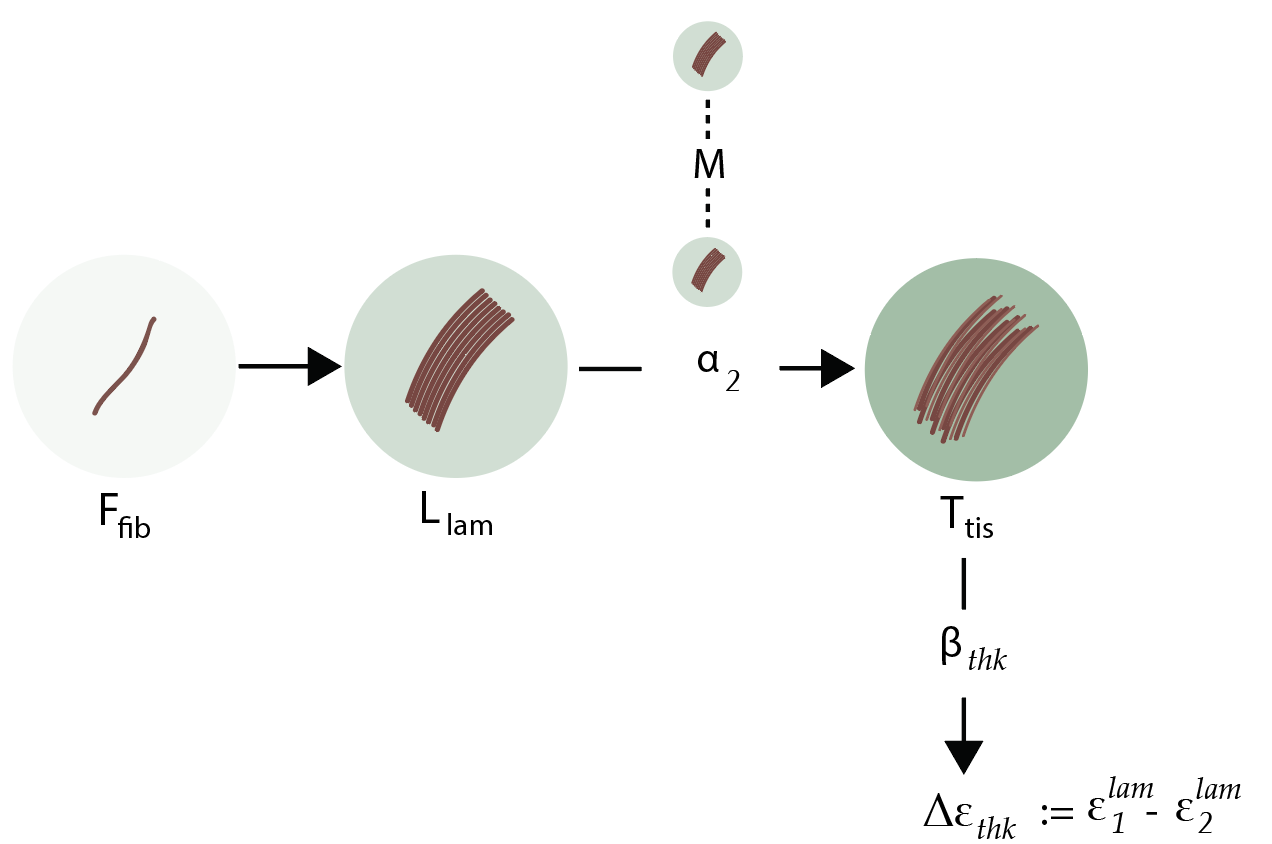
Figure 2: Lamina-to-tissue assembly by stacking Art4 laminae with fiber orientations, with reduction extracting macroscopic strain mismatch.
Engineering Translation and Isomorphic Construction
The implementation functor Art5 is realized by defining an isomorphic engineered hierarchy within Art6—here based on 4D-printed, anisotropic bilayer composites fabricated via fused filament fabrication (FFF).
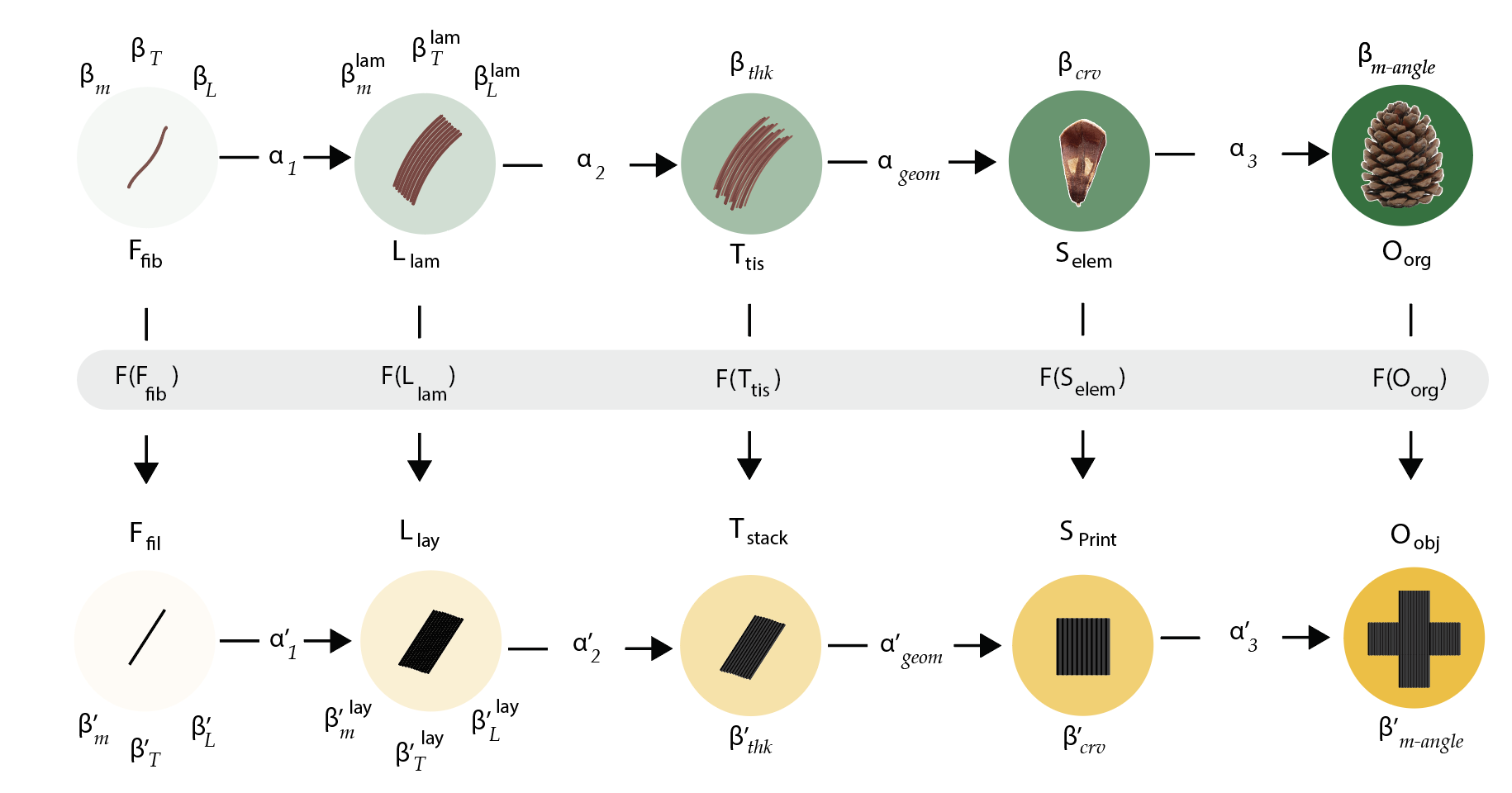
Figure 4: Top: Biological (Nat) hierarchy; Bottom: Engineered (Art) hierarchy. Vertical arrows depict the functorial translation Art7 mapping objects, assemblies, and reductions between the two.
This translation preserves:
- State/Stimulus Structure: State and input spaces are matched in type and organization.
- Dynamical Evolution: Evolution laws have identical form, differing only in material and process parameterization.
- Compositionality: All assembly and reduction morphisms in Nat have direct analogs in Art, ensuring simulation conditions are satisfied at each scale.
This enables direct propagation of verified design logic from biology to fabrication—irrespective of the physical substrate.
Specification and Execution: From Behavioral Target to Fabrication
The framework extends compositionality to manufacturing via the category Art8, capturing the multi-faceted mapping from design intent to executable machine programs. The projection Art9 ensures that all program variations within an admissible process window (e.g., infill, print speed, nozzle temperature) yield indistinguishable behavioral targets in Art, providing a rigorous means to traverse the fabrication design-space while guaranteeing physical consistency.
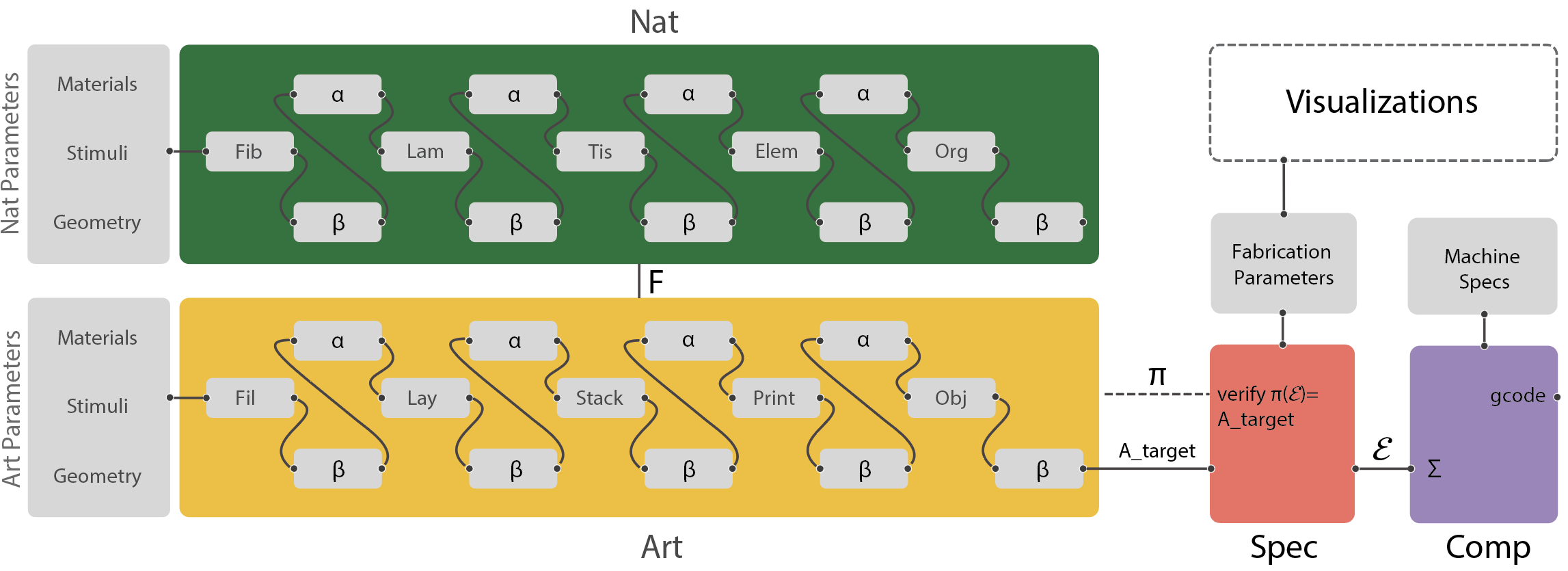
Figure 7: Workflow implementation in Grasshopper. Biological and engineered material properties, stimulus collectors, and hierarchical governing equations are linked through a modular, categorical computational graph; output path runs from behavioral target through fabrication specification to machine code.
The entire chain—Nat Spec0 Art Spec1 Spec Spec2 Comp—is operationalized in a parameterized, modular pipeline using Grasshopper (Rhinoceros 3D), ensuring every step retains compositional structure and functional verifiability.
Empirical Validation and Generativity
A central hypothesis—which the paper claims and demonstrates both theoretically and practically—is that compositionality is not merely descriptive but generative. The pipeline is instantiated on four actuator classes, spanning two stimulus types (hygroscopic, thermal) and two kinematic responses (bending, twisting). Only two local variations are introduced: the fiber-scale stimulus law and the tissue-scale reduction (observable extraction). The remaining architecture, functors, and computational pipeline are entirely unchanged.
- Notably, the "thermal twisting" actuator class is **not explicitly constructed**; it arises as an automatic composition of previously validated modules (thermal fiber scale and twisting reduction), highlighting the exponential growth of accessible design space with the number of such modules.
Quantitative agreement is reported between model predictions and experimental measurements for all four actuator classes; every design, fabricated on first attempt with generated G-code, exhibits targeted actuation modes and predicted geometries.
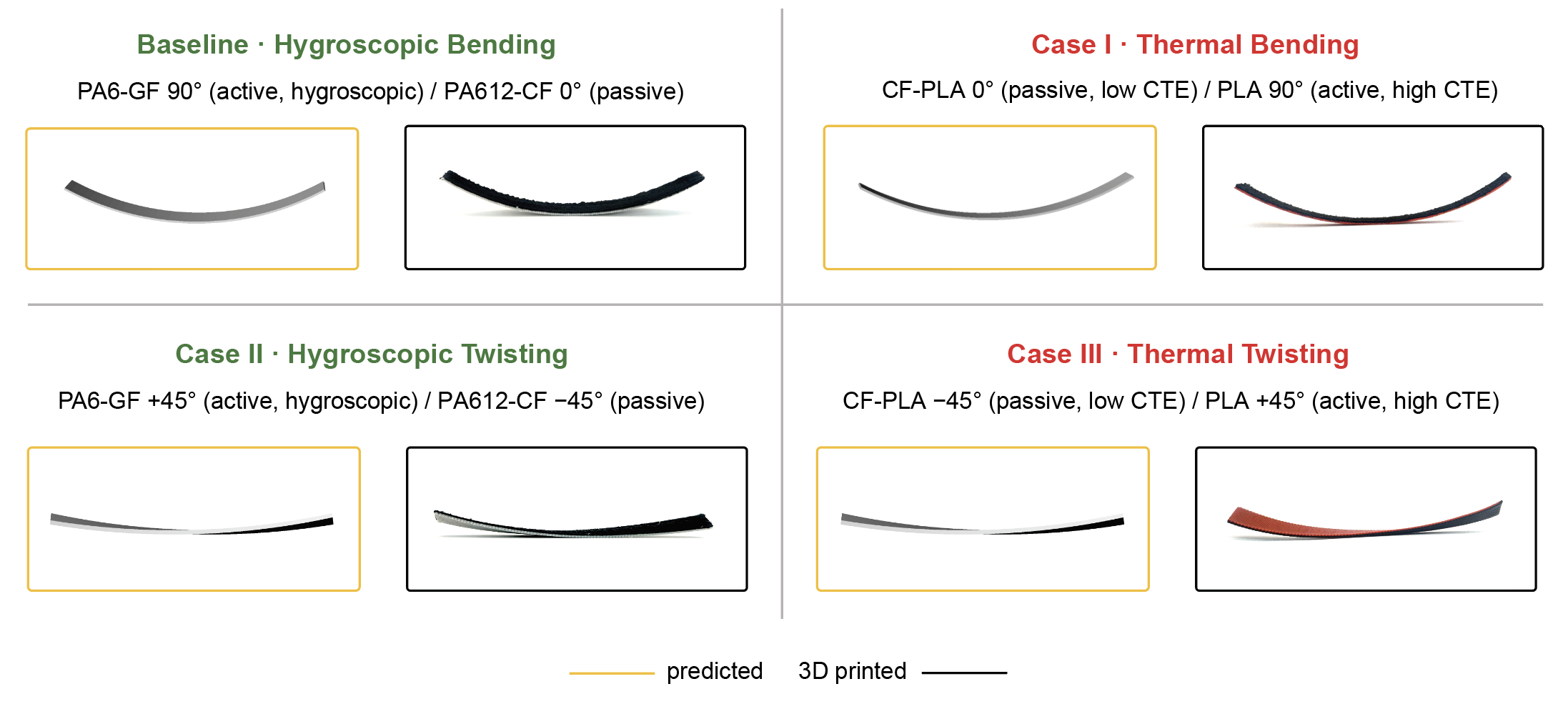
Figure 9: Predicted and observed actuation for all four actuator classes, organized by stimulus type (columns) and response (rows); left: pipeline-computed deformations, right: experimental realization.
Implications and Future Directions
The presented methodology has significant theoretical and practical implications:
- Rigorous Compositional Verification: The framework ensures that behavioral correctness is guaranteed by compositional structure—if all local morphisms are validated, any composite structure is globally valid by construction.
- Generative Design-Space Enlargement: The verification burden scales linearly with the number of independent modules, while the number of constructible devices (via recombination and composition) scales combinatorially.
- Seamless Integration with Generative AI: The structure of Spec3, Spec4, Spec5, and Spec6 aligns naturally with graph- and ontology-based reasoning in AI-driven materials discovery [Buehler2024, Buehler2025], enabling rapid, verifiable design generation and search.
Practical extensions are anticipated in several directions, including incorporation of uncertainty propagation [Huang2026], more complex and nonlinear material laws, and multi-agent or neurosymbolic AI systems for automated proposal and verification of new categorical modules.
Conclusion
This work articulates a unified, end-to-end categorical method for translating biological hierarchy and logic into engineered, fabricable, and verifiable stimulus-response systems. The framework's core strength lies in its ability to make the compositional structure explicit and operational—supporting both rigorous verification and generative expansion of the design space. The research lays a formal foundation for integrating rigorous physical modeling, compositional logic, and modern generative AI in materials design, and has clear practical ramifications for the automation and reliability of nature-derived engineering.
References
See (2604.26367) for full bibliography.

