- The paper establishes a layered categorical framework that formalizes schema-based learning by decoupling syntax, implementation, and semantics.
- It demonstrates modular convergence results by showing that value iteration via schema updates is equivalent to Bellman operator fixed-point convergence.
- The work provides a principled method for AGI development by enabling modular transfer learning, causal discovery, and rigorous comparative analysis.
Towards Schema-Based Learning from a Category-Theoretic Perspective: An Expert Analysis
Introduction and Motivation
The paper "Working Paper: Towards Schema-based Learning from a Category-Theoretic Perspective" (2604.10589) presents a formal structural program for schema-based learning (SBL) grounded in category theory. The authors articulate a multi-layered categorical hierarchy integrating modularity, compositionality, and hierarchical organization—core architectural properties necessary for scalable, interpretable, and adaptive cognitive systems. Unlike monolithic architectures predominant in current paradigms (e.g., RL, Active Inference), this framework supports principled separation between syntax, implementation, and semantics, thus enabling both abstract reasoning and empirical evaluation across heterogeneous agent architectures.
Hierarchical Categorical Framework
The SBL framework is constructed as a weak hierarchical n-categorical system, comprising interconnected layers:
- Schema Level: The syntactic component (Schsyn) is described as a free multicategory of schema types and fundamental cognitive operators. Implementation functors assign concrete representational languages, and the Grothendieck construction yields the total category (Schimpl), encoding both abstract and realized schemas.
- Semantic Layer: Schemas are mapped via functors into the Kleisli category KL(G) of the Giry monad, providing probabilistic models. Empirical semantics are formalized as stochastic kernels (e.g., Markov kernels) in Schsem, ensuring rigorous treatment of uncertainty and causality.
- Workflow Level: Schimpl is endowed with a duoidal structure, supporting sequential (∙) and parallel (⊗) schema composition and transformations. This structure models abstract cognitive procedures without prescribing concrete execution semantics.
- Mind Level: The Mind category encapsulates tuples of mental spaces, internal predictive models, memory subsystems, and cognitive modules. Cognitive modules orchestrate schema workflows with explicit success criteria and logical signatures, and memory is indexed as presheaves over Schimpl.
- Agent-Level / Architecture: The agent layer couples Mind and Body categories, formalizing the interface between internal computation and sensorimotor embodiment. The SBL category is embedded in a broader architectural category (Schsyn0), facilitating comparison with RL, Active Inference, and other paradigms.
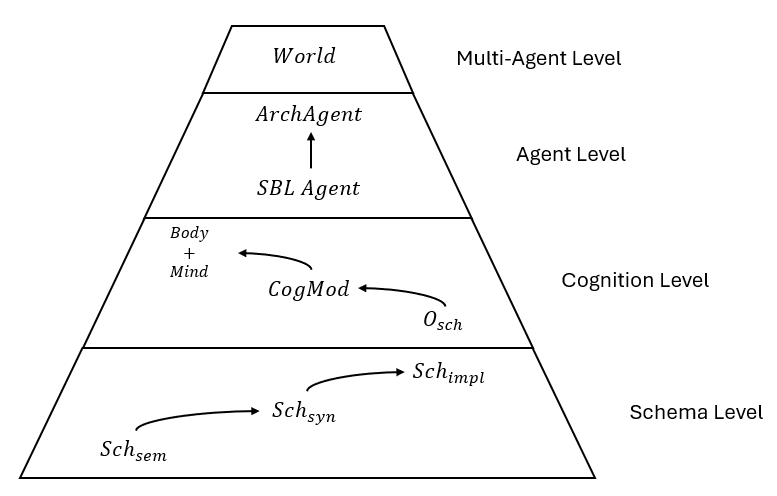
Figure 1: Category pyramid illustrating the hierarchical organization of syntactic, implementation, semantic, cognitive, and agent layers.
Core Design Principles for Schema-Based Learning
The SBL architecture is characterized by several non-trivial structural principles:
- Modularization and Hierarchy: Cognitive capabilities are organized through reusable schema fragments. This prevents catastrophic forgetting/interference common in monolithic neural architectures.
- Compositionality: Schema operations are compositional at all scales, from low-level transformations to agent-level workflows.
- Separation of Body and Mind: Decouples sensorimotor dynamics from internal cognitive models, supporting embodiment-independence and asynchronous processing.
- Explicit Differentiation Between Memory and Cognition: Memory subsystems are handled via structured presheaves, while cognition is orchestrated through module workflows.
- Architectural Requirements for AGI: The framework aims to enable causal discovery, latent variable learning, macroaction learning, concept formation, and goal adaptation, posited as necessary for AGI.
Syntactic Layer
Schemas are defined as objects in a multicategory, with morphisms generated by fundamental operators: combination (parallel and serial), encapsulation, refactorization, context conditioning, addition, and deletion. Duality relations among predictive schemas enable inference in opposing directions (e.g., action to observation, observation to action). Operator algebra ensures strong formal properties (idempotence, associativity, commutativity, closure).
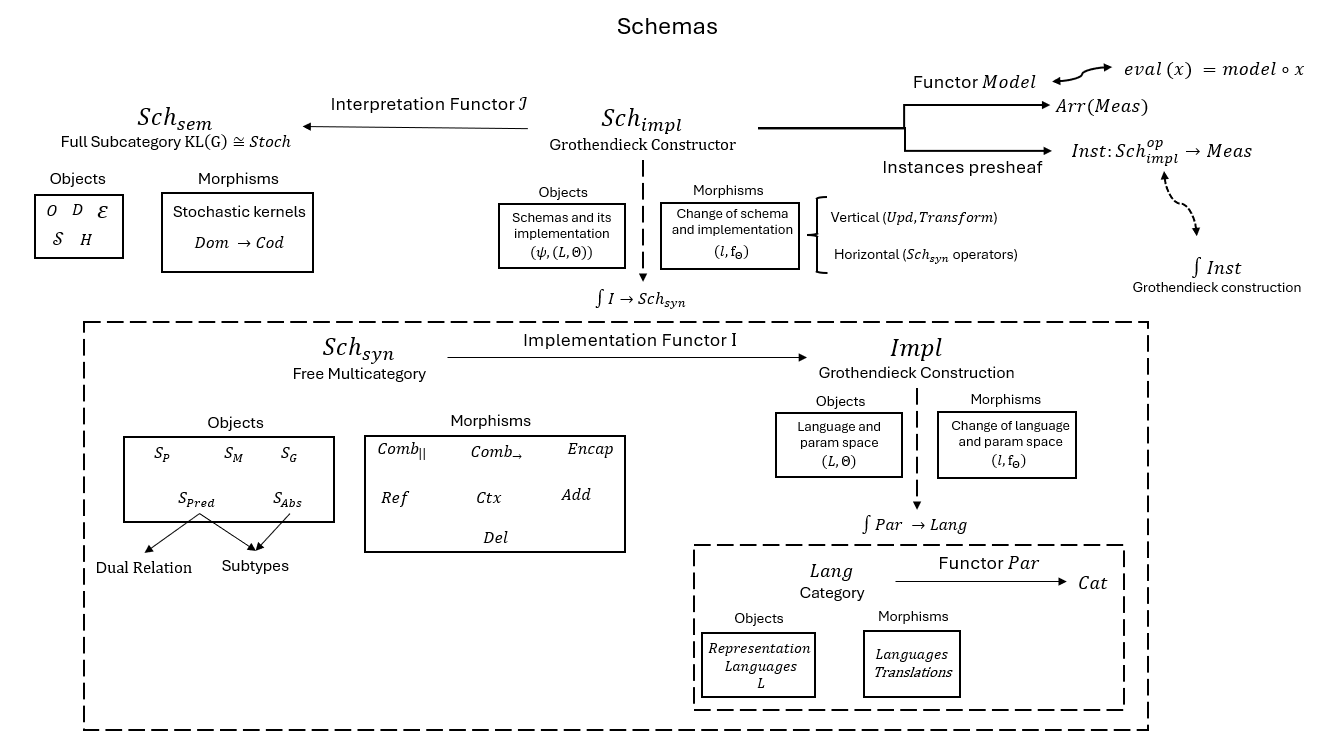
Figure 2: Schemas formalization map indicating functorial relationships between syntactic, implementation, and semantic categories.
Implementation and Semantic Layers
The implementation functor Schsyn1 assigns schemas to concrete representational paradigms (neural, symbolic, probabilistic, etc.), with measurable parameter spaces. The Grothendieck construction yields Schsyn2 and vertical morphisms for updating and transforming implementations. The Model functor maps schemas into the Kleisli category Schsyn3, formalizing stochastic semantics and supporting instance evaluation.
Semantic interpretation is strict via functor Schsyn4, ensuring that schemas, their implementations, and their probabilistic models are consistently related. The presheaf Schsyn5 indexes all possible evaluated instances.
Duoidal Workflow Structure
Sequential and parallel composition is realized via duoidal products. The interchange law ensures distributivity, enabling workflow specification independent of algorithmic details. Workflows act on the Mind category via structured actions, allowing cognitive modules to coordinate schema transformations and state evolution.
Each Mind object comprises mental spaces, sets of internal schemas, and a cognitive kernel (memory system and cognitive modules). Memory is a category of subsystems indexed by Schsyn6, with operations (Schsyn7) acting via natural transformations. Cognitive modules are structured units with typed domains/codomains, admissible workflows, local success evaluators, and restricted operator signatures.
The categorical Mind carries both sequential and parallel monoidal compositions, supporting distributed, modular, and selective execution via optics/lenses. This enables partial updates and non-interfering concurrent execution, crucial for scalability and interpretability.
Agent Architecture and Comparative Framework
At the highest layer, SBL agents are formalized as pairs of Mind and Body, with morphisms representing both information transformation and dynamical evolution. The agent architecture is situated within Schsyn8, a meta-category supporting comparative analysis across paradigms.
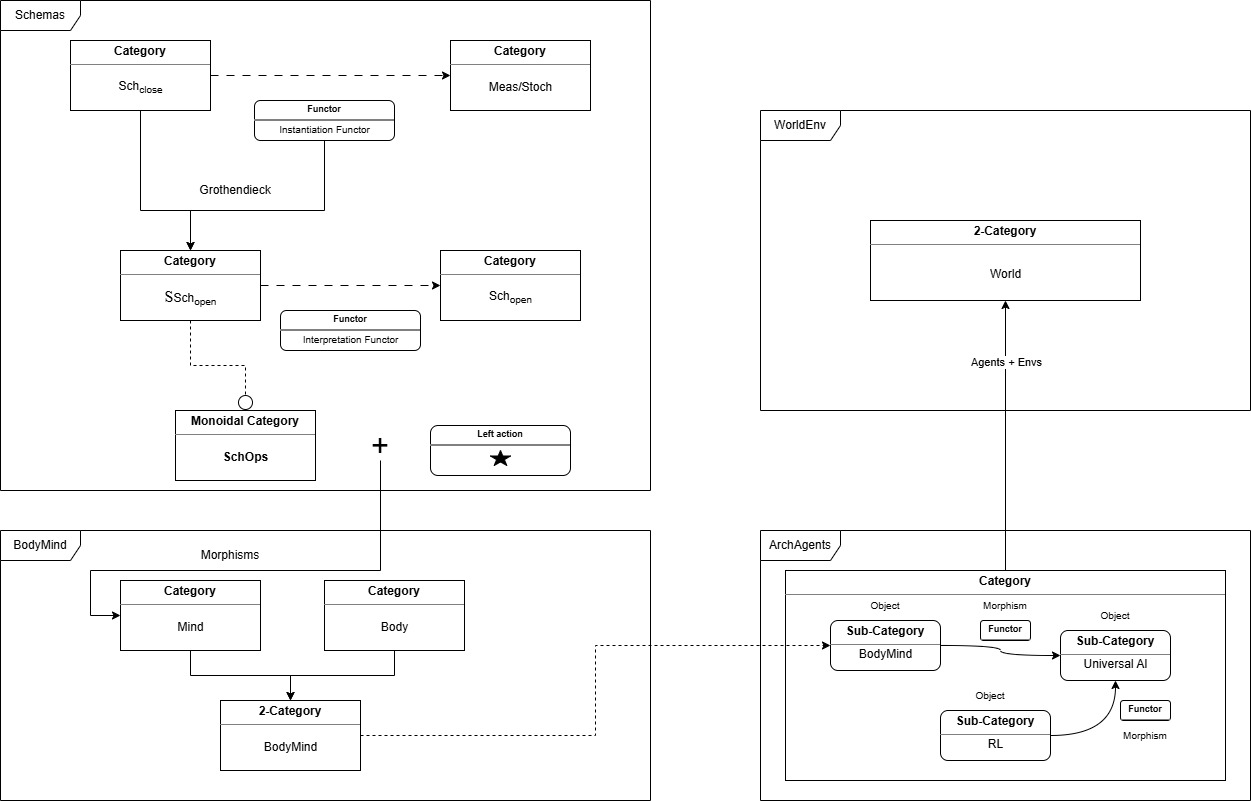
Figure 3: Category formalization diagram representing the coupling between Mind and Body and their respective interfaces with the environment.
The paper establishes functorial lifting of value iteration via schema updates, showing that schema module convergence is equivalent to Bellman operator fixed-point convergence (supremum norm guarantees) under standard RL assumptions. Causal schemas are embedded within coalgebraic PROPs, and structural search (GES moves) is formalized via monoidal natural transformations; convergence to the correct homotopy class is demonstrated under appropriate score function regularity. These results substantiate bold claims that the categorical framework supports rigorous modular convergence and causal discovery mechanisms without departing from the formalism.
Implications, Limitations, and Future Directions
The presented SBL framework provides a coherent language for AGI-oriented architectures, unifying schema manipulation, cognition, embodiment, and architectural variability within a rigorous mathematical context. Practical implications include principled transfer learning, non-interfering incremental adaptation, and explicit comparison across agent paradigms.
Theoretical implications span functorial analysis of learning dynamics, controlled factorization of cognitive modules, and categorical semantics of causality. The abstraction enables formal treatment of retrospective and procedural learning.
Limitations include incomplete formalization of abstract schemas, conditional workflows, and asynchronous execution semantics. Ongoing work aims to extend the workflow layer to richer control structures, deepen lens-based execution in Mind, and refine architectural coupling mechanisms.
Future developments in AI will likely exploit categorical abstraction for scalable, interpretable, and robust modularity, facilitating integration of heterogeneous paradigms and systematic comparative analysis.
Conclusion
The schema-based learning framework developed in this paper constitutes a layered categorical formalism integrating modularity, compositionality, and semantic rigor. By decoupling syntax, implementation, and semantics, and embedding these within duoidal and cognitive layers, the framework achieves principled separation of concerns, facilitating analysis, composition, and comparison across agent architectures. The established convergence results for cognitive modules and causal schemas validate the categorical approach, supporting strong claims regarding modular learning and causal discovery. As formal elaboration proceeds, this direction is positioned to substantially impact both theoretical foundations and practical design of AGI-capable systems.

