- The paper proposes a formal framework leveraging category theory to compare AGI architectures by distinguishing syntactic workflows and epistemic structures.
- It demonstrates how hypergraph categories and functorial mappings enable detailed analysis of agent modules, feedback loops, and knowledge modularity.
- The framework systematically compares architectures such as RL, CRL, SBL, and AIXI, underlining differences in expressivity, modularity, and causal structure.
A Category-Theoretic Comparative Framework for AGI Architectures
Introduction and Motivation
This paper develops a rigorous, category-theoretic framework for the formalization, comparison, and analysis of AGI architectures (2603.28906). The central thesis is that categorical structures—specifically, hypergraph categories equipped with symmetric monoidal and commutative Frobenius algebraic properties—provide a unifying syntax in which a broad spectrum of AGI agent models can be described. These range from classical reinforcement learning (RL) to causal RL, universal AI agents (e.g., AIXI), and schema-based learning (SBL), among others. The approach abstracts agent architectures from implementation details, instead treating them as algebraic theories of computational interaction, distinguishing between syntactic workflow (component organization) and epistemic structure (admissible knowledge units and their transformations).
Such a formalism enables the structural and property-based comparison of architectures, the definition of morphisms (structure-preserving translations) between them, and the principled analysis of architectural expressivity, modularity, and comparative capabilities.
Categorical Foundations: The ArchAgents Category
The proposed framework defines a category ArchAgents, whose objects are agent architectures, themselves characterized by a triple:
- Syntactic layer: A hypergraph category specifying interfaces, primitive computational modules, and their wiring.
- Knowledge layer: A hypergraph category capturing admissible knowledge types and their transformation workflows.
- Syntax–Knowledge interface: A profunctor encoding admissible interactions between syntactic components and internal knowledge carriers.
Architectural morphisms are formalized as pairs of symmetric monoidal functors between the respective syntactic and knowledge layers, together with compatibility data relating the interfaces via natural transformations. This abstraction permits the formal definition of architecture equivalence, reduction, and expressivity hierarchies.
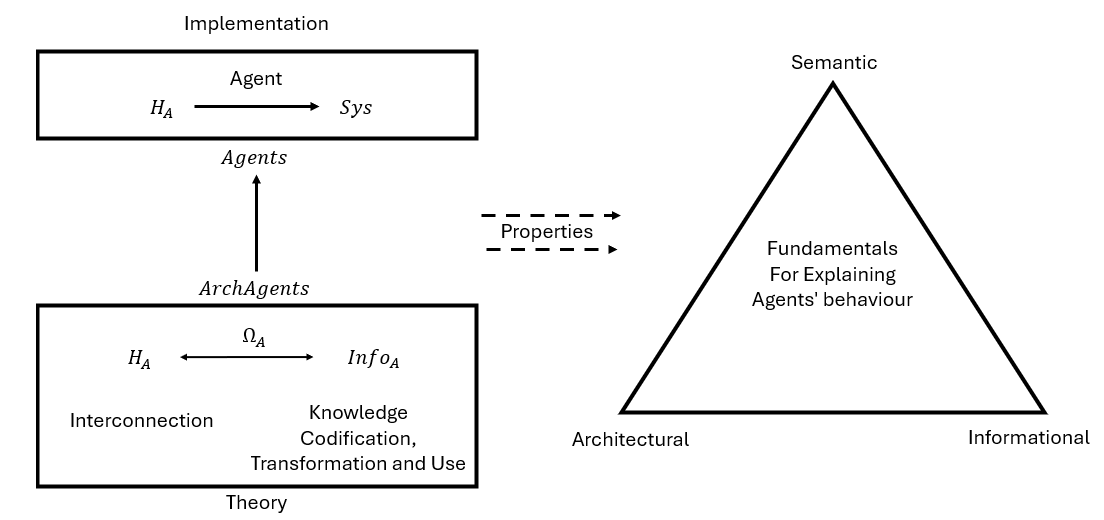
Figure 1: Framework map situating the categorical structures for comparing AGI architectures.
Concrete Agents as Functorial Realizations
A concrete agent is defined as an implementation-level interpretation of an architecture: a pair of strong symmetric monoidal functors from the syntactic and knowledge categories to a semantic system category (e.g., stochastic kernels, function spaces), satisfying compatibility conditions on knowledge-relevant generators. The framework then organizes all agents into a Grothendieck fibration over ArchAgents, where each fibre corresponds to the class of agents implementing a given architecture. Reindexing functors permit the transport of agents across architecture morphisms, thus formalizing architectural inheritance, translation, and reduction.
Three orthogonal classes of properties are defined:
- Structural properties: Diagrammatic invariants (existence of feedback loops, factorization, compositional equivalence) within the presentation of the hypergraph category. These are stable under morphisms of architectures.
- Informational properties: Constraints on the epistemic layer—how information is encoded, modularized, and updated, and what forms of knowledge are representable or isolated by the architecture.
- Semantic properties: Properties of concrete agents (e.g., convergence, expressivity, sample efficiency) certified via logical institutions, which facilitate proof-carrying agents and the modular transfer of guarantees across category morphisms and architectural refinement.
Comparative Categorical Analysis: Case Studies
A systematic sequence of case studies illustrates the explanatory and comparative power of the proposed categorical framework. Each case is presented as a formal object in the category ArchAgents. The sequence demonstrates increasing representational and organizational capability.
Reinforcement Learning (RL)
Classical RL is instantiated as an architecture with a minimal syntactic workflow (state, action, experience, parameter types; policy, environment interaction, update) and monolithic knowledge (single parameter carrier Θ). The architecture admits a single feedback loop and no internal knowledge modularity; all learning updates operate globally.
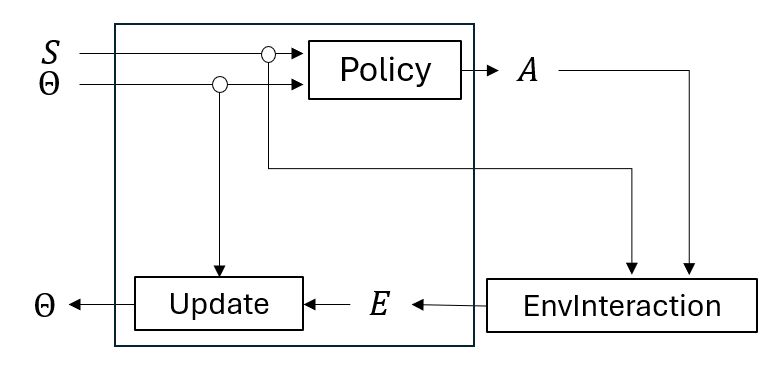
Figure 2: RL string diagram, highlighting the centralized feedback structure of parameter updates.
Causal RL (CRL)
CRL extends RL by structurally separating policy parameters from a causal environment model. The string diagram exposes dual feedback loops for policy and causal knowledge, supporting intervention and counterfactual reasoning via explicit 'do' operators. The knowledge architecture allows distinct update and intervention operations.
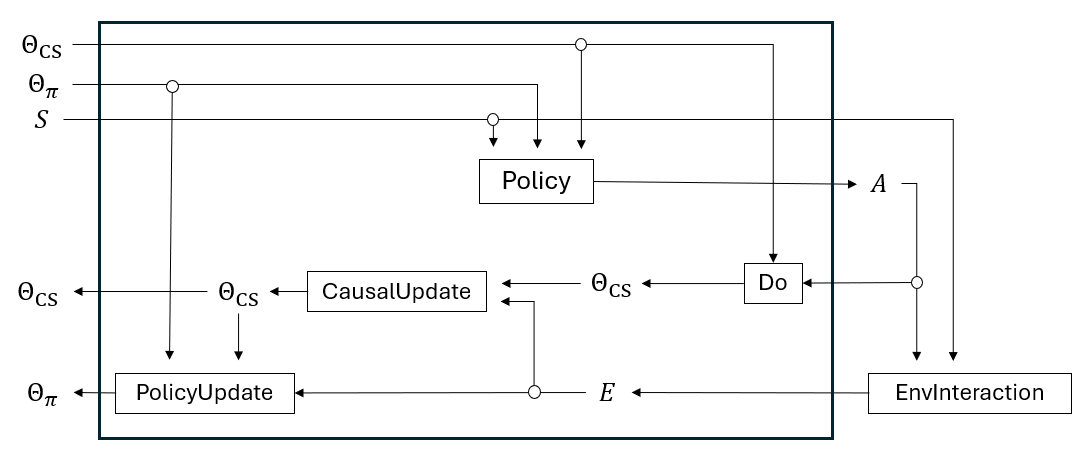
Figure 3: CRL string diagram, visualizing twin feedback cycles for policy and causal model components.
Schema-Based Learning (SBL)
SBL radically generalizes prior architectures, introducing modular, compositional schemas as first-class knowledge units, cognitive modules with specialized execution routes, explicit memory, and body–mind mediated interfaces. The architecture supports the dynamic creation, deletion, selection, combination, and encapsulation of schemas; learning is localized to active schemas during cognitive workflows. Internal interfaces are factored, enabling variable granularity and mitigated dimensionality.
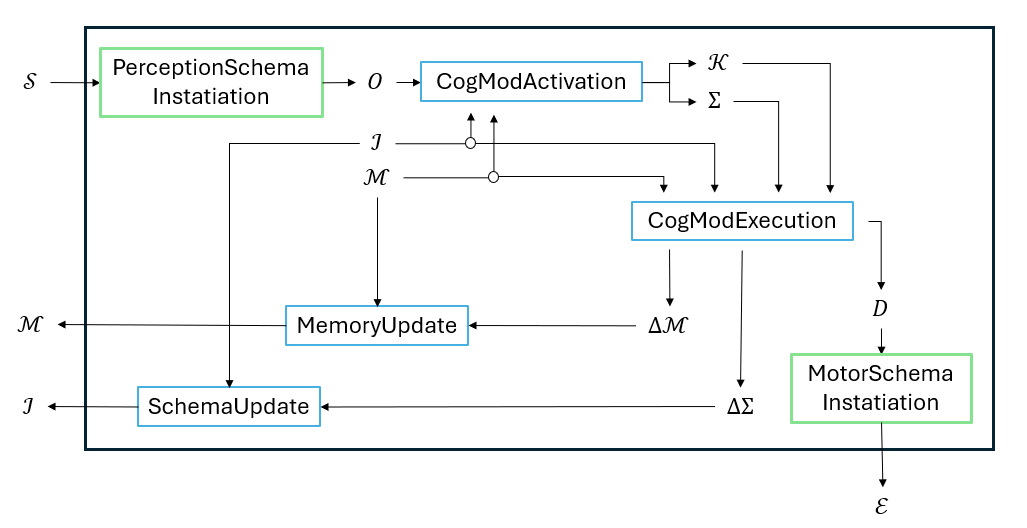
Figure 4: SBL string diagram, with blue indicating Mind modules, green for Body–Mind interfaces.
The transition from CRL to SBL is formalized as a sequence of categorical relaxations: factorization of interfaces, introduction of multiple model types, cognitive modules, temporal decoupling via memory, and body–mind interface insertion. Each relaxation is modeled as a morphism in ArchAgents (Figures 4–5).
Universal AI (AIXI)
The AIXI architecture is formalized as a hypergraph category in which the knowledge layer maintains a universal kernel, a set of plausible environments, and belief weights; knowledge update operators (e.g., posterior update, kernel mixing) are explicit. The AIXI realization clarifies the structural assumptions underlying Solomonoff induction-like agents.
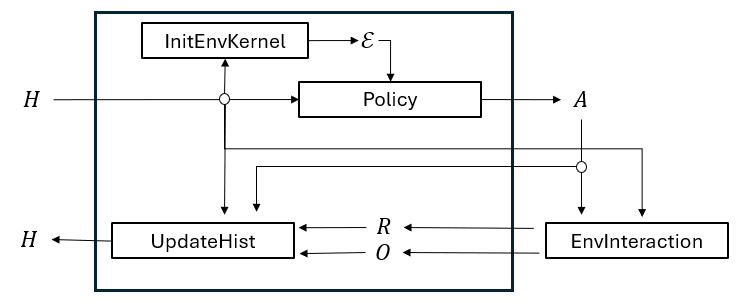
Figure 5: AIXI string diagram, encoding the cycle between history, universal prior, and policy selection.
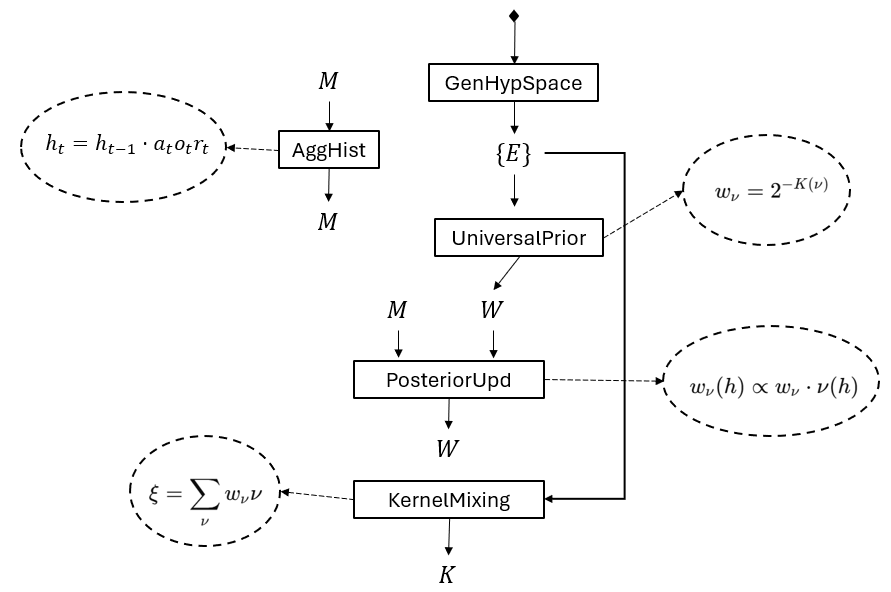
Figure 6: Theoretical AIXI workflow of knowledge and implementation operators.
Architectural Comparison
A summary comparative table highlights the categorical distinctions among RL, CRL, and SBL architectures:
| Architectural dimension |
RL |
CRL |
SBL |
| Persistent info structure |
Single Θ |
(Θπ, ΘCS) |
Family of schemas Σ |
| Feedback structure |
Single loop |
Two coupled loops |
Multiple, decoupled loops |
| Causal structure |
Not represented |
Explicit causal model |
Modular causal schemas |
| Knowledge modularity |
Not supported |
Weakly role-based |
Full modularity/compositionality |
| Continual learning |
Limited |
Partial |
Built-in (via schema dynamics) |
| Interface typing |
Monolithic |
Weakly typed |
Strongly typed and factored |
| Body–Mind mediation |
None |
None |
Explicit layer |
| Locality of updates |
Global |
Role-based |
Schema-local |
Implications and Future Directions
The categorical formalization systematically organizes AGI architectures independent of low-level implementation, enabling the following:
- Definition and inheritance of architectural properties and guarantees
- Functorial comparison of expressivity and modularity across paradigms
- Rigorous mapping of algorithmic and theoretical distinctions to explicit structural assumptions
- Compositionality and modularity in the design and verification of agents
- Interoperability with logical institutions for property certification and automated verification
Pragmatically, the framework provides a principled basis for constructing collaborative repositories of architectures, properties, and empirical evaluation platforms, as well as for benchmarking and guiding future AGI developments. Theoretically, it frames architectural questions—such as expressivity hierarchy, universality, and modularity—in formal categorical terms and opens the way for a comparative theory of general intelligence, potentially unifying cognitive science, control theory, learning, and causal inference.
Conclusion
This paper proposes a formal, category-theoretic comparative framework for AGI architectures. By treating architectures as algebraic theories of computational interconnection and knowledge management, the approach supports rigorous reasoning about structural differences, expressivity, and modular agent design. The categorical paradigm shifts the focus from algorithmic particulars to structural and property-based invariants, enabling both practical and theoretical advances in the study and construction of general intelligence across diverse formalisms.
References: See (2603.28906) for full citation.